Book I
Original German
1 „Die Welt ist meine Vorstellung:“ — dies ist eine Wahrheit, welche in Beziehung auf jedes lebende und erkennende Wesen gilt; wiewohl der Mensch allein sie in das reflektirte abstrakte Bewußtsein bringen kann: und thut er dies wirklich; so ist die philosophische Besonnenheit bei ihm eingetreten. Es wird ihm dann deutlich und gewiß, daß er keine Sonne kennt und keine Erde; sondern immer nur ein Auge, das eine Sonne sieht, eine Hand, die eine Erde fühlt; daß die Welt, welche ihn umgiebt, nur als Vorstellung da ist, d. h. durchweg nur in Beziehung auf ein Anderes, das Vorstellende, welches er selbst ist. — Wenn irgend eine Wahrheit a priori ausgesprochen werden kann, so ist es diese: denn sie ist die Aussage derjenigen Form aller möglichen und erdenklichen Erfahrung, welche allgemeiner, als alle andern, als Zeit, Raum und Kausalität ist: denn alle diese setzen jene eben schon voraus, und wenn jede dieser Formen, welche alle wir als so viele besondere Gestaltungen des Satzes vom Grunde erkannt haben, nur für eine besondere Klasse von Vorstellungen gilt; so ist dagegen das Zerfallen in Objekt und Subjekt die gemeinsame Form aller jener Klassen, ist diejenige Form, unter welcher allein irgend eine Vorstellung, welcher Art sie auch sei, abstrakt oder intuitiv, rein oder empirisch, nur überhaupt möglich und denkbar ist. Keine Wahrheit ist also gewisser, von allen andern unabhängiger und eines Beweises weniger bedürftig, als diese, daß Alles, was für die Erkenntniß da ist, also diese ganze Welt, nur Objekt in Beziehung auf das Subjekt ist, Anschauung des Anschauenden, mit Einem Wort, Vorstellung. Natürlich gilt Dieses, wie von der Gegenwart, so auch von jeder Vergangenheit und jeder Zukunft, vom Fernsten, wie vom Nahen: denn es gilt von Zeit und Raum selbst, in welchen allein sich dieses alles unterscheidet. Alles, was irgend zur Welt gehört und gehören kann, ist unausweichbar mit diesem Bedingtseyn durch das Subjekt behaftet, und ist nur für das Subjekt da. Die Welt ist Vorstellung.
Neu ist diese Wahrheit keineswegs. Sie lag schon in den skeptischen Betrachtungen, von welchen Kartesius ausging. Berkeley aber war der erste, welcher sie entschieden aussprach: er hat sich dadurch ein unsterbliches Verdienst um die Philosophie erworben, wenn gleich das Uebrige seiner Lehren nicht bestehen kann. Kants erster Fehler war die Vernachlässigung dieses Satzes, wie im Anhange ausgeführt ist. — Wie früh hingegen diese Grundwahrheit von den Weisen Indiens erkannt worden ist, indem sie als der Fundamentalsatz der dem Vyasa zugeschriebenen Vedantaphilosophie auftritt, bezeugt W. Jones, in der letzten seiner Abhandlungen: on the philosophy of the Asiatics; Asiatic researches, Vol. IV, p. 164: the fundamental tenet of the Vedanta school consisted not in denying the existence of matter, that is of solidity, impenetrability, and extended figure (to deny which would be lunacy), but in correcting the popular notion of it, and in contending that it has no essence independent of mental perception; that existence and perceptibility are convertible terms1. Diese Worte drücken das Zusammenbestehn der empirischen Realität mit der transscendentalen Idealität hinlänglich aus.
Also nur von der angegebenen Seite, nur sofern sie Vorstellung ist, betrachten wir die Welt in diesem ersten Buche. Daß [2] Das Grunddogma der Vedantaschule bestand nicht im Ableugnen des Daseyns der Materie, d. h. der Solidität, Undurchdringlichkeit und Ausdehnung (welche zu leugnen Wahnsinn wäre), sondern in der Berichtigung des gewöhnlichen Begriffs derselben, durch die Behauptung, daß sie kein von der erkennenden Auffassung unabhängiges Daseyn habe; indem Daseyn und Wahrnehmbarkeit Wechselbegriffe seien. jedoch diese Betrachtung, ihrer Wahrheit unbeschadet, eine einseitige, folglich durch irgend eine willkürliche Abstraktion hervorgerufen ist, kündigt Jedem das innere Widerstreben an, mit welchem er die Welt als seine bloße Vorstellung annimmt; welcher Annahme er sich andererseits doch nimmermehr entziehen kann. Die Einseitigkeit dieser Betrachtung aber wird das folgende Buch ergänzen, durch eine Wahrheit, welche nicht so unmittelbar gewiß ist, wie die, von der wir hier ausgehen; sondern zu welcher nur tiefere Forschung, schwierigere Abstraktion, Trennung des Verschiedenen und Vereinigung des Identischen führen kann, — durch eine Wahrheit, welche sehr ernst und Jedem, wo nicht furchtbar, doch bedenklich seyn muß, nämlich diese, daß eben auch er sagen kann und sagen muß: „die Welt ist mein Wille." —
Bis dahin aber, also in diesem ersten Buch, ist es nöthig, unverwandt diejenige Seite der Welt zu betrachten, von welcher wir ausgehen, die Seite der Erkennbarkeit, und demnach, ohne Widerstreben, alle irgend vorhandenen Objekte, ja sogar den eigenen Leib (wie wir bald näher erörtern werden) nur als Vorstellung zu betrachten, bloße Vorstellung zu nennen. Das, wovon hierbei abstrahirt wird, ist, wie später hoffentlich Jedem gewiß seyn wird, immer nur der Wille, als welcher allein die andere Seite der Welt ausmacht: denn diese ist, wie einerseits durch und durch Vorstellung, so andererseits durch und durch Wille. Eine Realität aber, die keines von diesen Beiden wäre, sondern ein Objekt an sich (zu welcher auch Kants Ding an sich ihm leider unter den Händen ausgeartet ist), ist ein erträumtes Unding und dessen Annahme ein Irrlicht in der Philosophie.
2 Dasjenige, was Alles erkennt und von Keinem erkannt wird, ist das Subjekt. Es ist sonach der Träger der Welt, die durchgängige, stets vorausgesetzte Bedingung alles Erscheinenden, alles Objekts: denn nur für das Subjekt ist, was nur immer da ist. Als dieses Subjekt findet Jeder sich selbst, jedoch nur sofern er erkennt, nicht sofern er Objekt der Erkenntniß ist. Objekt ist aber schon sein Leib, welchen selbst wir daher, von diesem Standpunkt aus, Vorstellung nennen. Denn der Leib ist Objekt unter Objekten und den Gesetzen der Objekte unterworfen, obwohl er unmittelbares Objekt ist [3]. Er liegt, wie alle Objekte der Anschauung, in den Formen alles Erkennens, in Zeit und Raum, durch welche die Vielheit ist. Das Subjekt aber, das Erkennende, nie Erkannte, liegt auch nicht in diesen Formen, von denen selbst es vielmehr immer schon vorausgesetzt wird: ihm kommt also weder Vielheit, noch deren Gegensatz, Einheit, zu. Wir erkennen es nimmer, sondern es eben ist es, das erkennt, wo nur erkannt wird.
Die Welt als Vorstellung also, in welcher Hinsicht allein wir sie hier betrachten, hat zwei wesentliche, nothwendige und untrennbare Hälften. Die eine ist das Objekt: dessen Form ist Raum und Zeit, durch diese die Vielheit. Die andere Hälfte aber, das Subjekt, liegt nicht in Raum und Zeit: denn sie ist ganz und ungetheilt in jedem vorstellenden Wesen; daher ein einziges von diesen, eben so vollständig, als die vorhandenen Millionen, mit dem Objekt die Welt als Vorstellung ergänzt: verschwände aber auch jenes einzige; so wäre die Welt als Vorstellung nicht mehr. Diese Hälften sind daher unzertrennlich, selbst für den Gedanken: denn jede von beiden hat nur durch und für die andere Bedeutung und Daseyn, ist mit ihr da und verschwindet mit ihr. Sie begränzen sich unmittelbar: wo das Objekt anfängt, hört das Subjekt auf. Die Gemeinschaftlichkeit dieser Gränze zeigt sich eben darin, daß die wesentlichen und daher allgemeinen Formen alles Objekts, welche Zeit, Raum und Kausalität sind, auch ohne die Erkenntniß des Objekts selbst, vom Subjekt ausgehend gefunden und vollständig erkannt werden können, d. h. in Kants Sprache, a priori in unserm Bewußtseyn liegen. Dieses entdeckt zu haben, ist ein Hauptverdienst Kants und ein sehr großes. Ich behaupte nun überdies, daß der Satz vom Grunde der gemeinschaftliche Ausdruck für alle diese uns a priori bewußten Formen des Objekts ist, und daß daher Alles, was wir rein a priori wissen, nichts ist, als eben der Inhalt jenes Satzes und was aus diesem folgt, in ihm also eigentlich unsere ganze a priori gewisse Erkenntniß ausgesprochen ist. In meiner Abhandlung über den Satz vom Grunde habe ich ausführlich gezeigt, wie jedes irgend [4] Ueber den Satz vom Grunde, 2. Aufl., §. 22. mögliche Objekt demselben unterworfen ist, d. h. in einer nothwendigen Beziehung zu andern Objekten steht, einerseits als bestimmt, andererseits als bestimmend: dies geht so weit, daß das ganze Daseyn aller Objekte, sofern sie Objekte, Vorstellungen und nichts anderes sind, ganz und gar zurückläuft auf jene ihre nothwendige Beziehung zu einander, nur in solcher besteht, also gänzlich relativ ist: wovon bald ein Mehreres. Ich habe ferner gezeigt, daß, gemäß den Klassen, in welche die Objekte ihrer Möglichkeit nach zerfallen, jene nothwendige Beziehung, welche der Satz vom Grunde im Allgemeinen ausdrückt, in andern Gestalten erscheint; wodurch wiederum die richtige Eintheilung jener Klassen sich bewährt. Ich setze hier beständig alles dort Gesagte als bekannt und dem Leser gegenwärtig voraus: denn es würde, wenn es nicht dort schon gesagt wäre, hier seine nothwendige Stelle haben.
3 Der Hauptunterschied zwischen allen unsern Vorstellungen ist der des Intuitiven und Abstrakten. Letzteres macht nur eine Klasse von Vorstellungen aus, die Begriffe: und diese sind auf der Erde allein das Eigenthum des Menschen, dessen ihn von allen Thieren unterscheidende Fähigkeit zu denselben von jeher Vernunft genannt worden ist [5]. Wir werden weiterhin diese abstrakten Vorstellungen für sich betrachten, zuvörderst aber ausschließlich von der intuitiven Vorstellung reden. Diese nun befaßt die ganze sichtbare Welt, oder die gesammte Erfahrung, nebst den Bedingungen der Möglichkeit derselben. Es ist, wie gesagt, eine sehr wichtige Entdeckung Kants, daß eben diese Bedingungen, diese Formen derselben, d. h. das Allgemeinste in ihrer Wahrnehmung, das allen ihren Erscheinungen auf gleiche Weise Eigene, Zeit und Raum, auch für sich und abgesondert von ihrem Inhalt, nicht nur in abstracto gedacht, sondern auch unmittelbar angeschaut werden kann, und daß diese Anschauung nicht etwan [6] Kant allein hat diesen Begriff der Vernunft verwirrt, in welcher Hinsicht ich auf den Anhang verweise, wie auch auf meine „Grundprobleme der Ethik“: Grundl. d. Moral, §. 6, S. 148—154, der ersten Auflage. ein durch Wiederholung von der Erfahrung entlehntes Phantasma ist, sondern so sehr unabhängig von der Erfahrung, daß vielmehr umgekehrt diese als von jener abhängig gedacht werden muß, indem die Eigenschaften des Raumes und der Zeit, wie sie die Anschauung a priori erkennt, für alle mögliche Erfahrung als Gesetze gelten, welchen gemäß diese überall ausfallen muß. Dieserhalb habe ich, in meiner Abhandlung über den Satz vom Grunde, Zeit und Raum, sofern sie rein und inhaltsleer angeschaut werden, als eine besondere und für sich bestehende Klasse von Vorstellungen betrachtet. So wichtig nun auch diese von Kant entdeckte Beschaffenheit jener allgemeinen Formen der Anschauung ist, daß sie nämlich für sich und unabhängig von der Erfahrung anschaulich und ihrer ganzen Gesetzmäßigkeit nach erkennbar sind, worauf die Mathematik mit ihrer Unfehlbarkeit beruht; so ist es doch eine nicht minder beachtungswerthe Eigenschaft derselben, daß der Satz vom Grunde, der die Erfahrung als Gesetz der Kausalität und Motivation, und das Denken als Gesetz der Begründung der Urtheile bestimmt, hier in einer ganz eigenthümlichen Gestalt auftritt, der ich den Namen Grund des Seyns gegeben habe, und welche in der Zeit die Folge ihrer Momente, und im Raum die Lage seiner sich ins Unendliche wechselseitig bestimmenden Theile ist.
Wem aus der einleitenden Abhandlung die vollkommene Identität des Inhalts des Satzes vom Grunde, bei aller Verschiedenheit seiner Gestalten, deutlich geworden ist, der wird auch überzeugt seyn, wie wichtig zur Einsicht in sein innerstes Wesen gerade die Erkenntniß der einfachsten seiner Gestaltungen, als solcher, ist, und für diese haben wir die Zeit erkannt. Wie in ihr jeder Augenblick nur ist, sofern er den vorhergehenden, seinen Vater, vertilgt hat, um selbst wieder eben so schnell vertilgt zu werden; wie Vergangenheit und Zukunft (abgesehen von den Folgen ihres Inhalts) so nichtig als irgend ein Traum sind, Gegenwart aber nur die ausdehnungs- und bestandlose Gränze zwischen beiden ist; eben so werden wir dieselbe Nichtigkeit auch in allen andern Gestalten des Satzes vom Grunde wiedererkennen und einsehen, daß wie die Zeit, so auch der Raum, und wie dieser, so auch Alles, was in ihm und der Zeit zugleich ist, Alles also, was aus Ursachen oder Motiven hervorgeht, nur ein relatives Daseyn hat, nur durch und für ein Anderes, ihm gleichartiges, d. h. wieder nur eben so bestehendes, ist. Das Wesentliche dieser Ansicht ist alt: Herakleitos bejammerte in ihr den ewigen Fluß der Dinge; Platon würdigte ihren Gegenstand herab, als das immerdar Werdende, aber nie Seiende; Spinoza nannte es bloße Accidenzien der allein seienden und bleibenden einzigen Substanz; Kant setzte das so Erkannte als bloße Erscheinung dem Dinge an sich entgegen; endlich die uralte Weisheit der Inder spricht: „es ist die Maja, der Schleier des Truges, welcher die Augen der Sterblichen umhüllt und sie eine Welt sehen läßt, von der man weder sagen kann, daß sie sei, noch auch, daß sie nicht sei: denn sie gleicht dem Traume, gleicht dem Sonnenglanz auf dem Sande, welchen der Wanderer von ferne für ein Wasser hält, oder auch dem hingeworfenen Strick, den er für eine Schlange ansieht.“ (Diese Gleichnisse finden sich in unzähligen Stellen der Veden und Puranas wiederholt.) Was Alle diese aber meinten und wovon sie reden, ist nichts Anderes, als was auch wir jetzt eben betrachten: die Welt als Vorstellung, unterworfen dem Satze des Grundes.
4 Wer die Gestaltung des Satzes vom Grunde, welche in der reinen Zeit als solcher erscheint und auf der alles Zählen und Rechnen beruht, erkannt hat, der hat eben damit auch das ganze Wesen der Zeit erkannt. Sie ist weiter nichts, als eben jene Gestaltung des Satzes vom Grunde, und hat keine andere Eigenschaft. Succession ist die Gestalt des Satzes vom Grunde in der Zeit; Succession ist das ganze Wesen der Zeit. — Wer ferner den Satz vom Grunde, wie er im bloßen rein angeschauten Raum herrscht, erkannt hat, der hat eben damit das ganze Wesen des Raumes erschöpft; da dieser durch und durch nichts Anderes ist, als die Möglichkeit der wechselseitigen Bestimmungen seiner Theile durch einander, welche Lage heißt. Die ausführliche Betrachtung dieser und Niederlegung der sich daraus ergebenden Resultate in abstrakte Begriffe, zu bequemerer Anwendung, ist der Inhalt der ganzen Geometrie. — Eben so nun, wer diejenige Gestaltung des Satzes vom Grunde, welche den Inhalt jener Formen (der Zeit und des Raumes), ihre Wahrnehmbarkeit, d. i. die Materie, beherrscht, also das Gesetz der Kausalität erkannt hat; der hat eben damit das ganze Wesen der Materie als solcher erkannt: denn diese ist durch und durch nichts als Kausalität, welches Jeder unmittelbar einsieht, sobald er sich besinnt. Ihr Seyn nämlich ist ihr Wirken: kein anderes Seyn derselben ist auch nur zu denken möglich. Nur als wirkend füllt sie den Raum, füllt sie die Zeit: ihre Einwirkung auf das unmittelbare Objekt (das selbst Materie ist) bedingt die Anschauung, in der sie allein existirt: die Folge der Einwirkung jedes andern materiellen Objekts auf ein anderes wird nur erkannt, sofern das letztere jetzt anders als zuvor auf das unmittelbare Objekt einwirkt, besteht nur darin. Ursach und Wirkung ist also das ganze Wesen der Materie: ihr Seyn ist ihr Wirken. (Das Nähere hierüber in der Abhandlung über den Satz vom Grunde, §. 21, S. 77.) Höchst treffend ist daher im Deutschen der Inbegriff alles Materiellen Wirklichkeit genannt [7], welches Wort viel bezeichnender ist, als Realität. Das, worauf sie wirkt, ist allemal wieder Materie: ihr ganzes Seyn und Wesen besteht also nur in der gesetzmäßigen Veränderung, die ein Theil derselben im andern hervorbringt, ist folglich gänzlich relativ, nach einer nur innerhalb ihrer Gränzen geltenden Relation, also eben wie die Zeit, eben wie der Raum.
Zeit aber und Raum, jedes für sich, sind auch ohne die Materie anschaulich vorstellbar; die Materie aber nicht ohne jene. Schon die Form, welche von ihr unzertrennlich ist, setzt den Raum voraus, und ihr Wirken, in welchem ihr ganzes Daseyn besteht, betrifft immer eine Veränderung, also eine Bestimmung der Zeit. Aber Zeit und Raum werden nicht bloß jedes für sich von der Materie vorausgesetzt; sondern eine Vereinigung beider macht ihr Wesen aus, eben weil dieses, wie gezeigt, im Wirken, in der Kausalität, besteht. Alle gedenkbaren, unzähligen Erscheinungen und Zustände nämlich könnten im unendlichen Raum, ohne sich zu beengen, neben einander liegen, oder auch in der unendlichen Zeit, ohne sich zu stören, auf einander folgen; daher dann eine nothwendige Beziehung derselben auf einander und eine Regel, [8] Mira in quibusdam rebus verborum proprietas est, et consuetudo sermonis antiqui quaedam efficacissimis notis signat. Seneca epist. 81. welche sie dieser gemäß bestimmte, keineswegs nöthig, ja nicht einmal anwendbar wäre: folglich gäbe es alsdann, bei allem Nebeneinander im Raum und allem Wechsel in der Zeit, so lange jede dieser beiden Formen für sich, und ohne Zusammenhang mit der andern ihren Bestand und Lauf hätte, noch gar keine Kausalität, und da diese das eigentliche Wesen der Materie ausmacht, auch keine Materie. — Nun aber erhält das Gesetz der Kausalität seine Bedeutung und Nothwendigkeit allein dadurch, daß das Wesen der Veränderung nicht im bloßen Wechsel der Zustände an sich, sondern vielmehr darin besteht, daß an demselben Ort im Raum jetzt ein Zustand ist und darauf ein anderer, und zu einer und derselben bestimmten Zeit hier dieser Zustand und dort jener: nur diese gegenseitige Beschränkung der Zeit und des Raums durch einander giebt einer Regel, nach der die Veränderung vorgehen muß, Bedeutung und zugleich Nothwendigkeit. Was durch das Gesetz der Kausalität bestimmt wird, ist also nicht die Succession der Zustände in der bloßen Zeit, sondern diese Succession in Hinsicht auf einen bestimmten Raum, und nicht das Daseyn der Zustände an einem bestimmten Ort, sondern an diesem Ort zu einer bestimmten Zeit. Die Veränderung, d. h. der nach dem Kausalgesetz eintretende Wechsel, betrifft also jedesmal einen bestimmten Theil des Raumes und einen bestimmten Theil der Zeit zugleich und im Verein. Demzufolge vereinigt die Kausalität den Raum mit der Zeit. Wir haben aber gefunden, daß im Wirken, also in der Kausalität, das ganze Wesen der Materie besteht: folglich müssen auch in dieser Raum und Zeit vereinigt seyn, d. h. sie muß die Eigenschaften der Zeit und die des Raumes, so sehr sich beide widerstreiten, zugleich an sich tragen, und was in jedem von jenen beiden für sich unmöglich ist, muß sie in sich vereinigen, also die bestandlose Flucht der Zeit mit dem starren unveränderlichen Beharren des Raumes, die unendliche Theilbarkeit hat sie von beiden. Diesem gemäß finden wir durch sie zuvörderst das Zugleichseyn herbeigeführt, welches weder in der bloßen Zeit, die kein Nebeneinander, noch im bloßen Raum, der kein Vor, Nach oder Jetzt kennt, seyn konnte. Das Zugleichseyn vieler Zustände aber macht eigentlich das Wesen der Wirklichkeit aus: denn durch dasselbe wird allererst die Dauer möglich, indem nämlich diese nur erkennbar ist an dem Wechsel des mit dem Dauernden zugleich Vorhandenen: aber auch nur mittelst des Dauernden im Wechsel erhält dieser jetzt den Charakter der Veränderung, d. h. des Wandels der Qualität und Form, beim Beharren der Substanz, d. i. der Materie9. Im bloßen Raum wäre die Welt starr und unbeweglich: kein Nacheinander, keine Veränderung, kein Wirken: eben mit dem Wirken ist aber auch die Vorstellung der Materie aufgehoben. In der bloßen Zeit wiederum wäre alles flüchtig: kein Beharren, kein Nebeneinander und daher kein Zugleich, folglich keine Dauer: also wieder auch keine Materie. Erst durch die Vereinigung von Zeit und Raum erwächst die Materie, d. i. die Möglichkeit des Zugleichseyns und dadurch der Dauer, durch diese wieder des Beharrens der Substanz, bei der Veränderung der Zustände [10]. Im Verein von Zeit und Raum ihr Wesen habend, trägt die Materie durchweg das Gepräge von beiden. Sie beurkundet ihren Ursprung aus dem Raum, theils durch die Form, die von ihr unzertrennlich ist, besonders aber (weil der Wechsel allein der Zeit angehört, in dieser allein und für sich aber nichts Bleibendes ist) durch ihr Beharren (Substanz), dessen Gewißheit a priori daher ganz und gar von der des Raumes abzuleiten ist [11]: ihren Ursprung aus der Zeit aber offenbart sie an der Qualität (Accidenz), ohne die sie nie erscheint, und welche schlechthin immer Kausalität, Wirken auf andere Materie, also Veränderung (ein Zeitbegriff) ist. Die Gesetzmäßigkeit dieses Wirkens aber bezieht sich immer auf Raum und Zeit zugleich und hat eben nur dadurch Bedeutung. Was für ein Zustand zu dieser Zeit an diesem Ort eintreten muß, ist die Bestimmung, auf welche ganz allein die Gesetzgebung der Kausalität sich erstreckt. Auf dieser Ableitung der Grundbestimmungen der Materie aus den uns a priori bewußten Formen unserer Erkenntniß beruht es, daß wir ihr gewisse Eigenschaften a priori zuerkennen, nämlich Raumerfüllung, d. i. Undurchdringlichkeit, d. i. Wirksamkeit12 Daß Materie und Substanz Eines sind, ist im Anhange ausgeführt.
13 Dies zeigt auch den Grund der Kantischen Erklärung der Materie, „daß sie sei das Bewegliche im Raum“: denn Bewegung besteht nur in der Vereinigung von Raum und Zeit.
14 Nicht von der Erkenntniß der Zeit, wie Kant will, welches im Anhange ausgeführt. sodann Ausdehnung, unendliche Theilbarkeit, Beharrlichkeit, d. h. Unzerstörbarkeit, und endlich Beweglichkeit; hingegen ist die Schwere, ihrer Ausnahmslosigkeit ungeachtet, doch wohl der Erkenntniß a posteriori beizuzählen, obgleich Kant in den „Metaphys. Anfangsgr. d. Naturwiss.", S. 71 (Rosenkranz: Ausg., S. 372) sie als a priori erkennbar aufstellt.
Wie aber das Objekt überhaupt nur für das Subjekt da ist, als dessen Vorstellung; so ist jede besondere Klasse von Vorstellungen nur für eine eben so besondere Bestimmung im Subjekt da, die man ein Erkenntnißvermögen nennt. Das subjektive Korrelat von Zeit und Raum für sich, als leere Formen, hat Kant reine Sinnlichkeit genannt, welcher Ausdruck, weil Kant hier die Bahn brach, beibehalten werden mag; obgleich er nicht recht paßt, da Sinnlichkeit schon Materie voraussetzt. Das subjektive Korrelat der Materie oder der Kausalität, denn beide sind Eines, ist der Verstand, und er ist nichts außerdem. Kausalität erkennen ist seine einzige Funktion, seine alleinige Kraft, und es ist eine große, Vieles umfassende, von mannigfaltiger Anwendung, doch unverkennbarer Identität aller ihrer Aeußerungen. Umgekehrt ist alle Kausalität, also alle Materie, mithin die ganze Wirklichkeit, nur für den Verstand, durch den Verstand, im Verstande. Die erste, einfachste, stets vorhandene Aeußerung des Verstandes ist die Anschauung der wirklichen Welt: diese ist durchaus Erkenntniß der Ursache aus der Wirkung: daher ist alle Anschauung intellektual. Es könnte dennoch nie zu ihr kommen, wenn nicht irgend eine Wirkung unmittelbar erkannt würde und dadurch zum Ausgangspunkte diente. Dieses aber ist die Wirkung auf die thierischen Leiber. Insofern sind diese die unmittelbaren Objekte des Subjekts: die Anschauung aller andern Objekte ist durch sie vermittelt. Die Veränderungen, welche jeder thierische Leib erfährt, werden unmittelbar erkannt, d. h. empfunden, und indem sogleich diese Wirkung auf ihre Ursache bezogen wird, entsteht die Anschauung der letzteren als eines Objekts. Diese Beziehung ist kein Schluß in abstrakten Begriffen, geschieht nicht durch Reflexion, nicht mit Willkür, sondern unmittelbar, nothwendig und sicher. Sie ist die Erkenntnißweise des reinen Verstandes, ohne welchen es nie zur Anschauung käme; sondern nur ein dumpfes, pflanzenartiges Bewußtseyn der Veränderungen des unmittelbaren Objekts übrig bliebe, die völlig bedeutungslos auf einander folgten, wenn sie nicht etwan als Schmerz oder Wollust eine Bedeutung für den Willen hätten. Aber wie mit dem Eintritt der Sonne die sichtbare Welt dasteht; so verwandelt der Verstand mit einem Schlage, durch seine einzige, einfache Funktion, die dumpfe, nichtssagende Empfindung in Anschauung. Was das Auge, das Ohr, die Hand empfindet, ist nicht die Anschauung: es sind bloße Data. Erst indem der Verstand von der Wirkung auf die Ursache übergeht, steht die Welt da, als Anschauung im Raume ausgebreitet, der Gestalt nach wechselnd, der Materie nach durch alle Zeit beharrend: denn er vereinigt Raum und Zeit in der Vorstellung Materie, d. i. Wirksamkeit. Diese Welt als Vorstellung ist, wie nur durch den Verstand, auch nur für den Verstand da. Im ersten Kapitel meiner Abhandlung „über das Sehen und die Farben" habe ich bereits auseinandergesetzt, wie aus den Datis, welche die Sinne liefern, der Verstand die Anschauung schafft, wie durch Vergleichung der Eindrücke, welche vom nämlichen Objekt die verschiedenen Sinne erhalten, das Kind die Anschauung erlernt, wie eben nur dieses den Aufschluß über so viele Sinnenphänomene giebt, über das einfache Sehen mit zwei Augen, über das Doppeltsehen beim Schielen, oder bei ungleicher Entfernung hinter einander stehender Gegenstände, die man zugleich ins Auge faßt, und über allen Schein, welcher durch eine plötzliche Veränderung an den Sinneswerkzeugen hervorgebracht wird. Viel ausführlicher und gründlicher jedoch habe ich diesen wichtigen Gegenstand behandelt in der zweiten Auflage der Abhdlg. über den Satz vom Grunde, §. 21. Alles daselbst Gesagte hätte hier seine nothwendige Stelle, müßte also eigentlich hier nochmals gesagt werden: da ich indessen fast so viel Widerwillen habe, mich selbst, als Andere abzuschreiben, auch nicht im Stande bin, es besser, als dort geschehen, darzustellen; so verweise ich darauf, statt es hier zu wiederholen, setze es nun aber auch als bekannt voraus.
Das Sehenlernen der Kinder und operirter Blindgebornen, das einfache Sehen des doppelt, mit zwei Augen, Empfundenen, das Doppeltsehen und Doppelttasten bei der Verrückung der Sinneswerkzeuge aus ihrer gewöhnlichen Lage, die aufrechte Erscheinung der Gegenstände, während ihr Bild im Auge verkehrt steht, das Uebertragen der Farbe, welche bloß eine innere Function, eine polarische Theilung der Thätigkeit des Auges ist, auf die äußern Gegenstände, und endlich auch das Stereoskop — dies Alles sind feste und unwiderlegliche Beweise davon, daß alle Anschauung nicht bloß sensual, sondern intellectual, d. h. reine Verstandeserkenntniß der Ursache aus der Wirkung ist, folglich das Gesetz der Kausalität voraussetzt, von dessen Erkenntniß alle Anschauung, mithin alle Erfahrung, ihrer ersten und ganzen Möglichkeit nach, abhängt, nicht umgekehrt die Erkenntniß des Kausalgesetzes von der Erfahrung, welches letztere der Humische Skepticismus war, der erst hiedurch widerlegt ist. Denn die Unabhängigkeit der Erkenntniß der Kausalität von aller Erfahrung, d. h. ihre Apriorität, kann allein dargethan werden aus der Abhängigkeit aller Erfahrung von ihr: und dieses wieder kann allein geschehen, indem man auf die hier angegebene und an den soeben bezeichneten Stellen ausgeführte Art nachweist, daß die Erkenntniß der Kausalität in der Anschauung überhaupt, in deren Gebiet alle Erfahrung liegt, schon enthalten ist, also völlig a priori in Hinsicht auf die Erfahrung besteht, von ihr als Bedingung vorausgesetzt wird, nicht sie voraussetzt: nicht aber kann dasselbe dargethan werden auf die von Kant versuchte und von mir in der Abhandlung über den Satz vom Grunde §. 23 kritisirte Weise.
5 Man hüte sich aber vor dem großen Mißverständniß, daß, weil die Anschauung durch die Erkenntniß der Kausalität vermittelt ist, deswegen zwischen Objekt und Subjekt das Verhältniß von Ursach und Wirkung bestehe; da vielmehr dasselbe immer nur zwischen unmittelbarem und vermitteltem Objekt, also immer nur zwischen Objekten Statt findet. Eben auf jener falschen Voraussetzung beruht der thörichte Streit über die Realität der Außenwelt, in welchem sich Dogmatismus und Skepticismus gegenüberstehen und jener bald als Realismus, bald als Idealismus auftritt. Der Realismus setzt das Objekt als Ursach, und deren Wirkung ins Subjekt. Der Fichte'sche Idealismus macht das Objekt zur Wirkung des Subjekts. Weil nun aber, was nicht genug eingeschärft werden kann, zwischen Subjekt und Objekt gar kein Verhältniß nach dem Satz vom Grunde Statt findet; so konnte auch weder die eine, noch die andere der beiden Behauptungen je bewiesen werden, und der Skepticismus machte auf beide siegreiche Angriffe. — Wie nämlich das Gesetz der Kausalität schon, als Bedingung, der Anschauung und Erfahrung vorhergeht, daher nicht aus diesen (wie Hume meinte) gelernt seyn kann; so gehen Objekt und Subjekt, schon als erste Bedingung, aller Erkenntniß, daher auch dem Satz vom Grunde überhaupt, vorher, da dieser nur die Form alles Objekts, die durchgängige Art und Weise seiner Erscheinung ist; das Objekt aber immer schon das Subjekt voraussetzt: zwischen beiden also kann kein Verhältniß von Grund und Folge seyn. Meine Abhandlung über den Satz vom Grunde soll eben dieses leisten, daß sie den Inhalt jenes Satzes als die wesentliche Form alles Objekts, d. h. als die allgemeine Art und Weise alles Objektseyns darstellt, als etwas, das dem Objekt als solchem zukommt: als solches aber setzt das Objekt überall das Subjekt voraus, als sein nothwendiges Korrelat: dieses bleibt also immer außerhalb des Gebietes der Gültigkeit des Satzes vom Grunde. Der Streit über die Realität der Außenwelt beruht eben auf jener falschen Ausdehnung der Gültigkeit des Satzes vom Grunde auch auf das Subjekt, und von diesem Mißverständnisse ausgehend konnte er sich selbst nie verstehen. Einerseits will der realistische Dogmatismus, die Vorstellung als Wirkung des Objekts betrachtend, diese beiden, Vorstellung und Objekt, die eben Eines sind, trennen und eine von der Vorstellung ganz verschiedene Ursache annehmen, ein Objekt an sich, unabhängig vom Subjekt: etwas völlig Undenkbares: denn eben schon als Objekt setzt es immer wieder das Subjekt voraus und bleibt daher immer nur dessen Vorstellung. Ihm stellt der Skepticismus, unter der selben falschen Voraussetzung, entgegen, daß man in der Vorstellung immer nur die Wirkung habe, nie die Ursache, also nie das Seyn, immer nur das Wirken der Objekte kenne; dieses aber mit jenem vielleicht gar keine Aehnlichkeit haben möchte, ja wohl gar überhaupt ganz fälschlich angenommen würde, da das Gesetz der Kausalität erst aus der Erfahrung angenommen sei, deren Realität nun wieder darauf beruhen soll. — Hierauf nun gehört Beiden die Belehrung, erstlich, daß Objekt und Vorstellung das Selbe sind; dann, daß das Seyn der anschaulichen Objekte eben ihr Wirken ist, daß eben in diesem des Dinges Wirklichkeit besteht, und die Forderung des Daseyns des Objekts außer der Vorstellung des Subjekts und auch eines Seyns des wirklichen Dinges verschieden von seinem Wirken, gar keinen Sinn hat und ein Widerspruch ist; daß daher die Erkenntniß der Wirkungsart eines angeschauten Objekts eben auch es selbst erschöpft, sofern es Objekt, d. h. Vorstellung ist, da außerdem für die Erkenntniß nichts an ihm übrig bleibt. Insofern ist also die angeschaute Welt in Raum und Zeit, welche sich als lauter Kausalität kund giebt, vollkommen real, und ist durchaus das, wofür sie sich giebt, und sie giebt sich ganz und ohne Rückhalt, als Vorstellung, zusammenhängend nach dem Gesetz der Kausalität. Dieses ist ihre empirische Realität. Andererseits aber ist alle Kausalität nur im Verstande und für den Verstand, jene ganze wirkliche, d. i. wirkende Welt ist also als solche immer durch den Verstand bedingt und ohne ihn nichts. Aber nicht nur dieserhalb, sondern schon weil überhaupt kein Objekt ohne Subjekt sich ohne Widerspruch denken läßt, müssen wir dem Dogmatiker, der die Realität der Außenwelt als ihre Unabhängigkeit vom Subjekt erklärt, eine solche Realität derselben schlechthin ableugnen. Die ganze Welt der Objekte ist und bleibt Vorstellung, und eben deswegen durchaus und in alle Ewigkeit durch das Subjekt bedingt: d. h. sie hat transscendentale Idealität. Sie ist aber dieserwegen nicht Lüge, noch Schein: sie giebt sich als das, was sie ist, als Vorstellung, und zwar als eine Reihe von Vorstellungen, deren gemeinschaftliches Band der Satz vom Grunde ist. Sie ist als solche dem gesunden Verstande, selbst ihrer innersten Bedeutung nach, verständlich und redet eine ihm vollkommen deutliche Sprache. Bloß dem durch Vernünfteln verschrobenen Geist kann es einfallen, über ihre Realität zu streiten, welches allemal durch unrichtige Anwendung des Satzes vom Grunde geschieht, der zwar alle Vorstellungen, welcher Art sie auch seyen, unter einander verbindet, keineswegs aber diese mit dem Subjekt, oder mit etwas, das weder Subjekt noch Objekt wäre, sondern bloß Grund des Objekts; ein Unbegriff, weil nur Objekte Grund seyn können und zwar immer wieder von Objekten. — Wenn man dem Ursprung dieser Frage nach der Realität der Außenwelt noch genauer nachforscht, so findet man, daß außer jener falschen Anwendung des Satzes vom Grunde auf Das, was außer seinem Gebiete liegt, noch eine besondere Verwechselung seiner Gestalten hinzukommt, nämlich diejenige Gestalt, die er bloß in Hinsicht auf die Begriffe oder abstrakten Vorstellungen hat, wird auf die anschaulichen Vorstellungen, die realen Objekte, übertragen und ein Grund des Erkennens gefordert von Objekten, die keinen andern als einen Grund des Werdens haben können. Ueber die abstrakten Vorstellungen, die zu Urtheilen verknüpften Begriffe, herrscht der Satz vom Grunde allerdings in der Art, daß jedes derselben seinen Werth, seine Gültigkeit, seine ganze Existenz, hier Wahrheit genannt, einzig und allein hat durch die Beziehung des Urtheils auf etwas außer ihm, seinen Erkenntnißgrund, auf welchen also immer zurückgegangen werden muß. Ueber die realen Objekte hingegen, die anschaulichen Vorstellungen, herrscht der Satz vom Grunde nicht als Satz vom Grund des Erkennens, sondern des Werdens, als Gesetz der Kausalität: jedes derselben hat ihm dadurch, daß es geworden ist, d. h. als Wirkung aus einer Ursache hervorgegangen ist, schon seine Schuld abgetragen: die Forderung eines Erkenntnißgrundes hat hier also keine Gültigkeit und keinen Sinn; sondern gehört einer ganz anderen Klasse von Objekten an. Daher auch erregt die anschauliche Welt, so lange man bei ihr stehen bleibt, im Betrachter weder Skrupel noch Zweifel: es giebt hier weder Irrthum noch Wahrheit; diese sind ins Gebiet des Abstrakten, der Reflexion gebannt. Hier aber liegt für Sinne und Verstand die Welt offen da, giebt sich mit naiver Wahrheit für Das, was sie ist, für anschauliche Vorstellung, welche gesetzmäßig am Bande der Kausalität sich entwickelt.
So wie wir die Frage nach der Realität der Außenwelt bis hieher betrachtet haben, war sie immer hervorgegangen aus einer. bis zum Mißverstehen ihrer selbst gehenden Verirrung der Vernunft, und insofern war die Frage nur durch Aufklärung ihres Inhalts zu beantworten. Sie mußte, nach Erforschung des ganzen Wesens des Satzes vom Grunde, der Relation zwischen Objekt und Subjekt und der eigentlichen Beschaffenheit der sinnlichen Anschauung, sich selbst aufheben, weil ihr eben gar keine Bedeutung mehr blieb. Allein jene Frage hat noch einen andern, von dem bisher angegebenen, rein spekulativen, gänzlich verschiedenen Ursprung, einen eigentlich empirischen, obwohl sie auch so noch immer in spekulativer Absicht aufgeworfen wird, und sie hat in dieser Bedeutung einen viel verständlicheren Sinn, als in jener ersteren, nämlich folgenden: wir haben Träume; ist nicht etwan das ganze Leben ein Traum? — oder bestimmter: giebt es ein sicheres Kriterium zwischen Traum und Wirklichkeit? zwischen Phantasmen und realen Objekten? — Das Vorgeben der geringern Lebhaftigkeit und Deutlichkeit der geträumten, als der wirklichen Anschauung, verdient gar keine Berücksichtigung; da noch Keiner diese beiden zum Vergleich neben einander gehalten hat; sondern man nur die Erinnerung des Traumes verglichen konnte mit der gegenwärtigen Wirklichkeit. — Kant löst die Frage so: „Der Zusammenhang der Vorstellungen unter sich nach dem Gesetze der Kausalität unterscheidet das Leben vom Traum." — Aber auch im Traume hängt alles Einzelne ebenfalls nach dem Satz vom Grunde in allen seinen Gestalten zusammen, und dieser Zusammenhang bricht bloß ab zwischen dem Leben und dem Traume und zwischen den einzelnen Träumen. Kants Antwort könnte daher nur noch so lauten: der lange Traum (das Leben) hat in sich durchgängigen Zusammenhang gemäß dem Satz vom Grunde, nicht aber mit den kurzen Träumen; obgleich jeder von diesen in sich denselben Zusammenhang hat: zwischen diesen und jenem also ist jene Brücke abgebrochen und daran unterscheidet man beide. — Jedoch eine Untersuchung, ob etwas geträumt oder geschehen sei, nach diesem Kriterium anzustellen, wäre sehr schwierig und oft unmöglich; da wir keineswegs im Stande sind, zwischen jeder erlebten Begebenheit und dem gegenwärtigen Augenblick den kausalen Zusammenhang Glied vor Glied zu verfolgen, deswegen aber doch nicht sie für geträumt erklären. Darum bedient man sich im wirklichen Leben, um Traum von Wirklichkeit zu unterscheiden, gemeiniglich nicht jener Art der Untersuchung. Das allein sichere Kriterium zur Unterscheidung des Traumes von der Wirklichkeit ist in der That kein anderes, als das ganz empirische des Erwachens, durch welches allerdings der Kausalzusammenhang zwischen den geträumten Begebenheiten und denen des wachen Lebens ausdrücklich und fühlbar abgebrochen wird. Einen vortrefflichen Beleg hiezu giebt die Bemerkung, welche Hobbes im Leviathan, Kap. 2, macht: nämlich daß wir Träume dann leicht auch hinterher für Wirklichkeit halten, wann wir, ohne es zu beabsichtigen, angekleidet geschlafen haben, vorzüglich aber, wann noch hinzukommt, daß irgend ein Unternehmen, oder Vorhaben, alle unsere Gedanken einnimmt und uns im Traum eben so wie im Wachen beschäftigt: in diesen Fällen wird nämlich das Erwachen fast so wenig als das Einschlafen bemerkt, Traum fließt mit Wirklichkeit zusammen und wird mit ihr vermengt. Dann bleibt freilich nur noch die Anwendung des Kantischen Kriteriums übrig: wenn nun aber nachher, wie es oft der Fall ist, der kausale Zusammenhang mit der Gegenwart, oder dessen Abwesenheit, schlechterdings nicht auszumitteln ist, so muß es auf immer unentschieden bleiben, ob ein Vorfall geträumt oder geschehen sei. — Hier tritt nun in der That die enge Verwandtschaft zwischen Leben und Traum sehr nahe an uns heran: auch wollen wir uns nicht schämen sie einzugestehen, nachdem sie von vielen großen Geistern anerkannt und ausgesprochen worden ist. Die Veden und Puranas wissen für die ganze Erkenntniß der wirklichen Welt, welche sie das Gewebe der Maja nennen, keinen bessern Vergleich und brauchen keinen häufiger, als den Traum. Platon sagt öfter, daß die Menschen nur im Traume leben, der Philosoph allein sich zu wachen bestrebe. Pindaros sagt (II. η, 135): σκιας οναρ ανθρωπος (umbrae somnium homo) und Sophokles:
῾Ορω γαρ ἡμας ουδεν οντας αλλο, πλην Ειδωλ', οσοιπερ ζωμεν, η κουφην σκιαν.
Ajax 125.
(Nos enim, quicunque vivimus, nihil aliud esse comperio, quam simulacra et levem umbram.)
Neben welchem am würdigsten Shakespeare steht:
We are such stuff As dreams are made of, and our little life Is rounded with a sleep. —
Temp. A. 4, Sc. 1.15
16 Wir sind solches Zeug, wie das, woraus die Träume gemacht sind, und unser kurzes Leben ist von einem Schlaf umschlossen.
Endlich war Calderon von dieser Ansicht so tief ergriffen, daß er in einem gewissermaaßen metaphysischen Drama „Das Leben ein Traum" sie auszusprechen suchte.
Nach diesen vielen Dichterstellen möge es nun auch mir vergönnt seyn, mich durch ein Gleichniß auszudrücken. Das Leben und die Träume sind Blätter eines und des nämlichen Buches. Das Lesen im Zusammenhang heißt wirkliches Leben. Wann aber die jedesmalige Lesestunde (der Tag) zu Ende und die Erholungszeit gekommen ist, so blättern wir oft noch müßig und schlagen, ohne Ordnung und Zusammenhang, bald hier, bald dort ein Blatt auf: oft ist es ein schon gelesenes, oft ein noch unbekanntes, aber immer aus dem selben Buch. So ein einzeln gelesenes Blatt ist zwar außer Zusammenhang mit der folgerechten Durchlesung: doch steht es hiedurch nicht so gar sehr hinter dieser zurück, wenn man bedenkt, daß auch das Ganze der folgerechten Lektüre ebenso aus dem Stegreife anhebt und endigt und sonach nur als ein größeres einzelnes Blatt anzusehen ist.
Obwohl also die einzelnen Träume vom wirklichen Leben dadurch geschieden sind, daß sie in den Zusammenhang der Erfahrung, welcher durch dasselbe stetig geht, nicht mit eingreifen, und das Erwachen diesen Unterschied bezeichnet; so gehört ja doch eben jener Zusammenhang der Erfahrung schon dem wirklichen Leben als seine Form an, und der Traum hat ebenso auch einen Zusammenhang in sich dagegen aufzuweisen. Nimmt man nun den Standpunkt der Beurtheilung außerhalb beider an, so findet sich in ihrem Wesen kein bestimmter Unterschied, und man ist genöthigt, den Dichtern zuzugeben, daß das Leben ein langer Traum sei.
Kehren wir nun von diesem ganz für sich bestehenden, empirischen Ursprung der Frage nach der Realität der Außenwelt zu ihrem spekulativen zurück, so haben wir zwar gefunden, daß dieser liege, erstlich in der falschen Anwendung des Satzes vom Grunde, nämlich auch zwischen Subjekt und Objekt, und sodann wieder in der Verwechselung seiner Gestalten, indem nämlich der Satz vom Grunde des Erkennens auf das Gebiet übertragen wurde, wo der Satz vom Grunde des Werdens gilt: allein dennoch hätte jene Frage schwerlich die Philosophen so anhaltend beschäftigen können, wenn sie ganz ohne allen wahren Gehalt wäre und nicht in ihrem Innersten doch irgend ein richtiger Gedanke und Sinn als ihr eigentlichster Ursprung läge, von welchem man demnach anzunehmen hätte, daß allererst, indem er in die Reflexion trat und seinen Ausdruck suchte, er in jene verkehrten, sich selbst nicht verstehenden Formen und Fragen eingegangen wäre. So ist es, meiner Meinung nach, allerdings; und als den reinen Ausdruck jenes innersten Sinnes der Frage, welchen sie nicht zu treffen wußte, setze ich diesen: Was ist diese anschauliche Welt noch außerdem, daß sie meine Vorstellung ist? Ist sie, deren ich mir nur einmal und zwar als Vorstellung bewußt bin, eben wie mein eigener Leib, dessen ich mir doppelt bewußt bin, einerseits Vorstellung, andererseits Wille? — Die deutlichere Erklärung und die Bejahung dieser Frage wird der Inhalt des zweiten Buches seyn, und die Folgesätze aus ihr werden den übrigen Theil dieser Schrift einnehmen.
6 Inzwischen betrachten wir für jetzt, in diesem ersten Buch, Alles nur als Vorstellung, als Objekt für das Subjekt: und wie alle andern realen Objekte, sehen wir auch den eigenen Leib, von dem das Anschauen der Welt in Jedem ausgeht, bloß von der Seite der Erkennbarkeit an: und er ist uns sonach nur eine Vorstellung. Zwar widerstrebt das Bewußtseyn eines Jeden, welches sich schon gegen das Erklären der andern Objekte für bloße Vorstellungen auflehnte, noch mehr, wenn der eigene Leib bloß eine Vorstellung seyn soll; welches daher kommt, daß Jedem das Ding an sich, sofern es als sein eigener Leib erscheint, unmittelbar, sofern es in den andern Gegenständen der Anschauung sich objektivirt, ihm nur mittelbar bekannt ist. Allein der Gang unserer Untersuchung macht diese Abstraktion, diese einseitige Betrachtungsart, dies gewaltsame Trennen des wesentlich zusammen Bestehenden nothwendig: daher muß jenes Widerstreben einstweilen unterdrückt und beruhigt werden durch die Erwartung, daß die folgenden Betrachtungen die Einseitigkeit der gegenwärtigen ergänzen werden, zur vollständigen Erkenntniß des Wesens der Welt.
Der Leib ist uns also hier unmittelbares Objekt, d. h. diejenige Vorstellung, welche den Ausgangspunkt der Erkenntniß des Subjekts macht, indem sie selbst, mit ihren unmittelbar erkannten Veränderungen, der Anwendung des Gesetzes der Kausalität vorhergeht und so zu dieser die ersten Data liefert. Alles Wesen der Materie besteht, wie gezeigt, in ihrem Wirken. Wirkung und Ursach giebt es aber nur für den Verstand, als welcher nichts weiter, als das subjektive Korrelat derselben ist. Aber der Verstand könnte nie zur Anwendung gelangen, wenn es nicht noch etwas Anderes gäbe, von welchem er ausgeht. Ein solches ist die bloß sinnliche Empfindung, das unmittelbare Bewußtseyn der Veränderungen des Leibes, vermöge dessen dieser unmittelbares Objekt ist. Die Möglichkeit der Erkennbarkeit der anschaulichen Welt finden wir demnach in zwei Bedingungen: die erste ist, wenn wir sie objektiv ausdrücken, die Fähigkeit der Körper auf einander zu wirken, Veränderungen in einander hervorzubringen, ohne welche allgemeine Eigenschaft aller Körper auch mittelst der Sensibilität der thierischen doch keine Anschauung möglich würde; wollen wir aber diese nämliche erste Bedingung subjektiv ausdrücken, so sagen wir: der Verstand vor Allem macht die Anschauung möglich: denn nur aus ihm entspringt und für ihn auch nur gilt das Gesetz der Kausalität, die Möglichkeit von Wirkung und Ursach, und nur für ihn und durch ihn ist daher die anschauliche Welt da. Die zweite Bedingung aber ist die Sensibilität thierischer Leiber, oder die Eigenschaft gewisser Körper, unmittelbar Objekte des Subjekts zu seyn. Die bloßen Veränderungen, welche die Sinnesorgane durch die ihnen specifisch angemessene Einwirkung von Außen erleiden, sind nun zwar schon Vorstellungen zu nennen, sofern solche Einwirkungen weder Schmerz noch Wollust erregen, d. h. keine unmittelbare Bedeutung für den Willen haben, und dennoch wahrgenommen werden, also nur für die Erkenntniß da sind: und insofern also sage ich, daß der Leib unmittelbar erkannt wird, unmittelbares Objekt ist; jedoch ist hier der Begriff Objekt nicht einmal im eigentlichsten Sinn zu nehmen: denn durch diese unmittelbare Erkenntniß des Leibes, welche der Anwendung des Verstandes vorhergeht und bloße sinnliche Empfindung ist, steht der Leib selbst nicht eigentlich als Objekt da, sondern erst die auf ihn einwirkenden Körper; weil jede Erkenntniß eines eigentlichen Objekts, d. h. einer im Raum anschaulichen Vorstellung, nur durch und für den Verstand ist, also nicht vor, sondern erst nach dessen Anwendung. Daher wird der Leib als eigentliches Objekt, d. h. als anschauliche Vorstellung im Raum, eben wie alle anderen Objekte, erst mittelbar, durch Anwendung des Gesetzes der Kausalität auf die Einwirkung eines seiner Theile auf den andern erkannt, also indem das Auge den Leib sieht, die Hand ihn betastet. Folglich wird durch das bloße Gemeingefühl die Gestalt des eigenen Leibes uns nicht bekannt; sondern nur durch die Erkenntniß, nur in der Vorstellung, d. h. nur im Gehirn, stellt auch der eigene Leib allererst sich dar als ein Ausgedehntes, Gegliedertes, Organisches: ein Blindgeborner erhält diese Vorstellung erst allmälig, durch die Data, welche das Getast ihm giebt; ein Blinder ohne Hände würde seine Gestalt nie kennen lernen, oder höchstens aus der Einwirkung anderer Körper auf ihn allmälig dieselbe erschließen und konstruiren. Mit dieser Restriktion also ist es zu verstehen, wenn wir den Leib unmittelbares Objekt nennen.
Uebrigens sind, dem Gesagten zufolge, alle thierischen Leiber unmittelbare Objekte, d. h. Ausgangspunkte der Anschauung der Welt, für das Alles erkennende und eben deshalb nie erkannte Subjekt. Das Erkennen, mit dem durch dasselbe bedingten Bewegen auf Motive, ist daher der eigentliche Charakter der Thierheit, wie die Bewegung auf Reize der Charakter der Pflanze: das Unorganisirte aber hat keine andere Bewegung, als die durch eigentliche Ursachen im engsten Verstande bewirkte; welches Alles ich ausführlicher erörtert habe in der Abhandlung über den Satz vom Grunde, 2. Aufl., §. 20, in der Ethik, erste Abhandl., III, und „über das Sehen und die Farben", §. 1; wohin ich also verweise.
Aus dem Gesagten ergiebt sich, daß alle Thiere Verstand haben, selbst die unvollkommensten: denn sie alle erkennen Objekte, und diese Erkenntniß bestimmt als Motiv ihre Bewegungen. — Der Verstand ist in allen Thieren und allen Menschen der nämliche, hat überall dieselbe einfache Form: Erkenntniß der Kausalität, Uebergang von Wirkung auf Ursach und von Ursach auf Wirkung, und nichts außerdem. Aber die Grade seiner Schärfe und die Ausdehnung seiner Erkenntnißsphäre sind höchst verschieden, mannigfaltig und vielfach abgestuft, vom niedrigsten Grad, welcher nur das Kausalitätsverhältniß zwischen dem unmittelbaren Objekt und den mittelbaren erkennt, also eben hinreicht, durch den Uebergang von der Einwirkung, welche der Leib erleidet, auf deren Ursach, diese als Objekt im Raum anzuschauen, bis zu den höheren Graden der Erkenntniß des kausalen Zusammenhanges der bloß mittelbaren Objekte unter einander, welche bis zum Verstehen der zusammengesetztesten Verkettungen von Ursachen und Wirkungen in der Natur geht. Denn auch dieses Letztere gehört immer noch dem Verstande an, nicht der Vernunft, deren abstrakte Begriffe nur dienen können, jenes unmittelbar Verstandene aufzunehmen, zu firiren und zu verknüpfen, nie das Verstehen selbst hervorzubringen. Jede Naturkraft und Naturgesetz, jeder Fall, in welchem sie sich äußern, muß zuerst vom Verstande unmittelbar erkannt, intuitiv aufgefaßt werden, ehe er in abstracto für die Vernunft ins reflektirte Bewußtseyn treten kann. Intuitive, unmittelbare Auffassung durch den Verstand war R. Hookes Entdeckung des Gravitationsgesetzes und die Zurückführung so vieler und großer Erscheinungen auf dies eine Gesetz, wie sodann Neutons Berechnungen solche bewährten; eben das war auch Lavoisiers Entdeckung des Sauerstoffs und seiner wichtigen Rolle in der Natur; eben das Göthes Entdeckung der Entstehungsart physischer Farben. Diese Entdeckungen alle sind nichts Anderes, als ein richtiges unmittelbares Zurückgehen von der Wirkung auf die Ursache, welchem alsbald die Erkenntniß der Identität der in allen Ursachen derselben Art sich äußernden Naturkraft folgt: und diese gesammte Einsicht ist eine bloß dem Grade nach verschiedene Aeußerung der nämlichen und einzigen Funktion des Verstandes, durch welche auch ein Thier die Ursache, welche auf seinen Leib wirkt, als Objekt im Raum anschaut. Daher sind auch jene großen Entdeckungen alle, eben wie die Anschauung und jede Verstandesäußerung, eine unmittelbare Einsicht und als solche das Werk des Augenblicks, ein apperçu, ein Einfall, nicht das Produkt langer Schlußketten in abstracto; welche letztere hingegen dienen, die unmittelbare Verstandeserkenntniß für die Vernunft, durch Niederlegung in ihre abstrakten Begriffe, zu firiren, d. h. sie deutlich zu machen, d. h. sich in den Stand zu setzen, sie Anderen zu deuten, zu bedeuten. — Jene Schärfe des Verstandes im Auffassen der kausalen Beziehungen der mittelbar erkannten Objekte findet ihre Anwendung nicht allein in der Naturwissenschaft (deren sämmtliche Entdeckungen ihr zu verdanken sind); sondern auch im praktischen Leben, wo sie Klugheit heißt; da sie hingegen in der ersteren Anwendung besser Scharfsinn, Penetration und Sagacität genannt wird: genau genommen bezeichnet Klugheit ausschließlich den im Dienste des Willens stehenden Verstand. Jedoch sind die Gränzen dieser Begriffe nie scharf zu ziehen, da es immer eine und dieselbe Funktion des nämlichen, schon bei der Anschauung der Objekte im Raum in jedem Thiere thätigen Verstandes ist, die, in ihrer größten Schärfe, bald in den Erscheinungen der Natur von der gegebenen Wirkung die unbekannte Ursache richtig erforscht und so der Vernunft den Stoff giebt zum Denken allgemeiner Regeln als Naturgesetze; bald, durch Anwendung bekannter Ursachen zu bezweckten Wirkungen, komplicirte sinnreiche Maschinen erfindet; bald, auf Motivation angewendet, entweder feine Intriguen und Machinationen durchschaut und vereitelt, oder aber auch selbst die Motive und die Menschen, welche für jedes derselben empfänglich sind, gehörig stellt, und sie eben nach Belieben, wie Maschinen durch Hebel und Räder, in Bewegung setzt und zu ihren Zwecken leitet. — Mangel an Verstand heißt im eigentlichen Sinne Dummheit und ist eben Stumpfheit in der Anwendung des Gesetzes der Kausalität, Unfähigkeit zur unmittelbaren Auffassung der Verkettungen von Ursach und Wirkung, Motiv und Handlung. Ein Dummer sieht nicht den Zusammenhang der Naturerscheinungen ein, weder wo sie sich selbst überlassen hervortreten, noch wo sie absichtlich gelenkt, d. h. zu Maschinen dienstbar gemacht sind: dieserhalb glaubt er gern an Zauberei und Wunder. Ein Dummer merkt nicht, daß verschiedene Personen, scheinbar unabhängig von einander, in der That aber in verabredetem Zusammenhange handeln: er läßt sich daher leicht mystifiziren und intriguiren: er merkt nicht die verheimlichten Motive gegebener Rathschläge, ausgesprochener Urtheile u. s. w. Immer aber mangelt ihm nur das Eine: Schärfe, Schnelligkeit, Leichtigkeit der Anwendung des Gesetzes der Kausalität, d. i. Kraft des Verstandes. — Das größte und in der zu betrachtenden Rücksicht lehrreiche Beispiel von Dummheit, das mir je vorgekommen, war ein völlig blödsinniger Knabe von etwan elf Jahren, im Irrenhause, der zwar Vernunft hatte, da er sprach und vernahm, aber an Verstand manchem Thiere nachstand: denn er betrachtete, so oft ich kam, ein Brillenglas, das ich am Halse trug und in welchem, durch die Spiegelung, die Fenster des Zimmers und Baumgipfel hinter diesen erschienen: darüber hatte er jedes Mal große Verwunderung und Freude, und wurde nicht müde, es mit Erstaunen anzusehen; weil er diese ganz unmittelbare Kausalität der Spiegelung nicht verstand.
Wie bei den Menschen die Grade der Schärfe des Verstandes sehr verschieden sind, so sind sie zwischen den verschiedenen Thiergattungen es wohl noch mehr. Bei allen, selbst denen, welche der Pflanze am nächsten stehen, ist doch so viel Verstand da, als zum Uebergang von der Wirkung im unmittelbaren Objekt zum vermittelten als Ursach, also zur Anschauung, zur Apprehension eines Objekts, hinreicht: denn diese eben macht sie zu Thieren, indem sie ihnen die Möglichkeit giebt einer Bewegung nach Motiven und dadurch des Aufsuchens, wenigstens Ergreifens der Nahrung; statt daß die Pflanzen nur Bewegung auf Reize haben, deren unmittelbare Einwirkung sie abwarten müssen, oder verschmachten, nicht ihnen nachgehen, oder sie ergreifen können: In den vollkommensten Thieren bewundern wir ihre große Sagacität: so beim Hunde, Elephanten, Affen, beim Fuchse, dessen Klugheit Büffon so meisterhaft geschildert hat. An diesen allerklügsten Thieren können wir ziemlich genau abmessen, wie viel der Verstand ohne Beihülfe der Vernunft, d. h. der abstrakten Erkenntniß in Begriffen, vermag: an uns selbst können wir Dieses nicht so erkennen, weil Verstand und Vernunft sich da immer wechselseitig unterstützen. Wir finden deshalb oft die Verstandesäußerungen der Thiere bald über, bald unter unserer Erwartung. Einerseits überrascht uns die Sagacität jenes Elephanten, der, nachdem er auf seiner Reise in Europa schon über viele Brücken gegangen war, sich einst weigert, eine zu betreten, über welche er doch wie sonst den übrigen Zug von Menschen und Pferden gehen sieht, weil sie ihm für sein Gewicht zu leicht gebaut scheint; andererseits wieder wundern wir uns, daß die klugen Orang-Utane das vorgefundene Feuer, an dem sie sich wärmen, nicht durch Nachlegen von Holz unterhalten: ein Beweis, daß dieses schon eine Ueberlegung erfordert, die ohne abstrakte Begriffe nicht zu Stande kommt. Daß die Erkenntniß von Ursach und Wirkung, als die allgemeine Verstandesform, auch sogar a priori den Thieren einwohne, ist zwar schon daraus völlig gewiß, daß sie ihnen, wie uns, die vorhergehende Bedingung aller anschaulichen Erkenntniß der Außenwelt ist: will man jedoch noch einen besonderen Beleg dazu, so betrachte man z. B. nur, wie selbst ein ganz junger Hund nicht wagt vom Tische zu springen, so sehr er es auch wünscht, weil er die Wirkung der Schwere seines Leibes vorhersieht, ohne übrigens diesen besonderen Fall schon aus Erfahrung zu kennen. Wir müssen indessen bei Beurtheilung des Verstandes der Thiere uns hüten, nicht ihm zuzuschreiben, was Aeußerung des Instinkts ist, einer von ihm, wie auch von der Vernunft, gänzlich verschiedenen Eigenschaft, die aber oft der vereinigten Thätigkeit jener beiden sehr analog wirkt. Die Erörterung desselben gehört jedoch nicht hierher, sondern wird bei Betrachtung der Harmonie oder sogenannten Teleologie der Natur im zweiten Buch ihre Stelle finden: und das 27. Kapitel der Ergänzungen ist ihr eigens gewidmet.
Mangel an Verstand hieß Dummheit; Mangel an Anwendung der Vernunft auf das Praktische werden wir später als Thorheit erkennen: so auch Mangel an Urtheilskraft als Einfalt; endlich stückweisen oder gar gänzlichen Mangel des Gedächtnisses als Wahnsinn. Doch von jedem an seinem Ort. — Das durch die Vernunft richtig Erkannte ist Wahrheit, nämlich ein abstraktes Urtheil mit zureichendem Grunde (Abhandlung üb. d. Satz vom Grunde, §. 29 ff.): das durch den Verstand richtig Erkannte ist Realität, nämlich richtiger Uebergang von der Wirkung im unmittelbaren Objekt auf deren Ursache. Der Wahrheit steht der Irrthum als Trug der Vernunft, der Realität der Schein als Trug des Verstandes gegenüber. Die ausführlichere Erörterung von allem Diesem ist im ersten Kapitel meiner Abhandlung über das Sehen und die Farben nachzulesen. — Schein tritt alsdann ein, wann eine und dieselbe Wirkung durch zwei gänzlich verschiedene Ursachen herbeigeführt werden kann, deren eine sehr häufig, die andere selten wirkt: der Verstand, der kein Datum hat zu unterscheiden, welche Ursache hier wirkt, da die Wirkung ganz dieselbe ist, setzt dann allemal die gewöhnliche Ursache voraus, und weil seine Thätigkeit nicht reflektiv und diskursiv ist, sondern direkt und unmittelbar, so steht solche falsche Ursache als angeschautes Objekt vor uns da, welches eben der falsche Schein ist. Wie auf diese Weise Doppeltsehen und Doppeltasten entstehen, wenn die Sinneswerkzeuge in eine ungewöhnliche Lage gebracht sind, habe ich am angeführten Orte gezeigt und eben damit einen unumstößlichen Beweis gegeben, daß die Anschauung nur durch den Verstand und für den Verstand dasteht. Beispiele von solchem Verstandestruge, oder Schein, sind ferner der ins Wasser getauchte Stab, welcher gebrochen erscheint; die Bilder sphärischer Spiegel, die bei konverer Oberfläche etwas hinter derselben, bei konkaver weit vor derselben erscheinen: auch gehört hieher die scheinbar größere Ausdehnung des Mondes am Horizont als im Zenith, welche nicht optisch ist; da, wie das Mikrometer beweist, das Auge den Mond im Zenith sogar in einem etwas größern Sehewinkel auffaßt, als am Horizont; sondern der Verstand ist es, welcher als Ursache des schwächern Glanzes des Mondes und aller Sterne am Horizont eine größere Entfernung derselben annimmt, sie wie irdische Gegenstände nach der Luftperspektive schätzend, und daher den Mond am Horizont für sehr viel größer als im Zenith, auch zugleich das Himmelsgewölbe für ausgedehnter am Horizont, also für abgeplattet hält. Die selbe falsch angewandte Schätzung nach der Luftperspektive läßt uns sehr hohe Berge, deren uns allein sichtbarer Gipfel in reiner durchsichtiger Luft liegt, für näher als sie sind, zum Nachtheil ihrer Höhe, halten, z. B. den Montblanc von Salenche aus gesehen. — Und alle solche täuschende Scheine stehen in unmittelbarer Anschauung vor uns da, welche durch kein Räsonnement der Vernunft wegzubringen ist: ein solches kann bloß den Irrthum, d. h. ein Urtheil ohne zureichenden Grund, verhüten, durch ein entgegengesetztes wahres, so z. B. in abstracto erkennen, daß nicht die größere Ferne, sondern die trüberen Dünste am Horizont Ursache des schwächern Glanzes von Mond und Sternen sind: aber der Schein bleibt in allen angeführten Fällen, jeder abstrakten Erkenntniß zum Trotz, unverrückbar stehen: denn der Verstand ist von der Vernunft, als einem beim Menschen allein hinzugekommenen Erkenntnißvermögen, völlig und scharf geschieden, und allerdings an sich auch im Menschen unvernünftig. Die Vernunft kann immer nur wissen: dem Verstand allein und frei von ihrem Einfluß bleibt das Anschauen.
7 In Hinsicht auf unsere ganze bisherige Betrachtung ist noch Folgendes wohl zu bemerken. Wir sind in ihr weder vom Objekt noch vom Subjekt ausgegangen; sondern von der Vorstellung, welche jene beiden schon enthält und voraussetzt; da das Zerfallen in Objekt und Subjekt ihre erste, allgemeinste und wesentlichste Form ist. Diese Form als solche haben wir daher zuerst betrachtet, sodann (wiewohl hier der Hauptsache nach auf die einleitende Abhandlung verweisend) die andern ihr untergeordneten Formen, Zeit, Raum und Kausalität, welche allein dem Objekt zukommen; jedoch weil sie diesem als solchem wesentlich sind, dem Subjekt aber wieder als solchem das Objekt wesentlich ist, auch vom Subjekt aus gefunden, d. h. a priori erkannt werden können, und insofern als die gemeinschaftliche Gränze beider anzusehen sind. Sie alle aber lassen sich zurückführen auf einen gemeinschaftlichen Ausdruck, den Satz vom Grunde, wie in der einleitenden Abhandlung ausführlich gezeigt ist.
Dies Verfahren unterscheidet nun unsere Betrachtungsart ganz und gar von allen je versuchten Philosophien, als welche alle entweder vom Objekt oder vom Subjekt ausgingen, und demnach das eine aus dem andern zu erklären suchten, und zwar nach dem Satz vom Grunde, dessen Herrschaft wir hingegen das Verhältniß zwischen Objekt und Subjekt entziehen, ihr bloß das Objekt lassend. — Man könnte als nicht unter dem angegebenen Gegensatz begriffen die in unsern Tagen entstandene und allgemein bekannt gewordene Identitäts-Philosophie ansehen, sofern dieselbe weder Objekt noch Subjekt zum eigentlichen ersten Ausgangspunkte macht, sondern ein drittes, das durch Vernunft-Anschauung erkennbare Absolutum, welches weder Objekt noch Subjekt, sondern die Einerleiheit beider ist. Obgleich ich, aus gänzlichem Mangel aller Vernunft-Anschauung, von der besagten ehrwürdigen Einerleiheit und dem Absolutum mitzureden, mich nicht unterfangen werde; so muß ich dennoch, indem ich bloß auf den Allen, auch uns Profanen, offenliegenden Protokollen der Vernunft-Anschauer fuße, bemerken, daß besagte Philosophie nicht von dem oben aufgestellten Gegensatze zweier Fehler auszunehmen ist; da sie trotz der nicht denkbaren, sondern bloß intellektual anschaubaren, oder durch eigenes Versenken in sie zu erfahrenden Identität von Subjekt und Objekt, dennoch jene beiden entgegengesetzten Fehler nicht vermeidet; sondern vielmehr nur beide in sich vereinigt, indem sie selbst in zwei Disciplinen zerfällt, nämlich den transcendentalen Idealismus, der die Fichtesche Ich-Lehre ist und folglich, nach dem Satz vom Grunde, das Objekt vom Subjekt hervorgebracht oder aus diesem herausgesponnen werden läßt, und zweitens die Naturphilosophie, welche ebenso aus dem Objekt allmälig das Subjekt werden läßt, durch Anwendung einer Methode, welche Konstruktion genannt wird, von der mir sehr wenig, aber doch so viel klar ist, daß sie ein Fortschreiten gemäß dem Satze vom Grunde in mancherlei Gestalten ist. Auf die tiefe Weisheit selbst, welche jene Konstruktion enthält, thue ich Verzicht; da mir, dem die Vernunft-Anschauung völlig abgeht, alle jene sie voraussetzenden Vorträge ein Buch mit sieben Siegeln seyn müssen; welches denn auch in solchem Grade der Fall ist, daß, es ist seltsam zu erzählen, bei jenen Lehren tiefer Weisheit mir immer ist, als hörte ich nichts als entsetzliche und noch obendrein höchst langweilige Windbeuteleien.
Die vom Objekt ausgehenden Systeme hatten zwar immer die ganze anschauliche Welt und ihre Ordnung zum Problem; doch ist das Objekt, welches sie zum Ausgangspunkte nehmen, nicht immer diese, oder deren Grundelement die Materie: vielmehr läßt sich, in Gemäßheit der in der einleitenden Abhandlung aufgestellten vier Klassen möglicher Objekte eine Eintheilung jener Systeme machen. So kann man sagen, daß von der ersten jener Klassen, oder der realen Welt, ausgegangen sind: Thales und die Jonier, Demokritos, Epikuros, Jordan Bruno und die französischen Materialisten. Von der zweiten, oder dem abstrakten Begriff: Spinoza (nämlich vom bloß abstrakten und allein in seiner Definition existirenden Begriff Substanz) und früher die Eleaten. Von der dritten Klasse, nämlich der Zeit, folglich den Zahlen: die Pythagoreer und die Chinesische Philosophie im Y-king. Endlich von der vierten Klasse, nämlich dem durch Erkenntniß motivirten Willensakt: die Scholastiker, welche eine Schöpfung aus Nichts, durch den Willensakt eines außerweltlichen, persönlichen Wesens lehren.
Am konsequentesten und am weitesten durchzuführen ist das objektive Verfahren, wenn es als eigentlicher Materialismus auftritt. Dieser setzt die Materie, und Zeit und Raum mit ihr, als schlechthin bestehend, und überspringt die Beziehung auf das Subjekt, in welcher dies Alles doch allein da ist. Er ergreift ferner das Gesetz der Kausalität zum Leitfaden, an dem er fortschreiten will, es nehmend als an sich bestehende Ordnung der Dinge, veritas aeterna; folglich den Verstand überspringend, in welchem und für welchen allein Kausalität ist. Nun sucht er den ersten, einfachsten Zustand der Materie zu finden, und dann aus ihm alle anderen zu entwickeln, aufsteigend vom bloßen Mechanismus zum Chemismus, zur Polarität, Vegetation, Animalität: und gesetzt, dies gelänge, so wäre das letzte Glied der Kette die thierische Sensibilität, das Erkennen: welches folglich jetzt als eine bloße Modifikation der Materie, ein durch Kausalität herbeigeführter Zustand derselben, aufträte. Wären wir nun dem Materialismus, mit anschaulichen Vorstellungen, bis dahin gefolgt; so würden wir, auf seinem Gipfel mit ihm angelangt, eine plötzliche Anwandlung des unauslöschlichen Lachens der Olympier spüren, indem wir, wie aus einem Traum erwachend, mit einem Male inne würden, daß sein letztes, so mühsam herbeigeführtes Resultat, das Erkennen, schon beim allerersten Ausgangspunkt, der bloßen Materie, als unumgängliche Bedingung vorausgesetzt war, und wir mit ihm zwar die Materie zu denken uns eingebildet, in der That aber nichts Anderes als das die Materie vorstellende Subjekt, das sie sehende Auge, die sie fühlende Hand, den sie erkennenden Verstand gedacht hätten. So enthüllte sich unerwartet die enorme petitio principii: denn plötzlich zeigte sich das letzte Glied als den Anhaltspunkt, an welchem schon das erste hing, die Kette als Kreis; und der Materialist gliche dem Freiherrn von Münchhausen, der, zu Pferde im Wasser schwimmend, mit den Beinen das Pferd, sich selbst aber an seinem nach Vorne übergeschlagenen Zopf in die Höhe zieht. Demnach besteht die Grundabsurdität des Materialismus darin, daß er vom Objektiven ausgeht, ein Objektives zum letzten Erklärungsgrunde nimmt, sei nun dieses die Materie, in abstracto, wie sie nur gedacht wird, oder die schon in die Form eingegangene, empirisch gegebene, also der Stoff, etwan die chemischen Grundstoffe, nebst ihren nächsten Verbindungen. Dergleichen nimmt er als an sich und absolut existirend, um daraus die organische Natur und zuletzt das erkennende Subjekt hervorgehen zu lassen und diese dadurch vollständig zu erklären; — während in Wahrheit alles Objektive, schon als solches, durch das erkennende Subjekt, mit den Formen seines Erkennens, auf mannigfaltige Weise bedingt ist und sie zur Voraussetzung hat, mithin ganz verschwindet, wenn man das Subjekt wegdenkt. Der Materialismus ist also der Versuch, das uns unmittelbar Gegebene aus dem mittelbar Gegebenen zu erklären. Alles Objektive, Ausgedehnte, Wirkende, also alles Materielle, welches der Materialismus für ein so solides Fundament seiner Erklärungen hält, daß eine Zurückführung darauf (zumal wenn sie zuletzt auf Stoß und Gegenstoß hinausliefe) nichts zu wünschen übrig lassen könne, — alles Dieses, sage ich, ist ein nur höchst mittelbar und bedingterweise Gegebenes, demnach nur relativ Vorhandenes: denn es ist durchgegangen durch die Maschinerie und Fabrikation des Gehirns und also eingegangen in deren Formen, Zeit, Raum und Kausalität, vermöge welcher allererst es sich darstellt als ausgedehnt im Raum und wirkend in der Zeit. Aus einem solchermaaßen Gegebenen will nun der Materialismus sogar das unmittelbar Gegebene, die Vorstellung (in der jenes Alles dasteht), und am Ende gar den Willen erklären, aus welchem vielmehr alle jene Grundkräfte, welche sich am Leitfaden der Ursachen und daher gesetzmäßig äußern, in Wahrheit zu erklären sind. — Der Behauptung, daß das Erkennen Modifikation der Materie ist, stellt sich also immer mit gleichem Recht die umgekehrte entgegen, daß alle Materie nur Modifikation des Erkennens des Subjekts, als Vorstellung desselben, ist. Dennoch ist im Grunde das Ziel und das Ideal aller Naturwissenschaft ein völlig durchgeführter Materialismus. Daß wir nun diesen hier als offenbar unmöglich erkennen, bestätigt eine andere Wahrheit, die aus unserer fernern Betrachtung sich ergeben wird, daß nämlich alle Wissenschaft im eigentlichen Sinne, worunter ich die systematische Erkenntniß am Leitfaden des Satzes vom Grunde verstehe, nie ein letztes Ziel erreichen, noch eine völlig genügende Erklärung geben kann; weil sie das innerste Wesen der Welt nie trifft, nie über die Vorstellung hinaus kann, vielmehr im Grunde nichts weiter, als das Verhältniß einer Vorstellung zur andern kennen lehrt.
Jede Wissenschaft geht immer von zwei Haupt-Datis aus. Deren eines ist allemal der Satz vom Grunde, in irgend einer Gestalt, als Organon; das andere ihr besonderes Objekt, als Problem. So hat z. B. die Geometrie den Raum als Problem; den Grund des Seyns in ihm als Organon: die Arithmetik hat die Zeit als Problem, und den Grund des Seyns in ihr als Organon: die Logik hat die Verbindungen der Begriffe als solche zum Problem, den Grund des Erkennens zum Organon: die Geschichte hat die geschehenen Thaten der Menschen im Großen und in Masse zum Problem, das Gesetz der Motivation als Organon: die Naturwissenschaft nun hat die Materie als Problem und das Gesetz der Kausalität als Organon: ihr Ziel und Zweck demnach ist, am Leitfaden der Kausalität, alle möglichen Zustände der Materie auf einander und zuletzt auf einen zurückzuführen, und wieder aus einander und zuletzt aus einem abzuleiten. Zwei Zustände stehen sich daher in ihr als Extreme entgegen: der Zustand der Materie, wo sie am wenigsten, und der, wo sie am meisten unmittelbares Objekt des Subjekts ist: d. h. die todteste, roheste Materie, der erste Grundstoff, und dann der menschliche Organismus. Den ersten sucht die Naturwissenschaft als Chemie, den zweiten als Physiologie. Aber bis jetzt sind beide Extreme unerreicht, und bloß zwischen beiden ist Einiges gewonnen. Auch ist die Aussicht ziemlich hoffnungslos. Die Chemiker, unter der Voraussetzung, daß die qualitative Theilung der Materie nicht wie die quantitative ins Unendliche gehen wird, suchen die Zahl ihrer Grundstoffe, jetzt noch etwan 60, immer mehr zu verringern: und wären sie bis auf zwei gekommen, so würden sie diese auf einen zurückführen wollen. Denn das Gesetz der Homogeneität leitet auf die Voraussetzung eines ersten chemischen Zustandes der Materie, der allen anderen, als welche nicht der Materie als solcher wesentlich, sondern nur zufällige Formen, Qualitäten, sind, vorhergegangen ist und allein der Materie als solcher zukommt. Andererseits ist nicht einzusehen, wie dieser, da noch kein zweiter, um auf ihn zu wirken, da war, je eine chemische Veränderung erfahren konnte; wodurch hier im Chemischen die selbe Verlegenheit eintritt, auf welche im Mechanischen Epikuros stieß, als er anzugeben hatte, wie zuerst das eine Atom aus der ursprünglichen Richtung seiner Bewegung kam: ja, dieser sich ganz von selbst entwickelnde und weder zu vermeidende, noch aufzulösende Widerspruch könnte ganz eigentlich als eine chemische Antinomie aufgestellt werden: wie er sich hier an dem ersten der beiden gesuchten Extreme der Naturwissenschaft findet, so wird sich uns auch am zweiten ein ihm entsprechendes Gegenstück zeigen. — Zur Erreichung dieses andern Extrems der Naturwissenschaft ist ebenso wenig Hoffnung; da man immer mehr einsieht, daß nie ein Chemisches auf ein Mechanisches, noch ein Organisches auf ein Chemisches, oder Elektrisches, zurückgeführt werden kann. Die aber, welche heut zu Tage diesen alten Irrweg von Neuem einschlagen, werden ihn bald, wie alle ihre Vorgänger, still und beschämt zurückschleichen. Hievon wird im folgenden Buch ausführlicher die Rede seyn. Die hier nur beiläufig erwähnten Schwierigkeiten stehen der Naturwissenschaft auf ihrem eigenen Gebiet entgegen. Als Philosophie genommen, wäre sie überdies Materialismus: dieser aber trägt, wie wir gesehen, schon bei seiner Geburt den Tod im Herzen; weil er das Subjekt und die Formen des Erkennens überspringt, welche doch bei der rohesten Materie, von der er anfangen möchte, schon ebenso sehr, als beim Organismus, zu dem er gelangen will, vorausgesetzt sind. Denn „kein Objekt ohne Subjekt“ ist der Satz, welcher auf immer allen Materialismus unmöglich macht. Sonnen und Planeten, ohne ein Auge, das sie sieht, und einen Verstand, der sie erkennt, lassen sich zwar mit Worten sagen: aber diese Worte sind für die Vorstellung ein Sideroxylon. Nun leitet aber dennoch andererseits das Gesetz der Kausalität und die ihm nachgehende Betrachtung und Forschung der Natur uns nothwendig zu der sichern Annahme, daß, in der Zeit, jeder höher organisirte Zustand der Materie erst auf einen roheren gefolgt ist: daß nämlich Thiere früher als Menschen, Fische früher als Landthiere, Pflanzen auch früher als diese, das Unorganische vor allem Organischen dagewesen ist; daß folglich die ursprüngliche Masse eine lange Reihe von Veränderungen durchzugehen gehabt, bevor das erste Auge sich öffnen konnte. Und dennoch bleibt immer von diesem ersten Auge, das sich öffnete, und habe es einem Insekt angehört, das Daseyn jener ganzen Welt abhängig, als von dem nothwendig Vermittelnden der Erkenntniß, für die und in der sie allein ist und ohne die sie nicht einmal zu denken ist: denn sie ist schlechthin Vorstellung, und bedarf als solche des erkennenden Subjekts, als Trägers ihres Daseyns: ja, jene lange Zeitreihe selbst, von unzähligen Veränderungen gefüllt, durch welche die Materie sich steigerte von Form zu Form, bis endlich das erste erkennende Thier ward, diese ganze Zeit selbst ist ja allein denkbar in der Identität eines Bewußtseyns, dessen Folge von Vorstellungen, dessen Form des Erkennens sie ist und außer der sie durchaus alle Bedeutung verliert und gar nichts ist. So sehen wir einerseits nothwendig das Daseyn der ganzen Welt abhängig vom ersten erkennenden Wesen, ein so unvollkommenes dieses immer auch seyn mag; andererseits ebenso nothwendig dieses erste erkennende Thier völlig abhängig von einer langen ihm vorhergegangenen Kette von Ursachen und Wirkungen, in die es selbst als ein kleines Glied eintritt. Diese zwei widersprechenden Ansichten, auf jede von welchen wir in der That mit gleicher Nothwendigkeit geführt werden, könnte man allerdings wieder eine Antinomie in unserm Erkenntnißvermögen nennen und sie als Gegenstück der in jenem ersten Extrem der Naturwissenschaft gefundenen aufstellen; während die Kantische vierfache Antinomie in der, gegenwärtiger Schrift angehängten Kritik seiner Philosophie als eine grundlose Spiegelfechterei nachgewiesen werden wird. — Der sich uns hier zuletzt nothwendig ergebende Widerspruch findet jedoch seine Auflösung darin, daß, in Kants Sprache zu reden, Zeit, Raum und Kausalität nicht dem Dinge an sich zukommen, sondern allein seiner Erscheinung, deren Form sie sind; welches in meiner Sprache so lautet, daß die objektive Welt, die Welt als Vorstellung, nicht die einzige, sondern nur die eine, gleichsam die äußere Seite der Welt ist, welche noch eine ganz und gar andere Seite hat, die ihr innerstes Wesen, ihr Kern, das Ding an sich ist: und dieses werden wir im folgenden Buche betrachten, es benennend, nach der unmittelbarsten seiner Objektivationen, Wille. Die Welt als Vorstellung aber, welche allein wir hier betrachten, hebt allerdings erst an mit dem Aufschlagen des ersten Auges, ohne welches Medium der Erkenntniß sie nicht seyn kann, also auch nicht vorher war. Aber ohne jenes Auge, d. h. außer der Erkenntniß, gab es auch kein Vorher, keine Zeit. Dennoch hat deswegen nicht die Zeit einen Anfang, sondern aller Anfang ist in ihr: da sie aber die allgemeinste Form der Erkennbarkeit ist, welcher sich alle Erscheinungen mittelst des Bandes der Kausalität einfügen, so steht mit dem ersten Erkennen auch sie (die Zeit) da, mit ihrer ganzen Unendlichkeit nach beiden Seiten, und die Erscheinung, welche diese erste Gegenwart füllt, muß zugleich erkannt werden als ursächlich verknüpft und abhängig von einer Reihe von Erscheinungen, die sich unendlich in die Vergangenheit erstreckt, welche Vergangenheit selbst jedoch ebenso wohl durch diese erste Gegenwart bedingt ist, als umgekehrt diese durch jene; so daß, wie die erste Gegenwart, so auch die Vergangenheit, aus der sie stammt, vom erkennenden Subjekt abhängig und ohne dasselbe nichts ist, jedoch die Nothwendigkeit herbeiführt, daß diese erste Gegenwart nicht als die erste, d. h. als keine Vergangenheit zur Mutter habend und als Anfang der Zeit, sich darstellt; sondern als Folge der Vergangenheit, nach dem Grunde des Seyns in der Zeit, und so auch die sie füllende Erscheinung als Wirkung früherer jene Vergangenheit füllender Zustände, nach dem Gesetz der Kausalität. — Wer mythologische Deuteleien liebt, mag als Bezeichnung des hier ausgedrückten Moments des Eintritts der dennoch anfangslosen Zeit die Geburt des Kronos (χρονος), des jüngsten Titanen, ansehen, mit dem, da er seinen Vater entmannt, die rohen Erzeugnisse des Himmels und der Erde aufhören und jetzt das Götter- und Menschengeschlecht den Schauplatz einnimmt.
Diese Darstellung, auf welche wir gekommen sind, indem wir dem konsequentesten der vom Objekt ausgehenden philosophischen Systeme, dem Materialismus, nachgingen, dient zugleich die untrennbare gegenseitige Abhängigkeit, bei nicht aufzuhebendem Gegensatz, zwischen Subjekt und Objekt anschaulich zu machen; welche Erkenntniß darauf leitet, das innerste Wesen der Welt, das Ding an sich, nicht mehr in einem jener beiden Elemente der Vorstellung, sondern vielmehr in einem von der Vorstellung gänzlich Verschiedenen zu suchen, welches nicht mit einem solchen ursprünglichen, wesentlichen und dabei unauflöslichen Gegensatz behaftet ist.
Dem erörterten Ausgehen vom Objekt, um aus diesem das Subjekt entstehen zu lassen, steht das Ausgehen vom Subjekt entgegen, welches aus diesem das Objekt hervortreiben will. So häufig und allgemein aber in aller bisherigen Philosophie jenes Erstere gewesen ist; so findet sich dagegen vom Letzteren eigentlich nur ein einziges Beispiel, und zwar ein sehr neues, die Schein-Philosophie des J. G. Fichte, welcher daher in dieser Hinsicht bemerkt werden muß, so wenig ächten Werth und innern Gehalt seine Lehre an sich auch hatte, ja, überhaupt nur eine Spiegelfechterei war, die jedoch mit der Miene des tiefsten Ernstes, gehaltenem Ton und lebhaftem Eifer vorgetragen und mit beredter Polemik schwachen Gegnern gegenüber vertheidigt, glänzen konnte und etwas zu seyn schien. Aber der ächte Ernst, der, allen äußeren Einflüssen unzugänglich, sein Ziel, die Wahrheit, unverwandt im Auge behält, fehlte diesem, wie allen ähnlichen, sich in die Umstände schickenden Philosophen, gänzlich. Dem konnte freilich nicht anders seyn. Der Philosoph nämlich wird es immer durch eine Perplexität, welcher er sich zu entwinden sucht, und welche des Platons θαυμαζειν, das er ein μαλα φιλοσοφικον παθος nennt, ist. Aber hier scheidet die unächten Philosophen von den ächten dieses, daß letzteren aus dem Anblick der Welt selbst jene Perplexität erwächst, jenen ersteren hingegen nur aus einem Buche, einem vorliegenden Systeme: dieses war denn auch Fichte's Fall, da er bloß über Kant's Ding an sich zum Philosophen geworden ist und ohne dasselbe höchst wahrscheinlich ganz andere Dinge mit viel besserem Erfolg getrieben hätte, da er bedeutendes rhetorisches Talent besaß. Wäre er jedoch in den Sinn des Buches, das ihn zum Philosophen gemacht hat, die Kritik der reinen Vernunft, nur irgend tief gedrungen; so würde er verstanden haben, daß ihre Hauptlehre, dem Geiste nach, diese ist: daß der Satz vom Grunde nicht, wie alle scholastische Philosophie will, eine veritas aeterna ist, d. h. nicht eine unbedingte Gültigkeit vor, außer und über aller Welt habe; sondern nur eine relative und bedingte, allein in der Erscheinung geltende, er mag als nothwendiger Nexus des Raumes oder der Zeit, oder als Kausalitäts-, oder als Erkenntnißgrundes-Gesetz auftreten; daß daher das innere Wesen der Welt, das Ding an sich, nimmer an seinem Leitfaden gefunden werden kann; sondern alles, wozu dieser führt, immer selbst wieder abhängig und relativ, immer nur Erscheinung, nicht Ding an sich ist; daß er ferner gar nicht das Subjekt trifft, sondern nur Form der Objekte ist, die eben deshalb nicht Dinge an sich sind, und daß mit dem Objekt schon sofort das Subjekt und mit diesem jenes da ist; also weder das Objekt zum Subjekt, noch dieses zu jenem erst als Folge zu seinem Grunde hinzukommen kann. Aber von allem Diesem hat nicht das Mindeste an Fichte gehaftet: ihm war das allein Interessante bei der Sache das Ausgehen vom Subjekt, welches Kant gewählt hatte, um das bisherige Ausgehen vom Objekt, welches dadurch zum Ding an sich geworden, als falsch zu zeigen. Fichte aber nahm dies Ausgehen vom Subjekt für Das, worauf es ankomme, vermeinte, nach Weise aller Nachahmer, daß wenn er Kanten darin noch überböte, er ihn auch überträfe, und wiederholte nun in dieser Richtung die Fehler, welche der bisherige Dogmatismus in der entgegengesetzten begangen und eben dadurch Kants Kritik veranlaßt hatte; so daß in der Hauptsache nichts geändert war und der alte Grundfehler, die Annahme eines Verhältnisses von Grund und Folge zwischen Objekt und Subjekt, nach wie vor blieb, der Satz vom Grunde daher, eben wie zuvor, eine unbedingte Gültigkeit behielt und das Ding an sich, statt wie sonst ins Objekt, jetzt in das Subjekt des Erkennens verlegt war, die gänzliche Relativität dieser Beiden aber, welche anzeigt, daß das Ding an sich, oder innere Wesen der Welt, nicht in ihnen, sondern außer diesem, wie außer jedem andern nur beziehungsweise Existirenden zu suchen sei, nach wie vor unerkannt blieb. Gleich als ob Kant gar nicht dagewesen wäre, ist der Satz vom Grunde bei Fichte noch eben Das, was er bei allen Scholastikern war, eine aeterna veritas. Nämlich gleich wie über die Götter der Alten noch das ewige Schicksal herrschte, so herrschten über den Gott der Scholastiker noch jene aeternae veritates, d. h. die metaphysischen, mathematischen und metalogischen Wahrheiten, bei Einigen auch die Gültigkeit des Moralgesetzes. Diese veritates allein hiengen von nichts ab: durch ihre Nothwendigkeit aber war sowohl Gott als Welt. Dem Satz vom Grund, als einer solchen veritas aeterna, zufolge ist also bei Fichte das Ich Grund der Welt oder des Nicht-Ichs, des Objekts, welches eben seine Folge, sein Machwerk ist. Den Satz vom Grund weiter zu prüfen oder zu kontroliren, hat er sich daher wohl gehütet. Sollte ich aber die Gestalt jenes Satzes angeben, an deren Leitfaden Fichte das Nicht-Ich aus dem Ich hervorgehen läßt, wie aus der Spinne ihr Gewebe; so finde ich, daß es der Satz vom Grunde des Seyns im Raum ist: denn nur auf diesen bezogen erhalten jene quaalvollen Deduktionen der Art und Weise wie das Ich das Nicht-Ich aus sich produzirt und fabrizirt, welche den Inhalt des sinnlosesten und bloß dadurch langweiligsten Buchs, das je geschrieben, ausmachen, doch eine Art von Sinn und Bedeutung. — Diese Fichte'sche Philosophie, sonst nicht einmal der Erwähnung werth, ist uns also nur interessant als der spät erschienene eigentliche Gegensatz des uralten Materialismus, welcher das konsequenteste Ausgehen vom Objekt war, wie jene das vom Subjekt. Wie der Materialismus übersah, daß er mit dem einfachsten Objekt schon sofort auch das Subjekt gesetzt hatte; so übersah Fichte, daß er mit dem Subjekt (er mochte es nun tituliren, wie er wollte) nicht nur auch schon das Objekt gesetzt hatte, weil kein Subjekt ohne solches denkbar ist; sondern er übersah auch dieses, daß alle Ableitung a priori, ja alle Beweisführung überhaupt, sich auf eine Nothwendigkeit stützt, alle Nothwendigkeit aber ganz allein auf den Satz vom Grund; weil nothwendig seyn und aus gegebenem Grunde folgen — Wechselbegriffe sind17, daß der Satz vom Grunde aber nichts Anderes als die allgemeine Form des Objekts als solchen ist, mithin das Objekt schon voraussetzt, nicht aber, vor und außer demselben geltend, es erst herbeiführen und in Gemäßheit seiner Gesetzgebung entstehen lassen kann. Ueberhaupt also hat das Ausgehen vom Subjekt mit dem oben dargestellten Ausgehen vom Objekt den selben Fehler gemein, zum voraus anzunehmen, was es erst abzuleiten vorgiebt, nämlich das nothwendige Korrelat seines Ausgangspunkts.
Von diesen beiden entgegengesetzten Mißgriffen nun unterscheidet sich unser Verfahren toto genere, indem wir weder vom Objekt noch vom Subjekt ausgehen, sondern von der Vorstellung, als erster Thatsache des Bewußtseyns, deren erste wesentlichste Grundform das Zerfallen in Objekt und Subjekt ist, die Form des Objekts wieder der Satz vom Grund, in seinen verschiedenen Gestalten, deren jede die ihr eigene Klasse von Vorstellungen so sehr beherrscht, daß, wie gezeigt, mit der Erkenntniß jener Gestalt auch das Wesen der ganzen Klasse erkannt ist, indem diese (als Vorstellung) eben nichts Anderes als jene Gestalt selbst ist: so die Zeit selbst nichts Anderes als der Grund des Seyns in ihr, d. h. Succession; der Raum nichts Anderes als der Satz vom Grund in ihm, also Lage; die Materie nichts Anderes als Kausalität; der Begriff (wie sich sogleich zeigen wird) nichts Anderes als Beziehung auf den Erkenntnißgrund. Diese gänzliche und durchgängige Relativität der Welt als Vorstellung, sowohl nach ihrer allgemeinsten Form (Subjekt und Objekt), als nach der dieser untergeordneten (Satz vom Grund), weist uns, wie gesagt, darauf hin, das innerste Wesen der Welt in einer ganz andern, von der Vorstellung durchaus verschiedenen Seite derselben zu suchen, welche das nächste Buch in einer jedem lebenden Wesen ebenso unmittelbar gewissen Thatsache nachweisen wird.
18 Siehe hierüber „Die vierfache Wurzel des Satzes vom Grunde", 2. Aufl., §. 49.
Doch ist zuvor noch diejenige Klasse von Vorstellungen zu betrachten, welche dem Menschen allein angehört, deren Stoff der Begriff und deren subjektives Korrelat die Vernunft ist, wie das der bisher betrachteten Vorstellungen Verstand und Sinnlichkeit war, welche auch jedem Thiere beizulegen sind [19].
8 Wie aus dem unmittelbaren Lichte der Sonne in den geborgten Wiederschein des Mondes, gehn wir von der anschaulichen, unmittelbaren, sich selbst vertretenden und verbürgenden Vorstellung über zur Reflexion, zu den abstrakten, diskursiven Begriffen der Vernunft, die allen Gehalt nur von jener anschaulichen Erkenntniß und in Beziehung auf dieselbe haben. So lange wir uns rein anschauend verhalten, ist Alles klar, fest und gewiß. Da giebt es weder Fragen, noch Zweifeln, noch Irren: man will nicht weiter, kann nicht weiter, hat Ruhe im Anschauen, Befriedigung in der Gegenwart. Die Anschauung ist sich selber genug; daher was rein aus ihr entsprungen und ihr treu geblieben ist, wie das ächte Kunstwerk, niemals falsch seyn, noch durch irgend eine Zeit widerlegt werden kann: denn es giebt keine Meinung, sondern die Sache selbst. Aber mit der abstrakten Erkenntniß, mit der Vernunft, ist im Theoretischen der Zweifel und der Irrthum, im Praktischen die Sorge und die Reue eingetreten. Wenn in der anschaulichen Vorstellung der Schein auf Augenblicke die Wirklichkeit entstellt, so kann in der abstrakten der Irrthum Jahrtausende herrschen, auf ganze Völker sein eisernes Joch werfen, die edelsten Regungen der Menschheit ersticken und selbst Den, welchen zu täuschen er nicht vermag, durch seine Sklaven, seine Getäuschten, in Fesseln legen lassen. Er ist der Feind, gegen welchen die weisesten Geister aller Zeiten den ungleichen Kampf unterhielten, und nur was sie ihm abgewannen, ist Eigenthum der Menschheit geworden. Daher ist es gut, sogleich auf ihn aufmerksam zu machen, indem wir den Boden betreten, auf welchem sein Gebiet liegt. Obwohl oft gesagt worden, daß man der Wahrheit nachspüren soll, auch wo kein Nutzen von ihr abzusehen, weil dieser mittelbar seyn und hervortreten kann, wo man ihn nicht erwartet; so finde ich hier doch noch hinzuzusetzen, daß man auch ebenso sehr bestrebt seyn soll, jeden Irrthum aufzudecken und auszurotten, auch wo kein Schaden von ihm abzusehen, weil auch dieser sehr mittelbar seyn und einst hervortreten kann, wo man ihn nicht erwartet: denn jeder Irrthum trägt ein Gift in seinem Innern. Ist es der Geist, ist es die Erkenntniß, welche den Menschen zum Herrn der Erde macht; so giebt es keine unschädliche Irrthümer, noch weniger ehrwürdige, heilige Irrthümer. Und zum Trost Derer, welche dem edlen und so schweren Kampf gegen den Irrthum, in irgend einer Art und Angelegenheit, Kraft und Leben widmen, kann ich mich nicht entbrechen, hier hinzuzusetzen, daß zwar so lange, als die Wahrheit noch nicht dasteht, der Irrthum sein Spiel treiben kann, wie Eulen und Fledermäuse in der Nacht: aber eher mag man erwarten, daß Eulen und Fledermäuse die Sonne zurück in den Osten scheuchen werden, als daß die erkannte und deutlich und vollständig ausgesprochene Wahrheit wieder verdrängt werde, damit der alte Irrthum seinen breiten Platz nochmals ungestört einnehme. Das ist die Kraft der Wahrheit, deren Sieg schwer und mühsam, aber dafür, wenn einmal errungen, ihr nicht mehr zu entreißen ist.
20 Zu diesen ersten sieben Paragraphen gehören die vier ersten Kapitel des ersten Buches der Ergänzungen.
Außer den bis hieher betrachteten Vorstellungen nämlich, welche, ihrer Zusammensetzung nach, sich zurückführen ließen auf Zeit und Raum und Materie, wenn wir aufs Objekt, oder reine Sinnlichkeit und Verstand (d. i. Erkenntniß der Kausalität), wenn wir aufs Subjekt sehen, ist im Menschen allein, unter allen Bewohnern der Erde, noch eine andere Erkenntnißkraft eingetreten, ein ganz neues Bewußtseyn aufgegangen, welches sehr treffend und mit ahndungsvoller Richtigkeit die Reflexion genannt ist. Denn es ist in der That ein Wiederschein, ein Abgeleitetes von jener anschaulichen Erkenntniß, hat jedoch eine von Grund aus andere Natur und Beschaffenheit als jene angenommen, kennt deren Formen nicht, und auch der Satz vom Grund, der über alles Objekt herrscht, hat hier eine völlig andere Gestalt. Dieses neue, höher potenzirte Bewußtseyn, dieser abstrakte Reflex alles Intuitiven im nichtanschaulichen Begriff der Vernunft, ist es allein, der dem Menschen jene Besonnenheit verleiht, welche sein Bewußtseyn von dem des Thieres so durchaus unterscheidet, und wodurch sein ganzer Wandel auf Erden so verschieden ausfällt von dem seiner unvernünftigen Brüder. Gleich sehr übertrifft er sie an Macht und an Leiden. Sie leben in der Gegenwart allein; er dabei zugleich in Zukunft und Vergangenheit. Sie befriedigen das augenblickliche Bedürfniß; er sorgt durch die künstlichsten Anstalten für seine Zukunft, ja für Zeiten, die er nicht erleben kann. Sie sind dem Eindruck des Augenblicks, der Wirkung des anschaulichen Motivs gänzlich anheimgefallen: ihn bestimmen abstrakte Begriffe unabhängig von der Gegenwart. Daher führt er überlegte Pläne aus, oder handelt nach Maximen, ohne Rücksicht auf die Umgebung und die zufälligen Eindrücke des Augenblicks: er kann daher z. B. mit Gelassenheit die künstlichen Anstalten zu seinem eigenen Tode treffen, kann sich verstellen, bis zur Unerforschlichkeit, und sein Geheimniß mit ins Grab nehmen, hat endlich eine wirkliche Wahl zwischen mehreren Motiven: denn nur in abstracto können solche, neben einander im Bewußtseyn gegenwärtig, die Erkenntniß bei sich führen, daß eines das andere ausschließt, und so ihre Gewalt über den Willen gegen einander messen; wonach dann das überwiegende, indem es den Ausschlag giebt, die überlegte Entscheidung des Willens ist und als ein sicheres Anzeichen seine Beschaffenheit kund macht. Das Thier hingegen bestimmt der gegenwärtige Eindruck: nur die Furcht vor dem gegenwärtigen Zwange kann seine Begierde zähmen, bis jene Furcht endlich zur Gewohnheit geworden ist und nunmehr als solche es bestimmt: das ist Dressur. Das Thier empfindet und schaut an; der Mensch denkt überdies und weiß: Beide wollen. Das Thier theilt seine Empfindung und Stimmung mit, durch Geberde und Laut: der Mensch theilt dem andern Gedanken mit, durch Sprache, oder verbirgt Gedanken, durch Sprache. Sprache ist das erste Erzeugniß und das nothwendige Werkzeug seiner Vernunft: daher wird im Griechischen und im Italiänischen Sprache und Vernunft durch das selbe Wort bezeichnet: ὁ λογος, il discorso. Vernunft kommt von Vernehmen, welches nicht synonym ist mit Hören, sondern das Innewerden der durch Worte mitgetheilten Gedanken bedeutet. Durch Hülfe der Sprache allein bringt die Vernunft ihre wichtigsten Leistungen zu Stande, nämlich das übereinstimmende Handeln mehrerer Individuen, das planvolle Zusammenwirken vieler Tausende, die Civilisation, den Staat; ferner die Wissenschaft, das Aufbewahren früherer Erfahrung, das Zusammenfassen des Gemeinsamen in einen Begriff, das Mittheilen der Wahrheit, das Verbreiten des Irrthums, das Denken und Dichten, die Dogmen und die Superstitionen. Das Thier lernt den Tod erst im Tode kennen: der Mensch geht mit Bewußtseyn in jeder Stunde seinem Tode näher, und dies macht selbst Dem das Leben bisweilen bedenklich, der nicht schon am ganzen Leben selbst diesen Charakter der steten Vernichtung erkannt hat. Hauptsächlich dieserhalb hat der Mensch Philosophien und Religionen: ob jedoch Dasjenige, was wir mit Recht an seinem Handeln über Alles hoch schätzen, das freiwillige Rechtthun und der Edelmuth der Gesinnung, je die Frucht einer jener beiden gewesen, ist ungewiß. Als sichere, ihnen allein angehörige Erzeugnisse beider und Produktionen der Vernunft auf diesem Wege stehen hingegen da die wunderlichsten, abenteuerlichsten Meinungen der Philosophen verschiedener Schulen, und die seltsamsten, bisweilen auch grausamen Gebräuche der Priester verschiedener Religionen.
Daß alle diese so mannigfaltigen und so weit reichenden Aeußerungen aus einem gemeinschaftlichen Princip entspringen, aus jener besondern Geisteskraft, die der Mensch vor dem Thiere voraus hat, und welche man Vernunft, ὁ λογος, το λογιστικον, το λογιμον, ratio, genannt hat, ist die einstimmige Meinung aller Zeiten und Völker. Auch wissen alle Menschen sehr wohl die Aeußerungen dieses Vermögens zu erkennen, und zu sagen, was vernünftig, was unvernünftig sei, wo die Vernunft im Gegensatz mit andern Fähigkeiten und Eigenschaften des Menschen auftritt, und endlich, was wegen des Mangels derselben auch vom klügsten Thiere nie zu erwarten steht. Die Philosophen aller Zeiten sprechen im Ganzen auch übereinstimmend mit jener allgemeinen Kenntniß der Vernunft, und heben überdies einige besonders wichtige Aeußerungen derselben hervor, wie die Beherrschung der Affekte und Leidenschaften, die Fähigkeit, Schlüsse zu machen und allgemeine Principien, sogar solche, die vor aller Erfahrung gewiß sind, aufzustellen u. s. w. Dennoch sind alle ihre Erklärungen vom eigentlichen Wesen der Vernunft schwankend, nicht scharf bestimmt, weitläufig, ohne Einheit und Mittelpunkt, bald diese bald jene Aeußerung hervorhebend, daher oft von einander abweichend. Dazu kommt, daß Viele dabei von dem Gegensatz zwischen Vernunft und Offenbarung ausgehen, welcher der Philosophie ganz fremd ist, und nur dient die Verwirrung zu vermehren. Es ist höchst auffallend, daß bisher kein Philosoph alle jene mannigfaltigen Aeußerungen der Vernunft strenge auf eine einfache Funktion zurückgeführt hat, die in ihnen allen wiederzuerkennen wäre, aus der sie alle zu erklären wären und die demnach das eigentliche innere Wesen der Vernunft ausmachte. Zwar giebt der vortreffliche Locke, im „Essay on human understanding“, Buch 2, Kap. 11, §. 10 u. 11, als den unterscheidenden Charakter zwischen Thier und Mensch die abstrakten allgemeinen Begriffe sehr richtig an; und Leibnitz wiederholt Dieses völlig beistimmend, in den „Nouveaux essays sur l'entendement humain“, Buch 2, Kap. 11, §. 10 u. 11. Allein wenn Locke in Buch 4, Kap. 17, §. 2, 3, zur eigentlichen Erklärung der Vernunft kommt, so verliert er ganz jenen einfachen Hauptcharakter derselben aus dem Gesicht, und geräth eben auch auf eine schwankende, unbestimmte, unvollständige Angabe zerstückelter und abgeleiteter Aeußerungen derselben: auch Leibnitz, an der mit jener korrespondirenden Stelle seines Werkes, verhält sich im Ganzen ebenso, nur mit mehr Konfusion und Unklarheit. Wie sehr nun aber Kant den Begriff vom Wesen der Vernunft verwirrt und verfälscht hat, darüber habe ich im Anhange ausführlich geredet. Wer aber gar sich die Mühe giebt, die Masse philosophischer Schriften, welche seit Kant erschienen sind, in dieser Hinsicht zu durchgehen, der wird erkennen, daß, so wie die Fehler der Fürsten von ganzen Völkern gebüßt werden, die Irrthümer großer Geister ihren nachtheiligen Einfluß auf ganze Generationen, sogar auf Jahrhunderte verbreiten, ja, wachsend und sich fortpflanzend, zuletzt in Monstrositäten ausarten: welches Alles daher abzuleiten ist, daß, wie Berkeley sagt: Few men think; yet all will have opinions [21].
Wie der Verstand nur eine Funktion hat: unmittelbare Erkenntniß des Verhältnisses von Ursach und Wirkung, und die Anschauung der wirklichen Welt, wie auch alle Klugheit, Sagacität und Erfindungsgabe, so mannigfaltig auch ihre Anwendung ist, doch ganz offenbar nichts Anderes sind, als Aeußerungen jener einfachen Funktion; so hat auch die Vernunft eine Funktion: Bildung des Begriffs; und aus dieser einzigen erklären sich sehr leicht und ganz und gar von selbst alle jene oben angeführten Erscheinungen, die das Leben des Menschen von dem des Thieres unterscheiden, und auf die Anwendung oder Nicht-Anwendung jener Funktion deutet schlechthin Alles, was man überall und jederzeit vernünftig oder unvernünftig genannt hat [22].
9 Die Begriffe bilden eine eigenthümliche, von den bisher betrachteten, anschaulichen Vorstellungen toto genere verschiedene Klasse, die allein im Geiste des Menschen vorhanden ist. Wir können daher nimmer eine anschauliche, eine eigentlich evidente Erkenntniß von ihrem Wesen erlangen; sondern auch nur eine [23] Wenige Menschen denken, aber alle wollen Meinungen haben.
24 Mit diesem Paragraph ist zu vergleichen §. 26 u. 27 der zweiten Auflage der Abhandlung über den Satz vom Grunde. abstrakte und diskursive. Es wäre daher ungereimt zu fordern, daß sie in der Erfahrung, sofern unter dieser die reale Außenwelt, welche eben anschauliche Vorstellung ist, verstanden wird, nachgewiesen, oder wie anschauliche Objekte vor die Augen, oder vor die Phantasie gebracht werden sollten. Nur denken, nicht anschauen lassen sie sich, und nur die Wirkungen, welche durch sie der Mensch hervorbringt, sind Gegenstände der eigentlichen Erfahrung. Solche sind die Sprache, das überlegte planmäßige Handeln und die Wissenschaft; hernach was aus diesen allen sich ergiebt. Offenbar ist die Rede, als Gegenstand der äußeren Erfahrung, nichts Anderes als ein sehr vollkommener Telegraph, der willkürliche Zeichen mit größter Schnelligkeit und feinster Nüancirung mittheilt. Was bedeuten aber diese Zeichen? Wie geschieht ihre Auslegung? Uebersetzen wir etwan, während der Andere spricht, sogleich seine Rede in Bilder der Phantasie, die blitzschnell an uns vorüberfliegen und sich bewegen, verketten, umgestalten und ausmalen, gemäß den hinzuströmenden Worten und deren grammatischen Flexionen? Welch ein Tumult wäre dann in unserm Kopfe, während des Anhörens einer Rede, oder des Lesens eines Buches! So geschieht es keineswegs. Der Sinn der Rede wird unmittelbar vernommen, genau und bestimmt aufgefaßt, ohne daß in der Regel sich Phantasmen einmengten. Es ist die Vernunft, die zur Vernunft spricht, sich in ihrem Gebiete hält, und was sie mittheilt und empfängt, sind abstrakte Begriffe, nichtanschauliche Vorstellungen, welche ein für alle Mal gebildet und verhältnißmäßig in geringer Anzahl, doch alle unzähligen Objekte der wirklichen Welt befassen, enthalten und vertreten. Hieraus allein ist es erklärlich, daß nie ein Thier sprechen und vernehmen kann, obgleich es die Werkzeuge der Sprache und auch die anschaulichen Vorstellungen mit uns gemein hat: aber eben weil die Worte jene ganz eigenthümliche Klasse von Vorstellungen bezeichnen, deren subjektives Korrelat die Vernunft ist, sind sie für das Thier ohne Sinn und Bedeutung. So ist die Sprache, wie jede andere Erscheinung, die wir der Vernunft zuschreiben, und wie Alles, was den Menschen vom Thiere unterscheidet, durch dieses Eine und Einfache als seine Quelle zu erklären: die Begriffe, die abstrakten, nicht anschaulichen, allgemeinen, nicht in Zeit und Raum individuellen Vorstellungen. Nur in einzelnen Fällen gehen wir von den Begriffen zur Anschauung über, bilden uns Phantasmen als anschauliche Repräsentanten der Begriffe, denen sie jedoch nie adäquat sind. Diese sind in der Abhandlung über den Satz vom Grunde, §. 28, besonders erörtert worden, daher ich hier nicht dasselbe wiederholen will: mit dem dort Gesagten ist zu vergleichen, was Hume im zwölften seiner „Philosophical essays“, S. 244, und was Herder in der „Metakritik“ (einem übrigens schlechten Buch), Theil 1, S. 274, sagt. — Die Platonische Idee, welche durch den Verein von Phantasie und Vernunft möglich wird, macht den Hauptgegenstand des dritten Buchs gegenwärtiger Schrift aus.
Obgleich nun also die Begriffe von den anschaulichen Vorstellungen von Grund aus verschieden sind, so stehen sie doch in einer nothwendigen Beziehung zu diesen, ohne welche sie nichts wären, welche Beziehung folglich ihr ganzes Wesen und Daseyn ausmacht. Die Reflexion ist nothwendig Nachbildung, Wiederholung der urbildlichen anschaulichen Welt, wiewohl Nachbildung ganz eigener Art, in einem völlig heterogenen Stoff. Deshalb sind die Begriffe ganz passend Vorstellungen von Vorstellungen zu nennen. Der Satz vom Grunde hat hier ebenfalls eine eigene Gestalt, und wie diejenige, unter welcher er in einer Klasse von Vorstellungen herrscht, auch eigentlich immer das ganze Wesen dieser Klasse, sofern sie Vorstellungen sind, ausmacht und erschöpft, so daß, wie wir gesehen haben, die Zeit durch und durch Succession und sonst nichts, der Raum durch und durch Lage und sonst nichts, die Materie durch und durch Kausalität und sonst nichts ist: so besteht auch das ganze Wesen der Begriffe, oder der Klasse der abstrakten Vorstellungen, allein in der Relation, welche in ihnen der Satz vom Grunde ausdrückt: und da diese die Beziehung auf den Erkenntnißgrund ist, so hat die abstrakte Vorstellung ihr ganzes Wesen einzig und allein in ihrer Beziehung auf eine andere Vorstellung, welche ihr Erkenntnißgrund ist. Diese kann nun zwar wieder zunächst ein Begriff, oder abstrakte Vorstellung seyn, und sogar auch dieser wieder nur einen eben solchen abstrakten Erkenntnißgrund haben; aber nicht so ins Unendliche: sondern zuletzt muß die Reihe der Erkenntnißgründe mit einem Begriff schließen, der seinen Grund in der anschaulichen Erkenntniß hat. Denn die ganze Welt der Reflexion ruht auf der anschaulichen als ihrem Grunde des Erkennens. Daher hat die Klasse der abstrakten Vorstellungen von den andern das Unterscheidende, daß in diesen der Satz vom Grund immer nur eine Beziehung auf eine andere Vorstellung der nämlichen Klasse fordert, bei den abstrakten Vorstellungen aber zuletzt eine Beziehung auf eine Vorstellung aus einer andern Klasse.
Man hat diejenigen Begriffe, welche, wie eben angegeben, nicht unmittelbar, sondern nur durch Vermittelung eines oder gar mehrerer anderer Begriffe sich auf die anschauliche Erkenntniß beziehen, vorzugsweise abstracta, und hingegen die, welche ihren Grund unmittelbar in der anschaulichen Welt haben, concreta genannt. Diese letztere Benennung paßt aber nur ganz uneigentlich auf die durch sie bezeichneten Begriffe, da nämlich auch diese immer noch abstracta sind und keineswegs anschauliche Vorstellungen. Jene Benennungen sind aber auch nur aus einem sehr undeutlichen Bewußtseyn des damit gemeinten Unterschiedes hervorgegangen, können jedoch, mit der hier gegebenen Deutung, stehen bleiben. Beispiele der ersten Art, also abstracta im eminenten Sinn, sind Begriffe wie „Verhältniß, Tugend, Untersuchung, Anfang" u. s. w. Beispiele der letztern Art, oder uneigentlich so genannte concreta sind die Begriffe „Mensch, Stein, Pferd" u. s. w. Wenn es nicht ein etwas zu bildliches und dadurch ins Scherzhafte fallendes Gleichniß wäre; so könnte man sehr treffend die letzteren das Erdgeschoß, die ersteren die oberen Stockwerke des Gebäudes der Reflexion nennen [25].
Daß ein Begriff Vieles unter sich begreift, d. h. daß viele anschauliche, oder auch selbst wieder abstrakte Vorstellungen in der Beziehung des Erkenntnißgrundes zu ihm stehen, d. h. durch ihn gedacht werden, dies ist nicht, wie man meistens angiebt, eine wesentliche, sondern nur eine abgeleitete sekundäre Eigenschaft desselben, die sogar nicht immer in der That, wiewohl immer der Möglichkeit nach, daseyn muß. Jene Eigenschaft fließt daraus her, daß der Begriff Vorstellung einer Vorstellung ist, d. h. sein ganzes Wesen allein hat in seiner Beziehung auf eine andere Vorstellung; da er aber nicht diese Vorstellung selbst ist, ja diese sogar meistens zu einer ganz andern Klasse von Vorstellungen [26] Hiezu Kap. 5 u. 6 des zweiten Bandes. gehört, nämlich anschaulich ist, so kann sie zeitliche, räumliche und andere Bestimmungen und überhaupt noch viele Beziehungen haben, die im Begriff gar nicht mit gedacht werden, daher mehrere im Unwesentlichen verschiedene Vorstellungen durch denselben Begriff gedacht, d. h. unter ihn subsumirt werden können. Allein dies Gelten von mehreren Dingen ist keine wesentliche, sondern nur accidentale Eigenschaft des Begriffs. Es kann daher Begriffe geben, durch welche nur ein einziges reales Objekt gedacht wird, die aber deswegen doch abstrakt und allgemein, keineswegs aber einzelne und anschauliche Vorstellungen sind: dergleichen ist z. B. der Begriff, den Jemand von einer bestimmten Stadt hat, die er aber bloß aus der Geographie kennt: obgleich nur diese eine Stadt dadurch gedacht wird, so wären doch mehrere in einigen Stücken verschiedene Städte möglich, zu denen allen er paßte. Nicht also weil ein Begriff von mehreren Objekten abstrahirt ist, hat er Allgemeinheit; sondern umgekehrt, weil Allgemeinheit, d. i. Nichtbestimmung des Einzelnen, ihm als abstrakter Vorstellung der Vernunft wesentlich ist, können verschiedene Dinge durch denselben Begriff gedacht werden.
Aus dem Gesagten ergiebt sich, daß jeder Begriff, eben weil er abstrakte und nicht anschauliche und eben daher nicht durchgängig bestimmte Vorstellung ist, Dasjenige hat, was man einen Umfang oder Sphäre nennt, auch sogar in dem Fall, daß nur ein einziges reales Objekt vorhanden ist, das ihm entspricht. Nun finden wir durchgängig, daß die Sphäre jedes Begriffs mit den Sphären anderer etwas Gemeinschaftliches hat, d. h. daß in ihm zum Theil das Selbe gedacht wird, was in jenen andern, und in diesen wieder zum Theil das Selbe, was in jenem erstern; obgleich, wenn sie wirklich verschiedene Begriffe sind, jeder, oder wenigstens einer von beiden etwas enthält, das der andere nicht hat: in diesem Verhältniß steht jedes Subjekt zu seinem Prädikat. Dieses Verhältniß erkennen, heißt urtheilen. Die Darstellung jener Sphären durch räumliche Figuren ist ein überaus glücklicher Gedanke. Zuerst hat ihn wohl Gottfried Plouquet gehabt, der Quadrate dazu nahm; Lambert, wiewohl nach ihm, bediente sich noch bloßer Linien, die er unter einander stellte: Euler führte es zuerst mit Kreisen vollständig aus. Worauf diese so genaue Analogie zwischen den Verhältnissen der Begriffe und denen räumlicher Figuren zuletzt beruhe, weiß ich nicht anzugeben. Es ist inzwischen für die Logik ein sehr günstiger Umstand, daß alle Verhältnisse der Begriffe sich sogar ihrer Möglichkeit nach, d. h. a priori, durch solche Figuren anschaulich darstellen lassen, in folgender Art:
1) Die Sphären zweier Begriffe sind sich ganz gleich: z. B. der Begriff der Nothwendigkeit und der der Folge aus gegebenem Grunde; desgleichen der von Ruminantia und Bisulca (Wiederkäuer und Thiere mit gespaltenem Huf); auch von Wirbelthieren und Rothblütigen (wogegen jedoch wegen der Anneliden etwas einzuwenden wäre): es sind Wechselbegriffe. Solche stellt dann ein einziger Kreis dar, der sowohl den einen als den andern bedeutet.
2) Die Sphäre eines Begriffs schließt die eines andern ganz ein:
3) Eine Sphäre schließt zwei oder mehrere ein, die sich ausschließen und zugleich die Sphäre füllen:
4) Zwei Sphären schließen jede einen Theil der andern ein:
5) Zwei Sphären liegen in einer dritten, die sie jedoch nicht füllen:
Dieser letztere Fall gilt von allen Begriffen, deren Sphären nicht unmittelbare Gemeinschaft haben, da immer ein dritter, wenn gleich oft sehr weiter, beide einschließen wird.
Auf diese Fälle möchten alle Verbindungen von Begriffen zurückzuführen seyn, und die ganze Lehre von den Urtheilen, deren Konversion, Kontraposition, Reciprokation, Disjunktion (diese nach der dritten Figur) läßt sich daraus ableiten: ebenso auch die Eigenschaften der Urtheile, auf welche Kant die vorgeblichen Kategorien des Verstandes gründete, jedoch mit Ausnahme der hypothetischen Form, welche nicht mehr eine Verbindung von bloßen Begriffen, sondern von Urtheilen ist; sodann mit Ausnahme der Modalität, über welche, wie über jede Eigenschaft von Urtheilen, die den Kategorien zum Grunde gelegt ist, der Anhang ausführlich Rechenschaft giebt. Ueber die angegebenen möglichen Begriffsverbindungen ist nur noch zu bemerken, daß sie auch unter einander mannigfaltig verbunden werden können, z. B. die vierte Figur mit der zweiten. Nur wenn eine Sphäre, die eine andere ganz oder zum Theil enthält, wieder von einer dritten ganz eingeschlossen wird, stellen diese zusammen den Schluß in der ersten Figur dar, d. h. diejenige Verbindung von Urtheilen, durch welche erkannt wird, daß ein Begriff, der in einem andern ganz oder zum Theil enthalten ist, es auch ebenso in einem dritten ist, der wieder diesen enthält: oder auch das Umgekehrte davon, die Negation; deren bildliche Darstellung natürlich nur darin bestehen kann, daß zwei verbundene Sphären nicht in einer dritten liegen. Umschließen sich viele Sphären auf diese Weise, so entstehen lange Ketten von Schlüssen. — Diesen Schematismus der Begriffe, der schon in mehreren Lehrbüchern ziemlich gut ausgeführt ist, kann man der Lehre von dem Urtheilen, wie auch der ganzen Syllogistik zum Grunde legen, wodurch der Vortrag beider sehr leicht und einfach wird. Denn alle Regeln derselben lassen sich daraus ihrem Ursprung nach einsehen, ableiten und erklären. Diese aber dem Gedächtniß aufzuladen, ist nicht nothwendig, da die Logik nie von praktischem Nutzen, sondern nur von theoretischem Interesse für die Philosophie seyn kann. Denn obwohl sich sagen ließe, daß die Logik zum vernünftigen Denken sich verhält wie der Generalbaß zur Musik, und auch, wenn wir es weniger genau nehmen, wie die Ethik zur Tugend, oder die Aesthetik zur Kunst; so ist dagegen zu bedenken, daß noch kein Künstler es durch Studium der Aesthetik geworden ist, noch ein edler Charakter durch Studium der Ethik, daß lange vor Rameau richtig und schön komponirt wurde, und auch, daß man nicht den Generalbaß inne zu haben braucht, um Disharmonien zu bemerken: ebenso wenig braucht man Logik zu wissen, um sich durch Trugschlüsse nicht täuschen zu lassen. Jedoch muß eingeräumt werden, daß, wenn auch nicht für die Beurtheilung, dennoch für die Ausübung der musikalischen Komposition der Generalbaß von großem Nutzen ist: sogar auch mögen, wenn gleich in viel geringerem Grade, Aesthetik und selbst Ethik für die Ausübung einigen, wiewohl hauptsächlich negativen Nutzen haben, also auch ihnen nicht aller praktische Werth abzusprechen seyn: aber von der Logik läßt sich nicht einmal so viel rühmen. Sie ist nämlich bloß das Wissen in abstracto Dessen, was Jeder in concreto weiß. Daher, so wenig als man sie braucht, einem falschen Räsonnement nicht beizustimmen, so wenig ruft man ihre Regeln zu Hülfe, um ein richtiges zu machen, und selbst der gelehrteste Logiker setzt sie bei seinem wirklichen Denken ganz bei Seite. Dies erklärt sich aus Folgendem. Jede Wissenschaft besteht aus einem System allgemeiner, folglich abstrakter Wahrheiten, Gesetze und Regeln, in Bezug auf irgend eine Art von Gegenständen. Der unter diesen nachher vorkommende einzelne Fall wird nun jedesmal nach jenem allgemeinen Wissen, welches ein für alle Mal gilt, bestimmt; weil solche Anwendung des Allgemeinen unendlich leichter ist, als den vorkommenden einzelnen Fall für sich, von Vorne an zu untersuchen; indem allezeit die einmal erlangte allgemeine abstrakte Erkenntniß uns näher zur Hand liegt, als die empirische Untersuchung des Einzelnen. Mit der Logik aber ist es gerade umgekehrt. Sie ist das allgemeine, durch Selbstbeobachtung der Vernunft und Abstraktion von allem Inhalt erkannte und in der Form von Regeln ausgedrückte Wissen von der Verfahrungsweise der Vernunft. Dieser aber ist jene Verfahrungsweise nothwendig und wesentlich: sie wird also in keinem Fall davon abweichen, sobald sie sich selbst überlassen ist. Es ist daher leichter und sicherer, sie in jedem besondern Fall ihrem Wesen gemäß verfahren zu lassen, als ihr das aus diesem Verfahren erst abstrahirte Wissen davon, in Gestalt eines fremden von Außen gegebenen Gesetzes, vorzuhalten. Es ist leichter: weil, wenn gleich bei allen andern Wissenschaften die allgemeine Regel uns näher liegt, als die Untersuchung des einzelnen Falles allein und durch sich selbst; umgekehrt, beim Gebrauch der Vernunft, das im gegebenen Fall nöthige Verfahren derselben uns immer näher liegt, als die daraus abstrahirte allgemeine Regel, da das Denkende in uns ja selbst jene Vernunft ist. Es ist sicherer: weil viel leichter ein Irrthum in solchem abstrakten Wissen, oder dessen Anwendung, vorfallen kann, als ein Verfahren der Vernunft eintreten, das ihrem Wesen, ihrer Natur, zuwiderliefe. Daher kommt das Sonderbare, daß, wenn man in anderen Wissenschaften die Wahrheit des einzelnen Falles an der Regel prüft, in der Logik umgekehrt die Regel immer am einzelnen Fall geprüft werden muß: und auch der geübteste Logiker wird, wenn er bemerkt, daß er in einem einzelnen Fall anders schließt als eine Regel aussagt, immer eher einen Fehler in der Regel suchen, als in dem von ihm wirklich gemachten Schluß. Praktischen Gebrauch von der Logik machen wollen, hieße also Das, was uns im Einzelnen unmittelbar mit der größten Sicherheit bewußt ist, erst mit unsäglicher Mühe aus allgemeinen Regeln ableiten wollen: es wäre gerade so, wie wenn man bei seinen Bewegungen erst die Mechanik, und bei der Verdauung die Physiologie zu Rathe ziehen wollte: und wer die Logik zu praktischen Zwecken erlernt, gleicht dem, der einen Biber zu seinem Bau abrichten will. — Obgleich also ohne praktischen Nutzen, muß nichtsdestoweniger die Logik beibehalten werden, weil sie philosophisches Interesse hat, als specielle Kenntniß der Organisation und Aktion der Vernunft. Als abgeschlossene, für sich bestehende, in sich vollendete, abgerundete und vollkommen sichere Disciplin ist sie berechtigt, für sich allein und unabhängig von allem Andern wissenschaftlich abgehandelt und ebenso auf Universitäten gelehrt zu werden: aber ihren eigentlichen Werth erhält sie erst im Zusammenhange der gesammten Philosophie, bei Betrachtung des Erkennens, und zwar des vernünftigen oder abstrakten Erkennens. Demgemäß sollte ihr Vortrag nicht so sehr die Form einer auf das Praktische gerichteten Wissenschaft haben, nicht bloß nackte hingestellte Regeln zum richtigen Umkehren der Urtheile, Schließen u. s. w. enthalten; sondern mehr darauf gerichtet seyn, daß das Wesen der Vernunft und des Begriffs erkannt und der Satz vom Grunde des Erkennens ausführlich betrachtet werde: denn eine bloße Paraphrase desselben ist die Logik, und zwar eigentlich nur für den Fall, wo der Grund, welcher den Urtheilen Wahrheit giebt, nicht empirisch oder metaphysisch, sondern logisch oder metalogisch ist. Neben dem Satz vom Grunde des Erkennens sind daher die übrigen drei ihm so nah verwandten Grundgesetze des Denkens, oder Urtheile von metalogischer Wahrheit, aufzuführen; woraus denn nach und nach die ganze Technik der Vernunft erwächst. Das Wesen des eigentlichen Denkens, d. h. des Urtheilens und Schließens, ist aus der Verbindung der Begriffssphären, gemäß dem räumlichen Schema, auf die oben angedeutete Weise darzustellen und aus diesem alle Regeln des Urtheilens und Schließens durch Konstruktion abzuleiten. Der einzige praktische Gebrauch, den man von der Logik machen kann, ist, daß man, beim Disputiren, dem Gegner, nicht sowohl seine wirklichen Fehlschlüsse, als seine absichtlichen Trugschlüsse nachweist, indem man sie bei ihrem technischen Namen nennt. Durch solche Zurückdrängung der praktischen Richtung und Hervorhebung des Zusammenhanges der Logik mit der gesammten Philosophie, als ein Kapitel derselben, sollte ihre Kenntniß dennoch nicht seltener werden, als sie jetzt ist: denn heut zu Tage muß Jeder, welcher nicht in der Hauptsache roh bleiben und der unwissenden, in Dumpfheit befangenen Menge beigezählt werden will, spekulative Philosophie studirt haben: und dies deswegen, weil dieses neunzehnte Jahrhundert ein philosophisches ist; womit nicht sowohl gesagt seyn soll, daß es Philosophie besitze, oder Philosophie in ihm herrschend sei, als vielmehr, daß es zur Philosophie reif und eben deshalb ihrer durchaus bedürftig ist: dieses ist ein Zeichen hoch getriebener Bildung, sogar ein fester Punkt auf der Skala der Kultur der Zeiten27.
So wenig praktischen Nutzen die Logik haben kann, so ist dennoch wohl nicht zu leugnen, daß sie zum praktischen Behuf erfunden worden. Ihre Entstehung erkläre ich mir auf folgende Weise. Als unter den Eleatikern, Megarikern und Sophisten die Lust am Disputiren sich immer mehr entwickelt hatte und allmälig fast zur Sucht gestiegen war, mußte die Verwirrung, in welche fast jede Disputation gerieth, ihnen bald die Nothwendigkeit eines methodischen Verfahrens fühlbar machen, als Anleitung, zu welchem eine wissenschaftliche Dialektik zu suchen war. Das Erste, was bemerkt werden mußte, war, daß beide streitende Parteien allemal über irgend einen Satz einig seyn mußten, auf welchen die strittigen Punkte zurückzuführen waren, im Disputiren. Der Anfang des methodischen Verfahrens bestand darin, daß man diese gemeinschaftlich anerkannten Sätze förmlich als solche aussprach und an die Spitze der Untersuchung stellte. Diese Sätze aber betrafen Anfangs nur das Materiale der Untersuchung. Man wurde bald inne, daß auch in der Art und Weise, wie man auf die gemeinschaftlich anerkannte Wahrheit zurückging und seine Behauptungen aus ihr abzuleiten suchte, gewisse Formen und Gesetze befolgt wurden, über welche man, obgleich ohne vorhergegangene Uebereinkunft, sich dennoch nie veruneinigte, woraus man sah, daß sie der eigenthümliche, in ihrem Wesen liegende Gang der Vernunft selbst seyn mußten, das Formale der Untersuchung. Obgleich nun dieses nicht dem Zweifel und der Uneinigkeit ausgesetzt war, so gerieth doch irgend ein bis zur Pedanterie systematischer Kopf auf den Gedanken, daß es recht schön aussehen und die Vollendung der methodischen Dialektik seyn würde, wenn auch dieses Formelle alles Disputirens, dieses immer gesetzmäßige Verfahren der Vernunft selbst, ebenfalls in abstrakten Sätzen ausgesprochen würde, welche man eben wie jene das Materiale der Untersuchung betreffenden gemeinschaftlich anerkannten Sätze, an die Spitze der Untersuchung stellte, als [28] Hiezu Kap. 9 u. 10 des zweiten Bandes. den festen Kanon des Disputirens selbst, auf welchen man stets zurückzusehen und sich darauf zu berufen hätte. Indem man auf diese Weise Das, was man bisher wie durch stillschweigende Uebereinkunft befolgt, oder wie instinktmäßig ausgeübt hatte, nunmehr mit Bewußtseyn als Gesetz anerkennen und förmlich aussprechen wollte, fand man allmälig mehr oder minder vollkommene Ausdrücke für logische Grundsätze, wie den Satz vom Widerspruch, vom zureichenden Grunde, vom ausgeschlossenen Dritten, das dictum de omni et nullo, sodann die speciellern Regeln der Syllogistik, wie z. B. ex meris particularibus aut negativis nihil sequitur, a rationato ad rationem non valet consequentia u. s. w. Daß man hiemit aber nur langsam und sehr mühsam zu Stande kam und vor dem Aristoteles Alles sehr unvollkommen blieb, sehen wir theils aus der unbeholfenen und weitschweifigen Art, mit der in manchen Platonischen Gesprächen logische Wahrheiten ans Licht gebracht werden, noch besser aber aus dem, was uns Sextus Empirikus von den Streitigkeiten der Megariker über die leichtesten und einfachsten logischen Gesetze und die mühsame Art, wie sie solche zur Deutlichkeit brachten, berichtet (Sext. Emp. adv. Math. L. 8. p. 112 seqq.). Aristoteles aber sammelte, ordnete, berichtigte das Vorgefundene und brachte es zu einer ungleich höhern Vollkommenheit. Wenn man auf diese Weise beachtet, wie der Gang der Griechischen Kultur die Arbeit des Aristoteles vorbereitet und herbeigeführt hatte, wird man wenig geneigt seyn, der Angabe Persischer Schriftsteller Glauben zu schenken, welche uns Jones, sehr für dieselbe eingenommen, mittheilt, daß nämlich Kallisthenes bei den Indern eine fertige Logik vorgefunden und sie seinem Oheim Aristoteles übersandt habe (Asiatic researches, Bd. 4, S. 163). — Daß im traurigen Mittelalter dem disputirsüchtigen, beim Mangel aller Realkenntniß, an Formeln und Worten allein zehrenden Geiste der Scholastiker die Aristotelische Logik höchst willkommen seyn mußte, selbst in ihrer Arabischen Verstümmelung begierig ergriffen und bald zum Mittelpunkt alles Wissens erhoben wurde, läßt sich leicht begreifen. Von ihrem Ansehen zwar seitdem gesunken, hat sie sich dennoch bis auf unsere Zeit im Kredit einer für sich bestehenden, praktischen und höchst nöthigen Wissenschaft erhalten: sogar hat in unsern Tagen die Kantische Philosophie, die ihren Grundstein eigentlich aus der Logik nahm, wieder ein neues Interesse für sie rege gemacht, welches sie in dieser Hinsicht, d. h. als Mittel zur Erkenntniß des Wesens der Vernunft, auch allerdings verdient.
Wie die richtigen strengen Schlüsse dadurch zu Stande kommen, daß man das Verhältniß der Begriffssphären genau betrachtet, und nur wenn eine Sphäre genau in einer andern und diese wieder ganz in einer dritten enthalten ist, auch die erste für in der dritten ganz enthalten anerkennt; so beruht hingegen die Ueberredungskunst darauf, daß man die Verhältnisse der Begriffssphären nur einer oberflächlichen Betrachtung unterwirft und sie dann seinen Absichten gemäß einseitig bestimmt, hauptsächlich dadurch, daß, wenn die Sphäre eines betrachteten Begriffs nur zum Theil in einer andern liegt, zum Theil aber auch in einer ganz verschiedenen, man sie als ganz in der ersten liegend angiebt, oder ganz in der zweiten, nach der Absicht des Redners. Z. B. wenn von Leidenschaft geredet wird, kann man diese beliebig unter den Begriff der größten Kraft, des mächtigsten Agens in der Welt subsumiren, oder unter den Begriff der Unvernunft, und diesen unter den der Ohnmacht, der Schwäche. Dasselbe Verfahren kann man nun fortsetzen und bei jedem Begriff, auf den die Rede führt, von Neuem anwenden. Fast immer theilen sich in der Sphäre eines Begriffs mehrere andere, deren jede einen Theil des Gebiets des ersteren auf dem ihrigen enthält, selbst aber auch noch mehr außerdem umfaßt: von diesen letzteren Begriffssphären läßt man aber nur die eine beleuchtet werden, unter welche man den ersten Begriff subsumiren will, während man die übrigen unbeachtet liegen läßt, oder verdeckt hält. Auf diesem Kunstgriff beruhen eigentlich alle Ueberredungskünste, alle feineren Sophismen: denn die logischen, wie der mentiens, velatus, cornutus u. s. w. sind für die wirkliche Anwendung offenbar zu plump. Da mir nicht bekannt ist, daß man bisher das Wesen aller Sophistikation und Ueberredung auf diesen letzten Grund ihrer Möglichkeit zurückgeführt und denselben in der eigenthümlichen Beschaffenheit der Begriffe, d. i. in der Erkenntnißweise der Vernunft, nachgewiesen hat; so will ich, da mein Vortrag mich darauf geführt hat, die Sache, so leicht sie auch einzusehen ist, noch durch ein Schema auf der beifolgenden Tafel
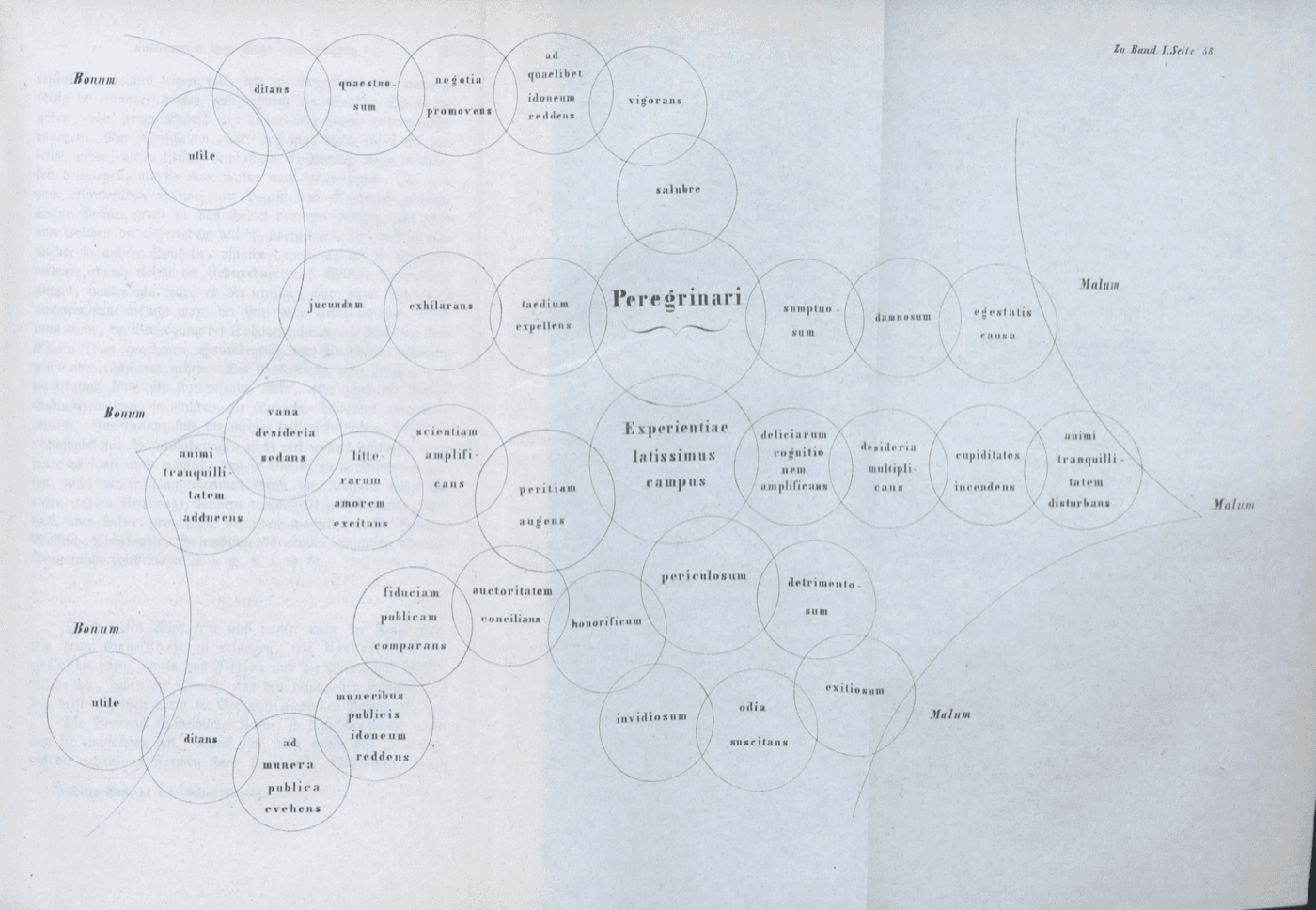
erläutern, welches zeigen soll, wie die Begriffssphären mannigfaltig in einander greifen und dadurch der Willkür Spielraum geben, von jedem Begriff auf diesen oder jenen andern überzugehen. Nur wünsche ich nicht, daß man durch die Tafel verleitet werde, dieser kleinen beiläufigen Erörterung mehr Wichtigkeit beizulegen, als sie ihrer Natur nach haben kann. Ich habe zum erläuternden Beispiel den Begriff des Reisens gewählt. Seine Sphäre greift in das Gebiet von vier andern, auf jeden von welchen der Ueberredner beliebig übergehen kann: diese greifen wieder in andere Sphären, manche davon zugleich in zwei und mehrere, durch welche der Ueberredner nach Willkür seinen Weg nimmt, immer als wäre es der einzige, und dann zuletzt, je nachdem seine Absicht war, bei Gut oder Uebel anlangt. Nur muß man, bei Verfolgung der Sphären, immer die Richtung vom Centro (dem gegebenen Hauptbegriff) zur Peripherie behalten, nicht aber rückwärts gehen. Die Einkleidung einer solchen Sophistikation kann die fortlaufende Rede, oder auch die strenge Schlußform seyn, je nachdem die schwache Seite des Hörers es anräth. Im Grunde sind die meisten wissenschaftlichen, besonders philosophischen Beweisführungen nicht viel anders beschaffen: wie wäre es sonst auch möglich, daß so Vieles, zu verschiedenen Zeiten, nicht nur irrig angenommen (denn der Irrthum selbst hat einen andern Ursprung), sondern demonstrirt und bewiesen, dennoch aber später grundfalsch befunden worden, z. B. Leibnitz-Wolfische Philosophie, Ptolemäische Astronomie, Stahlsche Chemie, Newtonische Farbenlehre u. s. w. u. s. w.29.
10 Durch dieses Alles tritt uns immer mehr die Frage nah, wie denn Gewißheit zu erlangen, wie Urtheile zu begründen seien, worin das Wissen und die Wissenschaft bestehe, welche wir, neben der Sprache und dem besonnenen Handeln, als den dritten großen durch die Vernunft gegebenen Vorzug rühmen.
Die Vernunft ist weiblicher Natur: sie kann nur geben, nachdem sie empfangen hat. Durch sich selbst allein hat sie nichts, als die gehaltlosen Formen ihres Operirens. Vollkommen reine [30] Hiezu Kap. 11 des zweiten Bandes.
Vernunfterkenntniß giebt es sogar keine andere, als die vier Sätze, welchen ich metalogische Wahrheit beigelegt habe, also die Sätze von der Identität, vom Widerspruch, vom ausgeschlossenen Dritten und vom zureichenden Erkenntnißgrunde. Denn selbst das Uebrige der Logik ist schon nicht mehr vollkommen reine Vernunfterkenntniß, weil es die Verhältnisse und Kombinationen der Sphären der Begriffe voraussetzt: aber Begriffe überhaupt sind erst da, nach vorhergegangenen anschaulichen Vorstellungen, die Beziehung auf welche ihr ganzes Wesen ausmacht, die sie folglich schon voraussetzen. Da indessen diese Voraussetzung sich nicht auf den bestimmten Gehalt der Begriffe, sondern nur allgemein auf ein Daseyn derselben erstreckt; so kann die Logik doch, im Ganzen genommen, für reine Vernunftwissenschaft gelten. In allen übrigen Wissenschaften hat die Vernunft den Gehalt aus den anschaulichen Vorstellungen erhalten: in der Mathematik aus den vor aller Erfahrung anschaulich bewußten Verhältnissen des Raumes und der Zeit; in der reinen Naturwissenschaft, d. h. in dem, was wir vor aller Erfahrung über den Lauf der Natur wissen, geht der Gehalt der Wissenschaft aus dem reinen Verstande hervor, d. h. aus der Erkenntniß a priori des Gesetzes der Kausalität und dessen Verbindung mit jenen reinen Anschauungen des Raumes und der Zeit. In allen anderen Wissenschaften gehört Alles, was nicht aus den eben genannten entlehnt ist, der Erfahrung an. Wissen überhaupt heißt: solche Urtheile in der Gewalt seines Geistes zu willkürlicher Reproduktion haben, welche in irgend etwas außer ihnen ihren zureichenden Erkenntnißgrund haben, d. h. wahr sind. Die abstrakte Erkenntniß allein ist also ein Wissen; dieses ist daher durch die Vernunft bedingt, und von den Thieren können wir, genau genommen, nicht sagen, daß sie irgend etwas wissen, wiewohl sie die anschauliche Erkenntniß, für diese auch Erinnerung und eben deshalb Phantasie haben, welche überdies ihr Träumen beweist. Bewußtseyn legen wir ihnen bei, dessen Begriff folglich, obgleich das Wort von Wissen genommen ist, mit dem des Vorstellens überhaupt, von welcher Art es auch sei, zusammenfällt. Daher auch legen wir der Pflanze zwar Leben, aber kein Bewußtseyn bei. — Wissen also ist das abstrakte Bewußtseyn, das Fixirthaben in Begriffen der Vernunft, des auf andere Weise überhaupt Erkannten.
11 In dieser Hinsicht ist nun der eigentliche Gegensatz des Wissens das Gefühl, dessen Erörterung wir deshalb hier einschalten müssen. Der Begriff, den das Wort Gefühl bezeichnet, hat durchaus nur einen negativen Inhalt, nämlich diesen, daß etwas, das im Bewußtseyn gegenwärtig ist, nicht Begriff, nicht abstrakte Erkenntniß der Vernunft sei: übrigens mag es seyn, was es will, es gehört unter den Begriff Gefühl, dessen unmäßig weite Sphäre daher die heterogensten Dinge begreift, von denen man nimmer einsieht, wie sie zusammenkommen, so lange man nicht erkannt hat, daß sie allein in dieser negativen Rücksicht, nicht abstrakte Begriffe zu seyn, übereinstimmen. Denn die verschiedensten, ja feindlichsten Elemente liegen ruhig neben einander in jenem Begriff, z. B. religiöses Gefühl, Gefühl der Wolluft, moralisches Gefühl, körperliches Gefühl als Getast, als Schmerz, als Gefühl für Farben, für Töne und deren Harmonien und Disharmonien, Gefühl des Hasses, Abscheues, der Selbstzufriedenheit, der Ehre, der Schande, des Rechts, des Unrechts, Gefühl der Wahrheit, ästhetisches Gefühl, Gefühl von Kraft, Schwäche, Gesundheit, Freundschaft, Liebe u. s. w. u. s. w. Durchaus keine Gemeinschaft ist zwischen ihnen, als die negative, daß sie keine abstrakte Vernunfterkenntniß sind; aber dieses wird am auffallendsten, wenn sogar die anschauliche Erkenntniß a priori der räumlichen Verhältnisse, und vollends die des reinen Verstandes unter jenen Begriff gebracht wird, und überhaupt von jeder Erkenntniß, jeder Wahrheit, deren man sich nur erst intuitiv bewußt ist, sie aber noch nicht in abstrakte Begriffe abgesetzt hat, gesagt wird, daß man sie fühle. Hievon will ich, zur Erläuterung, einige Beispiele aus neuern Büchern beibringen, weil sie frappante Belege meiner Erklärung sind. Ich erinnere mich, in der Einleitung einer Verdeutschung des Eukleides gelesen zu haben, man solle die Anfänger in der Geometrie die Figuren erst alle zeichnen lassen, ehe man zum Demonstriren schreite, weil sie alsdann die geometrische Wahrheit schon vorher fühlten, ehe ihnen die Demonstration die vollendete Erkenntniß beibrächte. — Ebenso wird in der „Kritik der Sittenlehre“ von F. Schleiermacher geredet vom logischen und mathematischen Gefühl (S. 339), auch vom Gefühl der Gleichheit oder Verschiedenheit zweier Formeln (S. 342); ferner in Tennemanns „Geschichte der Philosophie“, Bd. 1, S. 361, heißt es: „Man fühlte, daß die Trugschlüsse nicht richtig waren, konnte aber doch den Fehler nicht entdecken.“ — So lange man nun diesen Begriff Gefühl nicht aus dem rechten Gesichtspunkte betrachtet und nicht jenes eine negative Merkmal, welches allein ihm wesentlich ist, erkennt, muß derselbe, wegen der übermäßigen Weite seiner Sphäre und seines bloß negativen, ganz einseitig bestimmten und sehr geringen Gehaltes, beständig Anlaß zu Misverständnissen und Streitigkeiten geben. Da wir im Deutschen noch das ziemlich gleichbedeutende Wort Empfindung haben, so würde es dienlich seyn, dieses für die körperlichen Gefühle, als eine Unterart, in Beschlag zu nehmen. Der Ursprung jenes gegen alle anderen disproportionirten Begriffs Gefühl ist aber ohne Zweifel folgender. Alle Begriffe, und nur Begriffe sind es welche Worte bezeichnen, sind nur für die Vernunft da, gehen von ihr aus: man steht mit ihnen also schon auf einem einseitigen Standpunkt. Aber von einem solchen aus erscheint das Nähere deutlich und wird als positiv gesetzt; das Fernere fließt zusammen und wird bald nur noch negativ berücksichtigt: so nennt jede Nation alle Anderen Fremde, der Grieche alle Anderen Barbaren, der Engländer Alles, was nicht England oder Englisch ist, continent und continental, der Gläubige alle Anderen Ketzer, oder Heiden, der Adel alle Anderen roturiers, der Student alle Anderen Philister u. dgl. m. Dieselbe Einseitigkeit, man kann sagen dieselbe rohe Unwissenheit aus Stolz, läßt sich, so sonderbar es auch klingt, die Vernunft selbst zu Schulden kommen, indem sie unter den einen Begriff Gefühl jede Modifikation des Bewußtseyns befaßt, die nur nicht unmittelbar zu ihrer Vorstellungsweise gehört, d. h. nicht abstrakter Begriff ist. Sie hat dieses bisher, weil ihr eigenes Verfahren ihr nicht durch gründliche Selbstkenntniß deutlich geworden war, büßen müssen durch Misverständnisse und Verirrungen auf ihrem eigenen Gebiet, da man sogar ein besonderes Gefühlvermögen aufgestellt hat und nun Theorien desselben konstruirt.
12 Wissen, als dessen kontradiktorisches Gegentheil ich soeben den Begriff Gefühl erörtert habe, ist, wie gesagt, jede abstrakte Erkenntniß, d. h. Vernunfterkenntniß. Da nun aber die Vernunft immer nur das anderweitig Empfangene wieder vor die Erkenntniß bringt, so erweitert sie nicht eigentlich unser Erkennen, sondern giebt ihm bloß eine andere Form. Nämlich was intuitiv, was in concreto erkannt wurde, läßt sie abstrakt und allgemein erkennen. Dies ist aber ungleich wichtiger, als es, so ausgedrückt, dem ersten Blicke scheint. Denn alles sichere Aufbewahren, alle Mittheilbarkeit und alle sichere und weitreichende Anwendung der Erkenntniß auf das Praktische hängt davon ab, daß sie ein Wissen, eine abstrakte Erkenntniß geworden sei. Die intuitive Erkenntniß gilt immer nur vom einzelnen Fall, geht nur auf das Nächste, und bleibt bei diesem stehen, weil Sinnlichkeit und Verstand eigentlich nur ein Objekt zur Zeit auffassen können. Jede anhaltende, zusammengesetzte, planmäßige Thätigkeit muß daher von Grundsätzen, also von einem abstrakten Wissen ausgehen und danach geleitet werden. So ist z. B. die Erkenntniß, welche der Verstand vom Verhältniß der Ursach und Wirkung hat, zwar an sich viel vollkommener, tiefer und erschöpfender, als was davon in abstracto sich denken läßt: der Verstand allein erkennt anschaulich unmittelbar und vollkommen die Art des Wirkens eines Hebels, Flaschenzuges, Kammrades, das Ruhen eines Gewölbes in sich selbst u. s. w. Aber wegen der eben berührten Eigenschaft der intuitiven Erkenntniß, nur auf das unmittelbar Gegenwärtige zu gehen, reicht der bloße Verstand nicht hin zur Konstruktion von Maschinen und Gebäuden: vielmehr muß hier die Vernunft eintreten, an die Stelle der Anschauungen abstrakte Begriffe setzen, solche zur Richtschnur des Wirkens nehmen, und waren sie richtig, so wird der Erfolg eintreffen. Ebenso erkennen wir in reiner Anschauung vollkommen das Wesen und die Gesetzmäßigkeit einer Parabel, Hyperbel, Spirale; aber um von dieser Erkenntniß sichere Anwendung in der Wirklichkeit zu machen, müßte sie zuvor zum abstrakten Wissen geworden seyn, wobei sie freilich die Anschaulichkeit einbüßt, aber dafür die Sicherheit und Bestimmtheit des abstrakten Wissens gewinnt. Also erweitert alle Differentialrechnung eigentlich gar nicht unsere Erkenntniß von den Kurven, enthält nichts mehr, als was schon die bloße reine Anschauung derselben; aber sie ändert die Art der Erkenntniß, verwandelt die intuitive in eine abstrakte, welches für die Anwendung so höchst folgenreich ist. Hier kommt nun aber noch eine Eigenthümlichkeit unsers Erkenntnißvermögens zur Sprache, welche man bisher wohl nicht bemerken konnte, so lange der Unterschied zwischen anschaulicher und abstrakter Erkenntniß nicht vollkommen deutlich gemacht war. Es ist diese, daß die Verhältnisse des Raums nicht unmittelbar und als solche in die abstrakte Erkenntniß übertragen werden können, sondern hiezu allein die zeitlichen Größen, d. h. die Zahlen geeignet sind. Die Zahlen allein können in ihnen genau entsprechenden abstrakten Begriffen ausgedrückt werden, nicht die räumlichen Größen. Der Begriff Tausend ist vom Begriff Zehn genau so verschieden, wie beide zeitliche Größen es in der Anschauung sind: wir denken bei Tausend ein bestimmt vielfaches von Zehn, in welches wir jenes für die Anschauung in der Zeit beliebig auflösen können, d. h. es zählen können. Aber zwischen dem abstrakten Begriff einer Meile und dem eines Fußes, ohne alle anschauliche Vorstellung von beiden und ohne Hülfe der Zahl, ist gar kein genauer und jenen Größen selbst entsprechender Unterschied. In beiden wird überhaupt nur eine räumliche Größe gedacht, und sollen beide hinlänglich unterschieden werden, so muß durchaus entweder die räumliche Anschauung zu Hülfe genommen, also schon das Gebiet der abstrakten Erkenntniß verlassen werden, oder man muß den Unterschied in Zahlen denken. Will man also von den räumlichen Verhältnissen abstrakte Erkenntniß haben, so müssen sie erst in zeitliche Verhältnisse, d. h. in Zahlen, übertragen werden: deswegen ist nur die Arithmetik, nicht die Geometrie, allgemeine Größenlehre, und die Geometrie muß in Arithmetik übersetzt werden, wenn sie Mittheilbarkeit, genaue Bestimmtheit und Anwendbarkeit auf das Praktische haben soll. Zwar läßt sich ein räumliches Verhältniß als solches auch in abstracto denken, z. B. „der Sinus wächst nach Maaßgabe des Winkels“; aber wenn die Größe dieses Verhältnisses angegeben werden soll, bedarf es der Zahl. Diese Nothwendigkeit, daß der Raum, mit seinen drei Dimensionen, in die Zeit, welche nur eine Dimension hat, übersetzt werden muß, wenn man eine abstrakte Erkenntniß (d. h. ein Wissen, kein bloßes Anschauen) seiner Verhältnisse haben will, diese Nothwendigkeit ist es, welche die Mathematik so schwierig macht. Dies wird sehr deutlich, wenn wir die Anschauung der Kurven vergleichen mit der analytischen Berechnung derselben, oder auch nur die Tafeln der Logarithmen der trigonometrischen Funktionen mit der Anschauung der wechselnden Verhältnisse der Theile des Dreiecks, welche durch jene ausgedrückt werden: was hier die Anschauung in einem Blick, vollkommen und mit äußerster Genauigkeit auffaßt, nämlich wie der Kosinus abnimmt, indem der Sinus wächst, wie der Kosinus des einen Winkels der Sinus des andern ist, das umgekehrte Verhältniß der Ab- und Zunahme beider Winkel u. s. w., welches ungeheuern Gewebes von Zahlen, welcher mühsäligen Rechnung bedurfte es nicht, um dieses in abstracto auszudrücken: wie muß nicht, kann man sagen, die Zeit mit ihrer einen Dimension sich quälen, um die drei Dimensionen des Raumes wiederzugeben! Aber dies war nothwendig, wenn wir, zum Behuf der Anwendung, die Verhältnisse des Raumes in abstrakte Begriffe niedergelegt besitzen wollten: unmittelbar konnten jene nicht in diese eingehen, sondern nur durch Vermittelung der rein zeitlichen Größe, der Zahl, als welche allein der abstrakten Erkenntniß sich unmittelbar anfügt. Noch ist bemerkenswerth, daß, wie der Raum sich so sehr für die Anschauung eignet und, mittelst seiner drei Dimensionen, selbst komplicirte Verhältnisse leicht übersehen läßt, dagegen der abstrakten Erkenntniß sich entzieht; umgekehrt die Zeit zwar leicht in die abstrakten Begriffe eingeht, dagegen aber der Anschauung sehr wenig giebt: unsere Anschauung der Zahlen in ihrem eigenthümlichen Element, der bloßen Zeit, ohne Hinzuziehung des Raumes, geht kaum bis Zehn; darüber hinaus haben wir nur noch abstrakte Begriffe, nicht mehr anschauliche Erkenntniß der Zahlen: hingegen verbinden wir mit jedem Zahlwort und allen algebraischen Zeichen genau bestimmte abstrakte Begriffe.
Nebenbei ist hier zu bemerken, daß manche Geister nur im anschaulich Erkannten völlige Befriedigung finden. Grund und Folge des Seyns im Raum anschaulich dargelegt, ist es, was sie suchen: ein Eukleidischer Beweis, oder eine arithmetische Auflösung räumlicher Probleme, spricht sie nicht an. Andere Geister hingegen verlangen die zur Anwendung und Mittheilung allein brauchbaren abstrakten Begriffe: sie haben Geduld und Gedächtniß für abstrakte Sätze, Formeln, Beweisführungen in langen Schlußketten, und Rechnungen, deren Zeichen die komplicirtesten Abstraktionen vertreten. Diese suchen Bestimmtheit: jene Anschaulichkeit. Der Unterschied ist charakteristisch.
Das Wissen, die abstrakte Erkenntniß, hat ihren größten Werth in der Mittheilbarkeit und in der Möglichkeit, fixirt aufbehalten zu werden: erst hiedurch wird sie für das Praktische so unschätzbar wichtig. Einer kann vom kausalen Zusammenhange der Veränderungen und Bewegungen natürlicher Körper eine unmittelbare, anschauliche Erkenntniß im bloßen Verstande haben und in derselben völlige Befriedigung finden; aber zur Mittheilung wird sie erst geschickt, nachdem er sie in Begriffen fixirt hat. Selbst für das Praktische ist eine Erkenntniß der erstern Art hinreichend, sobald er auch die Ausführung ganz allein übernimmt, und zwar in einer, während noch die anschauliche Erkenntniß lebendig ist, ausführbaren Handlung; nicht aber, wenn er fremder Hülfe, oder auch nur eines zu verschiedenen Zeiten eintretenden eigenen Handelns und daher eines überlegten Planes bedarf. So kann z. B. ein geübter Billiardspieler eine vollständige Kenntniß der Gesetze des Stoßes elastischer Körper auf einander haben, bloß im Verstande, bloß für die unmittelbare Anschauung, und er reicht damit vollkommen aus: hingegen hat nur der wissenschaftliche Mechaniker ein eigentliches Wissen jener Gesetze, d. h. eine Erkenntniß in abstracto davon. Selbst zur Konstruktion von Maschinen reicht jene bloß intuitive Verstandeserkenntniß hin, wenn der Erfinder der Maschine sie auch allein ausführt, wie man oft an talentvollen Handwerkern ohne alle Wissenschaft sieht: hingegen sobald mehrere Menschen und eine zusammengesetzte, zu verschiedenen Zeitpunkten eintretende Thätigkeit derselben zur Ausführung einer mechanischen Operation, einer Maschine, eines Baues nöthig sind, muß der, welcher sie leitet, den Plan in abstracto entworfen haben, und nur durch Beihülfe der Vernunft ist eine solche zusammenwirkende Thätigkeit möglich. Merkwürdig ist es aber, daß bei jener erstern Art von Thätigkeit, wo Einer allein, in einer ununterbrochenen Handlung etwas ausführen soll, das Wissen, die Anwendung der Vernunft, die Reflexion ihm sogar oft hinderlich seyn kann, z. B. eben beim Billiardspielen, beim Fechten, beim Stimmen eines Instruments, beim Singen: hier muß die anschauliche Erkenntniß die Thätigkeit unmittelbar leiten: das Durchgehen durch die Reflexion macht sie unsicher, indem es die Aufmerksamkeit theilt und den Menschen verwirrt. Darum führen Wilde und rohe Menschen, die sehr wenig zu denken gewohnt sind, manche Leibesübungen, den Kampf mit Thieren, das Treffen mit dem Pfeil u. dgl. mit einer Sicherheit und Geschwindigkeit aus, die der reflektirende Europäer nie erreicht, eben weil seine Ueberlegung ihn schwanken und zaudern macht: denn er sucht z. B. die rechte Stelle, oder den rechten Zeitpunkt, aus dem gleichen Abstand von beiden falschen Extremen zu finden: der Naturmensch trifft sie unmittelbar, ohne auf die Abwege zu reflektiren. Ebenso hilft es mir nicht, wenn ich den Winkel, in welchem ich das Rasiermesser anzusetzen habe, nach Graden und Minuten in abstracto anzugeben weiß, wenn ich ihn nicht intuitiv kenne, d. h. im Griff habe. Auf gleiche Weise störend ist ferner die Anwendung der Vernunft bei dem Verständniß der Physiognomie: auch dieses muß unmittelbar durch den Verstand geschehen: der Ausdruck, die Bedeutung der Züge läßt sich nur fühlen, sagt man, d. h. eben geht nicht in die abstrakten Begriffe ein. Jeder Mensch hat seine unmittelbare intuitive Physiognomik und Pathognomik: doch erkennt Einer deutlicher, als der Andere, jene signatura rerum. Aber eine Physiognomik in abstracto zum Lehren und Lernen ist nicht zu Stande zu bringen; weil die Nüancen hier so fein sind, daß der Begriff nicht zu ihnen herab kann; daher das abstrakte Wissen sich zu ihnen verhält, wie ein musivisches Bild zu einem van der Werft oder Denner: wie, so fein auch die Musaik ist, die Gränzen der Steine doch stets bleiben und daher kein stetiger Uebergang einer Tinte in die andere möglich ist; so sind auch die Begriffe, mit ihrer Starrheit und scharfen Begränzung, so fein man sie auch durch nähere Bestimmung spalten möchte, stets unfähig, die feinen Modifikationen des Anschaulichen zu erreichen, auf welche es, bei der hier zum Beispiel genommenen Physiognomik, gerade ankommt31.
32 Ich bin dieserwegen der Meinung, daß die Physiognomik nicht weiter mit Sicherheit gehen kann, als zur Aufstellung einiger ganz allgemeiner Regeln, z. B. solcher: in Stirn und Auge ist das Intellektuale, im Munde und der untern Gesichtshälfte, das Ethische, die Willensäußerungen, zu lesen; — Stirn und Auge erläutern sich gegenseitig, jedes von beiden, ohne das andere gesehen, ist nur halb verständlich; — Genie ist nie ohne hohe, breite, schön gewölbte Stirn; diese aber oft ohne jenes; — von einem geistreichen Aussehen ist auf Geist um so sicherer zu schließen, je häßlicher das Gesicht ist, und von einem dummen Aussehen auf Dummheit desto sicherer, je schöner das Gesicht ist; weil Schönheit, als Angemessenheit zu dem Typus der Menschheit, schon an und für sich auch den Ausdruck geistiger Klarheit trägt, Häßlichkeit sich entgegengesetzt verhält, u. s. w.
Diese nämliche Beschaffenheit der Begriffe, welche sie den Steinen des Musivbildes ähnlich macht, und vermöge welcher die Anschauung stets ihre Asymptote bleibt, ist auch der Grund, weshalb in der Kunst nichts Gutes durch sie geleistet wird. Will der Sänger, oder Virtuose, seinen Vortrag durch Reflexion leiten, so bleibt er todt. Das Selbe gilt vom Komponisten, vom Maler, ja vom Dichter: immer bleibt für die Kunst der Begriff unfruchtbar: bloß das Technische in ihr mag er leiten: sein Gebiet ist die Wissenschaft. Wir werden im dritten Buch näher untersuchen, weshalb alle ächte Kunst aus der anschaulichen Erkenntniß hervorgeht, nie aus dem Begriff. — Sogar auch in Hinsicht auf das Betragen, auf die persönliche Annehmlichkeit im Umgange, taugt der Begriff nur negativ, um die groben Ausbrüche des Egoismus und der Bestialität zurückzuhalten, wie denn die Höflichkeit sein löbliches Werk ist; aber das Anziehende, Gratiose, Einnehmende des Betragens, das Liebevolle und Freundliche, darf nicht aus dem Begriff hervorgegangen seyn: sonst „fühlt man Absicht und man ist verstimmt.“ — Alle Verstellung ist Werk der Reflexion; aber auf die Dauer und unausgesetzt ist sie nicht haltbar: nemo potest personam diu ferre fictam, sagt Seneka, im Buche de clementia: auch wird sie dann meistens erkannt und verfehlt ihre Wirkung. Im hohen Lebensdrange, wo es schneller Entschlüsse, keden Handelns, raschen und festen Ergreifens bedarf, ist zwar Vernunft nöthig, kann aber, wenn sie die Oberhand gewinnt und das intuitive, unmittelbare, rein verständige Ausfinden und zugleich Ergreifen des Rechten verwirrend hindert und Unentschlossenheit herbeiführt, leicht Alles verderben.
Endlich geht auch Tugend und Heiligkeit nicht aus Reflexion hervor, sondern aus der innern Tiefe des Willens und deren Verhältniß zum Erkennen. Diese Erörterung gehört an eine ganz andere Stelle dieser Schrift: nur so viel mag ich hier bemerken, daß die auf das Ethische sich beziehenden Dogmen in der Vernunft ganzer Nationen die selben seyn können, aber das Handeln in jedem Individuo ein anderes, und so auch umgekehrt: das Handeln geschieht, wie man spricht, nach Gefühlen: d. h. eben nur nicht nach Begriffen, nämlich dem ethischen Gehalte nach. Die Dogmen beschäftigen die müßige Vernunft: das Handeln geht zuletzt unabhängig von ihnen seinen Gang, meistens nicht nach abstrakten, sondern nach unausgesprochenen Maximen, deren Ausdruck eben der ganze Mensch selbst ist. Daher, wie verschieden auch die religiosen Dogmen der Völker sind, so ist doch bei allen die gute That von unaussprechlicher Zufriedenheit, die böse von unendlichem Grausen begleitet: erstere erschüttert kein Spott: von letzterem befreit keine Absolution des Beichtvaters. Jedoch soll hiedurch nicht geleugnet werden, daß bei der Durchführung eines tugendhaften Wandels Anwendung der Vernunft nöthig sei: nur ist sie nicht die Quelle desselben; sondern ihre Funktion ist eine untergeordnete, nämlich die Bewahrung gefaßter Entschlüsse, das Vorhalten der Maximen, zum Widerstand gegen die Schwäche des Augenblicks und zur Konsequenz des Handelns. Das Selbe leistet sie am Ende auch in der Kunst, wo sie doch ebenso in der Hauptsache nichts vermag, aber die Ausführung unterstützt, eben weil der Genius nicht in jeder Stunde zu Gebote steht, das Werk aber doch in allen Theilen vollendet und zu einem Ganzen gerundet seyn soll33.
13 Alle diese Betrachtungen sowohl des Nutzens, als des Nachtheils der Anwendung der Vernunft, sollen dienen deutlich zu machen, daß, obwohl das abstrakte Wissen der Reflex der anschaulichen Vorstellung und auf diese gegründet ist, es ihr doch keineswegs so kongruirt, daß es überall die Stelle derselben vertreten34 Hiezu Kap. 7 des zweiten Bandes. könnte: vielmehr entspricht es ihr nie ganz genau; daher, wie wir gesehen haben, zwar viele der menschlichen Verrichtungen nur durch Hülfe der Vernunft und des überlegten Verfahrens, jedoch einige besser ohne deren Anwendung zu Stande kommen. — Eben jene Inkongruenz der anschaulichen und der abstrakten Erkenntniß, vermöge welcher diese sich jener immer nur so annähert, wie die Musivarbeit der Malerei, ist nun auch der Grund eines sehr merkwürdigen Phänomens, welches, eben wie die Vernunft, der menschlichen Natur ausschließlich eigen ist, dessen bisher immer von Neuem versuchte Erklärungen aber alle ungenügend sind: ich meyne das Lachen. Wir können, dieses seines Ursprunges wegen, uns einer Erörterung desselben an dieser Stelle nicht entziehen, obwohl sie unsern Gang von Neuem aufhält. Das Lachen entsteht jedesmal aus nichts Anderem, als aus der plötzlich wahrgenommenen Inkongruenz zwischen einem Begriff und den realen Objekten, die durch ihn, in irgend einer Beziehung, gedacht worden waren, und es ist selbst eben nur der Ausdruck dieser Inkongruenz. Sie tritt oft dadurch hervor, daß zwei oder mehrere reale Objekte durch einen Begriff gedacht und seine Identität auf sie übertragen wird; darauf aber eine gänzliche Verschiedenheit derselben im Uebrigen es auffallend macht, daß der Begriff nur in einer einseitigen Rücksicht auf sie paßte. Ebenso oft jedoch ist es ein einziges reales Objekt, dessen Inkongruenz zu dem Begriff, dem es einerseits mit Recht subsumirt worden, plötzlich fühlbar wird. Je richtiger nun einerseits die Subsumtion solcher Wirklichkeiten unter den Begriff ist, und je größer und greller andererseits ihre Unangemessenheit zu ihm, desto stärker ist die aus diesem Gegensatz entspringende Wirkung des Lächerlichen. Jedes Lachen also entsteht auf Anlaß einer paradoxen und daher unerwarteten Subsumtion; gleichviel ob diese durch Worte, oder Thaten sich ausspricht. Dies ist in der Kürze die richtige Erklärung des Lächerlichen.
Ich werde mich hier nicht damit aufhalten, Anekdoten als Beispiele desselben zu erzählen, um daran meine Erklärung zu erläutern: denn diese ist so einfach und faßlich, daß sie dessen nicht bedarf, und zum Beleg derselben ist jedes Lächerliche, dessen sich der Leser erinnert, auf gleiche Weise tauglich. Wohl aber erhält unsere Erklärung Bestätigung und Erläuterung zugleich durch die Entfaltung zweier Arten des Lächerlichen, in welche es zerfällt, und die eben aus jener Erklärung hervorgehen. Entweder nämlich sind in der Erkenntniß zwei oder mehrere sehr verschiedene reale Objekte, anschauliche Vorstellungen, vorhergegangen, und man hat sie willkürlich durch die Einheit eines beide fassenden Begriffes identifizirt: diese Art des Lächerlichen heißt Witz. Oder aber umgekehrt, der Begriff ist in der Erkenntniß zuerst da, und man geht nun von ihm zur Realität und zum Wirken auf dieselbe, zum Handeln über: Objekte, die übrigens grundverschieden, aber alle in jenem Begriffe gedacht sind, werden nun auf gleiche Weise angesehen und behandelt, bis ihre übrige große Verschiedenheit zur Ueberraschung und zum Erstaunen des Handelnden hervortritt: diese Art des Lächerlichen heißt Narrheit. Demnach ist jedes Lächerliche entweder ein witziger Einfall, oder eine närrische Handlung, je nachdem von der Diskrepanz der Objekte auf die Identität des Begriffs, oder aber umgekehrt gegangen wurde: ersteres immer willkürlich, letzteres immer unwillkürlich und von Außen aufgedrungen. Diesen Ausgangspunkt nun aber scheinbar umzukehren und Witz als Narrheit zu maskiren, ist die Kunst des Hofnarren und des Hanswurst: ein solcher, der Diversität der Objekte sich wohl bewußt, vereinigt dieselben, mit heimlichem Witz, unter einem Begriff, von welchem sodann ausgehend er von der nachher gefundenen Diversität der Objekte diejenige Ueberraschung erhält, welche er selbst sich vorbereitet hatte. — Es ergiebt sich aus dieser kurzen, aber hinreichenden Theorie des Lächerlichen, daß, letztern Fall der Lustigmacher bei Seite gesetzt, der Witz sich immer in Worten zeigen muß, die Narrheit aber meistens in Handlungen, wiewohl auch in Worten, wenn sie nämlich nur ihr Vorhaben ausspricht, statt es wirklich zu vollführen, oder auch sich in bloßen Urtheilen und Meinungen äußert.
Zur Narrheit gehört auch die Pedanterei. Sie entsteht daraus, daß man wenig Zutrauen zu seinem eigenen Verstande hat und daher ihm es nicht überlassen mag, im einzelnen Fall unmittelbar das Rechte zu erkennen, demnach ihn ganz und gar unter die Vormundschaft der Vernunft stellt und sich dieser überall bedienen, d. h. immer von allgemeinen Begriffen, Regeln, Maximen ausgehen und sich genau an sie halten will, im Leben, in der Kunst, ja im ethischen Wohlverhalten. Daher das der Pedanterei eigene Kleben an der Form, an der Manier, am Ausdruck und Wort, welche bei ihr an die Stelle des Wesens der Sache treten. Da zeigt sich denn bald die Inkongruenz des Begriffs zur Realität, zeigt sich, wie jener nie auf das Einzelne herabgeht und wie seine Allgemeinheit und starre Bestimmtheit nie genau zu den feinen Nüancen und mannigfaltigen Modifikationen der Wirklichkeit passen kann. Der Pedant kommt daher mit seinen allgemeinen Maximen im Leben fast immer zu kurz, zeigt sich unklug, abgeschmackt, unbrauchbar: in der Kunst, für die der Begriff unfruchtbar ist, producirt er leblose, steife, manierirte Aftergeburten. Sogar in ethischer Hinsicht kann der Vorsatz, recht oder edel zu handeln, nicht überall nach abstrakten Maximen ausgeführt werden; weil in vielen Fällen die unendlich fein nüancirte Beschaffenheit der Umstände eine unmittelbar aus dem Charakter hervorgegangene Wahl des Rechten nöthig macht, indem die Anwendung bloß abstrakter Maximen theils, weil sie nur halb passen, falsche Resultate giebt, theils nicht durchzuführen ist, indem sie dem individuellen Charakter des Handelnden fremd sind und dieser sich nie ganz verleugnen läßt: daher dann Inkonsequenzen folgen. Wir können Kanten, sofern er zur Bedingung des moralischen Werths einer Handlung macht, daß sie aus rein vernünftigen abstrakten Maximen, ohne alle Neigung oder momentane Aufwallung geschehe, vom Vorwurf der Veranlassung moralischer Pedanterei nicht ganz frei sprechen; welcher Vorwurf auch der Sinn des Schillerschen Epigramms, „Gewissenskrupel” überschrieben, ist. — Wenn, besonders in politischen Angelegenheiten, geredet wird von Doktrinärs, Theoretikern, Gelehrten u. s. w.; so sind Pedanten gemeint, d. h. Leute, welche die Dinge wohl in abstracto, aber nicht in concreto kennen. Die Abstraktion besteht im Wegdenken der nähern Bestimmungen: gerade auf diese aber kommt im Praktischen sehr viel an.
Noch ist, zur Vervollständigung der Theorie, eine Afterart des Witzes zu erwähnen, das Wortspiel, calembourg, pun, zu welchem auch die Zweideutigkeit, l’équivoque, deren Hauptgebrauch der obscöne (die Zote) ist, gezogen werden kann. Wie der Witz zwei sehr verschiedene reale Objekte unter einen Begriff zwingt, so bringt das Wortspiel zwei verschiedene Begriffe, durch Benutzung des Zufalls, unter ein Wort: der selbe Kontrast entsteht wieder, aber viel matter und oberflächlicher, weil er nicht aus dem Wesen der Dinge, sondern aus dem Zufall der Namengebung entsprungen ist. Beim Witz ist die Identität im Begriff, die Verschiedenheit in der Wirklichkeit; beim Wortspiel aber ist die Verschiedenheit in den Begriffen und die Identität in der Wirklichkeit, als zu welcher der Wortlaut gehört. Es wäre nur ein etwas zu gesuchtes Gleichniß, wenn man sagte, das Wortspiel verhalte sich zum Witz, wie die Parabel des obern umgekehrten Kegels zu der des untern. Der Misverstand des Worts aber, oder das quid pro quo, ist der unwillkürliche Calembourg, und verhält sich zu diesem gerade so wie die Narrheit zum Witz; daher auch muß oft der Harthörige, so gut wie der Narr, Stoff zum Lachen geben, und schlechte Komödienschreiber brauchen jenen statt diesen, um Lachen zu erregen.
Ich habe das Lachen hier bloß von der psychischen Seite betrachtet: hinsichtlich der physischen verweise ich auf das in Parerga, Bd. 2, Kap. 6, §. 96, S. 134 (erste Aufl.), darüber Beigebrachte35.
14 Von allen diesen mannigfaltigen Betrachtungen, durch welche hoffentlich der Unterschied und das Verhältniß zwischen der Erkenntnißweise der Vernunft, dem Wissen, dem Begriff einerseits, und der unmittelbaren Erkenntniß in der reinsinnlichen, mathematischen Anschauung und der Auffassung durch den Verstand andererseits, zu völliger Deutlichkeit gebracht ist, ferner auch von den episodischen Erörterungen über Gefühl und Lachen, auf welche wir durch die Betrachtung jenes merkwürdigen Verhältnisses unserer Erkenntnißweisen fast unumgänglich geleitet wurden, — kehre ich nunmehr zurück zur fernern Erörterung der Wissenschaft, als des, neben Sprache und besonnenem Handeln, dritten Vorzugs, den die Vernunft dem Menschen giebt. Die allgemeine Betrachtung der Wissenschaft, die uns hier obliegt, wird theils ihre Form, theils die Begründung ihrer Urtheile, endlich auch ihren Gehalt betreffen.
36 Hiezu Kap. 8 des zweiten Bandes.
Wir haben gesehen, daß, die Grundlage der reinen Logik ausgenommen, alles Wissen überhaupt seinen Ursprung nicht in der Vernunft selbst hat; sondern, anderweitig als anschauliche Erkenntniß gewonnen, in ihr niedergelegt ist, indem es dadurch in eine ganz andere Erkenntnißweise, die abstrakte, übergieng. Alles Wissen, d. h. zum Bewußtseyn in abstracto erhobene Erkenntniß, verhält sich zur eigentlichen Wissenschaft, wie ein Bruchstück zum Ganzen. Jeder Mensch hat durch Erfahrung, durch Betrachtung des sich darbietenden Einzelnen, ein Wissen um mancherlei Dinge erlangt: aber nur wer sich die Aufgabe macht, über irgend eine Art von Gegenständen vollständige Erkenntniß in abstracto zu erlangen, strebt nach Wissenschaft. Durch den Begriff allein kann er jene Art aussondern; daher steht an der Spitze jeder Wissenschaft ein Begriff, durch welchen der Theil aus dem Ganzen aller Dinge gedacht wird, von welchem sie eine vollständige Erkenntniß in abstracto verspricht: z. B. der Begriff der räumlichen Verhältnisse, oder des Wirkens unorganischer Körper auf einander, oder der Beschaffenheit der Pflanzen, der Thiere, oder der successiven Veränderungen der Oberfläche des Erdballs, oder der Veränderungen des Menschengeschlechts im Ganzen, oder des Baues einer Sprache u. s. w. Wollte die Wissenschaft die Kenntniß von ihrem Gegenstande dadurch erlangen, daß sie alle durch den Begriff gedachten Dinge einzeln erforschte, bis sie so allmälig das Ganze erkannt hätte; so würde theils kein menschliches Gedächtniß zureichen, theils keine Gewißheit der Vollständigkeit zu erlangen seyn. Daher benutzt sie jene oben erörterte Eigenthümlichkeit der Begriffssphären, einander einzuschließen, und geht hauptsächlich auf die weiteren Sphären, welche innerhalb des Begriffs ihres Gegenstandes überhaupt liegen: indem sie deren Verhältnisse zu einander bestimmt hat, ist eben damit auch alles in ihnen Gedachte im Allgemeinen mit bestimmt und kann nun, mittelst Aussonderung immer engerer Begriffssphären, genauer und genauer bestimmt werden. Hiedurch wird es möglich, daß eine Wissenschaft ihren Gegenstand ganz umfasse. Dieser Weg, den sie zur Erkenntniß geht, nämlich vom Allgemeinen zum Besonderen, unterscheidet sie vom gemeinen Wissen: daher ist die systematische Form ein wesentliches und charakteristisches Merkmal der Wissenschaft. Die Verbindung der allgemeinsten Begriffssphären jeder Wissenschaft, d. h. die Kenntniß ihrer obersten Sätze, ist unumgängliche Bedingung ihrer Erlernung: wie weit man von diesen auf die mehr besonderen Sätze gehen will, ist beliebig und vermehrt nicht die Gründlichkeit, sondern den Umfang der Gelehrsamkeit. — Die Zahl der oberen Sätze, welchen die übrigen alle untergeordnet sind, ist in den verschiedenen Wissenschaften sehr verschieden, so daß in einigen mehr Subordination, in andern mehr Koordination ist; in welcher Hinsicht jene mehr die Urtheilskraft, diese das Gedächtniß in Anspruch nehmen. Es war schon den Scholastikern bekannt37, daß, weil der Schluß zwei Prämissen erfordert, keine Wissenschaft von einem einzigen nicht weiter abzuleitenden Obersatz ausgehen kann; sondern deren mehrere, wenigstens zwei, haben muß. Die eigentlich klassifizirenden Wissenschaften: Zoologie, Botanik, auch Physik und Chemie, sofern diese letzteren auf wenige Grundkräfte alles unorganische Wirken zurückführen, haben die meiste Subordination; hingegen hat Geschichte eigentlich gar keine, da das Allgemeine in ihr bloß in der Uebersicht der Hauptperioden besteht, aus denen aber die besonderen Begebenheiten sich nicht ableiten lassen und ihnen nur der Zeit nach subordinirt, dem Begriff nach koordinirt sind: daher Geschichte, genau genommen, zwar ein Wissen, aber keine Wissenschaft ist. In der Mathematik sind zwar, nach der Eukleidischen Behandlung, die Axiome die allein indemonstrabeln Obersätze und ihnen alle Demonstrationen stufenweise streng subordinirt: jedoch ist diese Behandlung ihr nicht wesentlich, und in der That hebt jeder Lehrsatz doch wieder eine neue räumliche Konstruktion an, die an sich von den vorherigen unabhängig ist und eigentlich auch völlig unabhängig von ihnen erkannt werden kann, aus sich selbst, in der reinen Anschauung des Raumes, in welcher auch die verwickelteste Konstruktion eigentlich so unmittelbar evident ist, wie das Axiom: doch davon ausführlich weiter unten. Inzwischen bleibt immer jeder mathematische Satz doch eine allgemeine Wahrheit, welche für unzählige einzelne Fälle gilt, auch ist ein stufenweiser Gang von den einfachen Sätzen zu den komplicirten, welche auf jene zurückzuführen sind, ihr wesentlich: also ist Mathematik in jeder Hinsicht Wissenschaft. — Die [38] Suarez, Disput. metaphysicae, disp. III, sect. 3, tit. 3.
Vollkommenheit einer Wissenschaft als solcher, d. h. der Form nach, besteht darin, daß so viel wie möglich Subordination und wenig Koordination der Sätze sei. Das allgemein wissenschaftliche Talent ist demnach die Fähigkeit, die Begriffssphären nach ihren verschiedenen Bestimmungen zu subordiniren, damit, wie Platon wiederholentlich anempfiehlt, nicht bloß ein Allgemeines und unmittelbar unter diesem eine unübersehbare Mannigfaltigkeit neben einander gestellt die Wissenschaft ausmache; sondern vom Allgemeinsten zum Besonderen die Kenntniß allmälig herabschreite, durch Mittelbegriffe und nach immer näheren Bestimmungen gemachte Eintheilungen. Nach Kants Ausdrücken heißt dies, dem Gesetz der Homogeneität und dem der Specifikation gleichmäßig Genüge leisten. Eben daraus aber, daß dieses die eigentliche wissenschaftliche Vollkommenheit ausmacht, ergiebt sich, daß der Zweck der Wissenschaft nicht größere Gewißheit ist: denn diese kann auch die abgerissenste einzelne Erkenntniß ebenso sehr haben; sondern Erleichterung des Wissens, durch die Form desselben, und dadurch gegebene Möglichkeit der Vollständigkeit des Wissens. Es ist deshalb eine zwar gangbare, aber verkehrte Meinung, daß Wissenschaftlichkeit der Erkenntniß in der größern Gewißheit bestehe, und ebenso falsch ist die hieraus hervorgegangene Behauptung, daß nur Mathematik und Logik Wissenschaften im eigentlichen Sinne wären; weil nur in ihnen, wegen ihrer gänzlichen Apriorität, unumstößliche Gewißheit der Erkenntniß ist. Dieser letztere Vorzug selbst ist ihnen nicht abzustreiten: nur giebt er ihnen keinen besondern Anspruch auf Wissenschaftlichkeit, als welche nicht in der Sicherheit, sondern in der durch das stufenweise Herabsteigen vom Allgemeinen zum Besonderen begründeten systematischen Form der Erkenntniß liegt. — Dieser den Wissenschaften eigenthümliche Weg der Erkenntniß, vom Allgemeinen zum Besonderen, bringt es mit sich, daß in ihnen Vieles durch Ableitung aus vorhergegangenen Sätzen, also durch Beweise, begründet wird, und dies hat den alten Irrthum veranlaßt, daß nur das Bewiesene vollkommen wahr sei und jede Wahrheit eines Beweises bedürfe; da vielmehr im Gegentheil jeder Beweis einer unbewiesenen Wahrheit bedarf, die zuletzt ihn, oder auch wieder seine Beweise, stützt: daher eine unmittelbar begründete Wahrheit der durch einen Beweis begründeten so vorzuziehen ist, wie Wasser aus der Quelle dem aus dem Aquädukt. Anschauung, theils reine a priori, wie sie die Mathematik, theils empirische a posteriori, wie sie alle anderen Wissenschaften begründet, ist die Quelle aller Wahrheit und die Grundlage aller Wissenschaft. (Auszunehmen ist allein die auf nichtanschauliche, aber doch unmittelbare Kenntniß der Vernunft von ihren eigenen Gesetzen gegründete Logik.) Nicht die bewiesenen Urtheile, noch ihre Beweise; sondern jene aus der Anschauung unmittelbar geschöpften und auf sie, statt alles Beweises, gegründeten Urtheile sind in der Wissenschaft das, was die Sonne im Weltgebäude: denn von ihnen geht alles Licht aus, von welchem erleuchtet die anderen wieder leuchten. Unmittelbar aus der Anschauung die Wahrheit solcher ersten Urtheile zu begründen, solche Grundvesten der Wissenschaft aus der unübersehbaren Menge realer Dinge herauszuheben; das ist das Werk der Urtheilskraft, welche in dem Vermögen, das anschaulich Erkannte richtig und genau ins abstrakte Bewußtseyn zu übertragen, besteht, und demnach die Vermittlerin zwischen Verstand und Vernunft ist. Nur ausgezeichnete und das gewöhnliche Maaß überschreitende Stärke derselben in einem Individuo kann die Wissenschaften wirklich weiter bringen: aber Sätze aus Sätzen zu folgern, zu beweisen, zu schließen, vermag Jeder, der nur gesunde Vernunft hat. Hingegen das anschaulich Erkannte in angemessene Begriffe für die Reflexion absetzen und fixiren, so daß einerseits das Gemeinsame vieler realen Objekte durch einen Begriff, andererseits ihr Verschiedenes durch ebenso viele Begriffe gedacht wird, und also das Verschiedene, trotz einer theilweisen Uebereinstimmung, doch als verschieden, dann aber wieder das Identische, trotz einer theilweisen Verschiedenheit, doch als identisch erkannt und gedacht wird, Alles gemäß dem Zweck und der Rücksicht, die jedesmal obwalten: dies Alles thut die Urtheilskraft. Mangel derselben ist Einfalt. Der Einfältige verkennt bald die theilweise oder relative Verschiedenheit des in einer Rücksicht Identischen, bald die Identität des relativ oder theilweise Verschiedenen. Uebrigens kann auch auf diese Erklärung der Urtheilskraft Kants Eintheilung derselben in reflektirende und subsumirende angewandt werden, je nachdem sie nämlich von den anschaulichen Objekten zum Begriff, oder von diesem zu jenen übergeht, in beiden Fällen immer vermittelnd zwischen der anschaulichen Erkenntniß des Verstandes und der reflektiven der Vernunft. — Es kann keine Wahrheit geben, die unbedingt allein durch Schlüsse herauszubringen wäre; sondern die Nothwendigkeit, sie bloß durch Schlüsse zu begründen, ist immer nur relativ, ja subjektiv. Da alle Beweise Schlüsse sind, so ist für eine neue Wahrheit nicht zuerst ein Beweis, sondern unmittelbare Evidenz zu suchen, und nur so lange es an dieser gebricht, der Beweis einstweilen aufzustellen. Durch und durch beweisbar kann keine Wissenschaft seyn; so wenig als ein Gebäude in der Luft stehn kann: alle ihre Beweise müssen auf ein Anschauliches und daher nicht mehr Beweisbares zurückführen. Denn die ganze Welt der Reflexion ruht und wurzelt auf der anschaulichen Welt. Alle letzte, d. h. ursprüngliche Evidenz, ist eine anschauliche: dies verräth schon das Wort. Demnach ist sie entweder eine empirische, oder aber auf die Anschauung a priori der Bedingungen möglicher Erfahrung gegründet: in beiden Fällen liefert sie daher nur immanente, nicht transscendente Erkenntniß. Jeder Begriff hat seinen Werth und sein Daseyn allein in der, wenn auch sehr vermittelten Beziehung auf eine anschauliche Vorstellung: was von den Begriffen gilt, gilt auch von den aus ihnen zusammengesetzten Urtheilen, und von den ganzen Wissenschaften. Daher muß es irgendwie möglich seyn, jede Wahrheit, die durch Schlüsse gefunden und durch Beweise mitgetheilt wird, auch ohne Beweise und Schlüsse unmittelbar zu erkennen. Am schwersten ist dies gewiß bei manchen komplicirten mathematischen Sätzen, zu denen wir allein an Schlußketten gelangen, z. B. die Berechnung der Sehnen und Tangenten zu allen Bögen, mittelst Schlüssen aus dem Pythagorischen Lehrsatze: allein auch eine solche Wahrheit kann nicht wesentlich und allein auf abstrakten Sätzen beruhen, und auch die ihr zum Grunde liegenden räumlichen Verhältnisse müssen für die reine Anschauung a priori so hervorgehoben werden können, daß ihre abstrakte Aussage unmittelbar begründet wird. Vom Beweisen in der Mathematik wird aber sogleich ausführlich die Rede seyn.
Wohl wird oft und in hohem Tone geredet von Wissenschaften, welche durchweg auf richtigen Schlüssen aus sichern Prämissen beruhen und deshalb unumstößlich wahr seien. Allein durch rein logische Schlußketten wird man, seien die Prämissen auch noch so wahr, nie mehr erhalten, als eine Verdeutlichung und Ausführung Dessen, was schon in den Prämissen fertig liegt: man wird also nur explicite darlegen was daselbst implicite verstanden war. Mit jenen angerühmten Wissenschaften meint man jedoch besonders die mathematischen, namentlich die Astronomie. Die Sicherheit dieser letzteren stammt aber daher, daß ihr die a priori gegebene, also unfehlbare, Anschauung des Raumes zum Grunde liegt, alle räumlichen Verhältnisse aber eines aus dem andern, mit einer Nothwendigkeit (Seynsgrund), welche Gewißheit a priori liefert, folgen und sich daher mit Sicherheit aus einander ableiten lassen. Zu diesen mathematischen Bestimmungen kommt hier nur noch eine einzige Naturkraft, die Schwere, welche genau im Verhältniß der Massen und des Quadrats der Entfernung wirkt, und endlich das a priori gesicherte, weil aus dem der Kausalität folgende, Gesetz der Trägheit, nebst dem empirischen Datum der ein für alle Mal jeder dieser Massen aufgedrückten Bewegung. Dies ist das ganze Material der Astronomie, welches, sowohl durch seine Einfachheit, als seine Sicherheit, zu festen und, vermöge der Größe und Wichtigkeit der Gegenstände, sehr interessanten Resultaten führt. Z. B. kenne ich die Masse eines Planeten und die Entfernung seines Trabanten von ihm, so kann ich auf die Umlaufszeit dieses mit Sicherheit schließen, nach dem zweiten Kepplerschen Gesetz: der Grund dieses Gesetzes ist aber, daß, bei dieser Entfernung, nur diese Velocität den Trabanten zugleich an den Planeten fesselt und ihn vom Hineinfallen in denselben abhält. — Also nur auf solcher geometrischen Grundlage, d. h. mittelst einer Anschauung a priori, und noch dazu unter Anwendung eines Naturgesetzes, da läßt sich mit Schlüssen weit gelangen; weil sie hier gleichsam bloß Brücken von einer anschaulichen Auffassung zur andern sind; nicht aber ebenso mit bloßen und reinen Schlüssen, auf dem ausschließlich logischen Wege. — Der Ursprung der ersten astronomischen Grundwahrheiten aber ist eigentlich Induktion, d. h. Zusammenfassung des in vielen Anschauungen Gegebenen in ein richtiges unmittelbar begründetes Urtheil: aus diesem werden nachher Hypothesen gebildet, deren Bestätigung durch die Erfahrung, als der Vollständigkeit sich nähernde Induktion, den Beweis für jenes erste Urtheil giebt. Z. B. die scheinbare Bewegung der Planeten ist empirisch erkannt: nach vielen falschen Hypothesen über den räumlichen Zusammenhang dieser Bewegung (Planetenbahn), ward endlich die richtige gefunden, sodann die Gesetze, welche sie befolgt (die Keplerischen), zuletzt auch die Ursache derselben (allgemeine Gravitation), und sämmtlichen Hypothesen gab die empirisch erkannte Uebereinstimmung aller vorkommenden Fälle mit ihnen und mit den Folgerungen aus ihnen, also Induktion, vollkommene Gewißheit. Die Auffindung der Hypothese war Sache der Urtheilskraft, welche die gegebene Thatsache richtig auffaßte und demgemäß ausdrückte; Induktion aber, d. h. vielfache Anschauung, bestätigte ihre Wahrheit. Aber sogar auch unmittelbar, durch eine einzige empirische Anschauung, könnte diese begründet werden, sobald wir die Welträume frei durchlaufen könnten und teleskopische Augen hätten. Folglich sind Schlüsse auch hier nicht die wesentliche und einzige Quelle der Erkenntniß, sondern immer wirklich nur ein Nothbehelf.
Endlich wollen wir, um ein drittes heterogenes Beispiel aufzustellen, noch bemerken, daß auch die sogenannten metaphysischen Wahrheiten, d. h. solche, wie sie Kant in den metaphysischen Anfangsgründen der Naturwissenschaft aufstellt, nicht den Beweisen ihre Evidenz verdanken. Das a priori Gewisse erkennen wir unmittelbar: es ist, als die Form aller Erkenntniß, uns mit der größten Nothwendigkeit bewußt. Z. B. daß die Materie beharrt, d. h. weder entstehen, noch vergehen kann, wissen wir unmittelbar als negative Wahrheit: denn unsere reine Anschauung von Raum und Zeit giebt die Möglichkeit der Bewegung; der Verstand giebt, im Gesetz der Kausalität, die Möglichkeit der Aenderung der Form und Qualität: aber zu einem Entstehen oder Verschwinden von Materie gebricht es uns an Formen der Vorstellbarkeit. Daher ist jene Wahrheit zu allen Zeiten, überall und Jedem evident gewesen, noch jemals im Ernst bezweifelt worden; was nicht seyn könnte, wenn ihr Erkenntnißgrund kein anderer wäre, als ein so schwieriger auf Nadelspitzen einherschreitender Kantischer Beweis. Ja überdies habe ich (wie im Anhange ausgeführt) Kants Beweis falsch befunden und oben gezeigt, daß nicht aus dem Antheil, den die Zeit, sondern aus dem, welchen der Raum an der Möglichkeit der Erfahrung hat, das Beharren der Materie abzuleiten ist. Die eigentliche Begründung aller in diesem Sinn metaphysisch genannter Wahrheiten, d. h. abstrakter Ausdrücke der nothwendigen und allgemeinen Formen des Erkennens, kann nicht wieder in abstrakten Sätzen liegen; sondern nur im unmittelbaren, sich durch apodiktische und keine Widerlegung besorgende Aussagen a priori kund gebenden Bewußtseyn der Formen des Vorstellens. Will man dennoch einen Beweis derselben geben, so kann dieser nur darin bestehen, daß man nachweist, in irgend einer nicht bezweifelten Wahrheit sei die zu beweisende schon als Theil, oder als Voraussetzung enthalten: so habe ich z. B. gezeigt, daß alle empirische Anschauung schon die Anwendung des Gesetzes der Kausalität enthält, dessen Erkenntniß daher Bedingung aller Erfahrung ist und darum nicht erst durch diese gegeben und bedingt seyn kann, wie Hume behauptete. — Beweise sind überhaupt weniger für die, welche lernen, als für die, welche disputiren wollen. Diese leugnen hartnäckig die unmittelbar begründete Einsicht: nur die Wahrheit kann nach allen Seiten konsequent seyn; man muß daher jenen zeigen, daß sie unter einer Gestalt und mittelbar zugeben, was sie unter einer andern Gestalt und unmittelbar leugnen, also den logisch nothwendigen Zusammenhang zwischen dem Geleugneten und dem Zugestandenen.
Außerdem bringt aber auch die wissenschaftliche Form, nämlich Unterordnung alles Besonderen unter ein Allgemeines und so immerfort aufwärts, es mit sich, daß die Wahrheit vieler Sätze nur logisch begründet wird, nämlich durch ihre Abhängigkeit von anderen Sätzen, also durch Schlüsse, die zugleich als Beweise auftreten. Man soll aber nie vergessen, daß diese ganze Form nur ein Erleichterungsmittel der Erkenntniß ist, nicht aber ein Mittel zu größerer Gewißheit. Es ist leichter, die Beschaffenheit eines Thieres aus der Species, zu der es gehört, und so aufwärts aus dem genus, der Familie, der Ordnung, der Klasse zu erkennen, als das jedesmal gegebene Thier für sich zu untersuchen; aber die Wahrheit aller durch Schlüsse abgeleiteter Sätze ist immer nur bedingt und zuletzt abhängig von irgend einer, die nicht auf Schlüssen, sondern auf Anschauung beruht. Läge diese letztere uns immer so nahe, wie die Ableitung durch einen Schluß, so wäre sie durchaus vorzuziehen. Denn alle Ableitung aus Begriffen ist, wegen des oben gezeigten mannigfaltigen Ineinandergreifens der Sphären und der oft schwankenden Bestimmung ihres Inhalts, vielen Täuschungen ausgesetzt; wovon so viele Beweise falscher Lehren und Sophismen jeder Art Beispiele sind. — Schlüsse sind zwar der Form nach völlig gewiß: allein sie sind sehr unsicher durch ihre Materie, die Begriffe; weil theils die Sphären dieser oft nicht scharf genug bestimmt sind, theils sich so mannigfaltig durchschneiden, daß eine Sphäre theilweise in vielen andern enthalten ist, und man also willkürlich aus ihr in die eine oder die andere von diesen übergehen kann und von da wieder weiter, wie bereits dargestellt. Oder mit andern Worten: der terminus minor und auch der medius können immer verschiedenen Begriffen untergeordnet werden, aus denen man beliebig den terminus major und den medius wählt, wonach dann der Schluß verschieden ausfällt. — Ueberall folglich ist unmittelbare Evidenz der bewiesenen Wahrheit weit vorzuziehen, und diese nur da anzunehmen, wo jene zu weit herzuholen wäre, nicht aber, wo sie ebenso nahe oder gar näher liegt, als diese. Daher sahen wir oben, daß in der That bei der Logik, wo die unmittelbare Erkenntniß uns in jedem einzelnen Fall näher liegt, als die abgeleitete wissenschaftliche, wir unser Denken immer nur nach der unmittelbaren Erkenntniß der Denkgesetze leiten und die Logik unbenutzt lassen39.
15 Wenn wir nun mit unserer Ueberzeugung, daß die Anschauung die erste Quelle aller Evidenz, und die unmittelbare oder vermittelte Beziehung auf sie allein absolute Wahrheit ist, daß ferner der nächste Weg zu dieser stets der sicherste ist, da jede Vermittelung durch Begriffe vielen Täuschungen aussetzt; — wenn wir, sage ich, mit dieser Ueberzeugung uns zur Mathematik wenden, wie sie vom Eukleides als Wissenschaft aufgestellt und bis auf den heutigen Tag im Ganzen geblieben ist; so können wir nicht umhin, den Weg, den sie geht, seltsam, ja verkehrt zu finden. Wir verlangen die Zurückführung jeder logischen Begründung auf eine anschauliche; sie hingegen ist mit großer Mühe bestrebt, die ihr eigenthümliche, überall nahe, anschauliche40 Hiezu Kap. 12 des zweiten Bandes. Evidenz muthwillig zu verwerfen, um ihr eine logische zu substituiren. Wir müssen finden, daß dies ist, wie wenn Jemand sich die Beine abschnitte, um mit Krücken zu gehen, oder wie wenn der Prinz, im „Triumph der Empfindsamkeit“, aus der wirklichen schönen Natur flieht, um sich an einer Theaterdekoration, die sie nachahmt, zu erfreuen. — Ich muß hier an dasjenige erinnern, was ich im sechsten Kapitel der Abhandlung über den Satz vom Grunde gesagt habe, und setze es als dem Leser in frischem Andenken und ganz gegenwärtig voraus; so daß ich hier meine Bemerkungen daran knüpfe, ohne von Neuem den Unterschied auseinanderzusetzen zwischen dem bloßen Erkenntnißgrund einer mathematischen Wahrheit, der logisch gegeben werden kann, und dem Grunde des Seyns, welcher der unmittelbare, allein anschaulich zu erkennende Zusammenhang der Theile des Raumes und der Zeit ist, die Einsicht in welchen allein wahre Befriedigung und gründliche Kenntniß gewährt, während der bloße Erkenntnißgrund stets auf der Oberfläche bleibt, und zwar ein Wissen, daß es so ist, aber keines, warum es so ist, geben kann. Eukleides gieng diesen letztern Weg, zum offenbaren Nachtheil der Wissenschaft. Denn z. B. gleich Anfangs, wo er ein für alle Mal zeigen sollte, wie im Dreieck Winkel und Seiten sich gegenseitig bestimmen und Grund und Folge von einander sind, gemäß der Form, die der Satz vom Grund im bloßen Raume hat, und die dort, wie überall, die Nothwendigkeit giebt, daß Eines so ist, wie es ist; weil ein von ihm ganz verschiedenes Anderes so ist, wie es ist; statt so in das Wesen des Dreiecks eine gründliche Einsicht zu geben, stellt er einige abgerissene, beliebig gewählte Sätze über das Dreieck auf und giebt einen logischen Erkenntnißgrund derselben, durch einen mühsäligen, logisch, gemäß dem Satz des Widerspruchs geführten Beweis. Statt einer erschöpfenden Erkenntniß dieser räumlichen Verhältnisse, erhält man daher nur einige beliebig mitgetheilte Resultate aus ihnen, und ist in dem Fall, wie Jemand, dem die verschiedenen Wirkungen einer künstlichen Maschine gezeigt, ihr innerer Zusammenhang und Getriebe aber vorenthalten würde. Daß, was Eukleides demonstrirt, alles so sei, muß man, durch den Satz vom Widerspruch gezwungen, zugeben: warum es aber so ist, erfährt man nicht. Man hat daher fast die unbehagliche Empfindung, wie nach einem Taschenspielerstreich, und in der That sind einem solchen die meisten Eukleidischen Beweise auffallend ähnlich. Fast immer kommt die Wahrheit durch die Hinterthür herein, indem sie sich per accidens aus irgend einem Nebenumstand ergiebt. Oft schließt ein apagogischer Beweis alle Thüren, eine nach der andern, zu, und läßt nur die eine offen, in die man nun bloß deswegen hinein muß. Oft werden, wie im Pythagorischen Lehrsatze, Linien gezogen, ohne daß man weiß warum: hinterher zeigt sich, daß es Schlingen waren, die sich unerwartet zuziehn und den Assensus des Lernenden gefangen nehmen, der nun verwundert zugeben muß, was ihm seinem innern Zusammenhang nach völlig unbegreiflich bleibt, so sehr, daß er den ganzen Eukleides durchstudiren kann, ohne eigentliche Einsicht in die Gesetze der räumlichen Verhältnisse zu gewinnen, sondern statt ihrer nur einige Resultate aus ihnen auswendig lernt. Diese eigentlich empirische und unwissenschaftliche Erkenntniß gleicht der des Arztes, welcher Krankheit und Mittel dagegen, aber nicht den Zusammenhang beider kennt. Dieses alles aber ist die Folge, wenn man die einer Erkenntnißart eigenthümliche Weise der Begründung und Evidenz grillenhaft abweist, und statt ihrer eine ihrem Wesen fremde gewaltsam einführt. Indessen verdient übrigens die Art, wie vom Eukleides dieses durchgesetzt ist, alle Bewunderung, die ihm so viele Jahrhunderte hindurch geworden und so weit gegangen ist, daß man seine Behandlungsart der Mathematik für das Muster aller wissenschaftlichen Darstellung erklärte, nach der man sogar alle andern Wissenschaften zu modeln sich bemühte, später jedoch hievon zurückkam, ohne sehr zu wissen warum. In unsern Augen kann jene Methode des Eukleides in der Mathematik dennoch nur als eine sehr glänzende Verkehrtheit erscheinen. Nun läßt sich aber wohl immer von jeder großen, absichtlich und methodisch betriebenen, dazu vom allgemeinen Beifall begleiteten Verirrung, sie möge das Leben oder die Wissenschaft betreffen, der Grund nachweisen in der zu ihrer Zeit herrschenden Philosophie. — Die Eleaten zuerst hatten den Unterschied, ja öfteren Widerstreit entdeckt zwischen dem Angeschauten, φαινομενον, und dem Gedachten, νοουμενον41, und hatten ihn [42] An Kants Misbrauch dieser Griechischen Ausdrücke, der im Anhang gerügt ist, darf hier gar nicht gedacht werden. zu ihren Philosophemen, auch zu Sophismen, mannigfaltig benutzt. Ihnen folgten später Megariker, Dialektiker, Sophisten, Neu-Akademiker und Skeptiker; diese machten aufmerksam auf den Schein, d. i. auf die Täuschung der Sinne, oder vielmehr des ihre Data zur Anschauung umwandelnden Verstandes, welche uns oft Dinge sehen läßt, denen die Vernunft mit Sicherheit die Realität abspricht, z. B. den gebrochenen Stab im Wasser u. dgl. Man erkannte, daß der sinnlichen Anschauung nicht unbedingt zu trauen sei, und schloß voreilig, daß allein das vernünftige logische Denken Wahrheit begründe; obgleich Platon (im Parmenides), die Megariker, Pyrrhon und die Neu-Akademiker durch Beispiele (in der Art wie später Sextus Empirikus) zeigten, wie auch andererseits Schlüsse und Begriffe irre führten, ja Paralogismen und Sophismen hervorbrächten, die viel leichter entstehen und viel schwerer zu lösen sind, als der Schein in der sinnlichen Anschauung. Inzwischen behielt jener also im Gegensatz des Empirismus entstandene Rationalismus die Oberhand, und ihm gemäß bearbeitete Eukleides die Mathematik, also auf die anschauliche Evidenz (φαινομενον) bloß die Axiome nothgedrungen stützend, alles Uebrige aber auf Schlüsse (νοουμενον). Seine Methode blieb herrschend alle Jahrhunderte hindurch, und mußte es bleiben, so lange nicht die reine Anschauung a priori von der empirischen unterschieden wurde. Zwar scheint schon des Eukleides Kommentator Proklos jenen Unterschied völlig erkannt zu haben, wie die Stelle jenes Kommentators zeigt, welche Kepler in seinem Buche de harmonia mundi lateinisch übersetzt hat: allein Proklos legte nicht genug Gewicht auf die Sache, stellte sie zu isolirt auf, blieb unbeachtet und drang nicht durch. Erst zwei tausend Jahre später daher, wird die Lehre Kants, welche so große Veränderungen in allem Wissen, Denken und Treiben der Europäischen Völker hervorzubringen bestimmt ist, auch in der Mathematik eine solche veranlassen. Denn erst nachdem wir von diesem großen Geiste gelernt haben, daß die Anschauungen des Raumes und der Zeit von der empirischen gänzlich verschieden, von allem Eindruck auf die Sinne gänzlich unabhängig, diesen bedingend, nicht durch ihn bedingt, d. h. a priori sind, und daher dem Sinnentruge gar nicht offen stehen, erst jetzt können wir einsehen, daß des Eukleides logische Behandlungsart der Mathematik eine unnütze Vorsicht, eine Krücke für gesunde Beine ist, daß sie einem Wandrer gleicht, der Nachts einen hellen festen Weg für ein Wasser haltend, sich hütet ihn zu betreten, und stets daneben auf holprigtem Boden geht, zufrieden von Strecke zu Strecke an das vermeinte Wasser zu stoßen. Erst jetzt können wir mit Sicherheit behaupten, daß, was bei der Anschauung einer Figur sich uns als nothwendig ankündigt, nicht aus der auf dem Papier vielleicht sehr mangelhaft gezeichneten Figur kommt, auch nicht aus dem abstrakten Begriff, den wir dabei denken, sondern unmittelbar aus der uns a priori bewußten Form aller Erkenntniß: diese ist überall der Satz vom Grunde: hier ist sie, als Form der Anschauung, d. i. Raum, Satz vom Grunde des Seyns: dessen Evidenz und Gültigkeit aber ist ebenso groß und unmittelbar, wie die vom Satze des Erkenntnißgrundes, d. i. die logische Gewißheit. Wir brauchen und dürfen also nicht, um bloß der letztern zu trauen, das eigenthümliche Gebiet der Mathematik verlassen, um sie auf einem ihr ganz fremden, dem der Begriffe, zu beglaubigen. Halten wir uns auf jenem der Mathematik eigenthümlichen Boden, so erlangen wir den großen Vortheil, daß in ihr nunmehr das Wissen, daß etwas so sei, Eines ist mit dem, warum es so sei; statt daß die Eukleidische Methode beide gänzlich trennt und bloß das erstere, nicht das letztere erkennen läßt. Aristoteles aber sagt ganz vortrefflich, in den Analyt. post. I, 27: „Ακριβεστερα δ' επιστημη επιστημης και προτερα, ήτε του οτι και του διοτι ή αυτη, αλλα μη χωρις του οτι, της του διοτι.“ (Subtilior autem et praestantior ea est scientia, quâ quod aliquid sit, et cur sit una simulque intelligimus, non separatim quod, et cur sit.) Sind wir doch in der Physik nur dann befriedigt, wann die Erkenntniß, daß etwas so sei, vereint ist mit der, warum es so ist: daß das Quecksilber in der Torricellianischen Röhre 28 Zoll hoch steht, ist ein schlechtes Wissen, wenn nicht auch hinzukommt, daß es so vom Gegengewicht der Luft gehalten wird. Aber in der Mathematik soll uns die qualitas occulta des Cirkels, daß die Abschnitte jeder zwei in ihm sich schneidender Sehnen stets gleiche Rektangel bilden, genügen? Daß es so sei, beweist freilich Eukleides im 35sten Satze des dritten Buches: das Warum steht noch dahin. Ebenso lehrt der Pythagorische Lehrsatz uns eine qualitas occulta des rechtwinklichten Dreiecks kennen: des Eukleides stelzbeiniger, ja, hinterlistiger Beweis verläßt uns beim Warum, und beistehende, schon bekannte, einfache Figur giebt auf einen Blick weit mehr, als jener Beweis, Einsicht in die Sache und innere feste Ueberzeugung von jener Nothwendigkeit und von der Abhängigkeit jener Eigenschaft vom rechten Winkel:
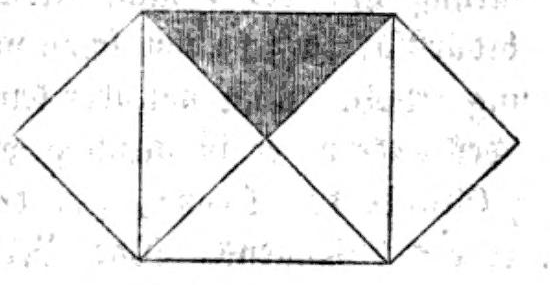
Auch bei ungleichen Katheten muß es sich zu einer solchen anschaulichen Ueberzeugung bringen lassen, wie überhaupt bei jeder möglichen geometrischen Wahrheit, schon deshalb, weil ihre Auffindung allemal von einer solchen angeschauten Nothwendigkeit ausging und der Beweis erst hinterher hinzu ersonnen ward: man bedarf also nur einer Analyse des Gedankenganges bei der ersten Auffindung einer geometrischen Wahrheit, um ihre Nothwendigkeit anschaulich zu erkennen. Es ist überhaupt die analytische Methode, welche ich für den Vortrag der Mathematik wünsche, statt der synthetischen, welche Eukleides gebraucht hat. Allerdings aber wird dies, bei komplicirten mathematischen Wahrheiten, sehr große, jedoch nicht unüberwindliche Schwierigkeiten haben. Schon fängt man in Deutschland hin und wieder an, den Vortrag der Mathematik zu ändern und mehr diesen analytischen Weg zu gehen. Am entschiedensten hat dies Herr Kosack, Lehrer der Mathematik und Physik am Gymnasio zu Nordhausen, gethan, indem er dem Programm zur Schulprüfung am 6. April 1852 einen ausführlichen Versuch, die Geometrie nach meinen Grundsätzen zu behandeln, beigegeben hat.
Um die Methode der Mathematik zu verbessern, wird vorzüglich erfordert, daß man das Vorurtheil aufgebe, die bewiesene Wahrheit habe irgend einen Vorzug vor der anschaulich erkannten, oder die logische, auf dem Satz vom Widerspruch beruhende, vor der metaphysischen, welche unmittelbar evident ist und zu der auch die reine Anschauung des Raumes gehört.
Das Gewisseste und überall Unerklärbare ist der Inhalt des Satzes vom Grunde. Denn dieser, in seinen verschiedenen Gestalten, bezeichnet die allgemeine Form aller unserer Vorstellungen und Erkenntnisse. Alle Erklärung ist Zurückführung auf ihn, Nachweisung im einzelnen Fall des durch ihn überhaupt ausgedrückten Zusammenhangs der Vorstellungen. Er ist sonach das Princip aller Erklärung und daher nicht selbst einer Erklärung fähig, noch ihrer bedürftig, da jede ihn schon voraussetzt und nur durch ihn Bedeutung erhält. Nun hat aber keine seiner Gestalten einen Vorzug vor der andern: er ist gleich gewiß und unbeweisbar als Satz vom Grunde des Seyns, oder des Werdens, oder des Handelns, oder des Erkennens. Das Verhältniß des Grundes zur Folge ist, in der einen wie in der andern seiner Gestalten, ein nothwendiges, ja es ist überhaupt der Ursprung, wie die alleinige Bedeutung, des Begriffs der Nothwendigkeit. Es giebt keine andere Nothwendigkeit, als die der Folge, wenn der Grund gegeben ist, und es giebt keinen Grund, der nicht Nothwendigkeit der Folge herbeiführte. So sicher also aus dem in den Prämissen gegebenen Erkenntnißgrunde die im Schlußsatze ausgesprochene Folge fließt, so sicher bedingt der Seynsgrund im Raum seine Folge im Raum: habe ich das Verhältniß dieser beiden anschaulich erkannt, so ist diese Gewißheit ebenso groß, wie irgend eine logische. Ausdruck eines solchen Verhältnisses ist aber jeder geometrische Lehrsatz, ebenso gut, wie eines der zwölf Axiome: er ist eine metaphysische Wahrheit und als solche ebenso unmittelbar gewiß, wie der Satz vom Widerspruche selbst, der eine metalogische Wahrheit und die allgemeine Grundlage aller logischen Beweisführung ist. Wer die anschaulich dargelegte Nothwendigkeit der in irgend einem Lehrsatze ausgesprochenen räumlichen Verhältnisse leugnet, kann mit gleichem Recht die Axiome leugnen, und mit gleichem Recht die Folge des Schlusses aus den Prämissen, ja den Satz vom Widerspruch selbst: denn alles Dieses sind gleich unbeweisbare, unmittelbar evidente und a priori erkennbare Verhältnisse. Wenn man daher die anschaulich erkennbare Nothwendigkeit räumlicher Verhältnisse erst durch eine logische Beweisführung aus dem Satze vom Widerspruch ableiten will; so ist es nicht anders, als wenn dem unmittelbaren Herrn eines Landes ein andrer dasselbe erst zu Lehn ertheilen wollte. Dies aber ist es, was Euklides gethan hat. Bloß seine Axiome läßt er nothgedrungen auf unmittelbarer Evidenz beruhen: alle folgenden geometrischen Wahrheiten werden logisch bewiesen, nämlich, unter Voraussetzung jener Axiome, aus der Uebereinstimmung mit den im Lehrsatz gemachten Annahmen, oder mit einem frühern Lehrsatz, oder auch aus dem Widerspruch des Gegentheils des Lehrsatzes mit den Annahmen, den Axiomen, den frühern Lehrsätzen, oder gar sich selbst. Aber die Axiome selbst haben nicht mehr unmittelbare Evidenz, als jeder andere geometrische Lehrsatz, sondern nur mehr Einfachheit durch geringeren Gehalt.
Wenn man einen Delinquenten vernimmt, so nimmt man seine Aussagen zu Protokoll, um aus ihrer Uebereinstimmung ihre Wahrheit zu beurtheilen. Dies ist aber ein bloßer Nothbehelf, bei dem man es nicht bewenden läßt, wenn man unmittelbar die Wahrheit jeder seiner Aussagen für sich erforschen kann; zumal da er von Anfang an konsequent lügen konnte. Jene erste Methode ist es jedoch, nach der Euklides den Raum erforschte. Zwar gieng er dabei von der richtigen Voraussetzung aus, daß die Natur überall, also auch in ihrer Grundform, dem Raum, konsequent seyn muß und daher, weil die Theile des Raumes im Verhältniß von Grund und Folge zu einander stehn, keine einzige räumliche Bestimmung anders seyn kann, als sie ist, ohne mit allen andern im Widerspruch zu stehen. Aber dies ist ein sehr beschwerlicher und unbefriedigender Umweg, der die mittelbare Erkenntniß der ebenso gewissen unmittelbaren vorzieht, der ferner die Erkenntniß, daß etwas ist, von der, warum es ist, zum großen Nachtheil der Wissenschaft trennt, und endlich dem Lehrling die Einsicht in die Gesetze des Raumes gänzlich vorenthält, ja, ihn entwöhnt vom eigentlichen Erforschen des Grundes und des innern Zusammenhanges der Dinge, ihn statt dessen anleitend, sich an einem historischen Wissen, daß es so sei, genügen zu lassen. Die dieser Methode so unablässig nachgerühmte Uebung des Scharfsinns besteht aber bloß darin, daß sich der Schüler im Schließen, d. h. im Anwenden des Satzes vom Widerspruch, übt, besonders aber sein Gedächtniß anstrengt, um alle jene Data, deren Uebereinstimmung zu vergleichen ist, zu behalten.
Es ist übrigens bemerkenswerth, daß diese Beweismethode bloß auf die Geometrie angewandt worden und nicht auf die Arithmetik: vielmehr läßt man in dieser die Wahrheit wirklich allein durch Anschauung einleuchten, welche hier im bloßen Zählen besteht. Da die Anschauung der Zahlen in der Zeit allein ist und daher durch kein sinnliches Schema, wie die geometrische Figur, repräsentirt werden kann; so fiel hier der Verdacht weg, daß die Anschauung nur empirisch und daher dem Schein unterworfen wäre, welcher Verdacht allein die logische Beweisart hat in die Geometrie bringen können. Zählen ist, weil die Zeit nur eine Dimension hat, die einzige arithmetische Operation, auf die alle andern zurückzuführen sind: und dies Zählen ist doch nichts Anderes, als Anschauung a priori, auf welche sich zu berufen man hier keinen Anstand nimmt, und durch welche allein das Uebrige, jede Rechnung, jede Gleichung, zuletzt bewährt wird. Man beweist z. B. nicht, daß
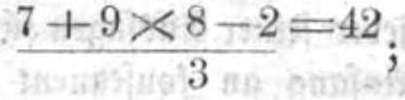
sondern man beruft sich auf die reine Anschauung in der Zeit, das Zählen, macht also jeden einzelnen Satz zum Axiom. Statt der Beweise, welche die Geometrie füllen, ist daher der ganze Inhalt der Arithmetik und Algebra eine bloße Methode zum Abkürzen des Zählens. Unsere unmittelbare Anschauung der Zahlen in der Zeit reicht zwar, wie oben erwähnt, nicht weiter, als etwa bis Zehn: darüber hinaus muß schon ein abstrakter Begriff der Zahl, durch ein Wort fixirt, die Stelle der Anschauung vertreten, welche daher nicht mehr wirklich vollzogen, sondern nur ganz bestimmt bezeichnet wird. Jedoch ist selbst so, durch das wichtige Hülfsmittel der Zahlenordnung, welche größere Zahlen immer durch die selben kleinen repräsentiren läßt, eine anschauliche Evidenz jeder Rechnung möglich gemacht, sogar da, wo man die Abstraktion so sehr zu Hülfe nimmt, daß nicht nur die Zahlen, sondern unbestimmte Größen und ganze Operationen nur in abstracto gedacht und in dieser Hinsicht bezeichnet werden, wie
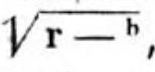
so daß man sie nicht mehr vollzieht, sondern nur andeutet.
Mit demselben Recht und derselben Sicherheit, wie in der Arithmetik, könnte man auch in der Geometrie die Wahrheit allein durch reine Anschauung a priori begründet seyn lassen. In der That ist es auch immer diese, gemäß dem Satz vom Grunde des Seyns anschaulich erkannte Nothwendigkeit, welche der Geometrie ihre große Evidenz ertheilt und auf der im Bewußtseyn eines Jeden die Gewißheit ihrer Sätze beruht: keineswegs ist es der auf Stelzen einherschreitende logische Beweis, welcher, der Sache immer fremd, meistens bald vergessen wird, ohne Nachtheil der Ueberzeugung, und ganz wegfallen könnte, ohne daß die Evidenz der Geometrie dadurch vermindert würde, da sie ganz unabhängig von ihm ist und er immer nur Das beweist, wovon man schon vorher, durch eine andere Erkenntnißart, völlige Ueberzeugung hat: insofern gleicht er einem feigen Soldaten, der dem von andern erschlagenen Feinde noch eine Wunde versetzt, und sich dann rühmt, ihn erlegt zu haben43.
Diesem allen zufolge wird es hoffentlich keinem Zweifel weiter unterliegen, daß die Evidenz der Mathematik, welche zum Musterbild und Symbol aller Evidenz geworden ist, ihrem Wesen nach nicht auf Beweisen, sondern auf unmittelbarer Anschauung beruht, welche also hier, wie überall, der letzte Grund und die Quelle aller Wahrheit ist. Jedoch hat die Anschauung, welche der Mathematik zum Grunde liegt, einen großen Vorzug vor jeder andern, also vor der empirischen. Nämlich, da sie a priori ist, mithin unabhängig von der Erfahrung, die immer nur theilweise und successiv gegeben wird; liegt ihr Alles gleich nahe, und man kann beliebig vom Grunde, oder von der Folge ausgehen. Dies nun giebt ihr eine völlige Untrüglichkeit dadurch, daß in ihr die Folge aus dem Grunde erkannt wird, welche Erkenntniß allein Nothwendigkeit hat: z. B. die Gleichheit der Seiten wird erkannt [44] Spinoza, der sich immer rühmt, more geometrico zu verfahren, hat dies wirklich noch mehr gethan, als er selbst wußte. Denn was ihm, aus einer unmittelbaren, anschaulichen Auffassung des Wesens der Welt, gewiß und ausgemacht war, sucht er unabhängig von jener Erkenntniß logisch zu demonstriren. Das beabsichtigte und bei ihm vorher gewisse Resultat erlangt er aber freilich nur dadurch, daß er willkürlich selbstgemachte Begriffe (substantia, causa sui u. s. w.) zum Ausgangspunkt nimmt und im Beweisen alle jene Willkürlichkeiten sich erlaubt, zu denen das Wesen der weiten Begriffssphären bequeme Gelegenheit giebt. Das Wahre und Vortrefflichste seiner Lehre ist daher bei ihm auch ganz unabhängig von den Beweisen, eben wie in der Geometrie.
Hiezu Kap. 13 des zweiten Bandes. als begründet durch die Gleichheit der Winkel; da hingegen alle empirische Anschauung und der größte Theil aller Erfahrung nur umgekehrt von der Folge zum Grunde geht, welche Erkenntnißart nicht unfehlbar ist, da Nothwendigkeit allein der Folge zukommt, sofern der Grund gegeben ist, nicht aber der Erkenntniß des Grundes aus der Folge, da dieselbe Folge aus verschiedenen Gründen entspringen kann. Diese letztere Art der Erkenntniß ist immer nur Induktion: d. h. aus vielen Folgen, die auf einen Grund deuten, wird der Grund als gewiß angenommen; da die Fälle aber nie vollständig beisammen seyn können, so ist die Wahrheit hier auch nie unbedingt gewiß. Diese Art von Wahrheit allein aber hat alle Erkenntniß durch sinnliche Anschauung und die allermeiste Erfahrung. Die Affektion eines Sinnes veranlaßt einen Verstandesschluß von der Wirkung auf die Ursache: weil aber vom Begründeten auf den Grund der Schluß nie sicher ist, so ist der falsche Schein, als Sinnentrug, möglich und oft wirklich, wie oben ausgeführt. Erst wenn mehrere oder alle fünf Sinne Affektionen erhalten, welche auf die selbe Ursache deuten, ist die Möglichkeit des Scheines äußerst klein geworden, dennoch aber vorhanden: denn in gewissen Fällen, z. B. durch falsche Münze, täuscht man die gesammte Sinnlichkeit. Im selben Fall ist alle empirische Erkenntniß, folglich die ganze Naturwissenschaft, ihren reinen (nach Kant metaphysischen) Theil bei Seite gesetzt. Auch hier werden aus den Wirkungen die Ursachen erkannt: daher beruht alle Naturlehre auf Hypothesen, die oft falsch sind und dann allmälig richtigeren Platz machen. Bloß bei den absichtlich angestellten Experimenten geht die Erkenntniß von der Ursach auf die Wirkung, also den sichern Weg: aber sie selbst werden erst in Folge von Hypothesen unternommen. Deshalb konnte kein Zweig der Naturwissenschaft, z. B. Physik, oder Astronomie, oder Physiologie, mit einem Male gefunden werden, wie Mathematik oder Logik es konnten; sondern es bedurfte und bedarf der gesammelten und verglichenen Erfahrungen vieler Jahrhunderte. Erst vielfache empirische Bestätigung bringt die Induktion, auf der die Hypothese beruht, der Vollständigkeit so nahe, daß sie für die Praxis die Stelle der Gewißheit einnimmt und der Hypothese ihr Ursprung so wenig nachtheilig erachtet wird, wie der Anwendung der Geometrie die Inkommensurabilität gerader und krummer Linien, oder der Arithmetik die nicht zu erlangende vollkommene Richtigkeit des Logarithmus: denn wie man die Quadratur des Cirkels und den Logarithmus durch unendliche Brüche der Richtigkeit unendlich nahe bringt, so wird auch durch vielfache Erfahrung die Induktion, d. h. die Erkenntniß des Grundes aus den Folgen, der mathematischen Evidenz, d. h. der Erkenntniß der Folge aus dem Grunde, zwar nicht unendlich, aber doch so nahe gebracht, daß die Möglichkeit der Täuschung gering genug wird, um vernachlässigt werden zu können. Vorhanden aber ist sie doch: z. B. ein Induktionsschluß ist auch der, von unzähligen Fällen auf alle, d. h. eigentlich auf den unbekannten Grund, von welchem alle abhängen. Welcher Schluß dieser Art scheint nun sicherer, als der, daß alle Menschen das Herz auf der linken Seite haben? Dennoch giebt es, als höchst seltene, völlig vereinzelte Ausnahmen, Menschen, denen das Herz auf der rechten Seite sitzt. — Sinnliche Anschauung und Erfahrungswissenschaft haben also die selbe Art der Evidenz. Der Vorzug, den Mathematik, reine Naturwissenschaft und Logik als Erkenntnisse a priori vor ihnen haben, beruht bloß darauf, daß das Formelle der Erkenntnisse, auf welches alle Apriorität sich gründet, ganz und zugleich gegeben ist und daher hier immer vom Grunde auf die Folge gegangen werden kann, dort aber meistens nur von der Folge auf den Grund. An sich ist übrigens das Gesetz der Kausalität, oder der Satz vom Grunde des Werdens, welcher die empirische Erkenntniß leitet, ebenso sicher, wie jene andern Gestaltungen des Satzes vom Grunde, denen obige Wissenschaften a priori folgen. — Logische Beweise aus Begriffen, oder Schlüsse, haben ebenso wohl, wie die Erkenntniß durch Anschauung a priori, den Vorzug, vom Grund auf die Folge zu gehen, wodurch sie an sich, d. h. ihrer Form nach, unfehlbar sind. Dies hat viel beigetragen, die Beweise überhaupt in so großes Ansehen zu bringen. Allein diese Unfehlbarkeit derselben ist eine relative: sie subsumiren bloß unter die oberen Sätze der Wissenschaft: diese aber sind es, welche den ganzen Fonds von Wahrheit der Wissenschaft enthalten, und sie dürfen nicht wieder bloß bewiesen seyn, sondern müssen sich auf Anschauung gründen, welche in jenen genannten wenigen Wissenschaften a priori eine reine, sonst aber immer empirisch und nur durch Induktion zum Allgemeinen erhoben ist. Wenn also auch bei Erfahrungswissenschaften das Einzelne aus dem Allgemeinen bewiesen wird, so hat doch wieder das Allgemeine seine Wahrheit nur vom Einzelnen erhalten, ist nur ein Speicher gesammelter Vorräthe, kein selbsterzeugender Boden.
Soviel von der Begründung der Wahrheit. — Ueber den Ursprung und die Möglichkeit des Irrthums sind seit Platons bildlichen Auflösungen darüber, vom Taubenschlage, wo man die unrechte Taube greift u. s. w. (Theaetet., S. 167 u. ff.), viele Erklärungen versucht worden. Kants vage, unbestimmte Erklärung vom Ursprung des Irrthums, mittelst des Bildes der Diagonalbewegung, findet man in der Kritik d. rein. Vern., S. 294 der ersten u. S. 350 der fünften Ausgabe. — Da die Wahrheit die Beziehung eines Urtheils auf seinen Erkenntnißgrund ist, so ist es allerdings ein Problem, wie der Urtheilende einen solchen Grund zu haben wirklich glauben kann und doch keinen hat, d. h. wie der Irrthum, der Trug der Vernunft, möglich ist. Ich finde diese Möglichkeit ganz analog der des Scheines, oder Truges des Verstandes, die oben erklärt worden. Meine Meinung nämlich ist (und das giebt dieser Erklärung gerade hier ihre Stelle), daß jeder Irrthum ein Schluß von der Folge auf den Grund ist, welcher zwar gilt, wo man weiß, daß die Folge jenen und durchaus keinen andern Grund haben kann; außerdem aber nicht. Der Irrende setzt entweder der Folge einen Grund, den sie gar nicht haben kann; worin er dann wirklichen Mangel an Verstand, d. h. an der Fähigkeit unmittelbarer Erkenntniß der Verbindung zwischen Ursach und Wirkung, zeigt: oder aber, was häufiger der Fall ist, er bestimmt der Folge einen zwar möglichen Grund, setzt jedoch zum Obersatz seines Schlusses von der Folge auf den Grund noch hinzu, daß die besagte Folge allemal nur aus dem von ihm angegebenen Grunde entstehe, wozu ihn nur eine vollständige Induktion berechtigen könnte, die er aber voraussetzt, ohne sie gemacht zu haben: jenes allemal ist also ein zu weiter Begriff, statt dessen nur stehen dürfte bisweilen, oder meistens; wodurch der Schlußsatz problematisch ausfiele und als solcher nicht irrig wäre. Daß der Irrende aber auf die angegebene Weise verfährt, ist entweder Uebereilung, oder zu beschränkte Kenntniß von der Möglichkeit, weshalb er die Nothwendigkeit der zu machenden Induktion nicht weiß. Der Irrthum ist also dem Schein ganz analog. Beide sind Schlüsse von der Folge auf den Grund: der Schein stets nach dem Gesetze der Kausalität und vom bloßen Verstande, also unmittelbar in der Anschauung selbst, vollzogen; der Irrthum, nach allen Formen des Satzes vom Grunde, von der Vernunft, also im eigentlichen Denken, vollzogen, am häufigsten jedoch ebenfalls nach dem Gesetze der Kausalität, wie folgende drei Beispiele belegen, die man als Typen oder Repräsentanten dreier Arten von Irrthümern ansehen mag. 1) Der Sinnenschein, (Trug des Verstandes) veranlaßt Irrthum (Trug der Vernunft), z. B. wenn man eine Malerei für ein Haut-Relief ansieht und wirklich dafür hält; es geschieht durch einen Schluß aus folgendem Obersatz: „Wenn Dunkelgrau stellenweise durch alle Nüancen in Weiß übergeht; so ist allemal die Ursache das Licht, welches Erhabenheiten und Vertiefungen ungleich trifft: ergo —.“ 2) „Wenn Geld in meiner Kasse fehlt; so ist die Ursache allemal, daß mein Bedienter einen Nachschlüssel hat: ergo —.“ 3) „Wenn das durch das Prisma gebrochene, d. i. herauf oder herab gerückte Sonnenbild, statt vorher rund und weiß, jetzt länglich und gefärbt erscheint; so ist die Ursache einmal und allemal, daß im Licht verschieden-gefärbte und zugleich verschieden-brechbare homogene Lichtstrahlen gesteckt haben, die, durch ihre verschiedene Brechbarkeit auseinandergerückt, jetzt ein längliches und zugleich verschiedenfarbiges Bild zeigen: ergo — bibamus!“ — Auf einen solchen Schluß aus einem, oft nur fälschlich generalisirten, hypothetischen, aus der Annahme eines Grundes zur Folge entsprungenen Obersatz muß jeder Irrthum zurückzuführen seyn; nur nicht etwan Rechnungsfehler, welche eben nicht eigentlich Irrthümer sind, sondern bloße Fehler: die Operation, welche die Begriffe der Zahlen angaben, ist nicht in der reinen Anschauung, dem Zählen, vollzogen worden; sondern eine andere statt ihrer.
Was den Inhalt der Wissenschaften überhaupt betrifft, so ist dieser eigentlich immer das Verhältniß der Erscheinungen der Welt zu einander, gemäß dem Satz vom Grunde und am Leitfaden des durch ihn allein geltenden und bedeutenden Warum. Die Nachweisung jenes Verhältnisses heißt Erklärung. Diese kann also nie weiter gehen, als daß sie zwei Vorstellungen zu einander in dem Verhältnisse der in der Klasse, zu der sie gehören, herrschenden Gestaltung des Satzes vom Grunde zeigt. Ist sie dahin gelangt, so kann gar nicht weiter Warum gefragt werden: denn das nachgewiesene Verhältniß ist dasjenige, welches schlechterdings nicht anders vorgestellt werden kann, d. h. es ist die Form aller Erkenntniß. Daher frägt man nicht warum 2 + 2 = 4 ist; oder warum Gleichheit der Winkel im Dreieck, Gleichheit der Seiten bestimmt; oder warum auf irgend eine gegebene Ursache ihre Wirkung folgt; oder warum aus der Wahrheit der Prämissen, die der Konklusion einleuchtet. Jede Erklärung, die nicht auf ein Verhältniß, davon weiter kein Warum gefordert werden kann, zurückführt, bleibt bei einer angenommenen qualitas occulta stehen: dieser Art ist aber auch jede ursprüngliche Naturkraft. Bei einer solchen muß jede naturwissenschaftliche Erklärung zuletzt stehen bleiben, also bei einem völlig Dunkelen: sie muß daher das innere Wesen eines Steines ebenso unerklärt lassen, wie das eines Menschen; kann so wenig von der Schwere, Kohäsion, chemischen Eigenschaften u. s. w., die Jener äußert, als vom Erkennen und Handeln Dieses Rechenschaft geben. So z. B. ist die Schwere eine qualitas occulta: denn sie läßt sich wegdenken, geht also nicht aus der Form des Erkennens als ein Nothwendiges hervor: dies hingegen ist der Fall mit dem Gesetze der Trägheit, als welches aus dem der Kausalität folgt; daher eine Zurückführung auf dasselbe eine vollkommen genügende Erklärung ist. Zwei Dinge nämlich sind schlechthin unerklärlich, d. h. nicht auf das Verhältniß, welches der Satz vom Grunde ausspricht, zurückzuführen: erstlich, der Satz vom Grunde selbst, in allen seinen vier Gestalten, weil er das Princip aller Erklärung ist, dasjenige, in Beziehung worauf sie allein Bedeutung hat; und zweitens, Das, was nicht von ihm erreicht wird, woraus aber eben das Ursprüngliche in allen Erscheinungen hervorgeht: es ist das Ding an sich, dessen Erkenntniß gar nicht die dem Satz vom Grunde unterworfene ist. Dieses Letztere muß hier nun ganz unverstanden stehen bleiben, da es erst durch das folgende Buch, in welchem wir auch diese Betrachtung der möglichen Leistungen der Wissenschaften wieder aufnehmen werden, verständlich werden kann. Aber da, wo die Naturwissenschaft, ja jede Wissenschaft, die Dinge stehen läßt, indem nicht nur ihre Erklärung derselben, sondern sogar das Princip dieser Erklärung, der Satz vom Grund, nicht über diesen Punkt hinausführt; da nimmt eigentlich die Philosophie die Dinge wieder auf und betrachtet sie nach ihrer, von jener ganz verschiedenen Weise. — In der Abhandlung über den Satz vom Grunde, §. 51, habe ich gezeigt, wie, in den verschiedenen Wissenschaften, die eine oder die andere Gestaltung jenes Satzes Hauptleitfaden ist: in der That möchte hienach sich vielleicht die treffendeste Eintheilung der Wissenschaften machen lassen. Jede nach jenem Leitfaden gegebene Erklärung ist aber, wie gesagt, immer nur relativ: sie erklärt die Dinge in Beziehung auf einander, läßt aber immer Etwas unerklärt, welches sie eben schon voraussetzt: Dieses ist z. B. in der Mathematik Raum und Zeit; in der Mechanik, Physik und Chemie die Materie, die Qualitäten, die ursprünglichen Kräfte, die Naturgesetze; in der Botanik und Zoologie die Verschiedenheit der Species und das Leben selbst; in der Geschichte das Menschengeschlecht, mit allen seinen Eigenthümlichkeiten des Denkens und Wollens; — in allen der Satz vom Grund in seiner jedesmal anzuwendenden Gestaltung. — Die Philosophie hat das Eigene, daß sie gar nichts als bekannt voraussetzt, sondern Alles ihr in gleichem Maaße fremd und ein Problem ist, nicht nur die Verhältnisse der Erscheinungen, sondern auch diese selbst, ja der Satz vom Grunde selbst, auf welchen Alles zurückzuführen die anderen Wissenschaften zufrieden sind, durch welche Zurückführung bei ihr aber nichts gewonnen wäre, da ein Glied der Reihe ihr so fremd ist, wie das andere, ferner auch jene Art des Zusammenhangs selbst ihr ebenso gut ein Problem ist, als das durch ihn Verknüpfte, und dieses wieder nach aufgezeigter Verknüpfung, so gut als vor derselben. Denn, wie gesagt, eben Jenes, was die Wissenschaften voraussetzen und ihren Erklärungen zum Grunde legen und zur Gränze setzen, ist gerade das eigentliche Problem der Philosophie, die folglich insofern da anfängt, wo die Wissenschaften aufhören. Beweise können nicht ihr Fundament seyn: denn diese leiten aus bekannten Sätzen unbekannte ab: aber ihr ist Alles gleich unbekannt und fremd. Es kann keinen Satz geben, in Folge dessen allererst die Welt mit allen ihren Erscheinungen da wäre: daher läßt sich nicht eine Philosophie, wie Spinoza wollte, ex firmis principiis demonstrirend ableiten. Auch ist die Philosophie das allgemeinste Wissen, dessen Hauptsätze also nicht Folgerungen aus einem andern, noch allgemeineren, seyn können. Der Satz vom Widerspruch setzt bloß die Uebereinstimmung der Begriffe fest; giebt aber nicht selbst Begriffe. Der Satz vom Grund erklärt Verbindungen der Erscheinungen, nicht diese selbst: daher kann Philosophie nicht darauf ausgehen, eine causa efficiens oder eine causa finalis der ganzen Welt zu suchen. Die gegenwärtige wenigstens sucht keineswegs, woher oder wozu die Welt dasei; sondern bloß, was die Welt ist. Das Warum aber ist hier dem Was untergeordnet: denn es gehört schon zur Welt, da es allein durch die Form ihrer Erscheinung, den Satz vom Grund, entsteht und nur insofern Bedeutung und Gültigkeit hat. Zwar könnte man sagen, daß Was die Welt sei, ein Jeder ohne weitere Hülfe erkenne; da er das Subjekt des Erkennens, dessen Vorstellung sie ist, selbst ist: auch wäre dies insoweit wahr. Allein jene Erkenntniß ist eine anschauliche, ist in concreto: dieselbe in abstracto wiederzugeben, das successive, wandelbare Anschauen und überhaupt alles Das, was der weite Begriff Gefühl umfaßt und bloß negativ, als nicht abstraktes, deutliches Wissen bezeichnet, eben zu einem solchen, zu einem bleibenden Wissen zu erheben, ist die Aufgabe der Philosophie. Sie muß demnach eine Aussage in abstracto vom Wesen der gesammten Welt seyn, vom Ganzen wie von allen Theilen. Um aber dennoch nicht in eine endlose Menge von einzelnen Urtheilen sich zu verlieren, muß sie sich der Abstraktion bedienen und alles Einzelne im Allgemeinen denken, seine Verschiedenheiten aber auch wieder im Allgemeinen: daher wird sie theils trennen, theils vereinigen, um alles Mannigfaltige der Welt überhaupt, seinem Wesen nach, in wenige abstrakte Begriffe zusammengefaßt, dem Wissen zu überliefern. Durch jene Begriffe, in welchen sie das Wesen der Welt fixirt, muß jedoch, wie das Allgemeine, auch das ganz Einzelne erkannt werden, die Erkenntniß beider also auf das Genaueste verbunden seyn: daher die Fähigkeit zur Philosophie eben darin besteht, worin Plato sie setzte, im Erkennen des Einen im Vielen und des Vielen im Einen. Die Philosophie wird demnach eine Summe sehr allgemeiner Urtheile seyn, deren Erkenntnißgrund unmittelbar die Welt selbst in ihrer Gesammtheit ist, ohne irgend etwas auszuschließen: also Alles, was im menschlichen Bewußtseyn sich vorfindet: sie wird seyn eine vollständige Wiederholung, gleichsam Abspiegelung der Welt in abstrakten Begriffen, welche allein möglich ist durch Vereinigung des wesentlich Identischen in einen Begriff und Aussonderung des Verschiedenen zu einem andern. Diese Aufgabe setzte schon Bako von Verulam der Philosophie, indem er sagte: ea demum vera est philosophia, quae mundi ipsius voces fidelissime reddit, et veluti dictante mundo conscripta est, et nihil aliud est, quam ejusdem simulacrum et reflectio, neque addit quidquam de proprio, sed tantum iterat et resonat. (de augm. scient., L. 2, c. 13). Wir nehmen jedoch dieses in einem ausgedehnteren Sinn, als Bako damals denken konnte.
Die Uebereinstimmung, welche alle Seiten und Theile der Welt, eben weil sie zu einem Ganzen gehören, mit einander haben, muß auch in jenem abstrakten Abbilde der Welt sich wiederfinden. Demnach könnte in jener Summe von Urtheilen das eine aus dem andern gewissermaaßen abgeleitet werden und zwar immer wechselseitig. Doch müssen sie hiezu für’s Erste daseyn und also zuvor, als unmittelbar durch die Erkenntniß der Welt in concreto begründet, aufgestellt werden, um so mehr, als alle unmittelbare Begründung sicherer ist, als die mittelbare: ihre Harmonie zu einander, vermöge welcher sie sogar zur Einheit eines Gedankens zusammenfließen, und welche entspringt aus der Harmonie und Einheit der anschaulichen Welt selbst, die ihr gemeinsamer Erkenntnißgrund ist, wird daher nicht als das Erste zu ihrer Begründung gebraucht werden; sondern nur noch als Bekräftigung ihrer Wahrheit hinzukommen. — Diese Aufgabe selbst kann erst durch ihre Auflösung vollkommen deutlich werden [45].
16 Nach dieser ganzen Betrachtung der Vernunft, als einer dem Menschen allein eigenen, besonderen Erkenntnißkraft, und der durch sie herbeigeführten, der menschlichen Natur eigenthümlichen Leistungen und Phänomene, bliebe mir jetzt noch übrig von der [46] Hiezu Kap. 17 des zweiten Bandes.
Vernunft zu reden, sofern sie die Handlungen der Menschen leitet, also in dieser Rücksicht praktisch genannt werden kann. Allein das hier zu Erwähnende hat größtentheils seine Stelle an einem andern Orte gefunden, nämlich im Anhang zu dieser Schrift, wo das Daseyn der von Kant so genannten praktischen Vernunft zu bestreiten war, welche er (freilich sehr bequem) als unmittelbare Quelle aller Tugend und als den Sitz eines absoluten (d. h. vom Himmel gefallenen) Soll darstellt. Die ausführliche und gründliche Widerlegung dieses Kantischen Princips der Moral habe ich später geliefert, in den „Grundproblemen der Ethik“. — Ich habe deshalb hier nur noch Weniges über den wirklichen Einfluß der Vernunft, im wahren Sinne dieses Worts, auf das Handeln zu sagen. Schon am Eingang unserer Betrachtung der Vernunft haben wir im Allgemeinen bemerkt, wie sehr das Thun und der Wandel des Menschen von dem des Thieres sich unterscheidet, und daß dieser Unterschied doch allein als Folge der Anwesenheit abstrakter Begriffe im Bewußtseyn anzusehen ist. Der Einfluß dieser auf unser ganzes Daseyn ist so durchgreifend und bedeutend, daß er uns zu den Thieren gewissermaaßen in das Verhältniß setzt, welches die sehenden Thiere zu den augenlosen (gewisse Larven, Würmer und Zoophyten) haben: letztere erkennen durch das Getast allein das ihnen im Raum unmittelbar Gegenwärtige, sie Berührende; die Sehenden dagegen einen weiten Kreis von Nahem und Fernem. Ebenso nun beschränkt die Abwesenheit der Vernunft die Thiere auf die ihnen in der Zeit unmittelbar gegenwärtigen anschaulichen Vorstellungen, d. i. realen Objekte: wir hingegen, vermöge der Erkenntniß in abstracto, umfassen, neben der engen wirklichen Gegenwart, noch die ganze Vergangenheit und Zukunft, nebst dem weiten Reiche der Möglichkeit: wir übersehen das Leben frei nach allen Seiten, weit hinaus über die Gegenwart und Wirklichkeit. Was also im Raum und für die sinnliche Erkenntniß das Auge ist, das ist gewissermaaßen in der Zeit und für die innere Erkenntniß die Vernunft. Wie aber die Sichtbarkeit der Gegenstände ihren Werth und Bedeutung doch nur dadurch hat, daß sie die Fühlbarkeit derselben verkündigt, so liegt der ganze Werth der abstrakten Erkenntniß immer in ihrer Beziehung auf die anschauliche. Daher auch legt der natürliche Mensch immer viel mehr Werth auf das unmittelbar und anschaulich Erkannte, als auf die abstrakten Begriffe, das bloß Gedachte: er zieht die empirische Erkenntniß der logischen vor. Umgekehrt aber sind diejenigen gesinnt, welche mehr in Worten, als Thaten leben, mehr in Papier und Bücher, als in die wirkliche Welt gesehen haben, und die in ihrer größten Ausartung zu Pedanten und Buchstabenmenschen werden. Daraus allein ist es begreiflich, wie Leibniz nebst Wolf und allen ihren Nachfolgern, so weit sich verirren konnten, nach dem Vorgange des Duns Skotus, die anschauliche Erkenntniß für eine nur verworrene abstrakte zu erklären! Zur Ehre Spinozas muß ich erwähnen, daß sein richtigerer Sinn umgekehrt alle Gemeinbegriffe für entstanden aus der Verwirrung des anschaulich Erkannten erklärt hat. (Eth. II, prop. 40, Schol. 1.) — Aus jener verkehrten Gesinnung ist es auch entsprungen, daß man in der Mathematik die ihr eigenthümliche Evidenz verwarf, um allein die logische gelten zu lassen; daß man überhaupt jede nicht abstrakte Erkenntniß unter dem weiten Namen Gefühl begriff und gering schätzte; daß endlich die Kantische Ethik den reinen, unmittelbar bei Erkenntniß der Umstände ansprechenden und zum Rechtthun und Wohlthun leitenden guten Willen als bloßes Gefühl und Aufwallung für werth- und verdienstlos erklärte, und nur dem aus abstrakten Maximen hervorgegangenen Handeln moralischen Werth zuerkennen wollte.
Die allseitige Uebersicht des Lebens im Ganzen, welche der Mensch durch die Vernunft vor dem Thiere voraus hat, ist auch zu vergleichen mit einem geometrischen, farblosen, abstrakten, verkleinerten Grundriß seines Lebensweges. Er verhält sich damit zum Thiere, wie der Schiffer, welcher mittelst Seekarte, Kompaß und Quadrant seine Fahrt und jedesmalige Stelle auf dem Meer genau weiß, zum unkundigen Schiffsvolk, das nur die Wellen und den Himmel sieht. Daher ist es betrachtungswerth, ja wunderbar, wie der Mensch, neben seinem Leben in concreto, immer noch ein zweites in abstracto führt. Im ersten ist er allen Stürmen der Wirklichkeit und dem Einfluß der Gegenwart Preis gegeben, muß streben, leiden, sterben, wie das Thier. Sein Leben in abstracto aber, wie es vor seinem vernünftigen Besinnen steht, ist die stille Abspiegelung des ersten und der Welt worin er lebt, ist jener eben erwähnte verkleinerte Grundriß. Hier im Gebiet der ruhigen Ueberlegung erscheint ihm kalt, farblos und für den Augenblick fremd, was ihn dort ganz besitzt und heftig bewegt: hier ist er bloßer Zuschauer und Beobachter. In diesem Zurückziehen in die Reflexion gleicht er einem Schauspieler, der seine Scene gespielt hat und bis er wieder auftreten muß, unter den Zuschauern seinen Platz nimmt, von wo aus er was immer auch vorgehen möge, und wäre es die Vorbereitung zu seinem Tode (im Stück), gelassen ansieht, darauf aber wieder hingeht und thut und leidet wie er muß. Aus diesem doppelten Leben geht jene von der thierischen Gedankenlosigkeit sich so sehr unterscheidende menschliche Gelassenheit hervor, mit welcher Einer, nach vorhergegangener Ueberlegung, gefaßtem Entschluß oder erkannter Nothwendigkeit, das für ihn Wichtigste, oft Schrecklichste kaltblütig über sich ergehen läßt, oder vollzieht: Selbstmord, Hinrichtung, Zweikampf, lebensgefährliche Wagstücke jeder Art und überhaupt Dinge, gegen welche seine ganze thierische Natur sich empört. Da sieht man dann, in welchem Maaße die Vernunft der thierischen Natur Herr wird, und ruft dem Starken zu: σιδηρειον νυ τοι ἦτορ! (ferreum certe tibi cor!) Il. 24, 521. Hier, kann man wirklich sagen, äußert sich die Vernunft praktisch: also überall, wo das Thun von der Vernunft geleitet wird, wo die Motive abstrakte Begriffe sind, wo nicht anschauliche, einzelne Vorstellungen, noch der Eindruck des Augenblicks, welcher das Thier leitet, das Bestimmende ist, da zeigt sich praktische Vernunft. Daß aber dieses gänzlich verschieden und unabhängig ist vom ethischen Werthe des Handelns, daß vernünftig Handeln und tugendhaft Handeln zwei ganz verschiedene Dinge sind, daß Vernunft sich ebenso wohl mit großer Bosheit, als mit großer Güte im Verein findet und der einen wie der andern durch ihren Beitritt erst große Wirksamkeit verleiht, daß sie zur methodischen, konsequenten Ausführung des edeln, wie des schlechten Vorsatzes, der klugen, wie der unverständigen Maxime, gleich bereit und dienstbar ist, welches eben ihre weibliche, empfangende und aufbewahrende, nicht selbst erzeugende Natur so mit sich bringt, — dieses Alles habe ich im Anhange ausführlich auseinandergesetzt, und durch Beispiele erläutert. Das dort Gesagte stände hier an seinem eigentlichen Platz, hat indessen, wegen der Polemik gegen Kants vorgebliche praktische Vernunft, dorthin verlegt werden müssen; wohin ich deshalb von hier wieder verweise.
Die vollkommenste Entwickelung der praktischen Vernunft, im wahren und ächten Sinne des Worts, der höchste Gipfel, zu dem der Mensch durch den bloßen Gebrauch seiner Vernunft gelangen kann, und auf welchem sein Unterschied vom Thiere sich am deutlichsten zeigt, ist als Ideal dargestellt im Stoischen Weisen. Denn die Stoische Ethik ist ursprünglich und wesentlich gar nicht Tugendlehre, sondern bloß Anweisung zum vernünftigen Leben, dessen Ziel und Zweck Glück durch Geistesruhe ist. Der tugendhafte Wandel findet sich dabei gleichsam nur per accidens, als Mittel, nicht als Zweck ein. Daher ist die Stoische Ethik, ihrem ganzen Wesen und Gesichtspunkt nach, grundverschieden von den unmittelbar auf Tugend dringenden ethischen Systemen, als da sind die Lehren der Veden, des Platon, des Christenthums und Kants. Der Zweck der Stoischen Ethik ist Glück: τελος το ευδαιμονειν (virtutes omnes finem habere beatitudinem) heißt es in der Darstellung der Stoa bei Stobäos. (Ecl., L. II, c. 7, p. 114, und ebenfalls p. 138.) Jedoch weist die Stoische Ethik nach, daß das Glück im innern Frieden und in der Ruhe des Geistes (αταραξια) allein sicher zu finden sei, und diese wieder allein durch Tugend zu erreichen: eben dieses nur bedeutet der Ausdruck, daß Tugend höchstes Gut sei. Wenn nun aber freilich allmälig der Zweck über das Mittel vergessen und die Tugend auf eine Weise empfohlen wird, die ein ganz anderes Interesse, als das des eigenen Glückes verräth, indem es diesem zu deutlich widerspricht; so ist dies eine von den Inkonsequenzen, durch welche in jedem System die unmittelbar erkannte, oder wie man sagt gefühlte Wahrheit auf den rechten Weg zurückleitet, den Schlüssen Gewalt anthuend; wie man dies z. B. deutlich sieht in der Ethik des Spinoza, welche aus dem egoistischen suum utile quaerere, durch handgreifliche Sophismen, reine Tugendlehre ableitet. Nach Dem, wie ich den Geist der Stoischen Ethik aufgefaßt habe, liegt ihr Ursprung in dem Gedanken, ob das große Vorrecht des Menschen, die Vernunft, welche ihm mittelbar, durch planmäßiges Handeln und was aus diesem hervorgeht, so sehr das Leben und dessen Lasten erleichtert, nicht auch fähig wäre, unmittelbar, d. h. durch bloße Erkenntniß, ihn den Leiden und Quaalen aller Art, welche sein Leben füllen, auf ein Mal zu entziehen, entweder ganz, oder doch beinahe ganz. Man hielt es dem Vorzug der Vernunft nicht angemessen, daß das mit ihr begabte Wesen, welches durch dieselbe eine Unendlichkeit von Dingen und Zuständen umfaßt und übersieht, dennoch durch die Gegenwart und durch die Vorfälle, welche die wenigen Jahre eines so kurzen, flüchtigen, ungewissen Lebens enthalten können, so heftigen Schmerzen, so großer Angst und Leiden, die aus dem ungestümen Drang des Begehrens und Fliehens hervorgehen, Preis gegeben seyn sollte, und meinte, die gehörige Anwendung der Vernunft müßte den Menschen darüber hinwegheben, ihn unverwundbar machen können. Daher sagte Antisthenes: Δει κτασθαι νουν, η βροχον (aut mentem parandam, aut laqueum. Plut. de stoic. repugn., c. 14), d. h. das Leben ist so voller Plagen und Hudeleien, daß man entweder, mittelst berichtigter Gedanken, sich darüber hinaussetzen, oder es verlassen muß. Man sah ein, daß die Entbehrung, das Leiden, nicht unmittelbar und nothwendig hervorging aus dem Nicht-haben; sondern erst aus dem Haben-wollen und doch nicht haben; daß also dieses Haben-wollen die nothwendige Bedingung ist, unter der allein das Nicht-haben zur Entbehrung wird, und den Schmerz erzeugt. Ου πενια λυπην εργαζεται, αλλα επιθυμια (non paupertas dolorem efficit, sed cupiditas), Epict. fragm. 25. Man erkannte zudem aus Erfahrung, daß bloß die Hoffnung, der Anspruch es ist, der den Wunsch gebiert und nährt; daher uns weder die vielen, Allen gemeinsamen und unvermeidlichen Uebel, noch die unerreichbaren Güter beunruhigen und plagen; sondern allein das unbedeutende Mehr und Weniger des dem Menschen Ausweichbaren und Erreichbaren; ja, daß nicht nur das absolut, sondern auch schon das relativ Unerreichbare, oder Unvermeidliche, uns ganz ruhig läßt; daher die Uebel, welche unserer Individualität einmal beigegeben sind, oder die Güter, welche ihr nothwendig versagt bleiben müssen, mit Gleichgültigkeit betrachtet werden, und daß, dieser menschlichen Eigenthümlichkeit zufolge, jeder Wunsch bald erstirbt, und also keinen Schmerz mehr erzeugen kann, wenn nur keine Hoffnung ihm Nahrung giebt. Aus diesem allen ergab sich, daß alles Glück nur auf dem Verhältniß beruht zwischen unseren Ansprüchen und dem, was wir erhalten: wie groß oder klein die beiden Größen dieses Verhältnisses sind, ist einerlei, und das Verhältniß kann sowohl durch Verkleinerung der ersten Größe, als durch Vergrößerung der zweiten hergestellt werden: und ebenso, daß alles Leiden eigentlich hervorgeht aus dem Misverhältniß dessen, was wir fordern und erwarten, mit dem, was uns wird, welches Misverhältniß aber offenbar nur in der Erkenntniß liegt [47], und durch bessere Einsicht völlig gehoben werden könnte. Daher sagte Chrysippos: δει ζην κατ' εμπειριαν των φυσει συμβαινοντων (Stob. Ecl., L. II, c. 7, p. 134), d. h. man soll leben mit gehöriger Kenntniß des Hergangs der Dinge in der Welt. Denn so oft ein Mensch irgendwie aus der Fassung kommt, durch ein Unglück zu Boden geschlagen wird, oder sich erzürnt, oder verzagt; so zeigt er eben dadurch, daß er die Dinge anders findet, als er sie erwartete, folglich daß er im Irrthum befangen war, die Welt und das Leben nicht kannte, nicht wußte, wie durch Zufall die leblose Natur, durch entgegengesetzte Zwecke, auch durch Bosheit, die belebte den Willen des Einzelnen bei jedem Schritte durchkreuzt: er hat also entweder seine Vernunft nicht gebraucht, um zu einem allgemeinen Wissen dieser Beschaffenheit des Lebens zu kommen, oder auch es fehlt ihm an Urtheilskraft, wenn, was er im Allgemeinen weiß, er doch im Einzelnen nicht wiedererkennt und deshalb davon überrascht und aus der Fassung gebracht wird [48]. So auch ist jede lebhafte Freude ein Irrthum, ein Wahn, weil kein erreichter Wunsch dauernd befriedigen kann, auch weil jeder Besitz und jedes Glück nur vom Zufall auf unbestimmte Zeit geliehen ist, und daher in der nächsten Stunde wieder zurückgefordert werden kann. Jeder Schmerz aber beruht auf dem Verschwinden eines solchen Wahns: beide also entstehen [49] Omnes perturbationes judicio censent fieri et opinione. Cic. Tusc., 4, 6. Ταρασσει τους ανθρωπους ου τα πραγματα, αλλα τα περι των πραγματων δογματα. (Perturbant homines non res ipsae, sed de rebus opiniones.) Epictet., c. V.
50 Τουτο γαρ εστι το αιτιον τοις ανθρωποις παντων των κακων, το τας προληψεις τας κοινας μη δυνασθαι εφαρμοζειν ταις επι μερους. (Haec est causa mortalibus omnium malorum, non posse communes notiones aptare singularibus.) Epict. dissert., III, 26. aus fehlerhafter Erkenntniß: dem Weisen bleibt daher Jubel wie Schmerz immer fern, und keine Begebenheit stört seine αταραξια.
Diesem Geist und Zweck der Stoa gemäß, fängt Epiktet damit an und kommt beständig darauf zurück, als auf den Kern seiner Weisheit, daß man wohl bedenken und unterscheiden solle, was von uns abhängt und was nicht, daher auf Letzteres durchaus nicht Rechnung machen; wodurch man zuverlässig frei bleiben wird vom allem Schmerz, Leiden und Angst. Was nun aber von uns abhängt, ist allein der Wille: und hier geschieht nun ein allmäliger Uebergang zur Tugendlehre, indem bemerkt wird, daß, wie die von uns nicht abhängige Außenwelt Glück und Unglück bestimmt, so aus dem Willen innere Zufriedenheit oder Unzufriedenheit mit uns selbst hervorgehe. Nachher aber ward gefragt, ob man den beiden ersteren oder den beiden letzteren die Namen bonum et malum beilegen solle? Das war eigentlich willkürlich und beliebig und that nichts zur Sache. Aber dennoch stritten hierüber unaufhörlich die Stoiker mit Peripatetikern und Epikuräern, unterhielten sich mit der unstatthaften Vergleichung zweier völlig inkommensurabeler Größen und den daraus hervorgehenden, entgegengesetzten, paradoren Aussprüchen, die sie einander zuwarfen. Eine interessante Zusammenstellung dieser, von der stoischen Seite aus, liefern uns die Paradoxa des Cicero.
Zenon, der Stifter, scheint ursprünglich einen etwas andern Gang genommen zu haben. Der Ausgangspunkt war bei ihm dieser: daß man zur Erlangung des höchsten Gutes, d. h. der Glücksäligkeit durch Geistesruhe, übereinstimmend mit sich selbst leben solle. (ὁμολογουμενως ζην· τουτο δ' εστι καθ' ενα λογον και συμφωνον ζην. — Consonanter vivere: hoc est secundum unam rationem et concordem sibi vivere. Stob. Ecl. eth., L. II, c. 7, p. 132. Imgleichen: αρετην διαθεσιν ειναι ψυχης συμφωνον ἑαυτῃ περι ολον τον βιον. Virtutem esse animi affectionem secum per totam vitam consentientem, ibid., p. 104.) Nun war aber dieses allein dadurch möglich, daß man durchaus vernünftig, nach Begriffen, nicht nach wechselnden Eindrücken und Launen sich bestimmte; da aber nur die Maxime unsers Handelns, nicht der Erfolg, noch die äußern Umstände, in unserer Gewalt sind: so mußte man, um immer konsequent bleiben zu können, allein jene, nicht diese sich zum Zwecke machen; wodurch wieder die Tugendlehre eingeleitet wird.
Aber schon den unmittelbaren Nachfolgern des Zenon schien sein Moralprincip — übereinstimmend zu leben — zu formal und inhaltsleer. Sie gaben ihm daher materialen Gehalt, durch den Zusatz: „übereinstimmend mit der Natur zu leben“ (ὁμολογουμενως τῃ φυσει ζην.); welches, wie Stobäos a. a. O. berichtet, zuerst vom Kleanthes hinzugesetzt wurde und die Sache sehr ins Weite schob, durch die große Sphäre des Begriffs und die Unbestimmtheit des Ausdrucks. Denn Kleanthes meinte die gesammte allgemeine Natur, Chrysippos aber die menschliche Natur insbesondere (Diog. Laërt., 7, 89). Das dieser letzteren allein Angemessene sollte nachher die Tugend seyn, wie den thierischen Naturen Befriedigung thierischer Triebe, wodurch wieder gewaltsam zur Tugendlehre eingelenkt, und, es mochte biegen oder brechen, die Ethik durch die Physik begründet werden sollte. Denn die Stoiker giengen überall auf Einheit des Princips: wie denn auch Gott und die Welt bei ihnen durchaus nicht zweierlei war.
Die Stoische Ethik, im Ganzen genommen, ist in der That ein sehr schätzbarer und achtungswerther Versuch, das große Vorrecht des Menschen, die Vernunft, zu einem wichtigen und heilbringenden Zweck zu benutzen, nämlich um ihn über die Leiden und Schmerzen, welchen jedes Leben anheimgefallen ist, hinauszuheben, durch eine Anweisung „Qua ratione queas traducere leniter aevum: Ne te semper inops agitet vexetque cupido, Ne pavor et rerum mediocriter utilium spes.“ und ihn eben dadurch im höchsten Grade der Würde theilhaft zu machen, welche ihm, als vernünftigem Wesen, im Gegensatz des Thieres zusteht, und von der in diesem Sinn allerdings die Rede seyn kann, nicht in einem andern. — Diese meine Ansicht der Stoischen Ethik brachte es mit sich, daß sie hier, bei Darstellung dessen, was die Vernunft ist und zu leisten vermag, erwähnt werden mußte. So sehr aber auch jener Zweck, durch Anwendung der Vernunft und durch eine bloß vernünftige Ethik in gewissem Grade erreichbar ist, wie denn auch die Erfahrung zeigt, daß jene rein vernünftigen Charaktere, die man gemeinhin praktische Philosophen nennt — und mit Recht, weil, wie der eigentliche d. i. der theoretische Philosoph das Leben in den Begriff überträgt, sie den Begriff ins Leben übertragen, — wohl die glücklichsten sind; so fehlt dennoch sehr viel, daß etwas Vollkommenes in dieser Art zu Stande kommen und wirklich die richtig gebrauchte Vernunft uns aller Last und allen Leiden des Lebens entziehen und zur Glücksäligkeit führen könnte. Es liegt vielmehr ein vollkommener Widerspruch darin, leben zu wollen ohne zu leiden, welchen daher auch das oft gebrauchte Wort „seeliges Leben“ in sich trägt: dieses wird demjenigen gewiß einleuchtend seyn, der meine folgende Darstellung bis ans Ende gefaßt haben wird. Dieser Widerspruch offenbart sich auch schon in jener Ethik der reinen Vernunft selbst, dadurch, daß der Stoiker genöthigt ist, seiner Anweisung zum glücksäligen Leben (denn das bleibt seine Ethik immer) eine Empfehlung des Selbstmordes einzuflechten (wie sich unter dem prächtigen Schmuck und Geräth orientalischer Despoten auch ein kostbares Fläschchen mit Gift findet), für den Fall nämlich, wo die Leiden des Körpers, die sich durch keine Sätze und Schlüsse wegphilosophiren lassen, überwiegend und unheilbar sind, sein alleiniger Zweck, Glücksäligkeit, also doch vereitelt ist, und nichts bleibt, um dem Leiden zu entgehen, als der Tod, der aber dann gleichgültig, wie jede andere Arzenei, zu nehmen ist. Hier wird ein starker Gegensatz offenbar, zwischen der Stoischen Ethik und allen jenen oben erwähnten, welche Tugend an sich und unmittelbar, auch mit den schwersten Leiden, zum Zweck machen und nicht wollen, daß man, um dem Leiden zu entfliehen, das Leben endige; obgleich keine von ihnen allen den wahren Grund zur Verwerfung des Selbstmordes auszusprechen wußte, sondern sie mühsam allerhand Scheingründe zusammensuchen: im vierten Buch wird jener Grund im Zusammenhang unserer Betrachtung sich ergeben. Aber obiger Gegensatz offenbart und bestätigt eben den wesentlichen, im Grundprincip liegenden Unterschied zwischen der Stoa, die eigentlich doch nur ein besonderer Eudämonismus ist, und jenen erwähnten Lehren, obgleich beide oft in den Resultaten zusammentreffen und scheinbare Verwandtschaft haben. Der oben erwähnte innere Widerspruch aber, mit welchem die Stoische Ethik, selbst in ihrem Grundgedanken, behaftet ist, zeigt sich ferner auch darin, daß ihr Ideal, der Stoische Weise, in ihrer Darstellung selbst, nie Leben oder innere poetische Wahrheit gewinnen konnte, sondern ein hölzerner, steifer Gliedermann bleibt, mit dem man nichts anfangen kann, der selbst nicht weiß wohin mit seiner Weisheit, dessen vollkommene Ruhe, Zufriedenheit, Glücksäligkeit dem Wesen der Menschheit geradezu widerspricht und uns zu keiner anschaulichen Vorstellung davon kommen läßt. Wie ganz anders erscheinen, neben ihn gestellt, die Weltüberwinder und freiwilligen Büßer, welche die Indische Weisheit uns aufstellt und wirklich hervorgebracht hat, oder gar der Heiland des Christenthums, jene vortreffliche Gestalt, voll tiefen Lebens, von größter poetischer Wahrheit und höchster Bedeutsamkeit, die jedoch, bei vollkommener Tugend, Heiligkeit und Erhabenheit, im Zustande des höchsten Leidens vor uns steht [51].
52 Hiezu Kap. 16 des zweiten Bandes.
Musean translation
Mouseia's complete machine-assisted Musean translation of the three prefaces, the four books with paragraphs 1 to 71, and the appendix on Kant, made directly from the corrected German text of the third edition (Leipzig, F. A. Brockhaus, 1859), with the printed page consulted wherever a reading was in doubt. Footnote numbers are this edition's own, assigned in reading order, so note calls and the notes they point to can differ; a few notes the scan cut short end where the printed page ends.
1 “The world is my representation”:—this is a truth that holds for every living and knowing being, though only man can bring it into reflective, abstract consciousness; and if he really does so, philosophical clear-headedness has come upon him. It then becomes plain and certain to him that he knows no sun and no earth, but only an eye that sees a sun, a hand that feels an earth; that the world surrounding him exists only as representation, that is, throughout only in relation to something else, the one who represents, which is he himself.—If any truth can be pronounced a priori, it is this one: for it is the statement of that form of all possible and conceivable experience which is more general than all the others, than time, space and causality; for all of these presuppose it already, and while each of these forms, all of which we have recognized as so many particular shapes of the principle of sufficient reason, holds only for a particular class of representations, the division into object and subject is, by contrast, the common form of all those classes, the form under which alone any representation, of whatever kind, abstract or intuitive, pure or empirical, is in any way possible and thinkable. No truth, then, is more certain, more independent of all others, and less in need of proof than this: that everything that exists for knowledge, hence this whole world, is only object in relation to the subject, intuition of the one who intuits, in a word, representation. Naturally this holds of the present as of every past and every future, of the farthest as of the nearest; for it holds of time and space themselves, in which alone all this is distinguished. Everything that belongs or can belong to the world is inescapably burdened with this conditionedness by the subject, and exists only for the subject. The world is representation.
This truth is by no means new. It already lay in the skeptical reflections from which Descartes set out. Berkeley, however, was the first to state it decisively: he thereby earned an immortal merit in philosophy, even though the rest of his teaching cannot stand. Kant’s first error was his neglect of this proposition, as is set out in the Appendix.—How early, on the other hand, this fundamental truth was recognized by the sages of India, appearing as it does as the basic proposition of the Vedanta philosophy ascribed to Vyasa, is attested by W. Jones in the last of his essays: on the philosophy of the Asiatics; Asiatic researches, Vol. IV, p. 164: the fundamental tenet of the Vedanta school consisted not in denying the existence of matter, that is of solidity, impenetrability, and extended figure (to deny which would be lunacy), but in correcting the popular notion of it, and in contending that it has no essence independent of mental perception; that existence and perceptibility are convertible terms1. These words sufficiently express the coexistence of empirical reality with transcendental ideality.
Thus it is only from the side indicated, only insofar as it is representation, that we consider the world in this first book. That [2] The basic dogma of the Vedanta school consisted not in denying the existence of matter, that is, of solidity, impenetrability and extension (to deny which would be madness), but in correcting the common concept of it, by the assertion that it has no existence independent of cognitive apprehension, existence and perceptibility being interchangeable concepts. however this consideration, without prejudice to its truth, is one-sided, and is therefore called forth by some arbitrary abstraction, is announced to everyone by the inner resistance with which they accept the world as their mere representation—an acceptance which, on the other hand, they can never escape. The one-sidedness of this consideration, however, will be made good by the following book, through a truth that is not so immediately certain as the one from which we start here, but to which only deeper inquiry, more difficult abstraction, the separation of the different and the union of the identical can lead—through a truth that must be very serious and, if not terrible, then at least disquieting to everyone, namely this: that they too can and must say, “the world is my will.”—
Until then, however, that is, in this first book, it is necessary to contemplate unswervingly that side of the world from which we start, the side of knowability, and accordingly, without resistance, to regard all objects that are in any way present, even our own body (as we shall soon discuss more closely), only as representation, and to call them mere representation. What is abstracted from here is, as I hope will later be certain to everyone, always only the will, which alone constitutes the other side of the world: for this world is, on the one hand, representation through and through, and on the other, will through and through. A reality, however, that would be neither of these two, but an object in itself (into which Kant’s thing in itself too has, unfortunately, degenerated in his hands), is a dreamed-up nonentity, and the assumption of it a will-o’-the-wisp in philosophy.
2 That which knows everything and is known by none is the subject. It is accordingly the bearer of the world, the universal and always presupposed condition of everything that appears, of every object: for whatever exists, exists only for the subject. Everyone finds themselves as this subject, but only insofar as they know, not insofar as they are an object of knowledge. Their body, however, is already object, and from this standpoint we therefore call it representation. For the body is an object among objects and subject to the laws of objects, although it is the immediate object [3]. It lies, like all objects of intuition, in the forms of all knowing, in time and space, through which there is plurality. The subject, however, the knower, never the known, does not lie in these forms either, which on the contrary always presuppose it: neither plurality, then, nor its opposite, unity, belongs to it. We never know it; rather it is precisely that which knows, wherever there is knowing.
The world as representation, then, in which respect alone we consider it here, has two essential, necessary and inseparable halves. One is the object: its form is space and time, and through these, plurality. The other half, however, the subject, does not lie in space and time: for it is whole and undivided in every representing being; hence a single one of these, just as completely as the millions that exist, completes the world as representation together with the object; but if that single one vanished, the world as representation would be no more. These halves are therefore inseparable, even for thought: for each of the two has meaning and existence only through and for the other, is there with it and vanishes with it. They bound each other immediately: where the object begins, the subject ends. That this boundary is common to both shows itself precisely in the fact that the essential and therefore universal forms of every object, which are time, space and causality, can be found and fully known starting from the subject, even without knowledge of the object itself; that is, in Kant’s language, they lie a priori in our consciousness. To have discovered this is a chief merit of Kant’s, and a very great one. I now assert, moreover, that the principle of sufficient reason is the common expression for all these forms of the object which we are conscious of a priori, and that therefore everything we know purely a priori is nothing but the content of that principle and what follows from it, so that in it our whole a priori certain knowledge is really expressed. In my treatise on the principle of sufficient reason I have shown at length how every [4] On the Principle of Sufficient Reason, 2nd ed., § 22. possible object is subject to it, that is, stands in a necessary relation to other objects, on one side as determined, on the other as determining: this goes so far that the whole existence of all objects, insofar as they are objects, representations and nothing else, runs entirely back to this their necessary relation to one another, consists only in it, and is therefore wholly relative: of which more shortly. I have shown further that, according to the classes into which objects divide by their possibility, that necessary relation which the principle of sufficient reason expresses in general appears in other shapes; whereby the correct division of those classes in turn proves itself. I presuppose here throughout everything said there as known and present to the reader: for if it had not been said there already, it would have its necessary place here.
3 The chief distinction among all our representations is that between the intuitive and the abstract. The latter constitutes only one class of representations, the concepts; and these are on earth the property of man alone, whose capacity for them, distinguishing him from all animals, has always been called reason [5]. We shall consider these abstract representations by themselves further on, but first we speak exclusively of intuitive representation. This now embraces the whole visible world, or the entire body of experience, together with the conditions of its possibility. It is, as I said, a very important discovery of Kant’s that these very conditions, these forms of experience, that is, the most general in its perception, what is common in the same way to all its appearances, time and space, can also, by themselves and separated from their content, not only be thought in abstracto, but also be directly intuited, and that this intuition is not, say, [6] Kant alone has confused this concept of reason; in this regard I refer to the Appendix, as also to my “Fundamental Problems of Ethics”: Basis of Morals, § 6, pp. 148–154, of the first edition. a phantasm borrowed from experience through repetition, but so independent of experience that, on the contrary, experience must be thought of as dependent on it, since the properties of space and time, as intuition knows them a priori, hold for all possible experience as laws according to which it must everywhere turn out. For this reason I have, in my treatise on the principle of sufficient reason, regarded time and space, insofar as they are intuited purely and empty of content, as a special class of representations, existing for itself. However important this property of those universal forms of intuition, discovered by Kant, namely that they are intuitable by themselves and independently of experience, and knowable in all their lawfulness, on which mathematics with its infallibility rests, it is nonetheless an equally noteworthy property of them that the principle of sufficient reason, which determines experience as the law of causality and motivation, and thinking as the law of the grounding of judgments, appears here in an entirely peculiar shape, to which I have given the name ground of being, and which in time is the sequence of its moments, and in space the position of its parts, which determine one another reciprocally to infinity.
Whoever has become clear, from the introductory treatise, about the complete identity of the content of the principle of sufficient reason, for all the diversity of its shapes, will also be convinced how important, for insight into its innermost essence, is precisely the knowledge of the simplest of its shapes as such; and that simplest shape, we have found, is time. As in time every moment is only insofar as it has annihilated the preceding one, its father, in order itself to be annihilated just as quickly; as past and future (apart from the consequences of their content) are as null as any dream, while the present is only the extensionless and unenduring boundary between the two: so shall we recognize the same nullity in all the other shapes of the principle of sufficient reason, and see that as time, so also space, and as space, so also everything that is in space and time at once, everything therefore that proceeds from causes or motives, has only a relative existence, is only through and for something else of its own kind, that is, something again existing just as it does. The essence of this view is old: Heraclitus lamented in it the eternal flux of things; Plato disparaged its object as that which is forever becoming but never is; Spinoza called it mere accidents of the one substance, which alone is and abides; Kant set what is thus known, as mere appearance, against the thing in itself; finally the primeval wisdom of the Indians says: “It is Maya, the veil of deception, which envelops the eyes of mortals and makes them see a world of which one can say neither that it is nor that it is not: for it resembles a dream, resembles the glitter of the sun on sand, which the traveler from afar takes for water, or the rope cast down, which he takes for a snake.” (These similes are repeated in countless passages of the Vedas and Puranas.) But what all of these meant, and of what they speak, is nothing other than what we too are now considering: the world as representation, subject to the principle of sufficient reason.
4 Whoever has recognized the shape of the principle of sufficient reason that appears in pure time as such, and on which all counting and calculating rests, has thereby also recognized the whole essence of time. It is nothing further than precisely that shape of the principle of sufficient reason, and has no other property. Succession is the shape of the principle of sufficient reason in time; succession is the whole essence of time.—Whoever, further, has recognized the principle of sufficient reason as it rules in mere, purely intuited space has thereby exhausted the whole essence of space; since this is through and through nothing other than the possibility of the reciprocal determinations of its parts by one another, which is called position. The detailed consideration of this, and the laying down of the results that follow from it in abstract concepts, for more convenient application, is the content of the whole of geometry.—Likewise, whoever has recognized that shape of the principle of sufficient reason which governs the content of those forms (of time and space), their perceptibility, that is, matter, and therefore the law of causality, has thereby recognized the whole essence of matter as such: for matter is through and through nothing but causality, as everyone sees immediately as soon as they reflect. Its being, namely, is its acting: no other being of it can even be thought. Only as acting does it fill space, fill time: its action upon the immediate object (which is itself matter) conditions the intuition in which alone it exists: the effect of any other material object upon another is known only insofar as the latter now acts upon the immediate object differently than before, and consists only in this. Cause and effect, then, is the whole essence of matter: its being is its acting. (More on this in the treatise on the principle of sufficient reason, § 21, p. 77.) Most aptly, therefore, is the sum of everything material called in German Wirklichkeit [7], a word far more expressive than Realität. That on which matter acts is always matter again: its whole being and essence thus consists only in the lawful change which one part of it produces in another, and is consequently wholly relative, according to a relation valid only within its own limits, hence just like time, just like space.
Time and space, however, each by itself, can be intuitively represented even without matter; matter, however, not without them. Even the form, which is inseparable from it, presupposes space, and its acting, in which its whole existence consists, always concerns a change, hence a determination of time. But time and space are not merely presupposed by matter each for itself; rather a union of the two constitutes its essence, precisely because this, as has been shown, consists in acting, in causality. For all conceivable, countless appearances and states could lie beside one another in infinite space without crowding each other, or follow one another in infinite time without disturbing each other; hence a necessary relation of them to one another, and a rule [8] Mira in quibusdam rebus verborum proprietas est, et consuetudo sermonis antiqui quaedam efficacissimis notis signat. Seneca epist. 81. which would determine them according to this relation, would by no means be necessary, indeed not even applicable. Consequently there would then be, for all the juxtaposition in space and all the alternation in time, so long as each of these two forms had its subsistence and course for itself and without connection with the other, no causality as yet at all, and since this constitutes the real essence of matter, no matter either.—Now, however, the law of causality receives its meaning and necessity only from the fact that the essence of change consists not in the mere alternation of states in themselves, but rather in this, that at the same place in space there is now one state and thereafter another, and at one and the same determinate time here this state and there that: only this reciprocal limitation of time and space by each other gives meaning, and at the same time necessity, to a rule according to which change must proceed. What is determined by the law of causality is therefore not the succession of states in mere time, but this succession with respect to a determinate space, and not the existence of states at a determinate place, but at this place at a determinate time. Change, that is, the alternation occurring according to the law of causality, therefore concerns each time a determinate part of space and a determinate part of time at once and in union. Accordingly, causality unites space with time. But we have found that the whole essence of matter consists in acting, hence in causality: consequently space and time must be united in matter too, that is, it must bear in itself at once the properties of time and those of space, however much the two conflict, and what is impossible in each of those two for itself it must unite in itself, hence the unenduring flight of time with the rigid, unchangeable persistence of space; its infinite divisibility it has from both. Accordingly we find that it first of all brings about simultaneity, which could be neither in mere time, which knows no juxtaposition, nor in mere space, which knows no before, after or now. The simultaneity of many states, however, really constitutes the essence of actuality: for through it duration first becomes possible, in that duration is knowable only by the alternation of what is present at the same time as the enduring; but also only by means of the enduring in the alternation does the latter receive the character of change, that is, of alteration of quality and form with persistence of substance, that is, of matter9. In mere space the world would be rigid and motionless: no succession, no change, no acting; but with acting the representation of matter too is canceled. In mere time, again, everything would be fleeting: no persistence, no juxtaposition and therefore no simultaneity, consequently no duration; hence again no matter either. Only through the union of time and space does matter arise, that is, the possibility of simultaneity and thereby of duration, and through this again of the persistence of substance amid the change of states [10]. Having its essence in the union of time and space, matter bears throughout the stamp of both. It attests its origin from space partly through the form that is inseparable from it, but especially (because change belongs to time alone, while in time alone and by itself there is nothing abiding) through its persistence (substance), the a priori certainty of which is therefore to be derived wholly from that of space [11]; its origin from time, however, it reveals in quality (accident), without which it never appears, and which is always, absolutely, causality, acting on other matter, hence change (a concept of time). The lawfulness of this acting, however, always relates to space and time at once, and has meaning only thereby. What state must occur at this time in this place is the determination to which alone the legislation of causality extends. On this derivation of the fundamental determinations of matter from the forms of our knowledge which we are conscious of a priori, it rests that we ascribe to matter certain properties a priori, namely filling of space, that is, impenetrability, that is, efficacy12 That matter and substance are one is set out in the Appendix.
13 This also shows the ground of Kant’s explanation of matter, “that it is the movable in space”: for motion consists only in the union of space and time.
14 Not from the knowledge of time, as Kant would have it, which is set out in the Appendix. then extension, infinite divisibility, persistence, that is, indestructibility, and finally mobility; gravity, on the other hand, notwithstanding its exceptionlessness, is rather to be reckoned as knowledge a posteriori, although Kant in the “Metaphysical Foundations of Natural Science,” p. 71 (Rosenkranz ed., p. 372) puts it forward as knowable a priori.
But as the object is there at all only for the subject, as its representation, so every particular class of representations is there only for an equally particular determination in the subject, which is called a faculty of knowledge. The subjective correlate of time and space by themselves, as empty forms, Kant called pure sensibility, an expression which, because Kant broke the trail here, may be retained, although it does not fit well, since sensibility already presupposes matter. The subjective correlate of matter or of causality—for the two are one—is the understanding, and it is nothing besides. To know causality is its one function, its sole power, and it is a great one, embracing much, of manifold application, yet of unmistakable identity in all its expressions. Conversely, all causality, hence all matter, therefore the whole of actuality, is only for the understanding, through the understanding, in the understanding. The first, simplest, ever-present expression of the understanding is the intuition of the actual world: this is throughout knowledge of the cause from the effect; hence all intuition is intellectual. It could nevertheless never come about if some effect were not known immediately and did not thereby serve as the point of departure. This, however, is the effect on animal bodies. To that extent these are the immediate objects of the subject: the intuition of all other objects is mediated through them. The changes which every animal body undergoes are known immediately, that is, sensed, and as soon as this effect is referred to its cause, the intuition of the latter as an object arises. This reference is no inference in abstract concepts, does not take place through reflection, nor arbitrarily, but immediately, necessarily and surely. It is the mode of knowledge of the pure understanding, without which intuition would never come about; there would remain only a dull, plantlike consciousness of the changes of the immediate object, which would follow one another with entire lack of meaning, unless they had, perhaps, as pain or pleasure, a meaning for the will. But as with the rising of the sun the visible world stands there, so the understanding, at a single stroke, through its one simple function, transforms the dull, meaningless sensation into intuition. What the eye, the ear, the hand senses is not intuition: it is mere data. Only as the understanding passes from the effect to the cause does the world stand there, as intuition spread out in space, changing in shape, persisting in matter through all time: for the understanding unites space and time in the representation of matter, that is, of efficacy. This world as representation is, as only through the understanding, so also only for the understanding. In the first chapter of my treatise “On Vision and Colors” I have already set out how, from the data which the senses supply, the understanding creates intuition; how by comparison of the impressions which the different senses receive from the same object the child learns intuition; how this alone gives the explanation of so many phenomena of the senses: of single vision with two eyes, of double vision in squinting, or with unequal distance of objects standing one behind another which one fixes with the eye at the same time, and of all illusion produced by a sudden alteration in the sense organs. Much more fully and thoroughly, however, have I treated this important subject in the second edition of the treatise on the principle of sufficient reason, § 21. Everything said there would have its necessary place here, and so would properly have to be said here once more; but since I have almost as great a repugnance to copying myself as to copying others, and am also not in a position to present it better than was done there, I refer to it instead of repeating it here, but now also presuppose it as known.
The learning to see of children and of the born-blind after an operation, the single vision of what is doubly sensed with two eyes, the double vision and double touch when the sense organs are displaced from their usual position, the upright appearance of objects while their image stands inverted in the eye, the transference of color, which is merely an internal function, a polar division of the activity of the eye, to external objects, and finally the stereoscope too—all this is firm and irrefutable proof that all intuition is not merely sensory but intellectual, that is, pure knowledge by the understanding of the cause from the effect, and consequently presupposes the law of causality, on the knowledge of which all intuition, hence all experience, depends as regards its first and whole possibility; not, conversely, the knowledge of the causal law on experience, which latter was Hume’s skepticism, and is first refuted thereby. For the independence of the knowledge of causality from all experience, that is, its apriority, can be shown only from the dependence of all experience on it: and this in turn can be done only by demonstrating, in the manner indicated here and carried out in the passages just cited, that the knowledge of causality is already contained in intuition in general, in whose domain all experience lies, and thus subsists wholly a priori with respect to experience, is presupposed by it as a condition, and does not presuppose it: but the same cannot be shown in the manner attempted by Kant and criticized by me in the treatise on the principle of sufficient reason, § 23.
5 But let us guard against the great misunderstanding that, because intuition is mediated by the knowledge of causality, the relation of cause and effect therefore holds between object and subject; for that relation holds, on the contrary, always only between immediate and mediate object, hence always only between objects. On precisely this false presupposition rests the foolish dispute over the reality of the external world, in which dogmatism and skepticism confront each other, and the former appears now as realism, now as idealism. Realism posits the object as cause, and its effect in the subject. Fichte’s idealism makes the object the effect of the subject. Since, however—and this cannot be impressed too strongly—there is no relation at all between subject and object according to the principle of sufficient reason, neither of the two assertions could ever be proved, and skepticism made victorious attacks on both.—For as the law of causality already precedes intuition and experience as their condition, and therefore cannot have been learned from them (as Hume thought), so object and subject precede all knowledge as its first condition, and therefore also the principle of sufficient reason in general, since this is only the form of every object, the universal manner and way of its appearance; the object, however, always already presupposes the subject: between the two, then, there can be no relation of ground and consequent. My treatise on the principle of sufficient reason is meant to accomplish precisely this, that it presents the content of that principle as the essential form of every object, that is, as the universal manner and way of all being an object, as something that belongs to the object as such; as such, however, the object everywhere presupposes the subject as its necessary correlate: the subject therefore always remains outside the domain of validity of the principle of sufficient reason. The dispute over the reality of the external world rests precisely on that false extension of the validity of the principle of sufficient reason to the subject as well, and starting from this misunderstanding it could never understand itself. On the one side, realistic dogmatism, regarding the representation as the effect of the object, wants to separate these two, representation and object, which are precisely one, and to assume a cause wholly different from the representation, an object in itself, independent of the subject: something altogether unthinkable; for as object it presupposes the subject again and again, and therefore always remains only its representation. Against it skepticism, on the same false presupposition, maintains that in the representation one always has only the effect, never the cause, hence never the being, and that one knows only the acting of objects; that this, however, might perhaps have no similarity at all to that, indeed might perhaps be assumed quite falsely in general, since the law of causality is supposed to have been first taken from experience, whose reality is in turn supposed to rest on it.—To both of them now belongs the instruction, first, that object and representation are the same; then, that the being of intuited objects is precisely their acting, that in this the actuality of the thing consists, and that the demand for an existence of the object outside the representation of the subject, and also for a being of the actual thing different from its acting, has no sense whatever and is a contradiction; that therefore the knowledge of the mode of action of an intuited object exhausts it too, insofar as it is object, that is, representation, since for knowledge nothing else remains in it. To that extent, then, the intuited world in space and time, which makes itself known as pure causality, is perfectly real, and is throughout what it gives itself out to be; and it gives itself out wholly and without reserve as representation, coherent according to the law of causality. This is its empirical reality. On the other hand, however, all causality exists only in the understanding and for the understanding; that whole actual, that is, acting world is therefore as such always conditioned by the understanding, and without it nothing. But not only on this account, but already because no object without a subject can be thought without contradiction, we must flatly deny to the dogmatist, who explains the reality of the external world as its independence of the subject, any such reality of it. The whole world of objects is and remains representation, and precisely therefore wholly and for all eternity conditioned by the subject: that is, it has transcendental ideality. But it is not on that account lie or illusion: it gives itself out as what it is, as representation, and indeed as a series of representations whose common bond is the principle of sufficient reason. As such it is intelligible to sound understanding, even in its innermost meaning, and speaks to it a perfectly clear language. Only to a mind twisted by sophistry can it occur to dispute its reality, which always happens through an incorrect application of the principle of sufficient reason, which connects all representations, of whatever kind they may be, with one another, but by no means these with the subject, or with something that would be neither subject nor object, but merely ground of the object: a non-concept, because only objects can be grounds, and indeed again only of objects.—If one inquires still more closely into the origin of this question about the reality of the external world, one finds that besides that false application of the principle of sufficient reason to what lies outside its domain, there is added a special confusion of its shapes: namely, the shape which it has solely with regard to concepts or abstract representations is transferred to intuitive representations, real objects, and a ground of knowing is demanded of objects that can have no other than a ground of becoming. Over abstract representations, the concepts joined into judgments, the principle of sufficient reason does indeed rule in such a way that each of them has its worth, its validity, its whole existence, here called truth, solely and alone through the relation of the judgment to something outside it, its ground of knowledge, to which recourse must therefore always be had. Over real objects, on the other hand, intuitive representations, the principle of sufficient reason rules not as the principle of the ground of knowing but of becoming, as the law of causality: each of them has already paid its debt to it by having become, that is, by having arisen as effect from a cause; the demand for a ground of knowledge therefore has no validity and no sense here, but belongs to an entirely different class of objects. Hence too the intuitive world, so long as one stays with it, arouses in the beholder neither scruple nor doubt: here there is neither error nor truth; these are banished to the realm of the abstract, of reflection. Here, however, the world lies open for sense and understanding, gives itself out with naive truth for what it is, for intuitive representation, which develops lawfully along the bond of causality.
As we have considered the question of the reality of the external world so far, it had always arisen from an aberration of reason that went as far as misunderstanding itself, and to that extent the question could be answered only by clarifying its content. After investigation of the whole essence of the principle of sufficient reason, of the relation between object and subject, and of the real nature of sensory intuition, it had to cancel itself, because no meaning at all remained to it. But that question has yet another origin, wholly different from the purely speculative one indicated so far, a properly empirical one, though even so it is still raised with a speculative intent, and in this sense it has a much more intelligible meaning than in the former, namely the following: we have dreams; is not the whole of life perhaps a dream?—or more precisely: is there a sure criterion between dream and actuality? between phantasms and real objects?—The allegation of lesser vividness and distinctness in dreamed intuition than in real intuition deserves no consideration at all, since no one has ever held the two side by side for comparison; one could only compare the memory of the dream with present actuality.—Kant resolves the question thus: “The connection of representations among themselves according to the law of causality distinguishes life from dream.”—But in the dream too everything particular likewise hangs together according to the principle of sufficient reason in all its shapes, and this connection breaks off only between life and dream and between the individual dreams. Kant’s answer could therefore be put only thus: the long dream (life) has throughout coherence in itself according to the principle of sufficient reason, but not with the short dreams, though each of these has the same coherence in itself: between these and that one, then, the bridge is broken off, and by this the two are distinguished.—However, to institute an inquiry whether something was dreamed or happened according to this criterion would be very difficult and often impossible; for we are by no means in a position to trace link by link the causal connection between every event we have experienced and the present moment, yet do not on that account declare it dreamed. Hence in real life, to distinguish dream from actuality, people commonly do not make use of that kind of inquiry. The only sure criterion for distinguishing dream from actuality is in fact none other than the wholly empirical one of waking, through which the causal connection between the dreamed events and those of waking life is indeed expressly and palpably broken off. An excellent proof of this is given by the remark Hobbes makes in the Leviathan, ch. 2: namely that we easily take dreams afterwards for actuality too when we have slept in our clothes without intending it, but especially when it is added that some undertaking or design occupies all our thoughts and busies us in dreams just as when awake: in these cases waking is noticed almost as little as falling asleep, dream flows together with actuality and is mingled with it. Then, to be sure, nothing remains but the application of the Kantian criterion: but if afterwards, as is often the case, the causal connection with the present, or its absence, is absolutely not to be ascertained, then it must remain forever undecided whether an occurrence was dreamed or happened.—Here, indeed, the close kinship between life and dream comes very near to us: nor shall we be ashamed to admit it, after it has been recognized and pronounced by many great minds. The Vedas and Puranas know no better comparison for the whole knowledge of the actual world, which they call the web of Maya, and use none more often than the dream. Plato says repeatedly that men live only in a dream, the philosopher alone strives to be awake. Pindar says (II. η, 135): σκιας οναρ ανθρωπος (umbrae somnium homo) and Sophocles:
῾Ορω γαρ ἡμας ουδεν οντας αλλο, πλην Ειδωλ’, οσοιπερ ζωμεν, η κουφην σκιαν.
Ajax 125.
(Nos enim, quicunque vivimus, nihil aliud esse comperio, quam simulacra et levem umbram.)
Beside which stands, most worthily, Shakespeare:
We are such stuff As dreams are made of, and our little life Is rounded with a sleep.—
Temp. A. 4, Sc. 1.15
16 We are such stuff as that of which dreams are made, and our short life is enclosed by a sleep.
Finally, Calderon was so deeply gripped by this view that he sought to express it in a drama, metaphysical to a certain extent, “Life a Dream.”
After these many passages from the poets, may it now be granted to me too to express myself through a simile. Life and dreams are leaves of one and the same book. Reading in connection is called actual life. But when the particular reading hour (the day) has come to an end and the time of recreation has arrived, we often go on idly turning the leaves, and open, without order or connection, now here, now there, a page: often it is one already read, often one still unknown, but always from the same book. Such a page read singly is, to be sure, out of connection with the consecutive reading: yet it does not thereby fall so very far behind it, if one considers that the whole of the consecutive reading also begins and ends just as impromptu, and accordingly is to be regarded only as a larger single page.
Although, then, the individual dreams are separated from actual life by the fact that they do not engage with the connection of experience, which runs continuously through the latter, and waking marks this difference, yet that very connection of experience already belongs to actual life as its form, and the dream, on its side, likewise has a connection within itself to show. If one now takes the standpoint of judgment outside both, one finds in their essence no definite difference, and one is compelled to concede to the poets that life is a long dream.
If we now return from this wholly self-subsisting, empirical origin of the question about the reality of the external world to its speculative one, we have indeed found that this lies, first, in the false application of the principle of sufficient reason, namely also between subject and object, and then again in the confusion of its shapes, in that the principle of the ground of knowing was transferred to the domain where the principle of the ground of becoming holds: yet that question could hardly have occupied philosophers so persistently if it were wholly without any true content, and if in its innermost core there did not lie some correct thought and meaning as its most proper origin, of which one must therefore assume that only when it entered reflection and sought its expression did it pass into those perverse forms and questions that do not understand themselves. So it is, in my opinion, indeed; and as the pure expression of that innermost meaning of the question, which it did not know how to hit, I put this: What is this intuitive world still besides being my representation? Is this world, of which I am conscious only once, and indeed as representation, like my own body, of which I am conscious doubly, on the one side representation, on the other will?—The clearer explanation and the affirmative answer to this question will be the content of the second book, and the consequences following from it will occupy the remaining part of this work.
6 Meanwhile, for the present, in this first book, we consider everything only as representation, as object for the subject: and like all other real objects, we regard our own body too, from which the intuiting of the world proceeds in each of us, solely from the side of knowability: and it is accordingly to us only a representation. The consciousness of each of us, to be sure, which already rebelled against the declaring of the other objects to be mere representations, resists still more when one’s own body is supposed to be only a representation; which comes from this, that the thing in itself, insofar as it appears as one’s own body, is known to everyone immediately, whereas insofar as it objectifies itself in the other objects of intuition it is known to them only mediately. But the course of our inquiry makes this abstraction, this one-sided way of considering, this violent separation of what essentially subsists together, necessary: hence that resistance must for the time being be suppressed and quieted by the expectation that the following considerations will supplement the one-sidedness of the present one, toward a complete knowledge of the essence of the world.
The body, then, is for us here the immediate object, that is, that representation which forms the starting point of the subject’s knowledge, in that it itself, with its immediately known changes, precedes the application of the law of causality and so supplies the first data for it. The whole essence of matter consists, as has been shown, in its acting. But effect and cause exist only for the understanding, which is nothing more than their subjective correlate. The understanding, however, could never come to application if there were not something else from which it starts. Such a thing is mere sensory sensation, the immediate consciousness of the changes of the body, by virtue of which the body is the immediate object. The possibility of knowing the intuitive world we find accordingly in two conditions: the first is, if we express it objectively, the capacity of bodies to act upon one another, to produce changes in one another, without which universal property of all bodies no intuition would be possible even by means of the sensibility of animal bodies; if, however, we want to express this same first condition subjectively, we say: the understanding above all makes intuition possible; for only from it springs, and only for it holds, the law of causality, the possibility of effect and cause, and only for it and through it, therefore, is the intuitive world there. The second condition, however, is the sensibility of animal bodies, or the property of certain bodies of being immediate objects of the subject. The mere changes which the sense organs undergo through the external influence specifically appropriate to them may indeed already be called representations, insofar as such influences excite neither pain nor pleasure, that is, have no immediate significance for the will, and are nevertheless perceived, hence exist only for knowledge: and to that extent I say that the body is known immediately, is immediate object; yet here the concept of object is not even to be taken in its most proper sense: for through this immediate knowledge of the body, which precedes the application of the understanding and is mere sensory sensation, the body itself does not properly stand there as object, but only the bodies acting upon it; because every knowledge of a proper object, that is, of a representation intuitable in space, exists only through and for the understanding, hence not before but only after its application. Therefore the body as a proper object, that is, as an intuitive representation in space, is known, just like all other objects, only mediately, by application of the law of causality to the action of one of its parts on another, as when the eye sees the body, the hand touches it. Consequently the shape of our own body is not made known to us by the mere general bodily feeling; rather only through knowledge, only in representation, that is, only in the brain, does our own body too first present itself as something extended, articulated, organic: one born blind receives this representation only gradually, through the data that touch gives him; a blind man without hands would never come to know his shape, or at most would gradually infer and construct it from the action of other bodies upon him. It is with this restriction, then, that we are to understand it when we call the body the immediate object.
Moreover, according to what has been said, all animal bodies are immediate objects, that is, starting points of the intuition of the world, for the subject that knows everything and for that very reason is never known. Knowing, together with the movement upon motives that it conditions, is therefore the real character of animality, as movement upon stimuli is the character of the plant: the unorganized, however, has no other movement than that brought about by causes in the narrowest sense; all of which I have discussed more fully in the treatise on the principle of sufficient reason, 2nd ed., § 20, in the Ethics, first essay, III, and in “On Vision and Colors,” § 1; to which I therefore refer.
From what has been said it follows that all animals have understanding, even the most imperfect: for all of them know objects, and this knowledge determines their movements as motive.—The understanding is the same in all animals and all human beings, has everywhere the same simple form: knowledge of causality, transition from effect to cause and from cause to effect, and nothing besides. But the degrees of its acuteness and the extent of its sphere of knowledge are most various, manifold and variously graded, from the lowest degree, which knows only the causal relation between the immediate object and the mediate ones, and so suffices just to intuit, by the transition from the action which the body suffers to its cause, this cause as an object in space, up to the higher degrees of knowledge of the causal connection of the merely mediate objects among one another, which goes as far as the understanding of the most composite chains of causes and effects in nature. For this last too still belongs to the understanding, not to reason, whose abstract concepts can only serve to take up, fix and link what has been immediately understood, never to produce the understanding itself. Every force of nature and law of nature, every case in which they manifest themselves, must first be known immediately by the understanding, grasped intuitively, before it can enter, in abstracto, for reason, into reflective consciousness. Intuitive, immediate grasp by the understanding was R. Hooke’s discovery of the law of gravitation and the reduction of so many and great phenomena to this one law, as Newton’s calculations then confirmed it; the same was also Lavoisier’s discovery of oxygen and its important role in nature; and the same was Goethe’s discovery of the mode of origin of physical colors. These discoveries are all nothing other than a correct immediate going back from the effect to the cause, which is soon followed by the knowledge of the identity of the force of nature manifesting itself in all causes of the same kind: and this entire insight is an expression, differing only in degree, of the same and sole function of the understanding through which an animal too intuits the cause that acts on its body as an object in space. Hence those great discoveries too are all, just like intuition and every expression of the understanding, an immediate insight and as such the work of a moment, an apperçu, a sudden idea, not the product of long chains of inference in abstracto; the latter, on the contrary, serve to fix the immediate knowledge of the understanding for reason, by laying it down in its abstract concepts, that is, to make it distinct, that is, to put oneself in a position to interpret it to others, to make it signify.—That acuteness of the understanding in grasping the causal relations of the objects known mediately finds its application not only in natural science (all of whose discoveries are to be ascribed to it) but also in practical life, where it is called prudence; whereas in the former application it is better called acumen, penetration and sagacity: strictly speaking, prudence designates exclusively the understanding that stands in the service of the will. Yet the limits of these concepts can never be drawn sharply, since it is always one and the same function of the same understanding, already active in every animal in the intuition of objects in space, which, in its greatest acuteness, now correctly investigates in the phenomena of nature the unknown cause from the given effect, and so gives reason the material for thinking general rules as laws of nature; now, by applying known causes to intended effects, invents complicated, ingenious machines; now, applied to motivation, either sees through and frustrates fine intrigues and machinations, or itself places the motives, and the human beings who are susceptible to each of them, properly, and sets them in motion at will, like machines by levers and wheels, and guides them to its ends.—Lack of understanding is called, in the proper sense, stupidity, and is precisely dullness in the application of the law of causality, incapacity for the immediate grasping of the chains of cause and effect, motive and action. A stupid person does not see the connection of natural phenomena, either where they come forth left to themselves, or where they are purposely directed, that is, made serviceable in machines: on this account such a person readily believes in magic and miracles. A stupid person does not notice that different persons, apparently independent of one another, are in fact acting in concerted connection: such a person is therefore easily mystified and intrigued against, and does not notice the concealed motives of advice given, of judgments pronounced, and so on. But always there is lacking only the one thing: acuteness, quickness, ease in the application of the law of causality, that is, power of the understanding.—The greatest example of stupidity, and an instructive one in the respect under consideration, that has ever come my way was a wholly imbecile boy of about eleven years, in an asylum, who indeed had reason, since he spoke and understood speech, but was inferior in understanding to many an animal: for whenever I came he would look at an eyeglass that I wore on my neck and in which, by reflection, the windows of the room and the tree tops behind them appeared: at this he had each time great wonder and joy, and never tired of gazing at it with astonishment; because he did not understand this wholly immediate causality of the reflection.
As among human beings the degrees of acuteness of the understanding are very different, so they are, probably still more, between the different animal species. In all of them, even those nearest to the plant, there is nevertheless as much understanding as suffices for the transition from the effect in the immediate object to the mediated one as cause, hence for intuition, for the apprehension of an object: for this is just what makes them animals, since it gives them the possibility of a movement according to motives, and thereby of seeking out, or at least seizing, food; whereas plants have only movement upon stimuli, whose immediate action they must await, or languish, unable to go after them or seize them. In the most perfect animals we admire their great sagacity: thus in the dog, elephant, ape, in the fox, whose prudence Buffon has described so masterfully. In these most intelligent animals we can measure fairly exactly how much the understanding can do without the aid of reason, that is, of abstract knowledge in concepts: in ourselves we cannot recognize this so well, because understanding and reason there always support each other reciprocally. We therefore find the expressions of understanding in animals now above, now below our expectation. On the one side the sagacity of that elephant surprises us who, after having already crossed many bridges on his journey in Europe, once refused to step onto one over which he nevertheless saw, as before, the rest of the train of men and horses pass, because it seemed to him built too lightly for his weight; on the other side we wonder again that the clever orang-utans do not keep up the fire they find, at which they warm themselves, by adding wood: a proof that this already requires a reflection which does not come about without abstract concepts. That the knowledge of cause and effect, as the universal form of the understanding, dwells even a priori in animals is already perfectly certain from the fact that it is for them, as for us, the preceding condition of all intuitive knowledge of the external world: if, however, one wants a special proof of it besides, one need only observe, for example, how even a quite young dog does not dare to jump from the table, however much it wishes, because it foresees the effect of the weight of its body, without otherwise knowing this particular case from experience. In judging the understanding of animals, however, we must beware of ascribing to it what is an expression of instinct, a property wholly different from it, as from reason, but which often works very analogously to the united activity of those two. The discussion of it, however, does not belong here, but will find its place in the second book, in the consideration of the harmony or so-called teleology of nature; and the 27th chapter of the Supplements is devoted to it expressly.
Lack of understanding was called stupidity; lack of the application of reason to the practical we shall later recognize as folly; likewise lack of power of judgment as simplicity; finally partial or even entire lack of memory as madness. But each in its place.—What is correctly known through reason is truth, namely an abstract judgment with sufficient ground (treatise on the principle of sufficient reason, § 29 ff.); what is correctly known through the understanding is reality, namely correct transition from the effect in the immediate object to its cause. To truth stands opposed error as deception of reason, to reality illusion as deception of the understanding. The fuller discussion of all this is to be read in the first chapter of my treatise on vision and colors.—Illusion occurs when one and the same effect can be brought about by two wholly different causes, of which one acts very frequently, the other seldom: the understanding, which has no datum for distinguishing which cause is acting here, since the effect is entirely the same, then always presupposes the usual cause, and because its activity is not reflective and discursive but direct and immediate, this false cause stands before us as intuited object, which is precisely the false illusion. How double vision and double touch arise in this way when the sense organs are brought into an unusual position I have shown in the place cited, and thereby given an irrefutable proof that intuition exists only through the understanding and for the understanding. Examples of such deception of the understanding, or illusion, are further the stick immersed in water, which appears broken; the images of spherical mirrors, which with a convex surface appear somewhat behind it, with a concave far in front of it; to this belongs also the apparently greater extension of the moon at the horizon than at the zenith, which is not optical; for, as the micrometer proves, the eye takes in the moon at the zenith even at a somewhat larger visual angle than at the horizon; but it is the understanding that assumes, as cause of the weaker brightness of the moon and of all stars at the horizon, a greater distance of them, estimating them like terrestrial objects by aerial perspective, and therefore takes the moon at the horizon to be very much larger than at the zenith, and the vault of heaven too to be more extended at the horizon, hence flattened. The same wrongly applied estimation by aerial perspective makes us take very high mountains, whose summit, alone visible to us, lies in clear transparent air, for nearer than they are, to the detriment of their height, for example Mont Blanc seen from Salenche.—And all such deceptive illusions stand before us in immediate intuition, which can be removed by no reasoning of reason: such reasoning can only prevent error, that is, a judgment without sufficient ground, by an opposite true one, as for example by knowing in abstracto that not the greater distance but the murkier vapors at the horizon are the cause of the weaker brightness of moon and stars: but the illusion remains immovably in all the cases cited, in defiance of any abstract knowledge: for the understanding is wholly and sharply separated from reason, as a faculty of knowledge added in man alone, and in itself, even in man, is indeed unreasoning. Reason can only ever know: to the understanding alone, free from its influence, intuiting remains.
7 With regard to our whole consideration up to now, the following is still well worth noting. We have started in it neither from the object nor from the subject, but from the representation, which already contains and presupposes both of them; since the division into object and subject is its first, most general and most essential form. This form as such we have therefore considered first, then (though here referring for the main part to the introductory treatise) the other forms subordinate to it, time, space and causality, which belong only to the object; yet because they are essential to this as such, while the object is in turn essential to the subject as such, they can also be found starting from the subject, that is, known a priori, and to that extent are to be regarded as the common boundary of both. All of them, however, can be traced back to one common expression, the principle of sufficient reason, as is shown at length in the introductory treatise.
This procedure now distinguishes our way of looking at things wholly from all philosophies ever attempted, which all proceeded either from the object or from the subject, and accordingly sought to explain the one from the other, and indeed according to the principle of sufficient reason, whose dominion we, on the contrary, withdraw from the relation between object and subject, leaving it only the object.—One might regard as not comprised under the stated opposition the philosophy of identity, which arose in our days and became generally known, insofar as it makes neither object nor subject the real first starting point, but a third, the Absolute, knowable by intuition of reason, which is neither object nor subject but the sameness of both. Although, for total lack of all intuition of reason, I shall not venture to join the discussion of the said venerable sameness and the Absolute, I must nevertheless, resting solely on the records of the intuiters of reason, which lie open to all, even to us profane, remark that the said philosophy is not to be excepted from the opposition of two errors set up above; for in spite of the identity of subject and object, which is not thinkable but only intellectually intuitable, or to be experienced by one’s own immersion in it, it yet does not avoid those two opposite errors, but rather unites both in itself, in that it itself falls apart into two disciplines, namely transcendental idealism, which is the Fichtean doctrine of the I and consequently lets the object, according to the principle of sufficient reason, be produced by the subject or spun out of it, and secondly the philosophy of nature, which likewise lets the subject gradually come to be out of the object, by the application of a method called construction, of which very little is clear to me, but still this much, that it is a progression according to the principle of sufficient reason in many shapes. The deep wisdom itself which that construction contains I renounce; for to me, to whom intuition of reason is wholly lacking, all those lectures presupposing it must be a book with seven seals; which is indeed so much the case that—it is strange to tell—in those teachings of deep wisdom it always seems to me as if I heard nothing but dreadful and, on top of that, most tedious bluster.
The systems proceeding from the object always had the whole intuitive world and its order as their problem; yet the object they take as their starting point is not always this world, or its basic element matter: rather, a division of those systems can be made in accordance with the four classes of possible objects set up in the introductory treatise. Thus one can say that from the first of those classes, the real world, there proceeded: Thales and the Ionians, Democritus, Epicurus, Giordano Bruno and the French materialists. From the second, the abstract concept: Spinoza (namely from the merely abstract concept substance, existing solely in its definition) and earlier the Eleatics. From the third class, namely time, hence numbers: the Pythagoreans and the Chinese philosophy in the Y-king. Finally, from the fourth class, namely the act of will motivated by knowledge: the Scholastics, who teach a creation out of nothing through the act of will of an extramundane, personal being.
The objective procedure can be carried through most consistently and furthest when it appears as actual materialism. This posits matter, and time and space with it, as absolutely subsisting, and leaps over the relation to the subject, in which all this alone exists. It further seizes the law of causality as a guiding thread along which it means to advance, taking it as an order of things subsisting in itself, veritas aeterna; hence leaping over the understanding, in which and for which alone causality is. Now it seeks to find the first, simplest state of matter, and then to develop all others from it, ascending from mere mechanism to chemism, to polarity, vegetation, animality; and supposing this succeeded, the last link of the chain would be animal sensibility, knowing, which would consequently now appear as a mere modification of matter, a state of it brought about by causality. If we had followed materialism thus far with intuitive representations, then, having arrived with it at its summit, we should feel a sudden fit of the inextinguishable laughter of the Olympians, as, waking as from a dream, we should all at once become aware that its last result, so laboriously brought about, knowing, had already been presupposed at the very first starting point, mere matter, as an indispensable condition, and that with it we had indeed imagined ourselves to be thinking matter, but in fact had thought nothing other than the subject representing matter, the eye that sees it, the hand that feels it, the understanding that knows it. Thus the enormous petitio principii would be unexpectedly unveiled: for suddenly the last link would show itself as the point of support on which the first already hung, the chain as a circle; and the materialist would be like Baron Münchhausen, who, swimming in water on horseback, draws the horse up with his legs and himself by his pigtail flung forward over his head. Thus the fundamental absurdity of materialism consists in this, that it starts from the objective, takes something objective as the ultimate ground of explanation, be this matter, in abstracto, as it is merely thought, or that which has already entered into form, empirically given, hence a particular stuff, say the chemical elements with their nearest compounds. Such things it takes as existing in themselves and absolutely, in order to let organic nature and finally the knowing subject proceed from them and thereby to explain these completely;—while in truth everything objective, already as such, is conditioned in manifold ways by the knowing subject with the forms of its knowing and has them as presupposition, and therefore vanishes entirely if one thinks the subject away. Materialism is therefore the attempt to explain what is immediately given to us from what is mediately given. Everything objective, extended, acting, hence everything material, which materialism holds to be so solid a foundation of its explanations that a reduction to it (above all if it ended finally in push and counter-push) could leave nothing to be desired—all this, I say, is a thing given only most mediately and conditionally, hence only relatively present: for it has passed through the machinery and fabrication of the brain and so has entered into its forms, time, space and causality, by virtue of which it first presents itself as extended in space and acting in time. From something given in such a manner, materialism now wants to explain even what is immediately given, the representation (in which all that stands), and in the end even the will, from which rather all those fundamental forces, which manifest themselves along the guiding thread of causes and therefore lawfully, are in truth to be explained.—The assertion that knowing is a modification of matter is thus always confronted, with equal right, by the converse, that all matter is only a modification of the knowing of the subject, as its representation. Nevertheless the goal and ideal of all natural science is at bottom a fully carried-out materialism. That we recognize this here as manifestly impossible confirms another truth that will result from our further consideration, namely that all science in the proper sense, by which I understand systematic knowledge along the guiding thread of the principle of sufficient reason, can never reach a final goal, nor give a wholly sufficient explanation; because it never touches the innermost essence of the world, can never get beyond the representation, but at bottom teaches us to know nothing more than the relation of one representation to another.
Every science always proceeds from two chief data. One of them is invariably the principle of sufficient reason, in some shape, as organon; the other its particular object, as problem. Thus geometry, for example, has space as problem and the ground of being in it as organon; arithmetic has time as problem and the ground of being in it as organon; logic has the connections of concepts as such for problem, the ground of knowing for organon; history has the deeds of human beings that have occurred, in the large and in the mass, for problem, the law of motivation as organon; natural science now has matter as problem and the law of causality as organon: its goal and purpose is therefore, along the guiding thread of causality, to trace all possible states of matter back to one another and finally to one, and again to derive them from one another and finally from one. Two states therefore confront each other in it as extremes: the state of matter in which it is least, and that in which it is most, immediate object of the subject: that is, the deadest, crudest matter, the first elementary stuff, and then the human organism. Natural science seeks the first as chemistry, the second as physiology. But up to now both extremes are unattained, and only between the two has something been gained. The prospect, too, is rather hopeless. The chemists, on the supposition that the qualitative division of matter will not go on to infinity like the quantitative, seek to reduce ever further the number of their elements, now still about 60; and if they had got down to two, they would want to trace these back to one. For the law of homogeneity leads to the supposition of a first chemical state of matter, which preceded all others, which are not essential to matter as such but only accidental forms, qualities, and which alone belongs to matter as such. On the other hand, it is not to be seen how this state, since no second was yet there to act upon it, could ever undergo a chemical change; whereby the same embarrassment arises here in the chemical sphere that Epicurus ran into in the mechanical, when he had to state how the one atom first got out of the original direction of its motion: indeed, this contradiction, developing quite of itself and neither to be avoided nor resolved, could quite properly be set up as a chemical antinomy: as it is found here in the first of the two sought extremes of natural science, so a corresponding counterpart to it will show itself to us in the second.—For the attainment of this other extreme of natural science there is just as little hope; since one sees more and more that a chemical can never be traced back to a mechanical, nor an organic to a chemical or electrical. Those, however, who today take this old wrong road anew will soon, like all their predecessors, creep back down it silent and ashamed. More will be said of this at length in the following book. The difficulties mentioned here only in passing confront natural science in its own domain. Taken as philosophy, it would moreover be materialism: this, however, as we have seen, carries death in its heart already at its birth; because it leaps over the subject and the forms of knowing, which are already presupposed in the crudest matter, from which it would begin, just as much as in the organism, which it wants to reach. For “no object without subject” is the proposition that makes all materialism forever impossible. Suns and planets without an eye that sees them and an understanding that knows them can indeed be said in words: but these words are for the representation a sideroxylon. Yet on the other hand the law of causality and the consideration and investigation of nature that follows it lead us necessarily to the certain assumption that, in time, every more highly organized state of matter has followed upon a cruder one: that animals, namely, were there before men, fishes before land animals, plants too before these, the inorganic before everything organic; that consequently the original mass had to pass through a long series of changes before the first eye could open. And yet the existence of that whole world always remains dependent on this first eye that opened, even were it an insect’s, as on the necessary mediator of knowledge, for which and in which alone it is and without which it cannot even be thought: for it is purely representation, and as such needs the knowing subject as the bearer of its existence: indeed that long series of time itself, filled with countless changes, through which matter raised itself from form to form until at last the first knowing animal came to be, this whole time itself is only thinkable in the identity of a consciousness, whose succession of representations, whose form of knowing it is, and apart from which it loses all meaning and is nothing at all. So we see on the one hand the existence of the whole world necessarily dependent on the first knowing being, however imperfect this may always be; on the other hand, just as necessarily, this first knowing animal wholly dependent on a long chain of causes and effects that preceded it, into which it itself enters as a small link. These two contradictory views, to each of which we are in fact led with equal necessity, one could indeed again call an antinomy in our faculty of knowledge, and set up as the counterpart of that found in the first extreme of natural science; while Kant’s fourfold antinomy will be shown, in the critique of his philosophy appended to the present work, to be a groundless sham fight.—The contradiction necessarily arising for us here at last finds its resolution, however, in this, that, to speak in Kant’s language, time, space and causality do not belong to the thing in itself but only to its appearance, whose forms they are; which in my language runs thus: the objective world, the world as representation, is not the only side of the world but only one, as it were its outer side; and the world has still a wholly other side, which is its innermost essence, its kernel, the thing in itself: and this we shall consider in the following book, naming it after the most immediate of its objectifications, will. The world as representation, however, which alone we consider here, indeed begins only with the opening of the first eye, without which medium of knowledge it cannot be, and therefore was not before. But without that eye, that is, apart from knowledge, there was also no before, no time. Nevertheless time does not for that reason have a beginning, but all beginning is in it; but since it is the most universal form of knowability, into which all appearances fit by means of the bond of causality, with the first knowing, time too stands there, with its whole infinity in both directions, and the appearance which fills this first present must at once be known as causally linked with and dependent on a series of appearances stretching infinitely into the past, which past itself, however, is just as much conditioned by this first present as, conversely, this by that; so that, like the first present, so also the past from which it springs is dependent on the knowing subject and without it nothing, yet brings about the necessity that this first present should present itself not as the first, that is, as having no past for its mother and as the beginning of time, but as the consequence of the past, according to the ground of being in time, and likewise the appearance filling it as the effect of earlier states filling that past, according to the law of causality.—Whoever loves mythological interpretations may regard as the symbol of the moment here expressed, of the entry of time, yet without beginning, the birth of Kronos (χρονος), the youngest of the Titans, with whom, as he emasculates his father, the crude productions of heaven and earth cease, and now the race of gods and men takes the stage.
This exposition, to which we have come by following the most consistent of the philosophical systems proceeding from the object, materialism, serves at the same time to make intuitively clear the inseparable mutual dependence, with irremovable opposition, between subject and object; which knowledge leads us to seek the innermost essence of the world, the thing in itself, no longer in either of those two elements of representation, but rather in something wholly different from the representation, which is not burdened with such an original, essential and at the same time irresolvable opposition.
Opposed to the starting from the object that we have discussed, in order to let the subject arise out of it, stands the starting from the subject, which seeks to force the object forth out of that. However frequent and general the former has been in all philosophy hitherto, of the latter there is, on the other hand, really found only a single example, and that a very recent one, the sham philosophy of J. G. Fichte, who therefore must be noticed in this respect, little as his doctrine had of genuine worth and inner substance in itself, indeed though it was altogether nothing but a sham fight, which nevertheless, delivered with an air of the deepest seriousness, a measured tone and lively zeal, and defended with eloquent polemic against weak opponents, was able to shine and seemed to be something. But genuine seriousness, which, inaccessible to all outward influences, keeps its goal, the truth, steadily in view, was wholly lacking in him, as in all similar philosophers who adapt themselves to circumstances. It could not, of course, have been otherwise. For one becomes a philosopher always through a perplexity from which one seeks to extricate oneself, and which is the θαυμαζειν of Plato, which he calls a μαλα φιλοσοφικον παθος. But what separates the spurious philosophers from the genuine here is this, that in the latter that perplexity grows out of the sight of the world itself, in the former, on the other hand, only out of a book, a system lying before them: and this was Fichte’s case too, since he became a philosopher solely through Kant’s thing in itself, and without it would most probably have pursued quite other things with much better success, as he possessed considerable rhetorical talent. Had he, however, penetrated at all deeply into the meaning of the book that made him a philosopher, the Critique of Pure Reason, he would have understood that its chief doctrine, in spirit, is this: that the principle of sufficient reason is not, as all scholastic philosophy would have it, a veritas aeterna, i.e. does not have an unconditioned validity before, outside of and above all the world; but only a relative and conditioned one, valid solely in the appearance, whether it present itself as the necessary nexus of space or of time, or as the law of causality, or as the law of the ground of knowledge; that therefore the inner essence of the world, the thing in itself, can never be found along its guiding thread; but everything to which this leads is itself again dependent and relative, always only appearance, not thing in itself; that it, furthermore, does not touch the subject at all, but is only the form of objects, which for that very reason are not things in themselves, and that with the object the subject is at once there, and with the subject the object; so that neither can the object be added to the subject, nor the subject to the object, afterwards as a consequence to its ground. But of all this not the least thing stuck to Fichte: to him the only interesting thing in the matter was the starting from the subject, which Kant had chosen in order to show as false the previous starting from the object, which thereby had become the thing in itself. Fichte, however, took this starting from the subject for what mattered, supposed, after the manner of all imitators, that if he outbid Kant in it he would also surpass him, and now repeated in this direction the errors which the dogmatism hitherto had committed in the opposite one, and by that very fact had occasioned Kant’s critique; so that in the main nothing was changed and the old fundamental error, the assumption of a relation of ground and consequent between object and subject, remained as before, the principle of sufficient reason therefore retained, just as formerly, an unconditioned validity, and the thing in itself, instead of being placed, as before, in the object, was now transferred into the subject of knowing, while the complete relativity of these two, which indicates that the thing in itself, or inner essence of the world, is to be sought not in them but outside of this, as outside of everything else that exists only relatively, remained, as before, unrecognized. As if Kant had not been there at all, the principle of sufficient reason is in Fichte still just what it was in all the Scholastics, an aeterna veritas. For just as above the gods of the ancients the eternal fate still ruled, so above the God of the Scholastics there still ruled those aeternae veritates, i.e. the metaphysical, mathematical and metalogical truths, with some also the validity of the moral law. These veritates alone depended on nothing: but it was through their necessity that God and world alike were. According to the principle of sufficient reason, as such a veritas aeterna, the I is therefore in Fichte the ground of the world or of the not-I, the object, which is precisely its consequence, its contrivance. He has therefore taken good care not to examine or check the principle of sufficient reason any further. Should I, however, name the shape of that principle along whose guiding thread Fichte lets the not-I proceed out of the I, as the web out of the spider, I find that it is the principle of the ground of being in space: for only in reference to this do those agonizing deductions of the manner in which the I produces and fabricates the not-I out of itself, which make up the content of the most senseless, and merely on that account the most tedious, book ever written, receive any kind of sense and meaning.—This Fichtean philosophy, otherwise not even worth mentioning, is therefore interesting to us only as the late-appearing real counterpart of the primeval materialism, which was the most consistent starting from the object, as that philosophy was the most consistent starting from the subject. Just as materialism overlooked that with the simplest object it had at once posited the subject as well, so Fichte overlooked that with the subject (he might style it as he pleased) he had not only already posited the object as well, since no subject is thinkable without one; but he overlooked also this, that all derivation a priori, indeed all proof whatever, rests on a necessity, but all necessity solely on the principle of sufficient reason; because to be necessary and to follow from a given ground—these are reciprocal concepts17, that the principle of sufficient reason, however, is nothing other than the universal form of the object as such, and thus presupposes the object already, and cannot, valid before and outside of it, first bring it about and let it arise in conformity with its legislation. Altogether, then, the starting from the subject has in common with the starting from the object presented above the same fault, that of assuming in advance what it only pretends to derive, namely the necessary correlate of its starting point.
From these two opposite mistakes our procedure now differs toto genere, in that we start neither from the object nor from the subject, but from the representation, as the first fact of consciousness, whose first and most essential basic form is the falling apart into object and subject, the form of the object being in turn the principle of sufficient reason, in its various shapes, each of which so thoroughly governs the class of representations proper to it that, as has been shown, with the knowledge of that shape the essence of the whole class is known too, since this class (as representation) is nothing other than that shape itself: so time itself is nothing other than the ground of being in it, i.e. succession; space nothing other than the principle of sufficient reason in it, that is, position; matter nothing other than causality; the concept (as will be shown directly) nothing other than relation to the ground of knowledge. This complete and thoroughgoing relativity of the world as representation, both according to its most general form (subject and object) and according to the form subordinate to it (the principle of sufficient reason), points us, as said, to seek the innermost essence of the world in a wholly other side of it, utterly different from the representation, which the next book will demonstrate in a fact just as immediately certain to every living being.
18 On this see “On the Fourfold Root of the Principle of Sufficient Reason,” 2nd ed., § 49.
Before this, however, we must still consider that class of representations which belongs to man alone, whose material is the concept and whose subjective correlate is reason, as that of the representations considered so far was understanding and sensibility, which are to be ascribed to every animal as well19.
8 As from the immediate light of the sun into the borrowed reflection of the moon, we pass from the intuitive, immediate representation, which speaks for itself and vouches for itself, to reflection, to the abstract, discursive concepts of reason, which have all their content only from that intuitive knowledge and in relation to it. So long as we behave in a purely intuitive way, everything is clear, firm and certain. There is neither questioning, nor doubting, nor erring: one wants to go no further, cannot go further, finds rest in intuiting, satisfaction in the present. Intuition is sufficient to itself; hence what has sprung purely from it and remained true to it, like the genuine work of art, can never be false, nor be refuted by any time: for it gives no opinion, but the thing itself. But with abstract knowledge, with reason, doubt and error have entered in theory, care and regret in practice. If in intuitive representation illusion for moments distorts reality, in the abstract error can reign for millennia, cast its iron yoke on whole peoples, stifle the noblest stirrings of mankind, and have even him whom it is unable to deceive laid in fetters by its slaves, its deceived. It is the enemy against which the wisest minds of all times carried on the unequal fight, and only what they won from it has become the property of mankind. It is therefore good to draw attention to it at once, as we set foot on the ground on which its domain lies. Although it has often been said that one should track down truth even where no utility from it is to be foreseen, because this may be indirect and come forth where one does not expect it, I find here that I must still add that one should be just as much concerned to uncover and root out every error, even where no harm from it is to be foreseen, because this too may be very indirect and some day come forth where one does not expect it: for every error bears a poison within it. If it is the mind, if it is knowledge, that makes man the lord of the earth, then there are no harmless errors, still less venerable, sacred errors. And for the consolation of those who devote strength and life to the noble and so difficult fight against error, in any field and concern, I cannot refrain from adding here that, so long as truth is not yet there, error can indeed play its game, like owls and bats in the night: but sooner might one expect owls and bats to chase the sun back into the east than that truth once recognized and distinctly and completely uttered should be driven out again, so that the old error might once more take its broad place undisturbed. This is the power of truth, whose victory is hard and toilsome, but, in return, once won, can no more be wrested from it.
20 To these first seven paragraphs belong the first four chapters of the first book of the Supplements.
For besides the representations considered up to this point, which by their composition could be traced back to time and space and matter if we look to the object, or to pure sensibility and understanding (that is, knowledge of causality) if we look to the subject, there has appeared in man alone, among all the inhabitants of the earth, yet another power of knowledge: a wholly new consciousness has dawned, which has been very aptly called, with a presaging rightness, reflection. For it is in fact a reflection, something derived from that intuitive knowledge, yet it has taken on a nature and constitution fundamentally different from that, does not know the forms of that knowledge, and the principle of sufficient reason as well, which rules over every object, has here a wholly different shape. This new consciousness, raised to a higher power, this abstract mirroring of everything intuitive in the non-intuitive concept of reason, is alone what gives man that deliberateness which so thoroughly distinguishes his consciousness from that of the animal, and through which his whole way of life on earth turns out so different from that of his unreasoning brothers. He surpasses them equally in power and in suffering. They live in the present alone; he lives at the same time in the future and the past as well. They satisfy the need of the moment; he provides for his future by the most elaborate arrangements, indeed for times he cannot live to see. They are wholly given over to the impression of the moment, to the effect of the intuitive motive; abstract concepts determine him independently of the present. Hence he carries out considered plans, or acts on maxims, regardless of his surroundings and the chance impressions of the moment. He can therefore, for example, calmly make the elaborate arrangements for his own death, can dissemble to the point of inscrutability and take his secret with him to the grave, and finally has a real choice among several motives: for only in abstracto can these, present side by side in consciousness, carry with them the knowledge that one excludes the other, and so measure their power over the will against each other; whereupon the preponderant one, by deciding the issue, is the considered decision of the will and, as a sure indication, makes known its constitution. The animal, on the other hand, is determined by the present impression: only fear of present constraint can tame its desire, until that fear has at last become habit and now as such determines it: that is training. The animal feels and perceives intuitively; man in addition thinks and knows: both will. The animal communicates its feeling and mood by gesture and sound; man communicates thoughts to another by language, or conceals thoughts by language. Language is the first product and the necessary instrument of his reason; hence in Greek and in Italian language and reason are designated by the same word: ὁ λογος, il discorso. Reason (Vernunft) comes from vernehmen, which is not synonymous with hearing (Hören), but means the becoming aware of thoughts communicated through words. By the aid of language alone reason accomplishes its most important achievements, namely the concerted action of several individuals, the planned cooperation of many thousands, civilization, the state; further, science, the preserving of earlier experience, the summing up of what is common in a single concept, the communication of truth, the spreading of error, thinking and writing poetry, dogmas and superstitions. The animal comes to know death only in dying; man draws nearer to his death consciously with every hour, and this at times makes life questionable even to him who has not already recognized in life as a whole this character of constant annihilation. It is chiefly on this account that man has philosophies and religions; whether, however, that which we rightly prize above everything in his conduct, voluntary right-doing and nobility of disposition, has ever been the fruit of either of the two, is uncertain. As sure products belonging to them alone, and as productions of reason along this path, there stand, on the other hand, the oddest, most fantastic opinions of the philosophers of different schools, and the strangest, at times also cruel, customs of the priests of different religions.
That all these so manifold and far-reaching manifestations spring from a common principle, from that special power of the mind which man has over the animal, and which has been called reason, ὁ λογος, το λογιστικον, το λογιμον, ratio, is the unanimous opinion of all times and peoples. All men, too, know very well how to recognize the manifestations of this faculty, and to say what is rational and what irrational, where reason appears in opposition to other faculties and qualities of man, and finally what, for want of it, is never to be expected even from the cleverest animal. The philosophers of all times also speak, on the whole, in agreement with this general acquaintance with reason, and moreover single out some especially important manifestations of it, such as the mastery of the affects and passions, the ability to draw inferences and to set up general principles, even such as are certain before all experience, and so on. Nevertheless, all their explanations of the real essence of reason are wavering, not sharply determined, diffuse, without unity and center, stressing now this manifestation, now that, and therefore often diverging from one another. To this it must be added that many of them start from the opposition between reason and revelation, which is wholly foreign to philosophy and serves only to increase the confusion. It is most striking that up to now no philosopher has strictly traced all these manifold manifestations of reason back to a single simple function, one that could be recognized in all of them, from which all of them could be explained, and which would accordingly constitute the real inner essence of reason. True, the excellent Locke, in the “Essay on human understanding,” Book 2, Chap. 11, §. 10 and 11, very rightly gives abstract general concepts as the distinguishing character between animal and man; and Leibniz repeats this with complete assent in the “Nouveaux essays sur l’entendement humain,” Book 2, Chap. 11, §. 10 and 11. But when Locke, in Book 4, Chap. 17, §. 2, 3, comes to the actual explanation of reason, he loses sight entirely of that simple chief character of it, and likewise falls into a wavering, indefinite and incomplete listing of fragmentary and derived manifestations of it; Leibniz too, in the passage of his work corresponding to that, conducts himself on the whole in the same way, only with more confusion and obscurity. How greatly Kant, however, has confused and falsified the concept of the essence of reason I have discussed at length in the Appendix. But whoever takes the trouble to go through, in this respect, the mass of philosophical writings which have appeared since Kant will recognize that, just as the faults of princes are atoned for by whole peoples, so the errors of great minds spread their pernicious influence over whole generations, even over centuries, and, growing and propagating themselves, degenerate at last into monstrosities: all of which is to be derived from the fact that, as Berkeley says: Few men think; yet all will have opinions [21].
As the understanding has but one function—immediate knowledge of the relation of cause and effect—and the intuition of the real world, like all prudence, sagacity and inventiveness, however manifold their application, are quite evidently nothing other than manifestations of that simple function; so reason too has one function: the forming of the concept; and from this single one all those phenomena cited above, which distinguish the life of man from that of the animal, explain themselves very easily and wholly of themselves, and to the application or non-application of that function everything points that has anywhere and at any time been called rational or irrational [22].
9 Concepts form a peculiar class, differing toto genere from the intuitive representations considered so far, a class that exists in the mind of man alone. We can therefore never attain an intuitive, a properly evident knowledge of their essence, but only an [23] Few men think, but all want to have opinions.
24 With this section compare §. 26 and 27 of the second edition of the treatise on the principle of sufficient reason. abstract and discursive one. It would therefore be absurd to demand that they be demonstrated in experience, in so far as by this is understood the real external world, which is itself intuitive representation, or that they be brought before the eyes or before the imagination like intuitive objects. They can only be thought, not intuited, and only the effects which man produces through them are objects of experience proper. Such are language, deliberate, planned action, and science; then whatever results from all these. Speech, evidently, as an object of external experience, is nothing other than a very perfect telegraph, which communicates arbitrary signs with the greatest speed and finest nuance. But what do these signs mean? How does their interpretation take place? Do we, perhaps, while the other speaks, at once translate his speech into images of the imagination, which fly past us with lightning speed and move, link together, transform and paint themselves in, according to the words streaming in and their grammatical inflections? What a tumult there would then be in our heads while listening to a speech or reading a book! It does not happen so at all. The sense of the speech is directly apprehended, grasped exactly and determinately, without phantasms as a rule mingling in. It is reason that speaks to reason, keeps within its own domain, and what it communicates and receives are abstract concepts, non-intuitive representations, which, formed once for all and relatively few in number, nevertheless comprise, contain and represent all the countless objects of the real world. Only from this is it explicable that no animal can ever speak and apprehend speech, although it has the instruments of speech, and also the intuitive representations, in common with us: but precisely because words designate that wholly peculiar class of representations whose subjective correlate is reason, they are for the animal without sense and meaning. Thus language, like every other manifestation that we ascribe to reason, and like everything that distinguishes man from the animal, is to be explained by this one and simple thing as its source: the concepts, the abstract, non-intuitive, general representations, not individual in time and space. Only in isolated cases do we pass from concepts to intuition and form for ourselves phantasms as intuitive representatives of the concepts, to which, however, they are never adequate. These have been discussed in particular in the treatise on the principle of sufficient reason, §. 28, so I do not wish to repeat the same here: with what is said there compare what Hume says in the twelfth of his “Philosophical essays,” p. 244, and what Herder says in the “Metakritik” (a bad book, by the way), Part 1, p. 274.—The Platonic Idea, which becomes possible through the union of imagination and reason, forms the main subject of the third book of the present work.
Although concepts are, then, fundamentally different from intuitive representations, they nevertheless stand in a necessary relation to these, without which they would be nothing, and which relation consequently constitutes their whole essence and existence. Reflection is necessarily an imitation, a repetition, of the archetypal intuitive world, though an imitation of quite its own kind, in a wholly heterogeneous material. Hence concepts may quite fittingly be called representations of representations. The principle of sufficient reason has here likewise a shape of its own; and just as the shape under which it rules in a class of representations also always constitutes and exhausts the whole essence of that class, in so far as the members are representations, so that, as we have seen, time is through and through succession and nothing else, space through and through position and nothing else, matter through and through causality and nothing else: so too the whole essence of concepts, or of the class of abstract representations, consists solely in the relation which the principle of sufficient reason expresses in them; and since this is the relation to the ground of knowledge, the abstract representation has its whole essence solely and exclusively in its relation to another representation, which is its ground of knowledge. This can, to be sure, at first again be a concept, or abstract representation, and even this again have only such an abstract ground of knowledge; but not thus to infinity: rather, the series of grounds of knowledge must in the end close with a concept that has its ground in intuitive knowledge. For the whole world of reflection rests on the intuitive world as its ground of knowing. Hence the class of abstract representations has this distinguishing mark from the others: that in these the principle of sufficient reason always demands only a relation to another representation of the same class, whereas with abstract representations it finally demands a relation to a representation from another class.
Those concepts which, as has just been stated, relate to intuitive knowledge not immediately but only through the mediation of one or even several other concepts have been called by preference abstracta, whereas those which have their ground immediately in the intuitive world have been called concreta. This latter name, however, fits only very improperly the concepts designated by it, since these too are still abstracta and by no means intuitive representations. Those names, moreover, arose only from a very indistinct consciousness of the difference meant by them, yet with the interpretation given here they may stand. Examples of the first kind, thus abstracta in the eminent sense, are concepts such as “relation, virtue, inquiry, beginning,” and so on. Examples of the latter kind, or improperly so-called concreta, are the concepts “man, stone, horse,” and so on. If it were not a simile a little too pictorial and thereby falling into the jocular, one could very aptly call the latter the ground floor, the former the upper stories of the edifice of reflection [25].
That a concept comprehends much under itself, that is, that many intuitive, or even themselves again abstract, representations stand to it in the relation of ground of knowledge, that is, are thought through it, this is not, as is mostly stated, an essential but only a derived, secondary property of it, which indeed need not always be present in fact, though it must always be present in possibility. That property flows from the fact that the concept is the representation of a representation, that is, has its whole essence solely in its relation to another representation; but since it is not this representation itself, indeed since this representation for the most part belongs to a wholly different class of representations [26] On this see Chaps. 5 and 6 of the second volume. so it, being intuitive, can have temporal, spatial and other determinations and in general many more relations which are not thought along in the concept at all, and hence several representations differing in what is inessential can be thought through the same concept, that is, subsumed under it. But this holding good of several things is not an essential but only an accidental property of the concept. There can therefore be concepts through which only a single real object is thought, which are nevertheless abstract and general, and by no means individual and intuitive representations: such, for example, is the concept someone has of a particular city which he knows only from geography: although only this one city is thought through it, several cities, differing in some respects, would be possible, to all of which it would fit. It is not, therefore, because a concept is abstracted from several objects that it has universality; rather, conversely, because universality, that is, non-determination of the particular, is essential to it as an abstract representation of reason, different things can be thought through the same concept.
From what has been said it follows that every concept, precisely because it is an abstract and not an intuitive, and for that very reason not a thoroughly determined, representation, has what is called an extension or sphere, even in the case that there is only a single real object corresponding to it. Now we find throughout that the sphere of every concept has something in common with the spheres of others, that is, that in it, in part, the same is thought that is thought in those others, and in these again, in part, the same that is thought in the former; although, if they are really different concepts, each, or at least one of the two, contains something that the other does not have: in this relation stands every subject to its predicate. To know this relation is to judge. The representation of these spheres by spatial figures is an exceedingly happy thought. Gottfried Plouquet seems to have had it first, who took squares for the purpose; Lambert, although after him, still used mere lines, which he placed one under another; Euler first carried it out fully with circles. On what this so exact analogy between the relations of concepts and those of spatial figures finally rests, I cannot say. It is, however, a very favorable circumstance for logic that all relations of concepts, even as to their possibility, that is, a priori, can be exhibited intuitively by such figures, in the following manner:
1) The spheres of two concepts are wholly equal: for example, the concept of necessity and that of the consequent from a given ground; likewise that of Ruminantia and Bisulca (ruminants and animals with cloven hoof); also of vertebrates and red-blooded animals (against which, however, something might be objected on account of the annelids): they are reciprocal concepts. Such are then represented by a single circle, which signifies both the one and the other.
2) The sphere of one concept wholly includes that of another:
3) One sphere includes two or more which exclude each other and at the same time fill the sphere:
4) Two spheres each include a part of the other:
5) Two spheres lie in a third, which they do not, however, fill:
This last case holds of all concepts whose spheres have no immediate community, since there will always be a third, though often a very wide one, that includes both.
To these cases all combinations of concepts may be reducible, and the whole doctrine of judgments, their conversion, contraposition, reciprocation, disjunction (this according to the third figure), can be derived from them; likewise also the properties of judgments on which Kant founded the supposed categories of the understanding, with the exception, however, of the hypothetical form, which is no longer a combination of mere concepts but of judgments, and then with the exception of modality, concerning which, as concerning every property of judgments laid at the basis of the categories, the Appendix gives a detailed account. As to the stated possible combinations of concepts, it remains only to remark that they can also be combined with one another in manifold ways, for example the fourth figure with the second. Only when a sphere that contains another wholly or in part is in turn wholly enclosed by a third do these together represent the syllogism in the first figure, that is, that combination of judgments by which it is known that a concept contained wholly or in part in another is likewise contained in a third that in turn contains this other; or also the converse of this, the negation, whose pictorial representation naturally can consist only in this, that two combined spheres do not lie in a third. If many spheres enclose one another in this way, long chains of syllogisms arise.—This schematism of concepts, which is already carried out fairly well in several textbooks, one can lay at the basis of the doctrine of judgments, as also of the whole of syllogistic, whereby the exposition of both becomes very easy and simple. For all the rules of these can be seen from it in their origin, derived and explained. To burden the memory with these, however, is not necessary, since logic can never be of practical use, but only of theoretical interest for philosophy. For although it might be said that logic stands to rational thinking as thorough-bass to music, and also, if we take it less exactly, as ethics to virtue, or aesthetics to art, it must on the other hand be considered that no artist has yet become one by the study of aesthetics, nor a noble character by the study of ethics, that long before Rameau music was composed correctly and beautifully, and also that one need not have mastered thorough-bass in order to notice discords: just as little need one know logic in order not to be deceived by fallacies. It must, however, be granted that, if not for judging, then at least for the practice of musical composition thorough-bass is of great use: even aesthetics, and ethics too, may, though in much lesser degree, have some use for practice, though chiefly negative, so that practical value is not to be denied them either; but of logic not even so much can be said in praise. For it is merely the knowledge in abstracto of what everyone knows in concreto. Hence, as little as one needs it in order not to assent to a false piece of reasoning, so little does one call its rules to one’s aid in order to make a correct one, and even the most learned logician sets them wholly aside in his actual thinking. This is explained as follows. Every science consists of a system of general, hence abstract truths, laws and rules, in reference to some kind of objects. The individual case subsequently occurring among these is then each time determined according to that general knowledge, which holds once for all; because such application of the general is infinitely easier than examining the individual case occurring, by itself, from the beginning; since the general abstract knowledge once attained always lies nearer to hand for us than the empirical examination of the particular. With logic, however, it is precisely the reverse. It is the general knowledge, gained by self-observation of reason and abstraction from all content and expressed in the form of rules, of the mode of procedure of reason. For reason, however, that mode of procedure is necessary and essential: in no case, therefore, will it deviate from it, once it is left to itself. It is therefore easier and safer to let it proceed in each particular case according to its essence than to hold up to it the knowledge of this, first abstracted from this procedure, in the shape of a foreign law given from outside. It is easier: because, although in all other sciences the general rule lies nearer to us than the examination of the individual case alone and by itself, conversely, in the use of reason the procedure necessary for it in the given case always lies nearer to us than the general rule abstracted from it, since that which thinks in us is itself that very reason. It is safer: because an error can much more easily occur in such abstract knowledge, or in its application, than a procedure of reason can enter that would run counter to its essence, its nature. Hence comes the singular fact that, whereas in other sciences the truth of the individual case is tested by the rule, in logic, conversely, the rule must always be tested by the individual case; and even the most practiced logician, if he notices that in an individual case he infers otherwise than a rule states, will always sooner seek a mistake in the rule than in the inference he has actually made. To want to make practical use of logic would thus mean to want to derive first, with unspeakable effort, from general rules what is immediately known to us in the particular with the greatest certainty: it would be exactly as if one wanted to consult mechanics before making one’s movements, and physiology for digestion; and whoever learns logic for practical purposes is like one who would train a beaver to build its lodge.—Although without practical use, logic must nonetheless be retained, because it has philosophical interest, as special knowledge of the organization and action of reason. As a closed discipline, subsisting by itself, complete in itself, rounded off and perfectly certain, it is entitled to be treated scientifically on its own and independently of all else, and likewise to be taught at universities; but it receives its real worth only in the connection of philosophy as a whole, in the consideration of knowing, and indeed of rational or abstract knowing. Accordingly its exposition should not have so much the form of a science directed to the practical, should not contain merely bare rules laid down for the correct conversion of judgments, inference, and so on, but should be directed more to this, that the essence of reason and of the concept be known and the principle of the ground of knowing be considered at length: for logic is a mere paraphrase of it, and indeed properly only for the case where the ground that gives judgments truth is not empirical or metaphysical but logical or metalogical. Beside the principle of the ground of knowing, therefore, the remaining three fundamental laws of thought so closely akin to it, or judgments of metalogical truth, are to be set out; from which, then, little by little the whole technique of reason grows. The essence of actual thinking, that is, of judging and inferring, is to be presented from the combination of the spheres of concepts, according to the spatial schema, in the manner indicated above, and from this all rules of judging and inferring are to be derived by construction. The only practical use that can be made of logic is that, in disputation, one shows one’s opponent not so much his actual mistaken inferences as his deliberate fallacies, by calling them by their technical name. Through such pushing back of the practical tendency and bringing out of the connection of logic with philosophy as a whole, as a chapter of it, knowledge of it should nevertheless not become rarer than it is now: for nowadays everyone who does not want to remain crude in the main thing and be counted among the ignorant crowd, caught in dullness, must have studied speculative philosophy; and this because this nineteenth century is a philosophical one; by which it is not so much to be said that it possesses philosophy, or that philosophy rules in it, as rather that it is ripe for philosophy and for that very reason in thorough need of it: this is a sign of highly advanced culture, even a fixed point on the scale of the culture of the ages27.
However little practical use logic can have, it cannot well be denied that it was invented for a practical purpose. I explain its origin to myself as follows. When among the Eleatics, Megarians and Sophists the delight in disputation had developed more and more and had gradually risen almost to a mania, the confusion into which nearly every disputation fell must soon have made them feel the necessity of a methodical procedure, as guidance toward which a scientific dialectic was to be sought. The first thing that had to be noticed was that both contending parties had always to be agreed on some proposition to which the contested points were to be referred, in disputing. The beginning of the methodical procedure consisted in formally stating these commonly acknowledged propositions as such and placing them at the head of the inquiry. These propositions, however, concerned at first only the material of the inquiry. One soon became aware that also in the manner and way in which one went back to the commonly acknowledged truth and sought to derive one’s assertions from it, certain forms and laws were followed, about which, although without previous agreement, one nevertheless never fell out, from which it was seen that they must be the peculiar course of reason itself lying in its essence, the formal element of the inquiry. Although this was not exposed to doubt and disagreement, yet some head systematic to the point of pedantry hit upon the thought that it would look very fine and be the perfection of methodical dialectic if this formal element of all disputing too, this always lawful procedure of reason itself, were likewise pronounced in abstract propositions, which one would place, just like those commonly acknowledged propositions concerning the material of the inquiry, at the head of the inquiry, as [28] On this see chap. 9 and 10 of the second volume. the fixed canon of disputation itself, to which one would always have to look back and appeal. In that one now wanted to recognize consciously as law and formally pronounce what one had hitherto followed as by tacit agreement, or practiced as if by instinct, one found gradually more or less perfect expressions for logical principles, such as the principle of contradiction, of sufficient reason, of the excluded third, the dictum de omni et nullo, then the more special rules of syllogistic, such as ex meris particularibus aut negativis nihil sequitur, a rationato ad rationem non valet consequentia, and so on. That one nevertheless came to this only slowly and with great trouble, and that before Aristotle everything remained very imperfect, we see partly from the clumsy and long-winded manner in which logical truths are brought to light in some Platonic dialogues, but better still from what Sextus Empiricus reports of the quarrels of the Megarians over the easiest and simplest logical laws and the laborious manner in which they brought these to clarity (Sext. Emp. adv. Math. L. 8. p. 112 seqq.). Aristotle, however, collected, ordered and corrected what he found and brought it to an incomparably higher perfection. When one observes in this way how the course of Greek culture had prepared and brought about the work of Aristotle, one will be little inclined to give credence to the statement of Persian writers, which Jones, very much taken with it, communicates to us, namely that Callisthenes found a ready-made logic among the Indians and sent it to his uncle Aristotle (Asiatic researches, vol. 4, p. 163).—That in the dismal Middle Ages the Aristotelian logic had to be most welcome to the disputatious spirit of the Scholastics, which, for lack of all real knowledge, fed on formulas and words alone, that it was eagerly seized upon even in its Arabic mutilation and soon raised to the center of all knowledge, is easily understood. Though fallen since then in prestige, it has nevertheless maintained itself down to our time in the credit of a self-subsisting, practical and highly necessary science: indeed in our days the Kantian philosophy, which really took its cornerstone from logic, has again aroused a new interest in it, which in this respect, that is, as a means to knowledge of the essence of reason, it does indeed deserve.
As correct, strict inferences come about by considering the relation of the spheres of concepts exactly, and only when one sphere is contained wholly in a second, and this again wholly in a third, acknowledging the first as wholly contained in the third as well; so, on the contrary, the art of persuasion rests on subjecting the relations of the spheres of concepts only to a superficial consideration and then determining them one-sidedly according to one’s intentions, mainly by this, that when the sphere of a concept under consideration lies only partly in another but partly also in a quite different one, one gives it out as lying wholly in the first, or wholly in the second, according to the speaker’s intention. For example, when passion is spoken of, one can subsume it at will under the concept of the greatest force, the mightiest agent in the world, or under the concept of unreason, and this under that of impotence, of weakness. The same procedure can then be continued and applied afresh to every concept to which the speech leads. Almost always several others divide up within the sphere of a concept, each of which contains a part of the territory of the first on its own, but itself also embraces still more besides: of these latter spheres of concepts, however, one lets only the one be illuminated under which one wants to subsume the first concept, while the rest are left unnoticed, or kept covered. On this device really rest all arts of persuasion, all finer sophisms; for the logical ones, such as the mentiens, velatus, cornutus, and so on, are obviously too clumsy for actual use. Since it is not known to me that the essence of all sophistication and persuasion has hitherto been traced back to this last ground of its possibility and demonstrated in the peculiar constitution of concepts, that is, in the mode of knowledge of reason, I will, since my exposition has led me to it, illustrate the matter, easy as it is to see, by a scheme on the accompanying table
which is to show how the spheres of concepts interlock in manifold ways and thereby give scope to caprice to pass from every concept to this or that other. Only I do not wish that one should be misled by the table into attaching more importance to this small incidental discussion than it can have by its nature. I have chosen the concept of travel as the illustrative example. Its sphere reaches into the territory of four others, to any one of which the persuader can pass at will: these reach again into other spheres, some of them into two or more at once, through which the persuader takes his way at pleasure, always as if it were the only one, and then at last, according as his intention was, arrives at Good or at Evil. Only, in following out the spheres, one must always keep the direction from the center (the given main concept) to the periphery, and not go backward. The garb of such a sophistication can be continuous speech or also the strict form of inference, according as the weak side of the hearer advises. At bottom most scientific, especially philosophical demonstrations are not much otherwise constituted: how else would it be possible that so much, at various times, not merely assumed erroneously (for error itself has another origin) but demonstrated and proved, has nevertheless later been found utterly false, for example the Leibnizian-Wolffian philosophy, Ptolemaic astronomy, Stahlian chemistry, the Newtonian theory of colors, and so on and so on29.
10 Through all this the question presses upon us more and more how certainty is to be attained, how judgments are to be grounded, in what knowing and science consist, which we extol, beside language and deliberate action, as the third great privilege given through reason.
Reason is of feminine nature: it can give only after it has received. By itself alone it has nothing but the contentless forms of its operating. Perfectly pure [30] On this see chap. 11 of the second volume.
rational knowledge there is, in fact, none other than the four propositions to which I have ascribed metalogical truth, that is, the propositions of identity, of contradiction, of the excluded third and of sufficient ground of knowledge. For even the rest of logic is no longer perfectly pure rational knowledge, because it presupposes the relations and combinations of the spheres of concepts: but concepts in general are there only after preceding intuitive representations, the reference to which constitutes their whole essence, and which they consequently already presuppose. Since, however, this presupposition does not extend to the determinate content of the concepts but only generally to an existence of them, logic, taken as a whole, can still count as pure science of reason. In all the other sciences reason has received the content from intuitive representations: in mathematics from the relations of space and time intuitively known before all experience; in pure natural science, that is, in what we know before all experience about the course of nature, the content of the science proceeds from the pure understanding, that is, from knowledge a priori of the law of causality and its connection with those pure intuitions of space and time. In all other sciences everything that is not borrowed from those just named belongs to experience. To know in general means: to have in the power of one’s mind, for voluntary reproduction, such judgments as have their sufficient ground of knowledge in something outside them, that is, are true. Abstract knowledge alone, then, is a knowing; this is therefore conditioned by reason, and of animals we cannot, strictly speaking, say that they know anything, although they have intuitive knowledge, and for this also memory and, for that very reason, imagination, which their dreaming moreover proves. Consciousness we ascribe to them, the concept of which consequently, although the word is taken from knowing, coincides with that of representing in general, of whatever kind it may be. Hence we ascribe to the plant life indeed, but no consciousness.—Knowing, then, is abstract consciousness, the fixing in concepts of reason of what has been otherwise cognized in general.
11 In this respect the proper opposite of knowing is feeling, whose discussion we must therefore insert here. The concept which the word feeling designates has throughout only a negative content, namely this, that something present in consciousness is not concept, not abstract knowledge of reason: for the rest it may be what it will, it falls under the concept feeling, whose immoderately wide sphere therefore comprises the most heterogeneous things, of which one never sees how they come together, so long as one has not recognized that they agree only in this negative respect, of not being abstract concepts. For the most different, indeed the most hostile elements lie peacefully side by side in that concept, for example religious feeling, feeling of sensual pleasure, moral feeling, bodily feeling as touch, as pain, as feeling for colors, for tones and their harmonies and discords, feeling of hatred, of disgust, of self-satisfaction, of honor, of shame, of right, of wrong, feeling of truth, aesthetic feeling, feeling of strength, weakness, health, friendship, love, and so on and so on. There is absolutely no community among them but the negative one, that they are not abstract rational knowledge; but this is most striking when even the intuitive knowledge a priori of the relations of space, and above all that of the pure understanding, is brought under that concept, and of every knowledge, every truth of which one is as yet conscious only intuitively, but has not yet set down in abstract concepts, it is said that one feels it. Of this I will adduce, by way of illustration, some examples from recent books, because they are striking proofs of my explanation. I remember having read in the introduction to a German version of Euclid that beginners in geometry should first be made to draw all the figures before one proceeds to demonstrating, because they would then feel the geometrical truth beforehand, before the demonstration brought them the completed knowledge.—Likewise in the “Critique of the Doctrine of Morals” by F. Schleiermacher there is talk of logical and mathematical feeling (p. 339), also of the feeling of equality or difference of two formulas (p. 342); further, in Tennemann’s “History of Philosophy,” vol. 1, p. 361, it says: “One felt that the fallacies were not correct, but yet could not discover the error.”—So long as one does not consider this concept feeling from the right point of view and does not recognize that one negative mark which alone is essential to it, it must, on account of the excessive width of its sphere and its merely negative, wholly one-sidedly determined and very slight content, give constant occasion to misunderstandings and disputes. Since we have in German the fairly synonymous word Empfindung, it would be useful to take this into possession for the bodily feelings, as a subspecies. The origin of that concept feeling, so disproportionate to all others, is however without doubt the following. All concepts, and it is only concepts that words designate, are there only for reason, proceed from it: with them, then, one already stands on a one-sided standpoint. But from such a standpoint what is nearer appears distinctly and is posited as positive; what is farther merges together and is soon considered only negatively: thus every nation calls all others foreigners, the Greek all others barbarians, the Englishman everything that is not England or English, continent and continental, the believer all others heretics or heathens, the nobility all others roturiers, the student all others philistines, and the like. The same one-sidedness, one may say the same crude ignorance from pride, can, however strange it sounds, be laid to the charge of reason itself, in that it comprises under the one concept feeling every modification of consciousness that only does not belong immediately to its own mode of representing, that is, is not abstract concept. It has had to pay for this hitherto, because its own procedure had not become clear to it through thorough self-knowledge, by misunderstandings and aberrations in its own domain, since one has even set up a special faculty of feeling and now constructs theories of it.
12 Knowing, whose contradictory opposite I have just discussed as the concept feeling, is, as said, all abstract knowledge, that is, rational knowledge. Since, however, reason always merely brings before knowledge again what has been received elsewhere, it does not properly widen our knowing, but gives it merely another form. For what was known intuitively, in concreto, it lets be known abstractly and universally. This, however, is incomparably more important than, so expressed, it seems at first glance. For all secure preservation, all communicability, and all secure and far-reaching application of knowledge to the practical depends on its having become a knowing, an abstract knowledge. Intuitive knowledge holds always only of the individual case, goes only to what is nearest, and stops there, because sensibility and understanding can properly apprehend only one object at a time. Every sustained, composite, planned activity must therefore proceed from principles, that is, from an abstract knowing, and be guided by it. Thus, for example, the knowledge which the understanding has of the relation of cause and effect is indeed in itself much more perfect, deeper and more exhaustive than what can be thought of it in abstracto: the understanding alone knows intuitively, immediately and perfectly the manner of action of a lever, a pulley, a cogwheel, the resting of a vault upon itself, and so on. But on account of the property of intuitive knowledge just touched on, that of going only to what is immediately present, the mere understanding does not suffice for the construction of machines and buildings: rather reason must step in here, put abstract concepts in place of intuitions, take these as the guideline of action, and if they were correct, the success will follow. Likewise we know in pure intuition perfectly the essence and lawfulness of a parabola, hyperbola, spiral; but in order to make secure application of this knowledge in actuality, it would first have to have become abstract knowing, in which it of course loses intuitiveness, but in return gains the certainty and definiteness of abstract knowing. Thus the whole differential calculus really does not widen our knowledge of curves at all, contains nothing more than what the mere pure intuition of them already contains; but it changes the kind of knowledge, transforms the intuitive into an abstract one, which is so highly consequential for application. Here, however, a further peculiarity of our faculty of knowledge must be mentioned, one which probably could not be noticed before, so long as the difference between intuitive and abstract knowledge was not made quite distinct. It is this: that the relations of space cannot be transferred immediately and as such into abstract knowledge, but for this only temporal magnitudes, that is, numbers, are suited. Numbers alone can be expressed in abstract concepts exactly corresponding to them, not spatial magnitudes. The concept thousand differs from the concept ten exactly as both temporal magnitudes do in intuition: in thinking thousand we think a determinate multiple of ten, into which we can resolve it at will for intuition in time, that is, count it. But between the abstract concept of a mile and that of a foot, without any intuitive representation of the two and without help of number, there is no exact difference at all corresponding to those magnitudes themselves. In both only a spatial magnitude is thought at all, and if the two are to be sufficiently distinguished, then either spatial intuition must absolutely be called in aid, and thus the domain of abstract knowledge already be left, or the difference must be thought in numbers. If one wants to have abstract knowledge of spatial relations, they must first be transferred into temporal relations, that is, into numbers: for this reason only arithmetic, not geometry, is the general doctrine of magnitude, and geometry must be translated into arithmetic if it is to have communicability, exact definiteness and applicability to the practical. A spatial relation as such can, to be sure, also be thought in abstracto, for example “the sine increases in proportion to the angle”; but if the magnitude of this relation is to be stated, number is needed. This necessity that space, with its three dimensions, must be translated into time, which has only one dimension, if one wants to have an abstract knowledge (that is, a knowing, no mere intuiting) of its relations—this necessity it is that makes mathematics so difficult. This becomes very clear when we compare the intuition of curves with their analytical calculation, or even only the tables of the logarithms of the trigonometric functions with the intuition of the changing relations of the parts of the triangle which are expressed by them: what intuition here grasps in one glance, perfectly and with the utmost exactness, namely how the cosine decreases as the sine increases, how the cosine of the one angle is the sine of the other, the inverse relation of the decrease and increase of the two angles, and so on—what an immense web of numbers, what toilsome calculation was needed to express this in abstracto! How time, one may say, must torment itself with its one dimension in order to render the three dimensions of space! But this was necessary if we wanted to possess the relations of space, for the sake of application, laid down in abstract concepts: immediately those could not enter into these, but only through the mediation of the purely temporal magnitude, number, which alone joins itself immediately to abstract knowledge. It is still worth noting that, as space is so well suited to intuition and, by means of its three dimensions, lets even complicated relations be easily surveyed, while it eludes abstract knowledge, conversely time enters easily into abstract concepts, but on the other hand gives very little to intuition: our intuition of numbers in their peculiar element, mere time, without drawing in space, scarcely goes as far as ten; beyond that we have only abstract concepts, no longer intuitive knowledge of numbers: yet with every number-word and all algebraic signs we connect exactly determined abstract concepts.
Incidentally it is to be remarked here that some minds find full satisfaction only in what is known intuitively. Ground and consequent of being in space, set out intuitively, is what they seek: a Euclidean proof, or an arithmetical solution of spatial problems, does not appeal to them. Other minds, on the contrary, demand the abstract concepts, which alone are usable for application and communication: they have patience and memory for abstract propositions, formulas, demonstrations in long chains of inference, and calculations whose signs stand for the most complicated abstractions. These seek definiteness: those, intuitiveness. The difference is characteristic.
Knowing, abstract knowledge, has its greatest worth in communicability and in the possibility of being kept fixed: only thereby does it become so inestimably important for the practical. One may have an immediate, intuitive knowledge in the mere understanding of the causal connection of the changes and movements of natural bodies and find complete satisfaction in it; but it becomes fit for communication only after one has fixed it in concepts. Even for the practical a knowledge of the first kind is sufficient, as soon as one also undertakes the execution wholly alone, and indeed in an action executable while the intuitive knowledge is still alive; but not when one needs the help of others, or even only an action of one’s own occurring at different times, and therefore a considered plan. Thus, for example, a practiced billiard player can have a complete knowledge of the laws of the impact of elastic bodies on one another, merely in the understanding, merely for immediate intuition, and he gets on with it perfectly well; whereas only the scientific mechanic has a proper knowing of those laws, that is, a knowledge of them in abstracto. Even for the construction of machines that merely intuitive knowledge of the understanding suffices, if the inventor of the machine also executes it alone, as one often sees in talented craftsmen without any science; whereas as soon as several persons and a composite activity of theirs, occurring at different points of time, are needed for the execution of a mechanical operation, a machine, a building, the one who directs them must have drafted the plan in abstracto, and only with the assistance of reason is such cooperative activity possible. It is remarkable, however, that in that first kind of activity, where one alone is to execute something in an uninterrupted action, knowing, the application of reason, reflection, can even often be a hindrance to him, for example in billiard playing, in fencing, in tuning an instrument, in singing: here intuitive knowledge must guide the activity immediately; passing it through reflection makes it uncertain, in that it divides the attention and confuses the man. Therefore savages and crude men, who are accustomed to think very little, carry out many bodily exercises, the fight with animals, the shooting of an arrow, and the like, with a certainty and speed that the reflecting European never attains, precisely because his deliberation makes him waver and hesitate: for he seeks, for example, to find the right place or the right moment by taking the same distance from the two false extremes; the natural man hits it immediately, without reflecting on the wrong paths. Likewise it does not help me if I know how to state in abstracto the angle at which I must set the razor, in degrees and minutes, if I do not know it intuitively, that is, have it in my grip. The application of reason is, furthermore, disturbing in the same way in the understanding of physiognomy: this too must happen immediately through the understanding: the expression, the meaning of the features can only be felt, one says, that is, precisely does not enter into abstract concepts. Every man has his immediate intuitive physiognomy and pathognomy: yet one recognizes more distinctly than another that signatura rerum. But a physiognomy in abstracto, to teach and to learn, cannot be brought about; because the nuances here are so fine that the concept cannot descend to them; hence abstract knowing stands to them like a mosaic picture to a van der Werff or a Denner: as, however fine the mosaic is, the boundaries of the stones always remain and therefore no continuous transition of one tint into another is possible; so too concepts, with their rigidity and sharp delimitation, however finely one might split them by closer determination, are always incapable of reaching the fine modifications of the intuitive, on which, in the physiognomy here taken as an example, everything just depends31.
32 I am therefore of the opinion that physiognomy cannot go further with certainty than to the establishment of some quite general rules, for example such as these: in forehead and eye is to be read the intellectual, in the mouth and the lower half of the face the ethical, the expressions of the will;—forehead and eye elucidate each other reciprocally, each of the two, seen without the other, is only half intelligible;—a man of genius is never without a high, broad, beautifully arched forehead; but such a forehead is often found without genius;—from an intelligent look one may infer intelligence the more surely the uglier the face is, and from a stupid look stupidity the more surely the more beautiful the face is; because beauty, as conformity to the type of humanity, already in and for itself bears also the expression of mental clarity, ugliness behaves oppositely, and so on.
This very constitution of concepts, which makes them similar to the stones of the mosaic picture, and by virtue of which intuition always remains their asymptote, is also the reason why nothing good is achieved in art by means of them. If the singer, or virtuoso, wants to guide his performance by reflection, he remains dead. The same holds of the composer, the painter, indeed the poet: for art the concept always remains unfruitful: it may guide only the technical element in it: its domain is science. We shall investigate more closely in the third book why all genuine art proceeds from intuitive knowledge, never from the concept.—Even with regard to conduct, to personal agreeableness in intercourse, the concept is of use only negatively, to hold back the coarse outbreaks of egoism and bestiality, as politeness is indeed its praiseworthy work; but the attractive, gracious, winning quality of conduct, the loving and friendly, must not have proceeded from the concept: otherwise “one feels the intention and is put out.”—All dissimulation is the work of reflection; but for the long run and without interruption it is not sustainable: nemo potest personam diu ferre fictam, says Seneca in the book de clementia: also it is then mostly recognized and misses its effect. In the great urgency of life, where quick resolves, bold action, swift and firm seizing are needed, reason is indeed necessary, but if it gains the upper hand and confusingly hinders the intuitive, immediate finding-out, performed by the understanding alone, and at the same time seizing of what is right, and brings about irresolution, it can easily spoil everything.
Finally, virtue and holiness too do not proceed from reflection, but from the inner depth of the will and its relation to knowing. This discussion belongs in an altogether different place of this work: I may remark here only so much, that the dogmas relating to the ethical can be the same in the reason of whole nations, but the acting in each individual different, and so also conversely: acting happens, as one says, according to feelings: that is, precisely not according to concepts, namely as regards the ethical content. The dogmas occupy the idle reason: the acting in the end takes its course independently of them, mostly not by abstract but by unspoken maxims, whose expression is precisely the whole man himself. Hence, however different the religious dogmas of peoples are, with all of them the good deed is accompanied by inexpressible satisfaction, the evil by infinite horror: the former no mockery shakes; from the latter no absolution of the confessor frees. Yet it is not hereby to be denied that for the carrying through of a virtuous course of life application of reason is necessary: only it is not its source; rather its function is a subordinate one, namely the preservation of resolutions taken, the holding up of maxims, for resistance against the weakness of the moment and for consistency of action. In the end it does the same in art too, where it can likewise do nothing in the main thing, but supports the execution, precisely because genius is not at one’s command every hour, but the work must nevertheless be completed in all its parts and rounded into a whole33.
13 All these reflections on both the use and the disadvantage of applying reason are meant to make clear that, although abstract knowledge is the reflex of intuitive representation and founded upon it, it is by no means so congruent with it that it could everywhere [34] On this see Chap. 7 of the second volume. take its place; rather, it never corresponds to it quite exactly. Hence, as we have seen, many human undertakings are accomplished only with the help of reason and deliberate procedure, yet some are accomplished better without applying them.—This very incongruity between intuitive and abstract cognition, by virtue of which the latter only ever approaches the former as mosaic work approaches painting, is also the ground of a most remarkable phenomenon which, just like reason, belongs exclusively to human nature, but of which all the explanations attempted anew up to now are inadequate: I mean laughter. On account of this origin we cannot evade a discussion of it here, although it once more holds up our progress. Laughter arises in every case from nothing other than the suddenly perceived incongruity between a concept and the real objects that had been thought through it in some respect, and it is itself merely the expression of this incongruity. It often comes to light when two or more real objects are thought through one concept and its identity is carried over to them; but then a complete difference between them in all other respects makes it striking that the concept fitted them only from a one-sided point of view. Just as often, however, it is a single real object whose incongruity with the concept, under which it has on one side rightly been subsumed, suddenly becomes palpable. Now the more correct, on the one hand, the subsumption of such realities under the concept is, and the greater and more glaring, on the other, their unsuitability to it, the stronger is the effect of the ridiculous that springs from this contrast. All laughter, then, arises on the occasion of a paradoxical and therefore unexpected subsumption, no matter whether it expresses itself in words or in deeds. This, in brief, is the correct explanation of the ridiculous.
I shall not linger here to tell anecdotes as examples of it in order to illustrate my explanation by them: for the explanation is so simple and easily grasped that it needs none, and any ridiculous thing the reader remembers serves equally well as proof of it. But our explanation receives confirmation and illustration at once from the unfolding of the two kinds into which the ridiculous divides, and which proceed from that very explanation. For either two or more very different real objects, intuitive representations, have come first in cognition, and one has arbitrarily identified them through the unity of a concept embracing both: this kind of the ridiculous is called wit. Or else, conversely, the concept is there first in cognition, and one passes from it to reality and to action upon it, to conduct: objects that are otherwise radically different, but are all thought in that concept, are now regarded and treated alike, until their otherwise great difference comes to light, to the surprise and astonishment of the one acting: this kind of the ridiculous is called folly. Accordingly every ridiculous thing is either a witty notion or a foolish act, according as one has gone from the discrepancy of the objects to the identity of the concept, or conversely: the former always voluntary, the latter always involuntary and forced on one from without. To invert this starting point apparently, and to mask wit as folly, is the art of the court jester and the buffoon: such a man, well aware of the diversity of the objects, unites them with secret wit under one concept, and then, setting out from this, he gets from the diversity of the objects discovered afterward just that surprise which he had himself prepared.—It follows from this brief but sufficient theory of the ridiculous that, setting aside this last case of the merrymaker, wit must always show itself in words, folly, however, mostly in actions, though also in words, namely when it merely announces its intention instead of really carrying it out, or expresses itself in mere judgments and opinions.
To folly belongs also pedantry. It arises from having little confidence in one’s own understanding, and therefore being unwilling to leave it to recognize directly what is right in the individual case; one accordingly places it wholly under the tutelage of reason and wants to make use of reason everywhere, that is, always to proceed from general concepts, rules, maxims, and to hold exactly to them, in life, in art, even in ethical conduct. Hence the clinging to form, to manner, to expression and word that is peculiar to pedantry, and that with it takes the place of the essence of the matter. Then the incongruity of the concept with reality soon shows itself; it becomes evident how the concept never descends to the particular, and how its generality and rigid definiteness can never fit exactly the fine nuances and manifold modifications of actuality. With his general maxims the pedant therefore almost always falls short in life, and shows himself imprudent, tasteless, useless: in art, for which the concept is unfruitful, he produces lifeless, stiff, mannered, spurious births. Even in the ethical respect the resolve to act rightly or nobly cannot everywhere be carried out according to abstract maxims; because in many cases the infinitely finely nuanced character of the circumstances makes necessary a choice of the right that proceeds directly from the character, since the application of merely abstract maxims partly gives false results, because they fit only by halves, and partly cannot be carried through, because they are foreign to the individual character of the one acting, and this can never wholly be denied: from which inconsistencies then follow. We cannot quite acquit Kant of the reproach of having occasioned moral pedantry, inasmuch as he makes it a condition of the moral worth of an action that it take place from purely rational, abstract maxims, without any inclination or momentary impulse; which reproach is also the sense of Schiller’s epigram headed “Scruples of Conscience.”—When, especially in political affairs, people speak of doctrinaires, theorists, scholars, and so on, pedants are meant, that is, people who know things well in abstracto but not in concreto. Abstraction consists in thinking away the closer determinations: but it is precisely on these that very much depends in practice.
To complete the theory, a spurious species of wit still has to be mentioned, the play on words, calembourg, pun, to which may also be reckoned ambiguity, l’équivoque, whose chief use is the obscene (the smutty jest). As wit forces two very different real objects under one concept, so the play on words, by making use of chance, brings two different concepts under one word: the same contrast arises again, but much feebler and more superficial, because it sprang not from the nature of things but from the accident of naming. In wit the identity is in the concept, the difference in reality; in the pun, however, the difference is in the concepts and the identity in reality, to which the sound of the word belongs. It would be only a somewhat too far-fetched comparison to say that the pun is related to wit as the parabola of the upper, inverted cone is to that of the lower. The misunderstanding of a word, however, or the quid pro quo, is the involuntary calembourg, and is related to it exactly as folly is to wit; hence the hard of hearing, as well as the fool, must often furnish matter for laughter, and bad writers of comedy use the former instead of the latter to excite laughter.
I have here considered laughter merely from the psychical side: with regard to the physical side I refer to what is adduced on the subject in Parerga, vol. 2, chap. 6, § 96, p. 134 (first ed.)35.
14 Of all these manifold reflections, by which, I hope, the difference and the relation between the mode of knowledge of reason, knowledge proper, the concept, on the one hand, and immediate cognition in purely sensuous, mathematical intuition and apprehension by the understanding, on the other, have been brought to complete clarity, and also of the episodic discussions of feeling and laughter, to which the consideration of that remarkable relation of our modes of knowledge led us almost unavoidably—I now return to the further discussion of science, as the third advantage, next to language and deliberate action, that reason gives to man. The general consideration of science that falls to us here will concern partly its form, partly the grounding of its judgments, and finally also its content.
36 On this see Chap. 8 of the second volume.
We have seen that, apart from the foundation of pure logic, all knowledge in general has its origin not in reason itself; rather, gained elsewhere as intuitive cognition, it is deposited in reason, passing thereby into an entirely different mode of knowledge, the abstract. All knowledge, that is, cognition raised to consciousness in abstracto, is related to science proper as a fragment to the whole. Every man has, through experience, through contemplation of the particular that presents itself, acquired knowledge of many sorts of things: but only he who sets himself the task of attaining complete cognition in abstracto of some kind of objects strives after science. Only through the concept can he single out that kind; hence at the head of every science stands a concept, through which that part of the whole of all things is thought of which it promises a complete cognition in abstracto: for example, the concept of spatial relations, or of the action of inorganic bodies on one another, or of the constitution of plants, of animals, or of the successive changes of the earth’s surface, or of the changes of the human race as a whole, or of the structure of a language, and so on. If science wanted to gain knowledge of its object by investigating separately all the things thought through the concept until it had thus gradually come to know the whole, then partly no human memory would suffice, partly no certainty of completeness could be attained. It therefore makes use of that peculiarity of concept-spheres, discussed above, of including one another, and goes mainly to the wider spheres that lie within the concept of its object in general: by determining their relations to one another, it has thereby also determined in general everything thought in them, and this can now, by singling out ever narrower concept-spheres, be determined more and more exactly. In this way it becomes possible for a science to embrace its object entirely. This path which it takes to knowledge, namely from the universal to the particular, distinguishes it from common knowledge: hence the systematic form is an essential and characteristic mark of science. The connection of the most general concept-spheres of every science, that is, knowledge of its supreme propositions, is the indispensable condition of learning it: how far one wishes to go from these to the more particular propositions is optional, and increases not the thoroughness but the extent of one’s learning.—The number of the higher propositions to which all the rest are subordinated is very different in the different sciences, so that in some there is more subordination, in others more coordination; in which respect the former call more on the power of judgment, the latter on memory. It was already known to the Scholastics37 that, because the syllogism requires two premises, no science can proceed from a single highest proposition that is not further derivable; rather it must have several, at least two. The properly classifying sciences: zoology, botany, also physics and chemistry, insofar as these last reduce all inorganic action to a few fundamental forces, have the most subordination; history, on the other hand, really has none at all, since the universal in it consists merely in the survey of the main periods, from which, however, the particular events cannot be derived, and to which they are subordinated only in time, coordinated in concept: hence history, strictly speaking, is indeed knowledge but not science. In mathematics, to be sure, according to the Euclidean treatment, the axioms are the only indemonstrable highest propositions and all demonstrations are strictly subordinated to them step by step: yet this treatment is not essential to it, and in fact every theorem begins a new spatial construction, which is in itself independent of the preceding ones and can really also be cognized quite independently of them, out of itself, in the pure intuition of space, in which even the most complicated construction is really as immediately evident as the axiom: but of this at length below. Meanwhile every mathematical proposition remains a universal truth, valid for countless individual cases, and a stepwise progress from the simple propositions to the complicated ones that are to be traced back to them is also essential to it: so mathematics is in every respect science.—The [38] Suarez, Disput. metaphysicae, disp. III, sect. 3, tit. 3.
perfection of a science as such, that is, in respect of form, consists in there being as much subordination and as little coordination of propositions as possible. The general scientific talent is accordingly the capacity to subordinate the concept-spheres according to their various determinations, so that, as Plato repeatedly recommends, science may not consist merely of one universal with an unsurveyable multiplicity set side by side immediately beneath it; but that knowledge may descend gradually from the most general to the particular, through intermediate concepts and divisions made according to ever closer determinations. In Kant’s terms, this means satisfying equally the law of homogeneity and that of specification. But from the very fact that this constitutes the proper scientific perfection it follows that the aim of science is not greater certainty: for the most disconnected single piece of cognition can have that just as well; rather it is the facilitation of knowledge through its form, and the possibility of completeness of knowledge thereby given. It is therefore a current but mistaken opinion that the scientific character of cognition consists in greater certainty, and equally false is the assertion that has proceeded from it, that only mathematics and logic are sciences in the proper sense; because only in them, on account of their entire apriority, is there irrefutable certainty of cognition. This latter advantage itself is not to be denied them: only it gives them no special claim to scientific character, which lies not in certainty but in the systematic form of cognition, grounded in the stepwise descent from the universal to the particular.—This path of cognition peculiar to the sciences, from the universal to the particular, brings with it that in them much is grounded by derivation from preceding propositions, that is, by proofs, and this has occasioned the old error that only what is proved is perfectly true and every truth needs a proof; whereas on the contrary every proof needs an unproved truth that in the end supports it, or again its proofs: hence a truth immediately grounded is to be preferred to one grounded by a proof, as water from the spring to that from the aqueduct. Intuition, partly pure a priori, as it grounds mathematics, partly empirical a posteriori, as it grounds all other sciences, is the source of all truth and the foundation of all science. (Only logic is to be excepted, which is founded on reason’s nonintuitive but still immediate knowledge of its own laws.) Not the proved judgments, nor their proofs, but those judgments drawn directly from intuition and founded upon it in place of any proof, are in science what the sun is in the universe: for from them all light proceeds, and illuminated by it the others in turn shine. To ground directly in intuition the truth of such first judgments, to lift such foundations of science out of the unsurveyable multitude of real things: that is the work of the power of judgment, which consists in the faculty of transferring what is known intuitively correctly and exactly into abstract consciousness, and is accordingly the mediator between understanding and reason. Only an eminent strength of it, exceeding the ordinary measure, in an individual can really advance the sciences: but to deduce, prove, and infer propositions from propositions anyone can do who has only sound reason. On the other hand, to set down and fix what is intuitively known in suitable concepts for reflection, so that on the one hand the common element of many real objects is thought through one concept, and on the other their differing elements through just as many concepts, and thus what differs, despite partial agreement, is nonetheless known and thought as different, and again what is identical, despite partial difference, as identical, all in accordance with the purpose and the consideration that prevail in each case: all this the power of judgment does. Lack of it is simple-mindedness. The simple-minded man now overlooks the partial or relative difference of what is identical in one respect, now the identity of what is relatively or partially different. Incidentally, to this explanation of the power of judgment Kant’s division of it into reflecting and subsuming can also be applied, according as it goes from the intuitive objects to the concept, or from the concept to those objects, in both cases always mediating between the intuitive cognition of the understanding and the reflective cognition of reason.—There can be no truth that could unconditionally be brought out by inferences alone; rather the necessity of grounding it merely through inferences is always only relative, indeed subjective. Since all proofs are inferences, one must for a new truth seek not a proof first but immediate evidence, and only so long as this is lacking is the proof to be set up in the interim. No science can be demonstrable throughout, any more than a building can stand in the air: all its proofs must lead back to something intuitive, and therefore no longer demonstrable. For the whole world of reflection rests and is rooted on the intuitive world. All ultimate, that is, original, evidence is intuitive: the word itself betrays this. Accordingly it is either empirical, or founded on the intuition a priori of the conditions of possible experience: in both cases it therefore furnishes only immanent, not transcendent, cognition. Every concept has its value and its existence solely in its relation, however mediated, to an intuitive representation: what holds of concepts holds also of the judgments composed of them, and of the whole sciences. Hence it must somehow be possible to cognize immediately, without proofs and inferences, every truth that is found by inferences and communicated by proofs. This is certainly most difficult in the case of some complicated mathematical propositions, which we reach only by chains of inference, for example the calculation of the chords and tangents for all arcs, by inferences from the Pythagorean theorem: yet even such a truth cannot rest essentially and solely on abstract propositions, and the spatial relations underlying it too must be capable of being brought out for pure intuition a priori in such a way that their abstract statement is immediately grounded. Of proving in mathematics, however, we shall speak at length presently.
Much is indeed said, and in a lofty tone, of sciences that rest throughout on correct inferences from certain premises and are therefore irrefutably true. But by purely logical chains of inference one will never obtain, however true the premises, more than an elucidation and development of what already lies complete in the premises: one will thus only set out explicitly what was understood there implicitly. By those lauded sciences, however, one means especially the mathematical ones, in particular astronomy. The certainty of the latter, however, comes from this: that it is based on the a priori given, and thus infallible, intuition of space, while all spatial relations follow one from another with a necessity (ground of being) that yields certainty a priori, and so can be derived from one another with certainty. To these mathematical determinations there is added here only a single force of nature, gravity, which acts precisely in proportion to the masses and the square of the distance, and finally the law of inertia, assured a priori because it follows from that of causality, together with the empirical datum of the motion impressed once and for all on each of these masses. This is the whole material of astronomy, which, as much through its simplicity as through its certainty, leads to firm results, and, by virtue of the greatness and importance of the objects, very interesting ones. For example, if I know the mass of a planet and the distance of its satellite from it, I can infer with certainty the period of revolution of the latter, according to Kepler’s second law: the ground of this law, however, is that at this distance only this velocity at once binds the satellite to the planet and keeps it from falling into it.—Thus only on such a geometrical foundation, that is, by means of an intuition a priori, and moreover with the application of a law of nature, can one get far with inferences; because here they are, as it were, merely bridges from one intuitive apprehension to another; but not in the same way with mere and pure inferences, on the exclusively logical path.—The origin of the first fundamental truths of astronomy, however, is really induction, that is, the gathering up of what is given in many intuitions into a correct, immediately grounded judgment: from this hypotheses are afterward formed, whose confirmation by experience, as an induction approaching completeness, gives the proof of that first judgment. For example, the apparent motion of the planets is known empirically: after many false hypotheses on the spatial connection of this motion (planetary orbit), the correct one was at last found, then the laws it follows (the Keplerian), finally also its cause (universal gravitation), and to all the hypotheses the empirically known agreement of all occurring cases with them and with the consequences drawn from them, thus induction, gave perfect certainty. The finding of the hypothesis was a matter of the power of judgment, which correctly grasped the given fact and expressed it accordingly; induction, however, that is, manifold intuition, confirmed its truth. But even immediately, through a single empirical intuition, it could be grounded, as soon as we could range freely through the spaces of the universe and had telescopic eyes. Consequently inferences are here too not the essential and sole source of cognition, but always really only a makeshift.
Finally, to set up a third, heterogeneous example, let us note also that the so-called metaphysical truths, that is, such as Kant sets up in the Metaphysical First Principles of Natural Science, do not owe their evidence to proofs. What is certain a priori we cognize immediately: as the form of all cognition, we are conscious of it with the greatest necessity. For example, that matter persists, that is, can neither come into being nor pass away, we know immediately as a negative truth: for our pure intuition of space and time gives the possibility of motion; the understanding gives, in the law of causality, the possibility of change of form and quality: but for an arising or vanishing of matter we lack the forms of representability. Hence that truth has been evident at all times, everywhere, and to everyone, and has never been seriously doubted; which could not be if its ground of knowledge were no other than so difficult a Kantian proof, stepping along on needle points. Indeed, moreover, I have (as set out in the Appendix) found Kant’s proof false, and have shown above that the persistence of matter is to be derived not from the share that time has, but from the share that space has, in the possibility of experience. The real grounding of all truths called metaphysical in this sense, that is, of abstract expressions of the necessary and universal forms of knowing, cannot again lie in abstract propositions; but only in the immediate consciousness of the forms of representing, which announces itself in a priori statements that are apodictic and fear no refutation. If one nevertheless wishes to give a proof of them, this can consist only in showing that in some undoubted truth the one to be proved is already contained as a part or as a presupposition: thus I have shown, for example, that all empirical intuition already contains the application of the law of causality, whose cognition is therefore the condition of all experience and so cannot first be given and conditioned by it, as Hume asserted.—Proofs are in general less for those who want to learn than for those who want to dispute. These stubbornly deny the immediately grounded insight: only truth can be consistent on all sides; one must therefore show them that under one shape and mediately they concede what under another shape and immediately they deny, that is, the logically necessary connection between what is denied and what is conceded.
Besides, the scientific form too, namely the subordination of everything particular to a universal and so on continually upward, brings it about that the truth of many propositions is grounded only logically, namely through their dependence on other propositions, thus through inferences that at the same time appear as proofs. But one should never forget that this whole form is only a means of facilitating cognition, not a means to greater certainty. It is easier to recognize the constitution of an animal from the species to which it belongs, and so upward from the genus, the family, the order, the class, than to investigate each animal given on its own; but the truth of all propositions derived by inferences is always only conditional and ultimately dependent on some truth that rests not on inferences but on intuition. If this latter lay always as near to us as the derivation by an inference, it would be thoroughly preferable. For all derivation from concepts, on account of the manifold interlocking of the spheres shown above and the often wavering determination of their content, is exposed to many deceptions; of which so many proofs of false doctrines and sophisms of every kind are examples.—Inferences are indeed perfectly certain in form: but they are very uncertain through their matter, the concepts; because partly the spheres of these are often not sharply enough determined, partly they intersect in such manifold ways that one sphere is partly contained in many others, and so one can arbitrarily pass from it into one or another of these and from there on again, as already set forth. Or in other words: the terminus minor and also the medius can always be subordinated to different concepts, from which one chooses at will the terminus major and the medius, whereupon the inference turns out differently.—Everywhere, consequently, immediate evidence is far preferable to the proved truth, and the latter is to be accepted only where the former would have to be fetched too far, not where it lies as near, or even nearer, than the latter. Hence we saw above that in fact in logic, where immediate cognition lies nearer to us in every single case than the derived scientific one, we always guide our thinking only by the immediate cognition of the laws of thought and leave logic unused39.
15 If now, with our conviction that intuition is the first source of all evidence, and that relation to it, immediate or mediated, is alone absolute truth, that further the nearest way to this is always the surest, since every mediation through concepts exposes us to many deceptions;—if, I say, with this conviction we turn to mathematics as Euclid set it up as a science and as it has remained on the whole down to this day, we cannot help finding the path it takes strange, indeed perverse. We demand that every logical grounding be traced back to an intuitive one; mathematics, on the other hand, with great effort strives wantonly to reject the evidence peculiar to it, everywhere near, intuitive40 On this see Chap. 12 of the second volume. in order to substitute a logical one for it. We must find that this is as if someone cut off his legs in order to walk on crutches, or as if the prince in the “Triumph of Sensibility” fled from real, beautiful nature to take delight in a stage decoration that imitates it.—I must here recall what I said in the sixth chapter of the treatise on the principle of sufficient reason, and I presuppose it as fresh in the reader’s memory and wholly present; so that I connect my remarks here with it without setting out anew the difference between the mere ground of knowledge of a mathematical truth, which can be given logically, and the ground of being, which is the immediate connection of the parts of space and time, knowable only intuitively, insight into which alone affords true satisfaction and thorough knowledge, while the mere ground of knowledge always stays on the surface, and can indeed give a knowing that it is so, but none of why it is so. Euclid went the latter way, to the evident detriment of science. For example, right at the beginning, where he ought to have shown once for all how in the triangle angles and sides mutually determine each other and are ground and consequent of one another, in accordance with the form that the principle of sufficient reason has in mere space, and which there, as everywhere, gives the necessity that one thing is as it is because something wholly different from it is as it is; instead of giving in this way a thorough insight into the essence of the triangle, he sets up a few disconnected, arbitrarily chosen propositions about the triangle and gives a logical ground of knowledge for them, through a laborious proof conducted logically according to the principle of contradiction. Instead of an exhaustive cognition of these spatial relations one therefore receives only a few results from them, arbitrarily communicated, and is in the position of someone to whom the various effects of an artificial machine are shown but its inner connection and mechanism withheld. That all that Euclid demonstrates is so one must grant, compelled by the principle of contradiction: but why it is so one does not learn. One therefore has almost the uncomfortable feeling that follows a conjuror’s trick, and in fact most Euclidean proofs are strikingly similar to one. Almost always the truth enters by the back door, by resulting per accidens from some incidental circumstance. Often an apagogic proof shuts all the doors, one after another, and leaves only the one open, into which one must now go solely for that reason. Often, as in the Pythagorean theorem, lines are drawn without one’s knowing why: afterward it turns out that they were nooses that suddenly tighten and take captive the assent of the learner, who now must wonderingly concede what, in its inner connection, remains wholly incomprehensible to him, so much so that he can study the whole of Euclid through without gaining real insight into the laws of spatial relations, learning by heart in their place only a few results from them. This really empirical and unscientific cognition is like that of the physician who knows the disease and the remedy for it, but not the connection between the two. All this, however, is the consequence when one capriciously rejects the mode of grounding and evidence peculiar to a kind of cognition and forcibly introduces in its place one foreign to its nature. Meanwhile, the way in which Euclid carried this through deserves all the admiration that has fallen to him for so many centuries, and which went so far that his method of treating mathematics was declared the model of all scientific exposition, according to which men even took pains to mold all the other sciences, though later they turned back from this without very well knowing why. In our eyes, however, that method of Euclid in mathematics can appear only as a very brilliant perversity. Now one can always show, of any great error that is pursued deliberately and methodically and is moreover accompanied by general applause, whether it concern life or science, that its ground lies in the philosophy prevailing in its time.—The Eleatics first had discovered the difference, indeed the frequent conflict, between the perceived, φαινομενον, and the thought, νοουμενον41, and had made manifold use of it [42] Kant’s misuse of these Greek expressions, which is censured in the Appendix, must not be thought of here at all. in their philosophemes, and also in sophisms. They were followed later by Megarians, dialecticians, sophists, New Academics and skeptics; these called attention to the illusion, that is, the deception of the senses, or rather of the understanding which transforms their data into intuition, and which often lets us see things whose reality reason denies with certainty, for example the broken stick in water and the like. It was recognized that sensuous intuition is not to be trusted unconditionally, and one concluded hastily that only rational, logical thinking grounds truth; although Plato (in the Parmenides), the Megarians, Pyrrho and the New Academics showed by examples (in the way Sextus Empiricus did later) how on the other side too inferences and concepts lead astray, indeed produce paralogisms and sophisms that arise far more easily and are far harder to resolve than the illusion in sensuous intuition. Meanwhile that rationalism, which had arisen in opposition to empiricism, kept the upper hand, and in accordance with it Euclid worked out mathematics, resting on intuitive evidence (φαινομενον) only the axioms, under compulsion, but everything else on inferences (νοουμενον). His method remained dominant through all the centuries, and had to remain so, as long as pure intuition a priori was not distinguished from the empirical. To be sure, Euclid’s commentator Proclus seems already to have fully recognized that distinction, as the passage of that commentator shows which Kepler translated into Latin in his book de harmonia mundi: but Proclus did not lay enough weight on the matter, put it forward too much in isolation, remained unnoticed and did not prevail. Only two thousand years later, therefore, will the doctrine of Kant, which is destined to bring about such great changes in all the knowing, thinking and doing of the European peoples, occasion one in mathematics also. For only after we have learned from this great mind that the intuitions of space and time are wholly different from the empirical, wholly independent of all impression on the senses, conditioning it, not conditioned by it, that is, a priori, and therefore not at all open to the deception of the senses, only now can we see that Euclid’s logical treatment of mathematics is a needless precaution, a crutch for sound legs; that it resembles a wanderer who at night, taking a bright firm road for water, takes care not to tread it, and always walks beside it on rough ground, content to bump from stretch to stretch against the supposed water. Only now can we assert with certainty that what announces itself to us as necessary in the intuition of a figure comes not from the figure, perhaps very imperfectly drawn on paper, nor from the abstract concept we think in connection with it, but immediately from the form of all cognition that is known to us a priori: this is everywhere the principle of sufficient reason; here, as form of intuition, that is, space, it is the principle of sufficient reason of being: whose evidence and validity, however, are as great and as immediate as those of the principle of the ground of knowledge, that is, logical certainty. We therefore need not, and may not, in order to trust the latter alone, leave the proper domain of mathematics so as to accredit it on a ground wholly foreign to it, that of concepts. If we hold to that soil peculiar to mathematics, we gain the great advantage that in it the knowledge that something is so is now one with the knowledge of why it is so; whereas the Euclidean method wholly separates the two and lets us know only the former, not the latter. Aristotle, however, says quite excellently, in the Analyt. post. I, 27: “Ακριβεστερα δ’ επιστημη επιστημης και προτερα, ήτε του οτι και του διοτι ή αυτη, αλλα μη χωρις του οτι, της του διοτι.” (Subtilior autem et praestantior ea est scientia, quâ quod aliquid sit, et cur sit una simulque intelligimus, non separatim quod, et cur sit.) In physics, too, we are satisfied only when the cognition that something is so is united with that of why it is so: that the mercury in the Torricellian tube stands 28 inches high is a poor piece of knowledge unless it is added that it is so held by the counterweight of the air. But in mathematics the qualitas occulta of the circle, that the segments of any two chords intersecting in it always form equal rectangles, is to suffice for us? That it is so Euclid, to be sure, proves in the 35th proposition of the third book: the why is still left open. Likewise the Pythagorean theorem teaches us to know a qualitas occulta of the right-angled triangle: Euclid’s stilted, indeed sly proof leaves us in the lurch at the why, and the accompanying simple figure, already familiar, gives at a glance far more than that proof, insight into the matter and inner firm conviction of that necessity and of the dependence of that property on the right angle.
Even with unequal legs it must be possible to bring it to such an intuitive conviction, as with every possible geometrical truth, if only because its discovery always proceeded from such an intuited necessity and the proof was devised only afterward: one needs, therefore, only an analysis of the train of thought at the first discovery of a geometrical truth in order to cognize its necessity intuitively. It is, in general, the analytic method that I wish for the presentation of mathematics, instead of the synthetic that Euclid used. To be sure, this will have, with complicated mathematical truths, very great though not insurmountable difficulties. Already here and there in Germany people begin to change the presentation of mathematics and to go more by this analytic way. Herr Kosack, teacher of mathematics and physics at the Gymnasium in Nordhausen, has done this most decidedly, by appending to the program for the school examination on April 6, 1852, a detailed attempt to treat geometry according to my principles.
To improve the method of mathematics it is chiefly required that one give up the prejudice that proved truth has any advantage over truth known intuitively, or the logical truth, resting on the principle of contradiction, over the metaphysical, which is immediately evident and to which the pure intuition of space also belongs.
The most certain thing, and everywhere inexplicable, is the content of the principle of sufficient reason. For this, in its various forms, designates the universal form of all our representations and cognitions. All explanation is reduction to it, demonstration in the individual case of the connection of representations expressed by it in general. It is accordingly the principle of all explanation and therefore neither itself capable of an explanation nor in need of one, since every explanation already presupposes it and receives meaning only through it. Now none of its forms has an advantage over the other: it is equally certain and unprovable as principle of sufficient reason of being, or of becoming, or of acting, or of knowing. The relation of ground to consequent is, in one of its forms as in another, a necessary one, indeed it is in general the origin, as well as the sole meaning, of the concept of necessity. There is no other necessity than that of the consequent when the ground is given, and there is no ground that would not bring about necessity of the consequent. As surely, then, as from the ground of knowledge given in the premises the consequent expressed in the conclusion flows, so surely does the ground of being in space condition its consequent in space: if I have cognized the relation of these two intuitively, this certainty is as great as any logical one. Every geometrical theorem, however, is the expression of such a relation, just as much as one of the twelve axioms: it is a metaphysical truth and as such as immediately certain as the principle of contradiction itself, which is a metalogical truth and the universal foundation of all logical demonstration. Whoever denies the necessity, intuitively displayed, of the spatial relations expressed in any theorem can with equal right deny the axioms, and with equal right the consequence of the conclusion from the premises, indeed the principle of contradiction itself: for all these are equally unprovable, immediately evident relations knowable a priori. If, therefore, one wants to derive the intuitively knowable necessity of spatial relations first by a logical demonstration from the principle of contradiction, it is no different than if the immediate lord of a land were to have another first grant it to him as a fief. This, however, is what Euclid has done. Only his axioms does he, under compulsion, let rest on immediate evidence: all the following geometrical truths are proved logically, namely, on the presupposition of those axioms, from agreement with the assumptions made in the theorem, or with an earlier theorem, or also from the contradiction of the opposite of the theorem with the assumptions, the axioms, the earlier theorems, or even with itself. But the axioms themselves have no more immediate evidence than any other geometrical theorem, only more simplicity through lesser content.
When one examines a delinquent, one takes down his statements in the record in order to judge their truth from their agreement. This, however, is a mere expedient, with which one does not rest content if one can investigate directly the truth of each of his statements by itself; especially since he could have lied consistently from the start. That first method is nevertheless the one by which Euclid investigated space. To be sure, he proceeded from the correct presupposition that nature must be consistent everywhere, thus also in her basic form, space, and that therefore, because the parts of space stand to one another in the relation of ground and consequent, no single spatial determination can be otherwise than it is without standing in contradiction to all the others. But this is a very troublesome and unsatisfying detour, which prefers mediate cognition to the equally certain immediate cognition, which further separates the cognition that something is from that of why it is, to the great detriment of science, and finally withholds from the learner insight into the laws of space altogether, indeed weans him from the proper investigation of the ground and the inner connection of things, instructing him instead to be content with a historical knowledge that it is so. The exercise of acuteness so unceasingly lauded in this method consists, however, merely in the pupil’s practicing inference, that is, the application of the principle of contradiction, but especially in his straining his memory to retain all those data whose agreement is to be compared.
It is, incidentally, noteworthy that this method of proof has been applied only to geometry and not to arithmetic: rather, in arithmetic one really lets truth become evident through intuition alone, which here consists in mere counting. Since the intuition of numbers is in time alone and can therefore be represented by no sensuous schema, like the geometrical figure, the suspicion fell away here that the intuition was only empirical and therefore subject to illusion, a suspicion which alone could have brought the logical mode of proof into geometry. Counting, because time has only one dimension, is the sole arithmetical operation to which all the others are to be reduced: and this counting is nothing other than intuition a priori, to which one here makes no scruple of appealing, and by which alone all the rest, every calculation, every equation, is finally verified. One does not prove, for example, that
but one appeals to pure intuition in time, counting, thus makes each single proposition an axiom. Instead of the proofs that fill geometry, therefore, the whole content of arithmetic and algebra is a mere method of abbreviating counting. Our immediate intuition of numbers in time reaches, to be sure, as mentioned above, no further than perhaps ten: beyond this an abstract concept of number, fixed by a word, must already take the place of intuition, which is therefore no longer really carried out, but only quite definitely designated. Yet even so, through the important aid of the numerical order, which lets larger numbers always be represented by the same small ones, an intuitive evidence of every calculation is made possible, even where abstraction is called to one’s aid to such an extent that not only numbers but indefinite magnitudes and whole operations are thought only in abstracto and in this respect designated, as
so that one no longer carries them out but only indicates them.
With the same right and the same certainty as in arithmetic one could also let truth in geometry be grounded solely by pure intuition a priori. In fact it is indeed always this necessity, intuitively known in accordance with the principle of sufficient reason of being, which gives geometry its great evidence and on which the certainty of its propositions rests in everyone’s consciousness: by no means is it the logical proof stalking along on stilts, which, always foreign to the matter, is mostly soon forgotten, without detriment to conviction, and could be dropped altogether without any diminution of the evidence of geometry thereby, since this is wholly independent of it and it always proves only what one already has complete conviction of beforehand by another mode of cognition: in this respect it resembles a cowardly soldier who inflicts another wound on an enemy already slain by others, and then boasts of having killed him43.
In consequence of all this, it will, I hope, be open to no further doubt that the evidence of mathematics, which has become the model and symbol of all evidence, rests in its essence not on proofs but on immediate intuition, which here, as everywhere, is thus the ultimate ground and source of all truth. Yet the intuition which underlies mathematics has a great advantage over every other, that is, over the empirical. Namely, since it is a priori, hence independent of experience, which is always given only partially and successively, everything lies equally near to it, and one can start at will from the ground or from the consequent. This now gives it complete infallibility, in that in it the consequent is cognized from the ground, which cognition alone has necessity: for example, the equality of the sides is known [44] Spinoza, who is always boasting of proceeding more geometrico, has really done so even more than he himself knew. For what was certain and settled for him from an immediate, intuitive apprehension of the essence of the world he seeks to demonstrate logically, independently of that cognition. The intended result, however, which was certain to him beforehand, he attains of course only by taking arbitrarily self-made concepts (substantia, causa sui, etc.) as his starting point and allowing himself in proving all those arbitrarinesses for which the nature of the wide concept-spheres affords convenient opportunity. The true and most excellent part of his doctrine is therefore, in his case also, wholly independent of the proofs, just as in geometry.
On this see Chap. 13 of the second volume. as grounded in the equality of the angles; whereas all empirical intuition and the greater part of all experience goes only conversely from the consequent to the ground, which mode of cognition is not infallible, since necessity belongs only to the consequent, insofar as the ground is given, but not to the cognition of the ground from the consequent, since the same consequent can arise from different grounds. This latter kind of cognition is always only induction: that is, from many consequents that point to one ground, the ground is assumed as certain; but since the cases can never be all together, the truth here too is never unconditionally certain. This kind of truth alone, however, belongs to all cognition through sensuous intuition and to by far the most of experience. The affection of a sense occasions an inference of the understanding from the effect to the cause: but since the inference from the grounded to the ground is never certain, false illusion, as deception of the senses, is possible and often actual, as set out above. Only when several or all five senses receive affections that point to the same cause has the possibility of illusion become extremely small, yet it is still present: for in certain cases, for example by counterfeit coin, one deceives the whole sensibility. All empirical cognition is in the same case, and consequently the whole of natural science, its pure (according to Kant metaphysical) part set aside. Here too the causes are cognized from the effects: hence all natural science rests on hypotheses, which are often false and then gradually give place to more correct ones. Only in experiments deliberately made does cognition go from the cause to the effect, thus the sure way: but these themselves are first undertaken as a result of hypotheses. For that reason no branch of natural science, for example physics, or astronomy, or physiology, could be found at a stroke, as mathematics or logic could; rather it needed, and needs, the collected and compared experiences of many centuries. Only manifold empirical confirmation brings the induction on which the hypothesis rests so near to completeness that for practice it takes the place of certainty, and the hypothesis’s origin is considered as little prejudicial to it as the incommensurability of straight and curved lines is to the application of geometry, or the unattainable perfect exactness of the logarithm to arithmetic: for as one brings the quadrature of the circle and the logarithm infinitely near to exactness by infinite fractions, so also through manifold experience induction, that is, the cognition of the ground from the consequents, is brought to mathematical evidence, that is, the cognition of the consequent from the ground, not indeed infinitely near, but yet so near that the possibility of deception becomes small enough to be neglected. It is present, however, nonetheless: for example, an inference from innumerable cases to all, that is, really to the unknown ground on which all depend, is likewise an inductive inference. Now what inference of this kind seems surer than that all men have the heart on the left side? Yet there are, as most rare, wholly isolated exceptions, men whose heart is on the right side.—Sensuous intuition and empirical science have, then, the same kind of evidence. The advantage that mathematics, pure natural science and logic have over them as cognitions a priori rests merely on this, that the formal element of the cognitions, on which all apriority is grounded, is given entire and at once, and therefore here one can always go from the ground to the consequent, there, however, mostly only from the consequent to the ground. In itself, incidentally, the law of causality, or the principle of sufficient reason of becoming, which guides empirical cognition, is just as certain as those other forms of the principle of sufficient reason which the above sciences follow a priori.—Logical proofs from concepts, or inferences, have as well as cognition through intuition a priori the advantage of going from ground to consequent, by which they are in themselves, that is, in their form, infallible. This has contributed much to bringing proofs in general into such great esteem. But this infallibility of theirs is a relative one: they merely subsume under the higher propositions of science: but these are what contain the whole fund of truth of the science, and they may not in turn be merely proved, but must be grounded on intuition, which in those few sciences named is a pure intuition a priori, but otherwise is always empirical and raised to the universal only by induction. If, then, in the empirical sciences too the particular is proved from the universal, the universal has yet again received its truth only from the particular, is only a storehouse of gathered supplies, no self-producing soil.
So much for the grounding of truth.—On the origin and possibility of error, many explanations have been attempted since Plato’s figurative solutions of it, of the dovecote where one seizes the wrong dove, and so on (Theaetet., p. 167 ff.). Kant’s vague, indefinite explanation of the origin of error, by means of the image of diagonal motion, is found in the Critique of Pure Reason, p. 294 of the first and p. 350 of the fifth edition.—Since truth is the relation of a judgment to its ground of knowledge, it is certainly a problem how the one judging can really believe he has such a ground and yet has none, that is, how error, the deception of reason, is possible. I find this possibility wholly analogous to that of illusion, or deception of the understanding, which has been explained above. My opinion, namely (and this gives this explanation just here its place), is that every error is an inference from the consequent to the ground, which holds good where one knows that the consequent can have that ground and absolutely no other; but otherwise not. The erring man either posits for the consequent a ground that it cannot possibly have; in which case he shows a real lack of understanding, that is, of the capacity of immediate cognition of the connection between cause and effect: or else, which is more often the case, he assigns to the consequent a ground that is indeed possible, but adds to the major premise of his inference from the consequent to the ground that the said consequent always arises only from the ground he has stated, to which only a complete induction could entitle him, which, however, he presupposes without having made it: that “always” is thus too wide a concept, in place of which only “sometimes” or “mostly” should stand; whereby the conclusion would turn out problematic and as such not erroneous. That the erring man proceeds in the manner stated is due either to haste, or to too limited a knowledge of the possibility, because of which he does not know the necessity of the induction to be made. Error, then, is wholly analogous to illusion. Both are inferences from the consequent to the ground: illusion always carried out according to the law of causality and by the mere understanding, thus immediately in the intuition itself; error, carried out according to all the forms of the principle of sufficient reason, by reason, thus in thinking proper, most frequently, however, likewise according to the law of causality, as the following three examples attest, which one may regard as types or representatives of three kinds of errors. 1) Sense illusion (deception of the understanding) occasions error (deception of reason), for example when one takes a painting for a high relief and really believes it to be one; this happens through an inference from the following major premise: “If dark gray passes in places through all nuances into white, the cause is always light, which strikes elevations and depressions unequally: ergo—.” 2) “If money is missing from my cash box, the cause is always that my servant has a skeleton key: ergo—.” 3) “If the image of the sun refracted by the prism, that is, shifted up or down, appears, instead of round and white as before, now elongated and colored, the cause is once and for all that homogeneous rays of light, differently colored and at the same time differently refrangible, have been lodged in the light, which, moved apart by their different refrangibility, now show an elongated and at the same time many-colored image: ergo—bibamus!”—To such an inference from a major premise, often only falsely generalized, hypothetical, arising from the assumption of a ground for the consequent, every error must be traceable; only not, perhaps, errors of calculation, which are not really errors at all but mere mistakes: the operation which the concepts of the numbers indicated was not carried out in pure intuition, counting; but another in its place.
As for the content of the sciences in general, this is really always the relation of the world’s appearances to one another, in accordance with the principle of sufficient reason, and along the guiding thread of the Why, which has validity and meaning only through that principle. The demonstration of that relation is called explanation. Explanation can therefore never go further than to show two representations standing to each other in the relation that the form of the principle of sufficient reason prevailing in their class prescribes. Once it has reached this point, no further Why can be asked: for the relation demonstrated is the one that absolutely cannot be represented otherwise, that is, it is the form of all knowledge. Hence no one asks why 2 + 2 = 4; or why equality of angles in a triangle determines equality of sides; or why a given cause is followed by its effect; or why the truth of the conclusion is evident from the truth of the premises. Every explanation that does not lead back to a relation about which no further Why can be demanded comes to rest in an assumed qualitas occulta: and of this kind is every original force of nature. At such a force every explanation in natural science must finally come to a halt, that is, at something wholly dark: it must therefore leave the inner essence of a stone just as unexplained as that of a human being; it can account as little for the gravity, cohesion, chemical properties and so on that the former exhibits as for the knowing and acting of the latter. Gravity, for example, is a qualitas occulta: for it can be thought away, and so does not issue from the form of knowledge as something necessary; the law of inertia, by contrast, is another matter, since it follows from the law of causality, so that a reduction to it is a perfectly sufficient explanation. For two things are absolutely inexplicable, that is, cannot be traced back to the relation which the principle of sufficient reason expresses: first, the principle of sufficient reason itself, in all its four forms, because it is the principle of all explanation, that in relation to which alone explanation has meaning; and second, that which this principle does not reach, but from which the original element in all appearances proceeds: this is the thing in itself, whose cognition is not at all of the kind that is subject to the principle of sufficient reason. This latter must here remain wholly uncomprehended, since it can become intelligible only through the following book, in which we shall also take up again this consideration of what the sciences are able to accomplish. But where natural science, indeed every science, leaves things standing, because not only its explanation of them but even the principle of that explanation, the principle of sufficient reason, leads no further than this point, there philosophy properly takes the things up again and considers them in its own manner, which is entirely different from that of the sciences.—In the treatise on the principle of sufficient reason, § 51, I have shown how in the different sciences one or another form of that principle serves as the chief guiding thread: indeed the most fitting classification of the sciences might perhaps be made on this basis. Every explanation given along such a thread is, however, as I said, only ever relative: it explains things in relation to one another, but always leaves something unexplained, which it already presupposes. In mathematics this is space and time; in mechanics, physics and chemistry, matter, the qualities, the original forces, the laws of nature; in botany and zoology, the diversity of species and life itself; in history, the human race with all its peculiarities of thinking and willing;—in all of them, the principle of sufficient reason in whatever form is applicable in each case.—Philosophy has this peculiarity, that it presupposes nothing whatever as known, but everything is equally strange to it and a problem: not only the relations of appearances but the appearances themselves, indeed the principle of sufficient reason itself, to which the other sciences are content to trace everything back, though by such a tracing back nothing would be gained for philosophy, since one member of the series is as strange to it as the next; moreover, that kind of connection is for it just as much a problem as what is linked by it, and the linked thing, again, is as much a problem after the connection has been shown as before. For, as I said, precisely what the sciences presuppose, and lay at the foundation of their explanations, and set as their limit, is the very problem of philosophy, which therefore begins where the sciences leave off. Proofs cannot be its foundation: for proofs derive unknown propositions from known ones, whereas for philosophy everything is equally unknown and strange. There can be no proposition in consequence of which the world with all its appearances would first exist: hence a philosophy cannot be derived by demonstration ex firmis principiis, as Spinoza wanted. Philosophy, moreover, is the most general knowledge, whose main propositions therefore cannot be consequences drawn from another, still more general one. The principle of contradiction merely establishes the agreement of concepts; it does not itself supply concepts. The principle of sufficient reason explains connections among appearances, not the appearances themselves: hence philosophy cannot set out to seek a causa efficiens or a causa finalis of the whole world. The present philosophy, at least, by no means seeks from where or to what end the world exists, but merely what the world is. Here the Why is subordinate to the What: for it already belongs to the world, since it arises solely through the form of the world’s appearance, the principle of sufficient reason, and only to that extent has meaning and validity. One might indeed say that what the world is, everyone knows without further help, being himself the subject of knowing, whose representation the world is; and to that extent this would be true. But that knowledge is intuitive, is in concreto: to reproduce it in abstracto, to raise the successive, changing intuition, and in general everything that the wide concept feeling embraces and designates only negatively, as not abstract, distinct knowledge, to raise all this precisely into such knowledge, into an abiding knowledge, is the task of philosophy. It must accordingly be a statement in abstracto of the essence of the whole world, of the whole as of all its parts. Yet in order not to lose itself in an endless multitude of particular judgments, it must make use of abstraction and think everything particular in the universal, and its differences too again in the universal: hence it will partly separate, partly unite, so as to deliver to knowledge the entire manifold of the world, according to its essence, gathered into a few abstract concepts. Through those concepts, however, in which it fixes the essence of the world, the wholly particular must be known as well as the universal, so that the knowledge of both must be bound together with the utmost exactness: hence the capacity for philosophy consists precisely in what Plato made it consist in, in knowing the One in the many and the many in the One. Philosophy will accordingly be a sum of very general judgments, whose ground of knowledge is immediately the world itself in its entirety, excluding nothing: that is, everything that is to be found in human consciousness: it will be a complete repetition, as it were a mirroring, of the world in abstract concepts, which is possible only by uniting what is essentially identical in one concept and setting apart what is different in another. Bacon of Verulam already set this task for philosophy when he said: ea demum vera est philosophia, quae mundi ipsius voces fidelissime reddit, et veluti dictante mundo conscripta est, et nihil aliud est, quam ejusdem simulacrum et reflectio, neque addit quidquam de proprio, sed tantum iterat et resonat. (de augm. scient., L. 2, c. 13). We take this, however, in a wider sense than Bacon could then have thought.
The agreement which all sides and parts of the world have with one another, precisely because they belong to one whole, must also be found again in that abstract image of the world. Accordingly, in that sum of judgments one could to some extent be derived from another, and always reciprocally. But for this they must first of all exist, and therefore be set up beforehand as grounded immediately in knowledge of the world in concreto, all the more because all immediate grounding is surer than mediate. Their harmony with one another, by virtue of which they even flow together into the unity of one thought, and which springs from the harmony and unity of the perceptual world itself, their common ground of knowledge, will therefore not be used as the first thing for their grounding, but will come in only as a confirmation of their truth.—This task itself can become perfectly clear only through its solution [45].
16 After this entire consideration of reason, as a faculty of knowledge belonging to man alone and special to him, and of the achievements and phenomena it brings about, which are peculiar to human nature, there would now remain for me to speak of [46] On this see chap. 17 of the second volume.
reason insofar as it guides the actions of human beings, and may therefore in this respect be called practical. But most of what is to be mentioned here has already found its place elsewhere, namely in the Appendix to this work, where I had to dispute the existence of the so-called practical reason of Kant, which he (very conveniently, to be sure) presents as the immediate source of all virtue and as the seat of an absolute (that is, fallen from heaven) Ought. The detailed and thorough refutation of this Kantian principle of morals I supplied later, in the “Fundamental Problems of Ethics.”—I have therefore only a little more to say here about the real influence of reason, in the true sense of the word, upon conduct. Already at the entrance to our consideration of reason we remarked in general how greatly the doing and living of the human being differ from those of the animal, and that this difference is to be regarded solely as a consequence of the presence of abstract concepts in consciousness. The influence of these on our whole existence is so thoroughgoing and so significant that it places us in relation to the animals in some measure as the seeing animals stand to the eyeless (certain larvae, worms and zoophytes): the latter know, through touch alone, only what is immediately present to them in space, what touches them; the seeing, on the other hand, know a wide circle of the near and the far. In just the same way the absence of reason confines the animals to the perceptual representations, that is, real objects, immediately present to them in time: we, on the contrary, by virtue of knowledge in abstracto, embrace, besides the narrow actual present, the whole past and future as well, together with the wide realm of possibility: we survey life freely on every side, far beyond the present and the actual. What the eye is, then, in space and for sensuous knowledge, reason is in some measure in time and for inner knowledge. But just as the visibility of objects has its value and significance only in that it announces their tangibility, so the whole value of abstract knowledge always lies in its relation to the perceptual. Hence the natural man too always sets much more value on what is known immediately and perceptually than on abstract concepts, on the merely thought: he prefers empirical knowledge to logical. The opposite is the disposition of those who live more in words than in deeds, who have looked more into paper and books than into the real world, and who in their extreme degeneration become pedants and men of the letter. Only from this is it comprehensible how Leibniz, together with Wolf and all their successors, could go so far astray as to declare, following the lead of Duns Scotus, that perceptual knowledge is only a confused abstract knowledge! To the honor of Spinoza I must mention that his truer sense declared, conversely, all general concepts to have arisen from the confusion of what is known perceptually. (Eth. II, prop. 40, Schol. 1.)—From that perverted disposition it also sprang that in mathematics the evidence peculiar to it was rejected, so that logical evidence alone might count; that every knowledge that is not abstract was comprised under the wide name feeling and held in low esteem; and finally that Kantian ethics declared the pure good will, which responds immediately upon knowledge of the circumstances and leads to doing right and doing good, to be worthless and without merit, as mere feeling and a surge of emotion, and would grant moral worth only to action that has proceeded from abstract maxims.
The comprehensive survey of life as a whole, which man has over the animal through reason, may also be compared to a geometrical, colorless, abstract, reduced ground plan of his life’s path. He stands to the animal as the navigator, who by means of chart, compass and quadrant knows his course exactly, and his position at any moment on the sea, stands to the ignorant crew that sees only the waves and the sky. It is therefore worth reflecting on, indeed wonderful, how man, besides his life in concreto, always leads a second one in abstracto. In the first he is delivered over to all the storms of reality and to the influence of the present; he must strive, suffer, die, like the animal. But his life in abstracto, as it stands before his rational reflection, is the quiet mirroring of the first and of the world in which he lives; it is the reduced ground plan just mentioned. Here, in the realm of calm deliberation, what there possesses him wholly and moves him violently appears cold, colorless, and for the moment foreign: here he is a mere spectator and observer. In this withdrawal into reflection he is like an actor who has played his scene and, until he must appear again, takes his place among the audience, from where he calmly watches whatever may be going on, even if it is the preparation for his own death (in the play), but then goes back and acts and suffers as he must. From this double life springs that human composure, so very different from animal thoughtlessness, with which a man, after previous deliberation, a resolution taken, or a necessity recognized, coolly lets happen to himself, or carries out, what is for him most important and often most terrible: suicide, execution, the duel, perilous ventures of every kind, and in general things against which his whole animal nature revolts. Then one sees to what degree reason becomes master of the animal nature, and calls out to the strong man: σιδηρειον νυ τοι ἦτορ! (ferreum certe tibi cor!) Il. 24, 521. Here, one can truly say, reason expresses itself practically: and so, everywhere that doing is guided by reason, where the motives are abstract concepts, where what determines is neither perceptual, particular representations nor the impression of the moment, which guides the animal, there practical reason shows itself. But that this is wholly distinct from, and independent of, the ethical worth of action; that acting rationally and acting virtuously are two quite different things; that reason is found united just as well with great malice as with great goodness, and by its accession first lends great efficacy to the one as to the other; that it is equally ready and serviceable for the methodical, consistent execution of the noble purpose as of the bad, of the prudent maxim as of the imprudent, which its feminine nature—receiving and preserving, not itself begetting—brings with it: all this I have set out at length in the Appendix and illustrated by examples. What was said there would stand here in its proper place, but on account of the polemic against Kant’s alleged practical reason it had to be moved there; to which, therefore, I refer back again from here.
The most perfect development of practical reason, in the true and genuine sense of the word, the highest summit to which man can attain by the mere use of his reason, and on which his difference from the animal shows itself most clearly, is presented as an ideal in the Stoic sage. For Stoic ethics is originally and essentially not a doctrine of virtue at all, but merely instruction for the rational life, whose goal and purpose is happiness through peace of mind. A virtuous way of life enters into it only per accidens, as a means, not as an end. Hence Stoic ethics, in its whole nature and point of view, is fundamentally different from the ethical systems that press directly for virtue, such as the teachings of the Vedas, of Plato, of Christianity, and of Kant. The aim of Stoic ethics is happiness: τελος το ευδαιμονειν (virtutes omnes finem habere beatitudinem), it says in the account of the Stoa in Stobaeus. (Ecl., L. II, c. 7, p. 114, and likewise p. 138.) Yet Stoic ethics demonstrates that happiness is to be found with certainty only in inner peace and tranquillity of mind (αταραξια), and that this in turn is to be reached only through virtue: this alone is what the expression means, that virtue is the highest good. If, however, the end is gradually forgotten in favor of the means, and virtue is recommended in a way that betrays an interest quite other than that of one’s own happiness, since it contradicts that too plainly, this is one of those inconsistencies by which, in every system, the truth that is immediately known, or, as one says, felt, leads back to the right path, doing violence to the inferences; as one sees plainly, for example, in the ethics of Spinoza, which derives a pure doctrine of virtue from the egoistic suum utile quaerere by means of palpable sophisms. As I have grasped the spirit of Stoic ethics, its origin lies in the thought of whether man’s great prerogative, reason, which indirectly, through planned action and what proceeds from it, so greatly lightens life and its burdens, might not also be capable of withdrawing him immediately, that is, by mere knowledge, from the sufferings and torments of every kind that fill his life, at one stroke, either entirely or at least almost entirely. It was thought unbefitting to the excellence of reason that the being endowed with it, who through it embraces and surveys an infinity of things and conditions, should nevertheless be given over, by the present and by the incidents that the few years of so short, fleeting, uncertain a life can contain, to such violent pains, such great anxiety and suffering as spring from the tempestuous urge of desiring and shunning; and it was held that the proper application of reason must be able to lift man above all this and make him invulnerable. Hence Antisthenes said: Δει κτασθαι νουν, η βροχον (aut mentem parandam, aut laqueum. Plut. de stoic. repugn., c. 14), that is, life is so full of torments and vexations that one must either, by means of corrected thoughts, set oneself above it, or leave it. It was seen that privation, suffering, did not arise immediately and necessarily from not having, but only from wanting to have and yet not having; that this wanting to have is therefore the necessary condition under which alone not having becomes privation and produces pain. Ου πενια λυπην εργαζεται, αλλα επιθυμια (non paupertas dolorem efficit, sed cupiditas), Epict. fragm. 25. It was recognized, moreover, from experience that it is merely hope, merely the claim, that begets and nourishes the wish; hence we are troubled and tormented neither by the many evils common to all and unavoidable, nor by unattainable goods, but only by the insignificant more or less of what a man can evade and attain; indeed, that not only the absolutely but even the relatively unattainable or unavoidable leaves us quite calm; that the evils which are once for all attached to our individuality, or the goods which must necessarily remain denied to it, are therefore regarded with indifference; and that, in accordance with this human peculiarity, every wish soon dies away, and so can no longer produce pain, if only no hope gives it nourishment. From all this it followed that all happiness rests only on the relation between our claims and what we receive: how great or small the two magnitudes of this relation are is immaterial, and the relation can be established as well by reducing the first magnitude as by enlarging the second: and likewise that all suffering really proceeds from the disproportion between what we demand and expect and what comes to us, a disproportion which plainly lies only in knowledge [47] and could be removed entirely by better insight. Hence Chrysippus said: δει ζην κατ’ εμπειριαν των φυσει συμβαινοντων (Stob. Ecl., L. II, c. 7, p. 134), that is, one should live with proper knowledge of the course of things in the world. For whenever a man in any way loses his composure, is struck to the ground by misfortune, or flies into a rage, or loses heart, he shows by this very thing that he finds things otherwise than he expected, and consequently that he was caught in error, did not know the world and life, did not know how inanimate nature, by chance, and animate nature, by opposed purposes and even by malice, crosses the will of the individual at every step: he has therefore either not used his reason to arrive at a general knowledge of this character of life, or else he lacks power of judgment, if what he knows in general he nevertheless fails to recognize in the particular case, and is therefore surprised by it and thrown off balance [48]. So too every lively joy is an error, a delusion, because no attained wish can satisfy permanently, and also because every possession and every piece of good fortune is lent by chance only for an indefinite time, and can therefore be demanded back in the very next hour. Every pain, however, rests on the disappearance of such a delusion: both therefore arise [49] Omnes perturbationes judicio censent fieri et opinione. Cic. Tusc., 4, 6. Ταρασσει τους ανθρωπους ου τα πραγματα, αλλα τα περι των πραγματων δογματα. (Perturbant homines non res ipsae, sed de rebus opiniones.) Epictet., c. V.
50 Τουτο γαρ εστι το αιτιον τοις ανθρωποις παντων των κακων, το τας προληψεις τας κοινας μη δυνασθαι εφαρμοζειν ταις επι μερους. (Haec est causa mortalibus omnium malorum, non posse communes notiones aptare singularibus.) Epict. dissert., III, 26. from faulty knowledge: the sage therefore always remains aloof from jubilation as from pain, and no event disturbs his αταραξια.
In keeping with this spirit and purpose of the Stoa, Epictetus begins with, and constantly returns to, as the kernel of his wisdom, the point that one should consider well and distinguish what depends on us and what does not, and therefore should in no way count upon the latter; whereby one will reliably remain free from all pain, suffering and anxiety. But what depends on us is the will alone: and here a gradual transition to the doctrine of virtue takes place, in that it is observed that, just as the external world, which does not depend on us, determines good fortune and misfortune, so from the will there arises inner contentment or discontent with ourselves. Afterwards, however, the question was raised whether the names bonum et malum should be given to the former pair or to the latter. This was really arbitrary and a matter of preference, and made no difference to the matter. But the Stoics nevertheless disputed over it without end with the Peripatetics and Epicureans, entertaining themselves with the inadmissible comparison of two wholly incommensurable magnitudes and with the opposed, paradoxical pronouncements arising from it, which they hurled at one another. An interesting compilation of these, from the Stoic side, is furnished by the Paradoxa of Cicero.
Zeno, the founder, seems originally to have taken a somewhat different course. His starting point was this: that to attain the highest good, that is, blessedness through peace of mind, one should live in agreement with oneself. (ὁμολογουμενως ζην· τουτο δ’ εστι καθ’ ενα λογον και συμφωνον ζην.—Consonanter vivere: hoc est secundum unam rationem et concordem sibi vivere. Stob. Ecl. eth., L. II, c. 7, p. 132. Likewise: αρετην διαθεσιν ειναι ψυχης συμφωνον ἑαυτῃ περι ολον τον βιον. Virtutem esse animi affectionem secum per totam vitam consentientem, ibid., p. 104.) Now this was possible only if one determined oneself throughout rationally, by concepts, and not by changing impressions and moods; but since only the maxim of our action, not the outcome or the external circumstances, is in our power, one had, in order to remain always consistent, to make the former alone, not the latter, one’s aim; whereby the doctrine of virtue is again introduced.
But even Zeno’s immediate successors found his moral principle—to live in agreement—too formal and empty of content. They therefore gave it material content by the addition: “to live in agreement with nature” (ὁμολογουμενως τῃ φυσει ζην.); which, as Stobaeus reports in the passage cited, was first added by Cleanthes, and pushed the matter very far afield, through the great sphere of the concept and the indefiniteness of the expression. For Cleanthes meant universal nature as a whole, but Chrysippus meant human nature in particular (Diog. Laërt., 7, 89). What alone is fitting for the latter was then to be virtue, just as satisfaction of animal drives is for the animal natures, whereby a forced turn back into the doctrine of virtue was again made, and, bend or break, ethics was to be grounded on physics. For the Stoics everywhere aimed at unity of principle: as indeed God and the world were by no means two different things for them.
Stoic ethics, taken as a whole, is in fact a very valuable and respectable attempt to use man’s great prerogative, reason, for an important and salutary purpose, namely to lift him above the sufferings and pains to which every life is subject, by an instruction “Qua ratione queas traducere leniter aevum: Ne te semper inops agitet vexetque cupido, Ne pavor et rerum mediocriter utilium spes.” and thereby to make him share in the highest degree in the dignity that belongs to him as a rational being, in contrast to the animal, and of which, in this sense, one can indeed speak, not in any other.—This view of mine of Stoic ethics made it necessary that it be mentioned here, in presenting what reason is and what it is able to accomplish. However far that aim can be attained to a certain degree by the application of reason and by a merely rational ethics—as experience also shows that those purely rational characters whom one commonly calls practical philosophers (and rightly, because, as the real, that is the theoretical, philosopher carries life over into the concept, they carry the concept over into life) are probably the happiest—yet it falls very far short of anything perfect coming about in this way, and of rightly used reason really being able to withdraw us from all the burden and suffering of life and lead us to blessedness. Rather, there lies a perfect contradiction in wanting to live without suffering, a contradiction which the often-used phrase “blessed life” therefore carries within it: this will certainly be clear to anyone who has grasped my following exposition to the end. This contradiction already reveals itself in that ethics of pure reason itself, in that the Stoic is compelled to weave into his instruction for the blessed life (for that his ethics always remains) a recommendation of suicide (as among the splendid ornaments and furnishings of Oriental despots a precious little flask of poison is also found), namely for the case where the sufferings of the body, which no propositions and inferences can philosophize away, are overwhelming and incurable, his sole aim, blessedness, is thus frustrated after all, and nothing remains by which to escape suffering but death, which is then, however, to be taken with indifference, like any other medicine. Here a strong contrast becomes evident between Stoic ethics and all those mentioned above, which make virtue in itself and immediately the aim, even amid the severest sufferings, and do not want a man to end his life in order to flee suffering; although none of them all knew how to state the true ground for rejecting suicide, but laboriously scrape together all sorts of specious grounds: in the fourth book that ground will emerge in the connection of our consideration. But the above contrast reveals and confirms precisely the essential difference, lying in the fundamental principle, between the Stoa, which is really after all only a particular eudaemonism, and those doctrines mentioned, although the two often coincide in their results and have an apparent kinship. The inner contradiction mentioned above, however, with which Stoic ethics is afflicted even in its fundamental thought, shows itself further also in that its ideal, the Stoic sage, could never gain, in the very presentation given of him, life or inner poetic truth, but remains a wooden, stiff lay figure, with whom one can do nothing, who himself does not know what to do with his wisdom, whose perfect calm, contentment, blessedness flatly contradicts the nature of humanity and does not let us arrive at any intuitive representation of it. How wholly different, placed beside him, appear the world-conquerors and voluntary penitents whom Indian wisdom sets before us and has really produced, or even the Savior of Christianity, that excellent figure, full of profound life, of the greatest poetic truth and highest significance, who nevertheless, in perfect virtue, holiness and sublimity, stands before us in a state of supreme suffering [51].
52 On this see chap. 16 of the second volume.
Plain English translation
Mouseia's complete machine-assisted Plain English edition, made independently and directly from the same corrected German text of the 1859 third edition, then reviewed section by section against that German base and corrected, with the printed page consulted wherever a reading was in doubt. Footnote numbers are this edition's own, assigned in reading order, so note calls and the notes they point to can differ; a few notes the scan cut short end where the printed page ends.
1 “The world is my representation”: this is a truth that holds for every living and knowing being, though only a human being can bring it into reflective, abstract consciousness. When a person really does this, philosophical thoughtfulness has begun in them. It then becomes clear and certain to them that they know no sun and no earth, only an eye that sees a sun and a hand that feels an earth. The world around them exists only as representation, that is, entirely in relation to something else, the one who represents, which is they themselves.—If any truth can be stated a priori, it is this one. It states the form of all possible and imaginable experience, a form more general than any other, more general than time, space and causality. All of these already presuppose it. We have recognized each of these forms as one particular shape of the principle of sufficient reason, and each holds only for a particular class of representations. The splitting into object and subject, by contrast, is the common form of all those classes. It is the one form under which any representation at all, of whatever kind, abstract or intuitive, pure or empirical, is possible and thinkable. So no truth is more certain, more independent of all the others, or in less need of proof than this one: that everything that exists for knowledge, and so this whole world, is object only in relation to the subject, the intuitive perception of someone who perceives; in a word, representation. Of course this holds of the present just as it holds of every past and every future, of what is farthest just as of what is near. For it holds of time and space themselves, and only in them do all these things differ. Everything that belongs or can belong to the world carries this condition of depending on the subject, and cannot get rid of it. It exists only for the subject. The world is representation.
This truth is by no means new. It was already there in the skeptical reflections from which Descartes started. But Berkeley was the first to state it outright, and by doing so he earned an immortal merit in philosophy, even though the rest of his teaching cannot stand. Kant’s first mistake was neglecting this proposition, as is set out in the Appendix.—How early, on the other hand, the sages of India recognized this basic truth is shown by the fact that it appears as the fundamental proposition of the Vedanta philosophy, which is credited to Vyasa. W. Jones attests this in the last of his essays: on the philosophy of the Asiatics; Asiatic researches, Vol. IV, p. 164: the fundamental tenet of the Vedanta school consisted not in denying the existence of matter, that is of solidity, impenetrability, and extended figure (to deny which would be lunacy), but in correcting the popular notion of it, and in contending that it has no essence independent of mental perception; that existence and perceptibility are convertible terms1. These words adequately express how empirical reality and transcendental ideality exist side by side.
So in this first book we consider the world only from the side I have indicated, only insofar as it is representation. That [2] The basic dogma of the Vedanta school was not a denial that matter exists, that is, solidity, impenetrability and extension (to deny which would be madness), but a correction of the usual concept of it, by the claim that it has no existence independent of the knowing mind’s grasp of it, since existence and perceptibility are interchangeable concepts. this view, however, though it loses nothing of its truth, is one-sided, and so is produced by some arbitrary abstraction: this is announced to everyone by the inner resistance with which they accept the world as their mere representation, an acceptance they can never escape either. The next book will make up for the one-sidedness of this view with a truth that is not as immediately certain as the one we start from here. Only deeper inquiry, harder abstraction, and the separating of what differs and uniting of what is identical can lead to it. It is a truth that must be very serious, and if not terrifying then at least troubling, to everyone: namely that they too can and must say, “the world is my will.”—
Until then, that is, in this first book, we have to look steadily at the side of the world from which we start, the side of knowability. So we have to regard all objects that exist, and even our own body (as we will soon discuss more closely), only as representation, and call them mere representation, without resisting. What we leave out of account in doing so is, as I hope everyone will later be sure, always only the will, which alone makes up the other side of the world. For the world is through and through representation on one side, and through and through will on the other. A reality that was neither of these, but an object in itself (into which, unfortunately, even Kant’s thing in itself degenerated in his hands), is a dreamed-up non-thing, and assuming it is a will-o’-the-wisp in philosophy.
2 What knows everything and is known by nothing is the subject. So it is what carries the world, the constant, always presupposed condition of everything that appears, of every object. For whatever exists, exists only for the subject. Everyone finds themselves to be this subject, but only insofar as they know, not insofar as they are an object of knowledge. Their body, however, is already an object, and so from this standpoint we call it representation too. For the body is an object among objects and is subject to the laws of objects, even though it is the immediate object [3]. Like all objects of intuition, it lies in the forms of all knowing, in time and space, through which multiplicity exists. But the subject, the knower that is never known, does not lie in these forms either. These forms always presuppose it. So neither multiplicity nor its opposite, unity, belongs to it. We never know it. It is precisely what knows wherever anything is known.
So the world as representation, the only aspect in which we consider it here, has two essential, necessary and inseparable halves. One is the object. Its form is space and time, and through them, multiplicity. The other half, the subject, does not lie in space and time. It is whole and undivided in every representing being. So a single one of these beings, together with the object, completes the world as representation just as fully as the millions that exist do. And if that single one disappeared, the world as representation would be no more. The two halves are therefore inseparable, even in thought. Each has meaning and existence only through and for the other, is there with it and vanishes with it. They border directly on each other: where the object begins, the subject ends. That the border is shared shows in this: the essential, and therefore universal, forms of every object, which are time, space and causality, can be found and fully known starting from the subject, without knowing the object itself. In Kant’s language, they lie a priori in our consciousness. Discovering this is Kant’s main merit, and a very great one. I claim something further: that the principle of sufficient reason is the common expression of all these forms of the object that we know a priori. So everything we know purely a priori is nothing but the content of that principle and what follows from it, and our whole a priori certain knowledge is really stated in it. In my essay on the principle of sufficient reason I showed in detail how any [4] On the Principle of Sufficient Reason, 2nd ed., § 22. possible object is subject to it. That is, every object stands in a necessary relation to other objects, on one side as determined, on the other as determining. This goes so far that the whole existence of all objects, insofar as they are objects and representations and nothing else, runs entirely back to this necessary relation to one another. It consists only in that relation, and so is entirely relative. More on this soon. I showed further that, according to the classes into which objects divide by their possibility, this necessary relation, which the principle of sufficient reason expresses in general, appears in different forms. This in turn confirms that the division of the classes is right. I constantly assume here that everything said there is known and present to the reader. For if it had not been said there, it would necessarily have its place here.
3 The main difference among all our representations is that between the intuitive and the abstract. The abstract makes up only one class of representations, concepts. On earth these belong to human beings alone, and the ability to form them, which sets humans apart from all animals, has always been called reason [5]. Later we will look at these abstract representations by themselves, but first we speak only of intuitive representation. It takes in the whole visible world, or all experience, together with the conditions that make experience possible. As I said, it is a very important discovery of Kant’s that these very conditions, these forms of experience, can be not only thought in the abstract but also directly perceived by intuition, by themselves and apart from their content. These forms are the most general part of how experience is perceived, what belongs equally to all its appearances, namely time and space. And Kant’s discovery is also that this intuition is not [6] Kant alone has muddled this concept of reason; on this point I refer to the Appendix, and also to my “Fundamental Problems of Ethics”: Basis of Morals, § 6, pp. 148–154, of the first edition. a phantasm borrowed from experience by repetition. It is so independent of experience that, on the contrary, experience has to be thought of as dependent on it. For the properties of space and time, as intuition knows them a priori, hold for all possible experience as laws, and experience must always turn out according to them. For this reason, in my essay on the principle of sufficient reason I treated time and space, insofar as they are intuited purely and empty of content, as a special class of representations existing in its own right. Kant discovered something important about these general forms of intuition: they can be perceived by themselves, independent of experience, and known in all their lawfulness, and mathematics with its infallibility rests on this. Yet it is just as worth noting about them that the principle of sufficient reason, which governs experience as the law of causality and motivation, and governs thinking as the law of the grounding of judgments, appears here in a quite peculiar form. I have given this form the name ground of being. In time it is the succession of its moments, and in space it is the position of its parts, which determine one another reciprocally without end.
Anyone to whom the introductory essay has made clear that the principle of sufficient reason has exactly the same content in all its different forms will also be convinced how important it is, for seeing into its innermost nature, to know the simplest of its forms as such. For this simplest form we have identified time. In time, each moment exists only by having destroyed the one before it, its father, only to be destroyed itself just as quickly. Past and future (setting aside the consequences of their content) are as empty as any dream, and the present is only the border between them, with no extension and no duration. We will recognize this same emptiness in all the other forms of the principle of sufficient reason as well. We will see that space is like time, and that everything that is in space and time together is like space. That means everything that comes from causes or motives has only a relative existence: it exists only through and for something else of its own kind, that is, something that again exists only in the same way. The core of this view is old. Heraclitus lamented in it the eternal flux of things. Plato dismissed its object as what is always becoming but never is. Spinoza called it mere accidents of the one substance that alone is and remains. Kant set what is known in this way, as mere appearance, against the thing in itself. And finally the ancient wisdom of the Indians says: “It is Maya, the veil of deception, which covers the eyes of mortals and makes them see a world of which one can say neither that it is nor that it is not. For it is like a dream, like the glare of the sun on sand, which a traveler from far off takes for water, or like a rope thrown down, which the traveler takes for a snake.” (These comparisons are repeated in countless passages of the Vedas and Puranas.) But what all these thinkers meant and speak of is nothing other than what we are considering now: the world as representation, subject to the principle of sufficient reason.
4 Anyone who has recognized the form of the principle of sufficient reason that appears in pure time as such, and on which all counting and calculating rest, has thereby recognized the whole nature of time. Time is nothing more than that form of the principle, and has no other property. Succession is the form the principle takes in time; succession is the whole nature of time.—Likewise, anyone who has recognized the principle of sufficient reason as it rules in bare, purely intuited space has exhausted the whole nature of space. For space is through and through nothing other than the possibility of the reciprocal determinations of its parts by one another, which is called position. Examining this in detail, and putting the results into abstract concepts so they are easier to use, is the content of the whole of geometry.—In the same way, anyone who has recognized the form of the principle that governs the content of those forms (of time and space), their perceptibility, that is, matter, so the law of causality, has thereby recognized the whole nature of matter as such. For matter is through and through nothing but causality, as anyone sees directly as soon as they stop to think. Its being is its acting: no other being of it can even be thought. Only as acting does it fill space, and only as acting does it fill time. Its action on the immediate object (which is itself matter) conditions the intuition in which alone matter exists. The effect of any other material object on another is known only insofar as the latter now acts on the immediate object differently than before, and consists only in this. So cause and effect is the whole nature of matter: its being is its acting. (More on this in the essay on the principle of sufficient reason, § 21, p. 77.) It is therefore very fitting that in German the sum of everything material is called Wirklichkeit [7], a word that is much more telling than Realität. What matter acts on is always again matter. So its whole being and nature consists only in the lawful change that one part of it brings about in another. It is therefore entirely relative, by a relation that holds only within its own limits, just like time, just like space.
Time and space, each by itself, can be represented intuitively even without matter, but matter cannot be represented without them. Even its shape, which cannot be separated from it, presupposes space. And its acting, in which its whole existence consists, always concerns a change, and so a determination of time. But matter does not merely presuppose time and space, each taken separately. A union of the two makes up its nature, precisely because its nature, as shown, consists in acting, in causality. All the countless appearances and states that anyone could think of could lie side by side in infinite space without crowding one another, or follow one another in infinite time without disturbing one another. A necessary relation among them would then not be needed at all, and neither would a rule [8] Mira in quibusdam rebus verborum proprietas est, et consuetudo sermonis antiqui quaedam efficacissimis notis signat. Seneca epist. 81. that determined them by that relation; such a rule would not even be applicable. So there would then be no causality yet, for all the side-by-side existence in space and all the change in time, as long as each of the two forms had its own duration and course by itself, unconnected with the other. And since causality is the real nature of matter, there would be no matter either.—But the law of causality gets its meaning and its necessity only from this: the nature of change lies not in the bare alternation of states in itself, but rather in this—at the same place in space there is now one state and afterward another, and at one and the same definite time there is this state here and that state there. Only this mutual limiting of time and space by each other gives meaning, and necessity along with it, to a rule by which change must proceed. So what the law of causality determines is not the succession of states in bare time, but this succession with respect to a definite space. And it is not the existence of states at a definite place, but their existence at this place at a definite time. Change, that is, the alternation that takes place according to the causal law, therefore always concerns a definite part of space and a definite part of time at once and together. Accordingly, causality unites space with time. But we found that the whole nature of matter consists in acting, and so in causality. So space and time must be united in matter too. That is, matter must carry the properties of time and the properties of space together, however much the two conflict. What is impossible in either of them alone, matter must unite in itself: the unstable flight of time with the rigid, unchanging persistence of space. Infinite divisibility it has from both. Accordingly, we find that matter brings about, first of all, simultaneity, which could exist neither in bare time, which knows no side-by-side, nor in bare space, which knows no before, after or now. The simultaneity of many states, though, is really what makes up the nature of actuality. Only through simultaneity does duration first become possible, since duration can be known only by the change in what exists at the same time as the enduring thing. And conversely, only by means of what endures within change does that change take on the character of alteration, that is, of a change of quality and form while substance, that is, matter, persists9. In bare space the world would be rigid and motionless: no succession, no change, no acting. But with acting the representation of matter is also gone. In bare time, again, everything would be fleeting: no persistence, no side-by-side and so no simultaneity, and so no duration; and so again no matter. Only through the union of time and space does matter arise, that is, the possibility of simultaneity, and through that of duration, and through duration again of the persistence of substance while states change [10]. Since matter has its nature in the union of time and space, it carries the stamp of both throughout. It shows its origin from space partly by its shape, which cannot be separated from it, but especially by its persistence (substance). Change belongs to time alone, and in time alone and by itself nothing remains; so the certainty of this persistence a priori has to be derived entirely from that of space [11]. But it shows its origin from time in its quality (accident), without which it never appears, and which is always, without exception, causality, acting on other matter, and so change (a concept of time). The lawfulness of this acting, however, always refers to space and time together, and has meaning only because of that. What state must occur at this time at this place is the one determination to which the legislation of causality extends, and to which it extends alone. It rests on this derivation of the basic determinations of matter from the forms of our knowledge that we know a priori, that we recognize certain properties in matter a priori, namely the filling of space, that is, impenetrability, that is, efficacy12 Matter and substance are one and the same, as is set out in the Appendix.
13 This also shows the ground of Kant’s definition of matter, “that it is the movable in space”: for motion consists only in the union of space and time.
14 Not from the knowledge of time, as Kant would have it, as is set out in the Appendix. then extension, infinite divisibility, persistence, that is, indestructibility; and finally mobility. Weight, on the other hand, despite the fact that it has no exceptions, should probably be counted as knowledge a posteriori, although Kant, in the “Metaphysical Foundations of Natural Science,” p. 71 (Rosenkranz ed., p. 372), puts it forward as knowable a priori.
Just as the object exists at all only for the subject, as its representation, so every particular class of representations exists only for an equally particular determination in the subject, which is called a faculty of knowledge. The subjective correlate of time and space taken by themselves, as empty forms, Kant called pure sensibility. Since Kant broke the trail here, this term may be kept, although it does not fit well, because sensibility already presupposes matter. The subjective correlate of matter or of causality—for the two are one—is the understanding, and it is nothing besides. Knowing causality is its only function, its sole power. It is a great power, covering much, with many kinds of use, yet all its expressions are plainly the same. Conversely, all causality, and so all matter, and so the whole of actuality, exists only for the understanding, through the understanding, in the understanding. The first, simplest and always present expression of the understanding is the intuitive perception of the actual world. This is entirely knowledge of the cause from the effect. That is why all intuitive perception is intellectual. It could still never come about unless some effect were known directly and so served as a starting point. This is the effect on animal bodies. To that extent these bodies are the immediate objects of the subject, and the intuitive perception of all other objects is mediated through them. The changes that any animal body undergoes are known directly, that is, felt. As soon as this effect is related to its cause, the intuitive perception of that cause as an object arises. This relating is not an inference in abstract concepts. It does not happen by reflection, or by choice, but directly, necessarily and with certainty. It is the mode of knowledge of the pure understanding, without which intuitive perception would never come about. All that would remain is a dull, plantlike consciousness of the changes of the immediate object, which would follow one another with no meaning at all, unless as pain or pleasure they happened to mean something for the will. But just as the visible world stands there when the sun rises, so the understanding, at a single stroke and by its one simple function, turns the dull, empty sensation into intuitive perception. What the eye, the ear and the hand feel is not intuitive perception. It is mere data. Only when the understanding passes from the effect to the cause does the world stand there: spread out in space as intuition, changing in shape, persisting through all time as to matter. For the understanding unites space and time in the representation of matter, that is, of activity. This world as representation exists only through the understanding, and so also only for the understanding. In the first chapter of my essay “On Vision and Colors” I have already set out how the understanding creates intuitive perception from the data that the senses supply. A child learns intuitive perception by comparing the impressions that the different senses receive from the same object. This alone explains so many sensory phenomena: single vision with two eyes, double vision when the eyes squint or when objects stand one behind another at different distances and one takes them in at once, and every illusion produced by a sudden change in the sense organs. But I treated this important subject much more fully and thoroughly in the second edition of the essay on the principle of sufficient reason, § 21. Everything said there would have its necessary place here, so it really ought to be said again here. But I dislike copying myself almost as much as copying others, and I am also unable to present it better than it was done there. So I refer to it instead of repeating it, and I now assume it as known.
The way children learn to see, and the way people born blind learn after an operation; the single vision of what is sensed double with two eyes; the double vision and double touch when the sense organs are moved out of their usual position; the upright appearance of objects while their image in the eye is inverted; the transfer of color, which is merely an inner function, a polar division of the activity of the eye, onto external objects; and finally the stereoscope too—all of this is firm and irrefutable proof that all intuitive perception is not merely sensory but intellectual, that is, pure knowledge by the understanding of the cause from the effect. So it presupposes the law of causality. All intuitive perception, and therefore all experience, in its first and whole possibility, depends on knowing that law. It is not the other way around, that knowledge of the causal law depends on experience; that was Hume’s skepticism, and it is refuted only by this. For the independence of the knowledge of causality from all experience, that is, its a priori character, can be shown only from the dependence of all experience on it. And that can be done only by showing, in the way indicated here and carried out in the passages just named, that the knowledge of causality is already contained in intuitive perception in general, in whose domain all experience lies. So it exists completely a priori in relation to experience, is presupposed by experience as its condition, and does not presuppose it. The same cannot be shown in the way Kant tried, which I criticized in the essay on the principle of sufficient reason, § 23.
5 But we must guard against a big misunderstanding: that because intuitive perception is mediated by the knowledge of causality, the relation of cause and effect therefore holds between object and subject. That relation holds only between the immediate and the mediated object, and so always only between objects. The foolish quarrel over the reality of the external world rests on exactly this false assumption. In that quarrel dogmatism and skepticism face each other, and dogmatism appears now as realism, now as idealism. Realism makes the object the cause, and puts its effect in the subject. Fichte’s idealism makes the object the effect of the subject. But, and this cannot be stressed enough, no relation according to the principle of sufficient reason holds between subject and object at all. So neither of these two claims could ever be proved, and skepticism made victorious attacks on both.—The law of causality comes before intuitive perception and experience as their condition, and so cannot have been learned from them (as Hume thought). In the same way object and subject come before all knowledge as its first condition, and therefore before the principle of sufficient reason in general. For that principle is only the form of every object, the universal manner of its appearing, and the object always presupposes the subject already. So there can be no relation of ground and consequent between the two. My essay on the principle of sufficient reason is meant to do just this: to present the content of that principle as the essential form of every object, that is, as the general manner of all being an object, as something that belongs to the object as such. But as such, the object always presupposes the subject as its necessary correlate. So the subject always stays outside the domain in which the principle of sufficient reason is valid. The quarrel over the reality of the external world rests precisely on that false extension of the validity of the principle to the subject as well. Starting from this misunderstanding, the quarrel could never understand itself. On one side, realistic dogmatism regards the representation as an effect of the object. It wants to separate these two, representation and object, which are really one, and to assume a cause quite different from the representation, an object in itself, independent of the subject. That is something wholly unthinkable: for as an object it always presupposes the subject again, and so always remains only the subject’s representation. Against it, skepticism, on the same false assumption, objects that in the representation one always has only the effect, never the cause, and so never the being; one knows only the acting of objects. This acting, it says, may perhaps have no likeness at all to that being, and may even be assumed quite falsely overall, since the law of causality is supposed to have been taken from experience, whose reality in turn is supposed to rest on that law.—Both sides now need to be taught, first, that object and representation are the same thing; then, that the being of objects of intuitive perception is just their acting, that the thing’s actuality consists precisely in this, and that the demand for the object to exist outside the representation of the subject, and also for a being of the actual thing different from its acting, has no sense at all and is a contradiction. Therefore knowing how an object that is perceived acts also exhausts that object itself, insofar as it is object, that is, representation, since otherwise nothing of it is left for knowledge. So far, then, the world perceived in space and time, which shows itself to be pure causality, is completely real, and is entirely what it claims to be. It presents itself wholly and without reserve as representation, connected by the law of causality. This is its empirical reality. On the other hand, all causality exists only in the understanding and for the understanding. That whole actual, that is, acting, world is therefore, as such, always conditioned by the understanding and nothing without it. But there is a further reason, and not only this one: no object at all can be thought without a subject without contradiction. So we must flatly deny to the dogmatist, who explains the reality of the external world as its independence from the subject, that the world has any such reality. The whole world of objects is and remains representation, and for just this reason is wholly and for all eternity conditioned by the subject. That is, it has transcendental ideality. But it is not, because of this, a lie or an illusion. It presents itself as what it is, as representation, indeed as a series of representations whose common bond is the principle of sufficient reason. As such it is intelligible to sound understanding, even in its innermost meaning, and speaks a language that is perfectly clear to it. Only a mind twisted by over-clever reasoning could think of disputing its reality. That always happens through wrong use of the principle of sufficient reason. The principle connects all representations with one another, of whatever kind they may be, but by no means connects them with the subject, or with something that would be neither subject nor object but merely the ground of the object. That is a non-concept, since only objects can be grounds, and indeed always again of objects.—If one traces the origin of this question about the reality of the external world more exactly, one finds that besides that false use of the principle of sufficient reason on what lies outside its domain, there is a further confusion of its forms. The form it has only with regard to concepts or abstract representations is carried over to intuitive representations, the real objects, and a ground of knowing is demanded from objects that can have no ground but one of becoming. Over abstract representations, the concepts linked into judgments, the principle of sufficient reason does rule, in the sense that each of them has its value, its validity, its whole existence, here called truth, solely through the relation of the judgment to something outside it, its ground of knowledge, to which one must therefore always go back. Over real objects, the intuitive representations, the principle does not rule as the principle of the ground of knowing but of becoming, as the law of causality. Each of them has already paid its debt to the principle by having become, that is, by having come out of a cause as an effect. So the demand for a ground of knowledge has no validity or sense here; it belongs to a quite different class of objects. That is also why the world of intuitive perception, as long as one stays with it, arouses in the observer neither scruple nor doubt. Here there is neither error nor truth; these are banned to the domain of the abstract, of reflection. But here the world lies open to the senses and the understanding, and presents itself with naive truth as what it is, as intuitive representation, which unfolds in lawful order, tied together by causality.
As we have considered the question of the reality of the external world up to this point, it had always come from a straying of reason that went as far as misunderstanding itself, and to that extent the question could be answered only by clearing up its content. After the whole nature of the principle of sufficient reason, the relation between object and subject, and the real character of sensory intuition had been examined, the question had to cancel itself, because no meaning at all remained for it. But that question has another origin, wholly different from the purely speculative one given so far, an origin that is really empirical, though even so it is still raised with a speculative aim. In this sense it has a much more understandable meaning than in the first, namely this: we have dreams; is not the whole of life perhaps a dream?—or, more precisely: is there a sure criterion between dream and actuality? between phantasms and real objects?—The claim that dreamed perception is less vivid and clear than real perception deserves no consideration at all, since no one has yet held the two side by side for comparison. One could only compare the memory of the dream with present actuality.—Kant solves the question like this: “The connection of representations among themselves according to the law of causality distinguishes life from dream.”—But in a dream too, every single thing is connected according to the principle of sufficient reason in all its forms, and this connection breaks off only between life and the dream and between the individual dreams. So Kant’s answer could only come out like this: the long dream (life) has thoroughgoing connection in itself according to the principle of sufficient reason, but not with the short dreams, although each of these has the same connection in itself. So the bridge between them and the long dream is broken, and that is how one tells them apart.—But to carry out an inquiry into whether something was dreamed or happened by this criterion would be very hard and often impossible. We are by no means able to trace the causal connection link by link between every event we have lived through and the present moment, and yet we do not for that reason declare those events dreamed. So in real life, to tell dream from actuality, people usually do not use this kind of inquiry. The only sure criterion for distinguishing dream from actuality is in fact nothing other than the wholly empirical one of waking up, by which the causal connection between the dreamed events and those of waking life is explicitly and palpably broken. An excellent proof of this is the remark Hobbes makes in the Leviathan, ch. 2: that we easily take dreams for actuality afterward too, when we have slept dressed without intending to, but especially when, in addition, some undertaking or plan occupies all our thoughts and keeps us busy in dream as in waking. In these cases waking is noticed almost as little as falling asleep. Dream flows together with actuality and is mixed with it. Then only the application of the Kantian criterion remains. But if afterward, as often happens, the causal connection with the present, or its absence, simply cannot be worked out, then it must remain forever undecided whether an event was dreamed or happened.—Here the close kinship between life and dream does come very near us. And let us not be ashamed to admit it, since many great minds have recognized and spoken of it. The Vedas and Puranas know no better comparison for the whole knowledge of the actual world, which they call the web of Maya, and use none more often, than the dream. Plato often says that human beings live only in a dream, and the philosopher alone strives to be awake. Pindar says (II. η, 135): σκιας οναρ ανθρωπος (umbrae somnium homo) and Sophocles:
῾Ορω γαρ ἡμας ουδεν οντας αλλο, πλην Ειδωλ’, οσοιπερ ζωμεν, η κουφην σκιαν.
Ajax 125.
(Nos enim, quicunque vivimus, nihil aliud esse comperio, quam simulacra et levem umbram.)
Next to which stands, most worthily, Shakespeare:
We are such stuff As dreams are made of, and our little life Is rounded with a sleep.—
Temp. A. 4, Sc. 1.15
16 We are of such stuff as that of which dreams are made, and our short life is enclosed by a sleep.
Finally Calderon was so deeply moved by this view that he tried to express it in a drama of a somewhat metaphysical kind, “Life Is a Dream.”
After so many passages from the poets, may I too be allowed to express myself in a simile. Life and dreams are pages of one and the same book. Reading them in order is called real life. But when the daily reading hour (the day) is over and the time for rest has come, we often go on paging idly through the book. We open a page now here, now there, without order or connection. Sometimes it is a page we have already read, sometimes one still unknown, but always from the same book. A page read on its own like this is out of connection with the consistent reading from start to end. Yet it does not rank so far below that reading, when you consider that the whole of the consistent reading likewise begins and ends on the spur of the moment, and so can be seen only as one larger single page.
So although individual dreams are separated from real life by the fact that they do not join in the connection of experience, which runs continuously through real life, and waking marks this difference, that very connection of experience already belongs to real life as its form, and the dream can likewise show a connection within itself in return. If one now takes a standpoint for judging outside both, one finds no definite difference in their nature, and one is forced to grant the poets that life is a long dream.
If we now return from this wholly separate, empirical origin of the question about the reality of the external world to its speculative one, we found that the latter lies first in the false use of the principle of sufficient reason, namely also between subject and object, and then in the confusion of its forms, since the principle of the ground of knowing was carried over to the domain where the principle of the ground of becoming holds. Still, that question could hardly have occupied philosophers for so long if it were quite without any true content, and if at its core there did not lie some correct thought and sense as its real origin. We would have to assume that only when this thought entered reflection and sought its expression did it slip into those perverse forms and questions that do not understand themselves. That is how it is, in my opinion. As the pure expression of that innermost sense of the question, which the question did not know how to hit, I put this: What is this intuitive world besides being my representation? Is it—it, of which I am conscious only once, and then as representation—just as my own body is, of which I am conscious twice over: representation on one side, will on the other?—The clearer explanation and the affirmative answer to this question will be the content of the second book, and the consequences that follow from it will take up the rest of this work.
6 For now, in this first book, we consider everything only as representation, as an object for the subject. And like all other real objects, we also look at our own body, from which the perceiving of the world starts out in each of us, only from the side of knowability. So for us it is only a representation. Everyone’s consciousness, which already rebelled against declaring the other objects mere representations, resists even more when their own body is supposed to be only a representation. That comes from this: the thing in itself is known to each person directly insofar as it appears as their own body, but only indirectly insofar as it objectifies itself in the other objects of intuitive perception. But the course of our inquiry makes this abstraction, this one-sided way of looking, this violent separation of what essentially exists together, necessary. So that resistance must be suppressed and calmed for now by the expectation that the following reflections will make up for the one-sidedness of the present one, toward a complete knowledge of the nature of the world.
The body is therefore the immediate object for us here, that is, the representation that is the starting point of the subject’s knowledge. It comes before the application of the law of causality, along with its directly known changes, and so supplies the first data for it. The whole nature of matter consists, as shown, in its acting. But effect and cause exist only for the understanding, which is nothing more than their subjective correlate. And the understanding could never come to be used if there were not something else from which it starts. That something is bare sensory sensation, the immediate consciousness of the changes of the body, which makes the body an immediate object. So we find that the possibility of knowing the intuitive world rests on two conditions. The first, put objectively, is the ability of bodies to act on one another and produce changes in one another. Without this general property of all bodies, no intuitive perception would be possible, even with the sensitivity of animal bodies. If we put this same first condition subjectively, we say: above all, the understanding makes intuitive perception possible. For the law of causality, the possibility of effect and cause, springs only from the understanding and holds only for it. So the intuitive world exists only for the understanding and through it. The second condition is the sensitivity of animal bodies, or the property of certain bodies of being immediate objects of the subject. The mere changes that the sense organs undergo from outside action specifically suited to them can already be called representations, when such actions arouse neither pain nor pleasure, that is, have no immediate meaning for the will, and yet are perceived, and so exist only for knowledge. To that extent I say that the body is known immediately and is an immediate object. But even here the concept of object is not to be taken in its strictest sense. For through this immediate knowledge of the body, which comes before the use of the understanding and is mere sensory sensation, the body itself does not really stand there as an object. Only the bodies acting on it do. For all knowledge of a real object, that is, of a representation perceived in space, exists only through and for the understanding, and so not before its use but only after. Therefore the body, as a real object, that is, as intuitive representation in space, just like all other objects, is known only indirectly, by applying the law of causality to the action of one of its parts on another, as when the eye sees the body or the hand feels it. Consequently the mere general feeling of the body does not tell us the shape of our own body. Only through knowledge, only in the representation, that is, only in the brain, does our own body first present itself as something extended, jointed and organic. A person born blind gets this representation only gradually, from the data that touch gives. A blind person without hands would never learn their own shape, or at most would gradually infer and construct it from the action of other bodies on them. It is with this restriction, then, that we are to understand it when we call the body an immediate object.
Moreover, according to what has been said, all animal bodies are immediate objects, that is, starting points of the intuitive perception of the world, for the subject that knows everything and for just that reason is never known. Knowing, together with the moving on motives that it conditions, is therefore the real character of animality, just as moving on stimuli is the character of the plant. What is unorganized has no other motion than the one brought about by causes in the strictest sense. I have discussed all this more fully in the essay on the principle of sufficient reason, 2nd ed., § 20, in the Ethics, first essay, III, and in “On Vision and Colors,” § 1; I refer to those places.
From what has been said it follows that all animals have understanding, even the most imperfect: for they all know objects, and this knowledge determines their movements as a motive.—The understanding is the same in all animals and all humans. It has the same simple form everywhere: knowledge of causality, the move from effect to cause and from cause to effect, and nothing besides. But the degrees of its sharpness and the extent of its sphere of knowledge differ greatly, and are manifold and stepped in many ways. At the lowest degree it knows only the causal relation between the immediate object and the mediated ones. That just suffices, by the move from the action the body suffers to its cause, to perceive that cause as an object in space. At the higher degrees it knows the causal connection of the merely mediated objects with one another, and this goes as far as understanding the most complex chains of causes and effects in nature. For even this last still belongs to the understanding, not to reason, whose abstract concepts can only serve to take up, fix and link what the understanding has grasped directly, and never to produce the understanding itself. Every force of nature and every law of nature, and every case in which they show themselves, must first be known directly by the understanding, grasped intuitively, before it can enter reflective consciousness in abstracto for reason. R. Hooke’s discovery of the law of gravitation, and his tracing of so many great appearances back to this one law, as Newton’s calculations then confirmed it, was a direct, intuitive grasp by the understanding. So was Lavoisier’s discovery of oxygen and its important role in nature. So was Goethe’s discovery of how physical colors arise. All these discoveries are nothing other than a correct, direct going back from the effect to the cause. Soon after comes the knowledge of the identity of the force of nature that shows itself in all causes of the same kind. And this whole insight is an expression, differing only in degree, of the same single function of the understanding by which an animal too perceives the cause that acts on its body as an object in space. Therefore all those great discoveries too, like intuitive perception and every act of the understanding, are an immediate insight and as such the work of a moment, an apperçu, a sudden idea, not the product of long chains of inference in abstracto. These chains of inference serve instead to fix the direct knowledge of the understanding for reason by setting it down in its abstract concepts. That is, they serve to make it clear; that is, to put oneself in a position to explain it to others, to give it meaning.—That sharpness of the understanding in grasping the causal relations of objects known indirectly is used not only in natural science (all of whose discoveries are owed to it) but also in practical life, where it is called shrewdness. In the former use it is better called acuteness, penetration and sagacity. Strictly speaking, shrewdness means only the understanding that stands in the service of the will. But the limits of these concepts can never be drawn sharply, since it is always one and the same function of the same understanding, which is already active in every animal when it perceives objects in space. In its greatest sharpness this function sometimes correctly traces, in the appearances of nature, the unknown cause from the given effect, and so gives reason the material for thinking general rules as laws of nature. Sometimes, by applying known causes to intended effects, it invents complicated, ingenious machines. Sometimes, applied to motivation, it either sees through and foils subtle intrigues and machinations, or itself arranges the motives, and the people who are receptive to each of them, properly, and sets them in motion at will, like machines by levers and wheels, and steers them to its ends.—Lack of understanding is properly called stupidity. It is precisely dullness in applying the law of causality, inability to grasp directly the chains of cause and effect, of motive and action. A stupid person does not see the connection of the appearances of nature, neither where they appear left to themselves nor where they are purposely steered, that is, made to serve in machines. For this reason such a person readily believes in magic and miracles. A stupid person does not notice that different people, apparently independent of one another, are in fact acting in an agreed connection. So they are easily mystified and intrigued against. They do not notice the hidden motives of advice given, of judgments expressed, and so on. But what is always missing in them is one thing only: sharpness, speed and ease in applying the law of causality, that is, power of the understanding.—The greatest example of stupidity I have ever come across, and an instructive one in the respect under discussion, was a completely feeble-minded boy of about eleven, in an asylum. He had reason, since he spoke and understood speech, but in understanding he ranked below many an animal. Whenever I came, he looked at a spectacle lens that I wore around my neck, in which the windows of the room and treetops behind them appeared by reflection. Each time he was greatly amazed and delighted by this, and never tired of looking at it in wonder, because he did not understand this entirely direct causality of reflection.
Just as the degrees of sharpness of understanding differ greatly among humans, they probably differ even more among the different kinds of animals. In all of them, even those closest to the plant, there is as much understanding as is enough for the move from the effect in the immediate object to the mediated object as cause, and so for intuitive perception, for apprehending an object. This is precisely what makes them animals, because it gives them the possibility of moving on motives and so of seeking out, or at least seizing, their food. Plants, by contrast, have only movement on stimuli, whose direct action they must wait for or else waste away; they cannot go after stimuli or seize them. In the most perfect animals we admire their great sagacity: in the dog, the elephant, the ape, the fox, whose cleverness Buffon described so masterfully. In these cleverest animals we can measure fairly exactly how much the understanding can do without the help of reason, that is, of abstract knowledge in concepts. In ourselves we cannot see this so clearly, because understanding and reason always support each other there. So we often find the expressions of understanding in animals now above, now below our expectation. On one side we are surprised by the sagacity of that elephant who, after crossing many bridges on his journey through Europe, once refused to step on one, although he saw the rest of the procession of people and horses cross it as usual, because it seemed to him built too lightly for his weight. On the other side we wonder that the clever orangutans do not keep up a fire they have found, at which they warm themselves, by putting wood on it. That is proof that this already requires a reflection which does not come about without abstract concepts. That the knowledge of cause and effect, as the general form of the understanding, lives in animals a priori too, is already entirely certain from this: for them, as for us, it is the prior condition of all intuitive knowledge of the external world. But if one wants a special proof, just look at how even a very young dog does not dare to jump from the table, much as it wants to, because it foresees the effect of the weight of its body, without knowing this particular case from experience. In judging the understanding of animals, though, we must be careful not to ascribe to it what is the expression of instinct. Instinct is a property wholly different from the understanding, as from reason, though it often works very much like the joint activity of those two. The discussion of instinct does not belong here. It will find its place when we consider the harmony or so-called teleology of nature in the second book, and chapter 27 of the Supplements is devoted to it.
Lack of understanding was called stupidity. Lack of applying reason to practical matters we will later recognize as folly; likewise lack of power of judgment as simple-mindedness; and finally piecemeal or even complete lack of memory as madness. But each in its place.—What is correctly known through reason is truth, namely an abstract judgment with a sufficient ground (essay on the principle of sufficient reason, § 29 ff.). What is correctly known through the understanding is reality, namely a correct move from the effect in the immediate object to its cause. Opposed to truth stands error as deception of reason; opposed to reality stands illusion as deception of the understanding. The fuller discussion of all this can be read in the first chapter of my essay on vision and colors.—Illusion arises when one and the same effect can be brought about by two quite different causes, one of which acts very often and the other rarely. The understanding has no datum for telling which cause is at work here, since the effect is exactly the same, so it always presupposes the usual cause. And because its activity is not reflective and discursive but direct and immediate, this false cause stands before us as an object perceived, which is precisely the false illusion. How double vision and double touch arise in this way when the sense organs are brought into an unusual position I have shown in the place cited. By that I gave an irrefutable proof that intuitive perception exists only through the understanding and for the understanding. Further examples of such deception of the understanding, or illusion, are the stick dipped in water that looks broken, and the images in spherical mirrors, which appear somewhat behind the surface if it is convex, and far in front of it if it is concave. The apparently greater size of the moon at the horizon than at the zenith also belongs here. This is not optical: for, as the micrometer proves, the eye takes in the moon at the zenith at even a slightly larger visual angle than at the horizon. It is the understanding that takes a greater distance as the cause of the weaker brightness of the moon and all the stars at the horizon, and judges them by aerial perspective as it judges earthly objects. So it takes the moon at the horizon to be much larger than at the zenith, and at the same time the vault of heaven to be more extended at the horizon, and so flattened. The same misapplied estimation by aerial perspective makes us take very high mountains, whose summit, the only part visible to us, lies in pure transparent air, to be nearer than they are, to the detriment of their height, for example Mont Blanc seen from Salenche.—And all such deceptive illusions stand before us in immediate intuitive perception, which no reasoning of reason can remove. Reasoning can only prevent error, that is, a judgment without sufficient ground, by an opposite true judgment, as for example by knowing in abstracto that not greater distance but the denser vapors at the horizon are the cause of the weaker brightness of moon and stars. But in all the cases cited the illusion stays immovably in place, in spite of any abstract knowledge. For the understanding is wholly and sharply separated from reason, which is a faculty of knowledge added only in humans, and in itself, even in humans, the understanding is indeed unreasoning. Reason can only ever know. Intuitive perception remains for the understanding alone, free of reason’s influence.
7 Regarding our whole inquiry so far, the following should be noted. In it we started neither from the object nor from the subject, but from the representation, which already contains and presupposes both of them, since the splitting into object and subject is its first, most general and most essential form. So we considered this form as such first. Then (though here mostly referring to the introductory essay) we considered the other forms subordinate to it: time, space and causality, which belong only to the object. But these are essential to the object as such, and the object is again essential to the subject as such. So they can also be found starting from the subject, that is, known a priori, and to that extent are to be seen as the common border of both. All of them, though, can be traced back to one common expression, the principle of sufficient reason, as is shown in detail in the introductory essay.
This procedure sets our way of looking entirely apart from all the philosophies ever attempted. All of those started either from the object or from the subject, and so tried to explain the one from the other, and did so by the principle of sufficient reason. We, by contrast, withdraw the relation between object and subject from the rule of that principle, and leave it only the object.—One might think that the identity philosophy, which arose in our days and has become generally known, is not covered by this contrast. It makes neither object nor subject its real first starting point, but a third thing, the Absolute, which can be known by intuition of reason, and which is neither object nor subject but the sameness of both. I am wholly without any intuition of reason, so I will not presume to speak about this venerable sameness and the Absolute. Still, I rely only on the records of those who intuit by reason, which lie open to everyone, even to us uninitiated, and I must remark that this philosophy is not to be exempted from the contrast of two errors set up above. For despite the identity of subject and object, which cannot be thought but only intuited intellectually, or experienced by one’s own immersion in it, it still does not avoid those two opposite errors. Instead it merely unites both within itself, by itself splitting into two disciplines. One is transcendental idealism, which is Fichte’s doctrine of the I, and which therefore, following the principle of sufficient reason, has the object produced by the subject or spun out of it. The other is the philosophy of nature, which likewise lets the subject gradually come out of the object, by using a method called construction. Of that method very little is clear to me, but this much is: it is a progression according to the principle of sufficient reason in various forms. I renounce the deep wisdom that this construction contains. To me, who am wholly without intuition of reason, all the lectures that presuppose it must be a book with seven seals. This is so true that, strange to say, with those teachings of deep wisdom it always seems to me as though I were hearing nothing but dreadful and, on top of that, extremely boring bluster.
The systems that start from the object always had the whole intuitive world and its order as their problem. Still, the object they take as their starting point is not always this world, or its basic element, matter. Rather, a classification of these systems can be made by the four classes of possible objects set up in the introductory essay. So one can say that Thales and the Ionians, Democritus, Epicurus, Giordano Bruno and the French materialists started from the first of those classes, the real world. Spinoza started from the second, the abstract concept (namely the merely abstract concept of substance, which exists only in its definition), and earlier the Eleatics did. From the third class, namely time, and so numbers, started the Pythagoreans and the Chinese philosophy in the Y-king. Finally from the fourth class, namely the act of will motivated by knowledge, started the Scholastics, who teach a creation out of nothing by the act of will of a personal being outside the world.
The objective procedure can be carried through most consistently and furthest when it appears as materialism proper. Materialism takes matter, and time and space with it, as simply existing, and skips over the relation to the subject, in which all of this exists alone. It also seizes the law of causality as the thread to follow forward, taking it as an order of things existing in itself, veritas aeterna. So it skips over the understanding, in which and for which alone causality exists. Now it tries to find the first, simplest state of matter, and then to develop all the others from it, rising from mere mechanism to chemism, to polarity, vegetation, animality. And suppose this succeeded: the last link of the chain would be animal sensitivity, knowing. Knowing would then appear as a mere modification of matter, a state of it brought about by causality. If we had followed materialism this far with intuitive representations, then on reaching its summit with it we would feel a sudden fit of the inextinguishable laughter of the Olympians. As if waking from a dream, we would suddenly realize that its last result, knowing, so laboriously brought about, was already presupposed at the very first starting point, mere matter, as an unavoidable condition. We would have imagined we were thinking matter with it, but in fact we would have been thinking of nothing other than the subject that represents matter, the eye that sees it, the hand that feels it, the understanding that knows it. So the enormous petitio principii would unexpectedly be uncovered. For suddenly the last link would show itself as the point of support on which the first already hung, and the chain would show itself as a circle. And the materialist would be like Baron Münchhausen, who, swimming in water on his horse, pulls the horse up with his legs and himself up by his pigtail thrown forward. So the basic absurdity of materialism is that it starts from the objective and takes something objective as the last ground of explanation. This may be matter in abstracto, as it is only thought, or matter already entered into form, given empirically, that is, stuff, for example the basic chemical substances along with their nearest compounds. Materialism takes such things as existing in themselves and absolutely, in order to have organic nature and finally the knowing subject come out of them and so explain these completely. In truth, though, everything objective, already as such, is conditioned in many ways by the knowing subject, with the forms of its knowing, and has them as a presupposition, and so disappears entirely if one thinks the subject away. So materialism is the attempt to explain what is given to us directly from what is given indirectly. Everything objective, extended, acting, so everything material, is taken by materialism for such a solid foundation of its explanations that a reduction to it (especially if it ended up in push and counterpush) could leave nothing to wish for. All this, I say, is given only very indirectly and conditionally, and so exists only relatively. For it has gone through the machinery and manufacture of the brain, and so has entered its forms, time, space and causality, by which alone it presents itself as extended in space and acting in time. From something given in this way, materialism wants even to explain what is given directly, the representation (in which all of that stands), and in the end even the will, from which instead all those basic forces that show themselves lawfully along the thread of causes are really to be explained.—The claim that knowing is a modification of matter is therefore always met, with equal right, by the reverse claim: that all matter is only a modification of the subject’s knowing, as its representation. And yet at bottom the aim and ideal of all natural science is a fully carried-out materialism. That we recognize this here as plainly impossible confirms another truth that will result from our further inquiry. It is that all science in the proper sense, by which I mean systematic knowledge along the thread of the principle of sufficient reason, can never reach a final goal or give a fully satisfying explanation. For it never touches the innermost nature of the world, can never get beyond the representation, and at bottom teaches nothing more than the relation of one representation to another.
Every science always starts from two main data. One is always the principle of sufficient reason, in some form, as its organon; the other is its particular object, as its problem. So, for example, geometry has space as its problem and the ground of being in space as its organon. Arithmetic has time as its problem, and the ground of being in time as its organon. Logic has the connections of concepts as such as its problem and the ground of knowing as its organon. History has the deeds that human beings have done, on the large scale and in mass, as its problem, and the law of motivation as its organon. Natural science has matter as its problem and the law of causality as its organon. Its aim and purpose is therefore, along the thread of causality, to trace all possible states of matter back to one another and finally to one, and again to derive them from one another and finally from one. Two states therefore face each other in it as extremes: the state of matter in which it is least, and the state in which it is most, an immediate object of the subject. That is, the deadest, crudest matter, the first basic substance, and then the human organism. Natural science looks for the first as chemistry, the second as physiology. But so far both extremes are unreached, and only between them has something been gained. The prospect is also quite hopeless. Chemists assume that the qualitative division of matter will not go on to infinity as the quantitative does, and they try to reduce the number of their basic substances, now still about 60, more and more. If they had come down to two, they would want to reduce these to one. For the law of homogeneity leads to the assumption of a first chemical state of matter, which preceded all the others, since they are not essential to matter as such but only accidental forms, qualities, and which alone belongs to matter as such. On the other hand, it is not to be seen how this state, with no second one yet there to act on it, could ever undergo a chemical change. So the same embarrassment arises here in chemistry that Epicurus met in mechanics, when he had to say how one atom first came out of the original direction of its movement. Indeed, this contradiction, which develops entirely by itself and can neither be avoided nor resolved, could properly be set up as a chemical antinomy. As it is found here at the first of the two extremes sought by natural science, so a counterpart to it will show itself to us at the second.—There is just as little hope of reaching this other extreme of natural science, since people see more and more that a chemical thing can never be reduced to a mechanical one, nor an organic thing to a chemical or electrical one. But those who take up this old wrong road again today will soon, like all their predecessors, creep back along it quietly and ashamed. More on this will be said in the next book. The difficulties mentioned here only in passing confront natural science on its own territory. Taken as philosophy, it would moreover be materialism. But materialism, as we have seen, carries death in its heart from birth, because it skips over the subject and the forms of knowing. These are presupposed already in the crudest matter, from which it wants to begin, just as much as in the organism, which it wants to reach. For “no object without a subject” is the proposition that makes all materialism impossible forever. Suns and planets, without an eye that sees them and an understanding that knows them, can be said in words, but for the representation these words are a sideroxylon. Yet on the other hand the law of causality, and the examination and study of nature that follows it, lead us necessarily to the sure assumption that, in time, every more highly organized state of matter followed a cruder one. That is, animals existed before humans, fishes before land animals, plants before these, the inorganic before everything organic. So the original mass had to go through a long series of changes before the first eye could open. And yet the existence of that whole world remains dependent on this first eye that opened, even if it belonged to an insect. It depends on that eye as on the necessary mediator of knowledge, for which and in which alone the world is, and without which it cannot even be thought. For the world is simply representation, and as such needs the knowing subject as the bearer of its existence. Indeed, that long series of time itself, filled with countless changes through which matter rose from form to form until at last the first knowing animal came to be, this whole time itself is thinkable only in the identity of a consciousness, whose sequence of representations it is, whose form of knowing it is, and outside which it loses all meaning and is nothing at all. So on one side we necessarily see the existence of the whole world depending on the first knowing being, however imperfect this may be. On the other side we just as necessarily see this first knowing animal depending entirely on a long chain of causes and effects that preceded it, in which it appears itself as a small link. These two contradictory views, to each of which we are in fact led with equal necessity, one could indeed again call an antinomy in our faculty of knowledge, and set up as the counterpart of the one found at the first extreme of natural science. Meanwhile Kant’s fourfold antinomy will be shown, in the critique of his philosophy appended to the present work, to be a groundless sham fight.—The contradiction that necessarily results here at last finds its resolution in this: to speak Kant’s language, time, space and causality do not belong to the thing in itself but only to its appearance, whose form they are. In my language this goes: the objective world, the world as representation, is not the only side of the world but only one side, its outer side, so to speak. The world has a wholly different side, which is its innermost nature, its kernel, the thing in itself. We will look at this in the next book, naming it, after the most immediate of its objectifications, will. The world as representation, however, which alone we consider here, begins only with the opening of the first eye, without which medium of knowledge it cannot be, and so also was not before. But without that eye, that is, apart from knowledge, there was no before either, no time. Even so, time does not for this reason have a beginning; rather, all beginning is in time. But time is the most general form of knowability, into which all appearances fit by means of the bond of causality. So with the first knowing, time too (with its whole infinity in both directions) stands there. And the appearance that fills this first present must at the same time be known as causally linked with, and dependent on, a series of appearances that extends infinitely into the past. This past is itself just as much conditioned by this first present as, conversely, this present is by that past. So, like the first present, the past it comes from too depends on the knowing subject and is nothing without it. Yet it brings with it the necessity that this first present not show itself as the first, that is, as having no past for its mother and as the beginning of time, but as a consequence of the past, according to the ground of being in time. In the same way the appearance that fills it shows itself as the effect of earlier states that fill that past, according to the law of causality.—Whoever likes mythological interpretations may take as a sign of the moment expressed here, the entry of time which nonetheless has no beginning, the birth of Kronos (χρονος), the youngest Titan, with whom, since he emasculates his father, the crude offspring of heaven and earth cease and the race of gods and humans now takes the stage.
This presentation, which we have reached by following the most consistent of the philosophical systems that start from the object, materialism, serves at the same time to make clear the inseparable mutual dependence of subject and object, with an opposition between them that cannot be removed. This knowledge leads us to look for the innermost nature of the world, the thing in itself, no longer in one of those two elements of the representation, but in something wholly different from the representation, something that is not burdened with such an original, essential and irresolvable opposition.
Opposed to the approach just discussed, which starts from the object so that the subject may arise out of it, is the approach that starts from the subject and wants to push the object out of it. Common and general as the first has been in all philosophy up to now, of the second there is really only a single example, and a very recent one, the sham philosophy of J. G. Fichte; he therefore has to be noted in this respect, however little real worth or inner substance his teaching had in itself, and indeed it was nothing but a sham fight, though one that could shine and seem to be something, since it was presented with an air of the deepest seriousness, in a measured tone and with lively zeal, and defended with eloquent polemic against weak opponents. But real seriousness, which is closed to all outside influences and keeps its goal, the truth, steadily in view, was completely missing in him, as in all similar philosophers who adapt themselves to circumstances. Of course, it could not have been otherwise. For a philosopher always becomes one through a perplexity that he tries to free himself from, and this perplexity is Plato’s θαυμαζειν, which Plato calls a μαλα φιλοσοφικον παθος. But here is what separates the false philosophers from the real ones: in the real ones this perplexity grows out of the sight of the world itself, in the false ones only out of a book, a system that lies before them; this was also Fichte’s case, for he became a philosopher only through Kant’s thing in itself, and without it would most probably have done quite different things with much better success, as he had considerable rhetorical talent. Had he, however, penetrated at all deeply into the meaning of the book that made him a philosopher, the Critique of Pure Reason, he would have understood that its main teaching, in spirit, is this: that the principle of sufficient reason is not, as all scholastic philosophy wants it, a veritas aeterna, that is, does not have an unconditional validity before, outside and above the whole world, but only a relative and conditioned one, holding solely in the appearance, whether it shows up as the necessary nexus of space or of time, or as the law of causality, or as the law of the ground of knowledge; that the inner nature of the world, the thing in itself, can therefore never be found by following it as a guide, but everything to which it leads is itself again dependent and relative, always only appearance, not thing in itself; that it further does not touch the subject at all but is only the form of objects, which for that very reason are not things in themselves; and that with the object the subject is there at once, and with the subject the object, so that neither can the object come to the subject, nor the subject to the object, as a consequence comes to its ground. But not the slightest part of all this stuck with Fichte: the only interesting thing in the matter, for him, was the starting from the subject, which Kant had chosen in order to show that the earlier starting from the object, which had thereby become the thing in itself, was false. Fichte, however, took this starting from the subject to be what the matter turned on; he imagined, as all imitators do, that if he outdid Kant in this he would also surpass him, and he now repeated, in this direction, the mistakes that the earlier dogmatism had made in the opposite one, and by that very fact had prompted Kant’s Critique; so in the main nothing was changed, and the old basic mistake, the assumption of a relation of ground and consequence between object and subject, stayed as it was; the principle of sufficient reason therefore kept an unconditional validity, exactly as before; the thing in itself was now moved into the knowing subject instead of, as formerly, into the object; and the complete relativity of the two, which shows that the thing in itself, or inner nature of the world, is to be sought not in them but outside them, as outside everything else that exists only in relation, stayed unrecognized as before. As if Kant had never lived, the principle of sufficient reason in Fichte is still what it was for all the scholastics, an aeterna veritas. For just as eternal fate still ruled over the gods of the ancients, so those aeternae veritates still ruled over the God of the scholastics, that is, the metaphysical, mathematical and metalogical truths, and with some of them also the validity of the moral law. These veritates alone depended on nothing; but through their necessity both God and the world existed. According to the principle of sufficient reason, taken as such a veritas aeterna, the I in Fichte is therefore the ground of the world, or of the not-I, the object, which is simply its consequence, its handiwork. He therefore took good care not to examine or check the principle of sufficient reason any further. But suppose I had to name the form of that principle along whose thread Fichte lets the not-I come forth from the I, like a web from a spider; I find that it is the principle of sufficient reason of being in space, for only in relation to that do those tormenting deductions of the way the I produces and manufactures the not-I out of itself, which make up the content of the most senseless book ever written, and the most boring for that reason alone, get any kind of sense and meaning.—This Fichtean philosophy, otherwise not even worth mentioning, is then of interest to us only as the late-appearing true opposite of the age-old materialism, which was the most consistent starting from the object, as that philosophy was the most consistent starting from the subject. Just as materialism overlooked that with the simplest object it had already posited the subject as well, so Fichte overlooked that with the subject (whatever title he chose to give it) he had not only already posited the object too, since no subject is thinkable without one, but also this: that all derivation a priori, indeed all proof whatsoever, rests on a necessity, and all necessity solely on the principle of sufficient reason, because being necessary and following from a given ground are interchangeable concepts17; and that the principle of sufficient reason is nothing other than the general form of the object as such, and so already presupposes the object, and cannot, holding before and outside it, first bring it about and let it arise in accordance with the laws it lays down. In general, then, starting from the subject has the same fault as the starting from the object described above: it assumes in advance what it only claims to derive, namely the necessary correlate of its starting point.
Our procedure now differs toto genere from these two opposite mistakes, in that we start neither from the object nor from the subject, but from the representation, as the first fact of consciousness, whose first and most essential basic form is the splitting into object and subject, while the form of the object is in turn the principle of sufficient reason, in its different shapes, each of which so thoroughly governs its own class of representations that, as has been shown, knowing the shape also means knowing the nature of the whole class, since that class (as representation) is nothing other than that shape itself: so time is nothing other than the ground of being within it, that is, succession; space nothing other than the principle of sufficient reason within it, that is, position; matter nothing other than causality; the concept (as will be shown right away) nothing other than a relation to the ground of knowledge. This complete and thoroughgoing relativity of the world as representation, both in its most general form (subject and object) and in the form subordinate to that (the principle of sufficient reason), points us, as I said, to look for the innermost nature of the world in an entirely different side of it, one wholly distinct from representation, which the next book will show in a fact that is just as immediately certain to every living being.
18 On this, see “The Fourfold Root of the Principle of Sufficient Reason,” 2nd ed., § 49.
But first we must still consider the class of representations that belongs to human beings alone, whose material is the concept and whose subjective correlate is reason, just as the subjective correlate of the representations considered so far was understanding and sensibility, which must also be granted to every animal [19].
8 We move from the direct light of the sun to the borrowed reflection of the moon when we pass from the intuitive, immediate representation, which stands in for itself and vouches for itself, to reflection, to the abstract, discursive concepts of reason, which get all their content only from that intuitive knowledge and in relation to it. As long as we stay purely in intuition, everything is clear, firm and certain. There are no questions there, no doubts, no errors: one wants nothing further, can go no further, finds rest in intuiting and satisfaction in the present. Intuition is enough for itself; therefore what has sprung purely from it and stayed true to it, like the genuine work of art, can never be false and cannot be refuted by any time, for it gives no opinion but the thing itself. But with abstract knowledge, with reason, doubt and error have entered in theory, and worry and regret in practice. If in intuitive representation illusion can distort reality for a moment, in the abstract one error can rule for thousands of years, throw its iron yoke over whole nations, stifle the noblest impulses of humanity, and have even those whom it cannot deceive put in chains by its slaves, its deceived. It is the enemy against which the wisest minds of all ages carried on an unequal fight, and only what they won from it has become the property of humanity. So it is good to draw attention to it at once, as we step onto the ground where its territory lies. Although it has often been said that one should track down the truth even where no use can be foreseen from it, because the use may be indirect and may appear where one does not expect it, I find I must add here that one should be just as eager to uncover and root out every error, even where no harm can be foreseen from it, because this harm too may be very indirect and may one day appear where one does not expect it: for every error carries a poison inside. If it is the mind, if it is knowledge, that makes human beings masters of the earth, then there are no harmless errors, and even less any respectable, sacred errors. And as a comfort to those who devote strength and life to the noble and so hard fight against error, in any kind of matter or affair, I cannot refrain from adding here that error may indeed play its game as long as the truth is not yet there, like owls and bats in the night; but one may sooner expect owls and bats to chase the sun back to the east than expect that the truth, once recognized and clearly and completely stated, will be pushed out again so that the old error can take its broad place once more, undisturbed. That is the power of truth: its victory is hard and laborious, but in return, once it is won, that victory can never be wrested from it again.
20 To these first seven paragraphs belong the first four chapters of the first book of the Supplements.
For besides the representations considered so far, which could be traced back in their composition to time and space and matter if we look at the object, or to pure sensibility and understanding (that is, knowledge of causality) if we look at the subject, another power of knowledge has appeared in human beings alone, among all the inhabitants of the earth. A completely new consciousness has dawned, and it has been called reflection, very fittingly and with an accuracy that seems to have sensed the truth in advance. That is because it really is a reflection, something derived from that intuitive knowledge. Yet it has taken on a nature and character entirely different from that knowledge. It does not know its forms, and even the principle of sufficient reason, which rules over every object, has a completely different shape here. It is this new consciousness, raised to a higher power, this abstract reflection of everything intuitive in the non-intuitive concept of reason, that alone gives human beings that deliberateness. This is what makes their consciousness so utterly different from that of animals, and why their whole way of life on earth is so different from that of their unreasoning brothers. Human beings surpass animals just as much in power as in suffering. Animals live in the present alone. Human beings live in it too, but at the same time in the future and the past. Animals satisfy the need of the moment. Human beings provide for their future through the most elaborate arrangements, even for times they cannot live to see. Animals are wholly given over to the impression of the moment, to the effect of the intuitive motive. Human beings are determined by abstract concepts that do not depend on the present. So they carry out deliberate plans, or act on maxims, without regard to their surroundings and the chance impressions of the moment. They can, for example, calmly make the elaborate arrangements for their own deaths, can pretend to the point of being impossible to fathom, and can take their secret with them to the grave. Finally, they have a real choice between several motives. For only in abstracto can such motives, present side by side in consciousness, carry with them the knowledge that one excludes the other, and so measure their power over the will against each other. The one that prevails then settles the matter. It is the deliberate decision of the will, and as a sure sign it makes known the will’s own nature. An animal, by contrast, is determined by the present impression. Only fear of present compulsion can tame its desire, until that fear finally becomes habit and from then on determines it as habit. That is training. Animals feel and perceive intuitively. Human beings also think and know. Both will. Animals communicate their feeling and mood by gesture and sound. Human beings communicate thoughts to others by language, or hide thoughts by language. Language is the first product and the necessary tool of reason. That is why Greek and Italian use the same word for language and reason: ὁ λογος, il discorso. Vernunft (reason) comes from Vernehmen, which is not a synonym of hearing but means becoming aware of thoughts communicated through words. Reason achieves its most important accomplishments only with the help of language. These are the concerted action of several individuals, the planned cooperation of many thousands, civilization, the state; further, science, the preserving of earlier experience, the gathering of what is common into one concept, the communicating of truth, the spreading of error, thinking and writing poetry, dogmas and superstitions. Animals get to know death only in dying. Human beings come closer to their death every hour, and know it, and this sometimes makes life seem questionable even to someone who has not already recognized, in life as a whole, this character of constant annihilation. This is mainly why human beings have philosophies and religions. But whether what we rightly value above everything else in human conduct, doing right voluntarily and nobility of disposition, has ever been the fruit of either of them is uncertain. On the other hand, the things that stand there as the sure products of both, belonging to them alone and made by reason along this path, are the oddest, most fantastic opinions of the philosophers of the various schools and the strangest, sometimes also cruel, customs of the priests of the various religions.
All these varied and far-reaching activities spring from one shared principle. It is that special power of the mind which human beings have over animals, and which has been called reason, ὁ λογος, το λογιστικον, το λογιμον, ratio. All times and peoples agree on this. All people also know very well how to recognize the activities of this ability. They can say what is reasonable and what is unreasonable, where reason stands in contrast with other abilities and qualities of human beings, and finally what, for lack of reason, can never be expected even from the cleverest animal. The philosophers of all times, on the whole, speak in agreement with this common knowledge of reason. They also pick out some especially important activities of it, such as the control of emotions and passions, the ability to draw conclusions and to set up general principles, even ones that are certain before all experience, and so on. Even so, all their explanations of what reason really is are wavering and not sharply defined. They are long-winded, with no unity and no center, stressing now this activity, now that, and so they often differ from one another. On top of this, many of them start from the opposition between reason and revelation. That opposition is entirely foreign to philosophy and only adds to the confusion. It is very striking that no philosopher so far has strictly traced all these varied activities of reason back to one simple function. Such a function would have to be recognizable in all of them, would have to explain all of them, and would therefore make up the real inner nature of reason. It is true that the excellent Locke, in the “Essay on human understanding”, Book 2, chapter 11, §§ 10 and 11, names abstract general concepts, quite rightly, as the mark that distinguishes animal from human being. And Leibniz repeats this in complete agreement, in the “Nouveaux essays sur l’entendement humain”, Book 2, chapter 11, §§ 10 and 11. But when Locke comes to the actual explanation of reason, in Book 4, chapter 17, §§ 2 and 3, he loses sight of that simple main mark altogether. He, too, ends up with a wavering, vague, incomplete list of broken-up and derived activities of reason. Leibniz, in the matching passage of his work, does much the same overall, only with more confusion and less clarity. How badly Kant confused and falsified the concept of the nature of reason, I have discussed at length in the Appendix. And anyone who takes the trouble to go through, in this respect, the mass of philosophical writings that have appeared since Kant will see this. Just as whole nations pay for the mistakes of their princes, the errors of great minds spread their harmful influence over whole generations, even over centuries. They grow and propagate, and in the end degenerate into monstrosities. All of this comes from the fact that, as Berkeley says: Few men think; yet all will have opinions [21].
Understanding has only one function: immediate knowledge of the relation of cause and effect. The intuition of the real world, and likewise all cleverness, sagacity and inventiveness, however varied their uses, are plainly nothing but expressions of that one simple function. In the same way reason too has one function: the forming of concepts. From this single function all the differences listed above, which set human life apart from animal life, are explained very easily and entirely by themselves. And everything that has ever and anywhere been called reasonable or unreasonable points, without exception, to the use or non-use of that function [22].
9 Concepts make up a class of their own, different toto genere from the intuitive representations considered so far, and found only in the human mind. We can therefore never gain an intuitive, properly evident knowledge of their nature, but only an [23] Few people think, but all want to have opinions.
24 Compare with this paragraph §§ 26 and 27 of the second edition of the treatise on the principle of sufficient reason. abstract and discursive one. It would therefore be absurd to demand that concepts be proved in experience, if by experience we mean the real external world, which is itself intuitive representation. It would be equally absurd to demand that they be put before our eyes or before our imagination, as intuitive objects can be. They can only be thought, not intuited. Only the effects that human beings produce through them are objects of real experience. These effects are language, deliberate planned action and science, and then whatever follows from all of these. Speech, as an object of outer experience, is plainly nothing other than a very perfect telegraph, which passes on arbitrary signs with the greatest speed and the finest shades of meaning. But what do these signs mean? How are they interpreted? Do we, while the other person speaks, immediately translate the speech into images of the imagination, which fly past us in a flash, move, link up, change shape and fill in with color, following the words as they stream in and their grammatical endings? What an uproar there would be in our heads while listening to a speech or reading a book! That is not at all what happens. We take in the meaning of speech directly, grasp it exactly and definitely, and as a rule no phantasms mix in. It is reason speaking to reason, staying within its own territory. What it communicates and receives are abstract concepts, non-intuitive representations. They are formed once and for all, and are comparatively few in number, yet they cover, contain and stand for all the countless objects of the real world. This alone explains why no animal can ever speak or understand speech, although it shares with us the organs of speech and the intuitive representations too. The reason is that words name that wholly distinctive class of representations whose subjective correlate is reason, so for an animal they have no sense or meaning. So language, like every other phenomenon we ascribe to reason, and like everything that sets human beings apart from animals, is to be explained from this one simple source: concepts, the abstract, non-intuitive, general representations, which are not individual in time and space. Only in single cases do we pass from concepts to intuition and form phantasms for ourselves as intuitive stand-ins for concepts, though these are never adequate to them. I discussed these phantasms in particular in the treatise on the principle of sufficient reason, § 28, so I will not repeat it here. Compare what is said there with what Hume says in the twelfth of his “Philosophical essays”, p. 244, and with what Herder says in the “Metakritik” (a bad book, incidentally), part 1, p. 274.—The Platonic Idea, which becomes possible through the union of imagination and reason, is the main subject of the third book of the present work.
Concepts are thus radically different from intuitive representations. Still, they stand in a necessary relation to them. Without it they would be nothing, and so this relation makes up their whole nature and existence. Reflection is necessarily a copy, a repetition, of the original intuitive world. It is a copy of a quite special kind, though, made in an entirely different material. That is why concepts can fittingly be called representations of representations. The principle of sufficient reason has a shape of its own here too. The shape in which it rules over one class of representations always makes up and exhausts the whole nature of that class, insofar as its members are representations. As we have seen, time is through and through succession and nothing else, space is through and through position and nothing else, and matter is through and through causality and nothing else. In the same way the whole nature of concepts, or of the class of abstract representations, consists only in the relation which the principle of sufficient reason expresses in them. This relation is the relation to the ground of knowledge. So the abstract representation has its whole nature solely and entirely in its relation to another representation, which is its ground of knowledge. This other representation may itself first of all be a concept, or abstract representation, and even that one may again have only such an abstract ground of knowledge. But this cannot go on to infinity. In the end the series of grounds of knowledge must close with a concept that has its ground in intuitive knowledge. For the whole world of reflection rests on the intuitive world as its ground of knowing. So the class of abstract representations differs from the other classes in this: in the other classes the principle of sufficient reason always demands only a relation to another representation of the same class, but with abstract representations it demands, at the end, a relation to a representation from another class.
Some concepts, as just described, relate to intuitive knowledge not directly but only through one or even several other concepts. These have been called abstracta in the special sense. Those that have their ground directly in the intuitive world have been called concreta. This second name, however, fits the concepts it labels only very loosely, since these too are still abstracta and by no means intuitive representations. Both names came out of a very unclear awareness of the difference they were meant to mark. They can stay, though, with the interpretation given here. Examples of the first kind, abstracta in the highest sense, are concepts such as “relation, virtue, inquiry, beginning” and so on. Examples of the second kind, the so-called concreta (loosely so called), are the concepts “human being, stone, horse” and so on. If the comparison were not a little too pictorial, and so slightly comic, one could very aptly call the second kind the ground floor and the first kind the upper stories of the building of reflection [25].
A concept comprehends many things under it. That is, many intuitive or even abstract representations stand to it in the relation of ground of knowledge, which means that they are thought through it. Most people state this as an essential property of the concept. It is not. It is only a derived, secondary property, and it does not even always have to exist in fact, though it must always exist as a possibility. This property comes from the fact that a concept is a representation of a representation, that is, has its whole nature only in its relation to another representation. But the concept is not that representation itself. That representation, in fact, mostly belongs to an entirely different class of representations [26] On this, chapters 5 and 6 of the second volume. namely the intuitive class. So it can have determinations of time, of space and others, and in general many relations that are not thought in the concept at all. For that reason several representations that differ in inessential respects can be thought through the same concept, that is, subsumed under it. But this applying to several things is not an essential property of the concept, only an accidental one. So there can be concepts through which only one single real object is thought, and which are nevertheless abstract and general, and in no way individual, intuitive representations. An example is the concept someone has of a particular city that he knows only from geography. Only this one city is thought through it. Yet several cities that differ in some respects would be possible, and the concept would fit all of them. A concept, then, does not have generality because it is abstracted from several objects. It is the other way round. Generality, that is, leaving the individual undetermined, is essential to the concept as an abstract representation of reason, and that is why different things can be thought through the same concept.
It follows from what has been said that every concept has what is called an extent or sphere. This is because it is an abstract representation, not an intuitive one, and therefore not thoroughly determined. It has a sphere even where only one single real object corresponds to it. Now we find throughout that the sphere of every concept has something in common with the spheres of others. That is, the concept partly thinks the same thing that those others think, and each of those others in turn partly thinks the same thing as the first, even though, if they are really different concepts, each of them, or at least one of the two, contains something the other does not. Every subject stands in this relation to its predicate. To recognize this relation is to judge. Showing those spheres by spatial figures is an extremely happy idea. Gottfried Plouquet probably had it first, and he used squares. Lambert, though after him, still used mere lines, which he placed one under another. Euler was the first to carry it out fully, with circles. What this very exact analogy between the relations of concepts and those of spatial figures finally rests on, I cannot say. Meanwhile it is a very favorable circumstance for logic that all relations of concepts, even as to their possibility, that is, a priori, can be shown intuitively by such figures, in this way:
1) The spheres of two concepts are exactly equal. For example, the concept of necessity and that of following from a given ground. Likewise that of Ruminantia and Bisulca (ruminants and animals with a cloven hoof), and also that of vertebrates and red-blooded animals (though there would be something to object to there because of the annelids). These are interchangeable concepts. A single circle shows them, standing for the one as well as the other.
2) The sphere of one concept includes that of another entirely:
3) One sphere includes two or more that exclude each other and together fill the sphere:
4) Two spheres each include a part of the other:
5) Two spheres lie within a third, which they do not, however, fill:
This last case holds for all concepts whose spheres have no direct community, since a third sphere, even if often a very wide one, will always include both.
All connections of concepts may be traced back to these cases, and the whole doctrine of judgments (their conversion, contraposition, reciprocation, and disjunction, this last according to the third figure) can be derived from them. So can the properties of judgments on which Kant based the supposed categories of the understanding. The exceptions are the hypothetical form, which is no longer a connection of mere concepts but of judgments, and modality. The Appendix gives a detailed account of modality, as of every property of judgments that has been laid at the base of the categories. About the possible connections of concepts given here, only this remains to be noted: they can also be combined with one another in many ways, for example the fourth figure with the second. Only when one sphere that contains another wholly or in part is itself wholly enclosed by a third do these together represent the inference in the first figure. That is the connection of judgments by which it is known that a concept contained wholly or in part in another is likewise contained in a third that again contains this one. Or it is the reverse of this, the negation, whose pictorial representation can of course consist only in this: two connected spheres do not lie in a third. If many spheres enclose one another in this way, long chains of inferences arise.—This schematism of concepts, which is already carried out fairly well in several textbooks, can be laid at the base of the doctrine of judgments, as of the whole of syllogistics, and this makes the presentation of both very easy and simple. For all their rules can be seen, derived and explained from it in their origin. It is not necessary, though, to load the memory with these rules, since logic can never be of practical use, but only of theoretical interest for philosophy. For although one could say that logic is to rational thinking what thorough-bass is to music, and, if we take it less strictly, what ethics is to virtue or aesthetics to art, one must reflect on this: no artist has yet become one through the study of aesthetics, nor a noble character through the study of ethics; people composed correctly and beautifully long before Rameau; and one does not need to have thorough-bass in hand to notice discords. Just as little does one need to know logic to avoid being deceived by fallacies. Still, it must be granted that, if not for judging music, then for practicing musical composition, thorough-bass is of great use. Even aesthetics and ethics may, though in a much lesser degree, have some use for practice, though chiefly a negative one, so that not all practical value is to be denied them either. But of logic not even this much can be said. For it is merely the knowledge in abstracto of what everyone knows in concreto. So, just as one does not need it in order not to agree with a false piece of reasoning, one does not call on its rules to make a correct one, and even the most learned logician sets them wholly aside in his actual thinking. This is explained as follows. Every science consists of a system of general, and so abstract, truths, laws and rules about some kind of objects. The individual case that afterward comes up among these objects is then always determined by that general knowledge, which holds once and for all. For such an application of the general is infinitely easier than examining the individual case that comes up by itself, from the beginning. Once obtained, the general abstract knowledge is always nearer to hand than the empirical examination of the individual. With logic, however, it is just the reverse. Logic is the general knowledge of the procedure of reason, known by reason’s self-observation and by abstraction from all content, and expressed in the form of rules. But for reason that procedure is necessary and essential. So reason will never depart from it in any case, once it is left to itself. It is therefore easier and safer to let reason proceed according to its nature in each particular case than to hold up to it the knowledge of this procedure, abstracted from the procedure itself, in the form of a foreign law given from outside. It is easier: for although in all other sciences the general rule lies nearer to us than examining the individual case alone and by itself, in the use of reason it is the other way round. The procedure needed in the given case always lies nearer to us than the general rule abstracted from it, since what thinks in us is itself that very reason. It is safer: for an error can occur much more easily in such abstract knowledge, or in its application, than a procedure of reason can occur that would run against its essence, its nature. Hence the oddity that while in other sciences one tests the truth of the individual case against the rule, in logic the rule must always be tested against the individual case. And even the most practiced logician, when he notices that in an individual case he draws an inference differently from what a rule states, will always look for a mistake in the rule sooner than in the inference he actually made. To want to make practical use of logic would therefore mean wanting to derive, with unspeakable trouble from general rules, what is immediately known to us in the individual case with the greatest certainty. It would be exactly like consulting mechanics before moving one’s limbs, or physiology before digesting. And whoever learns logic for practical purposes is like someone who wants to train a beaver to build its lodge.—So although it has no practical use, logic must nonetheless be kept, because it has philosophical interest, as special knowledge of the organization and action of reason. As a closed discipline, standing on its own, complete in itself, rounded off and perfectly certain, it has the right to be treated scientifically by itself and independent of everything else, and likewise to be taught in universities. But it gets its real value only in the context of the whole of philosophy, in considering knowing, and in fact rational or abstract knowing. Accordingly, its presentation should not so much have the form of a science aimed at the practical, nor contain merely bare rules set out for correctly converting judgments, drawing inferences and so on. It should rather be aimed at making the nature of reason and of the concept known, and at considering the principle of the ground of knowing in detail. For logic is a mere paraphrase of that principle, and indeed really only for the case where the ground that gives judgments truth is not empirical or metaphysical but logical or metalogical. Beside the principle of the ground of knowing, the other three fundamental laws of thinking so closely related to it, or judgments of metalogical truth, are therefore to be set out. From these the whole technique of reason gradually grows. The nature of actual thinking, that is, of judging and inferring, is to be shown from the combination of the spheres of concepts, according to the spatial schema, in the way indicated above, and all the rules of judging and inferring are to be derived from it by construction. The only practical use that can be made of logic is, in disputes, to point out to the opponent not so much his real fallacies as his intentional sophisms, by naming them by their technical names. By thus pushing back the practical aim and bringing out the connection of logic with the whole of philosophy, as a chapter of it, knowledge of logic should nonetheless become no rarer than it is now. For nowadays everyone who does not want to stay crude in what matters most and be counted among the ignorant crowd, caught in dullness, must have studied speculative philosophy. This is so because this nineteenth century is a philosophical one. That is not meant to say so much that it possesses philosophy or that philosophy rules in it, as that it is ripe for philosophy and for just that reason is in thorough need of it. This is a sign of highly advanced education, indeed a fixed point on the scale of culture of the ages27.
However little practical use logic can have, it can still hardly be denied that it was invented for a practical purpose. I explain its origin to myself as follows. Among the Eleatics, Megarians and Sophists, the pleasure in disputing developed more and more and gradually rose almost to a craze. The confusion into which almost every dispute fell soon made them feel the need for a methodical procedure, as guidance, for which a scientific dialectic had to be sought. The first thing that had to be noticed was that both disputing parties must always agree on some proposition, to which the points in dispute were to be traced back. The beginning of the methodical procedure consisted in stating these commonly acknowledged propositions formally as such and placing them at the head of the inquiry. At first, though, these propositions concerned only the material of the inquiry. People soon noticed that in the way they went back to the commonly acknowledged truth and tried to derive their claims from it, they also followed certain forms and laws, about which they never fell out, though without any prior agreement. From this they saw that these must be the peculiar course of reason itself, lying in its nature, the formal side of the inquiry. Now although this was not exposed to doubt and disagreement, some head, systematic to the point of pedantry, hit on the thought that it would look very fine, and would be the completion of methodical dialectic, if this formal side of all disputing, this always lawful procedure of reason itself, were also stated in abstract propositions. Like those commonly acknowledged propositions concerning the material of the inquiry, these too were to be placed at the head of the inquiry, as [28] On this see ch. 9 and 10 of the second volume. the fixed canon of disputing itself, which one would always have to look back to and appeal to. In this way, what they had so far followed as if by silent agreement, or practiced as if by instinct, they now wanted to recognize consciously as law and state formally. And so they gradually found more or less perfect expressions for logical principles, such as the principle of contradiction, of sufficient reason, of the excluded third, the dictum de omni et nullo, and then the more specific rules of syllogistics, such as ex meris particularibus aut negativis nihil sequitur, a rationato ad rationem non valet consequentia, and so on. That they reached this only slowly and with great effort, and that before Aristotle everything remained very imperfect, we see partly from the clumsy and long-winded way in which logical truths are brought to light in some Platonic dialogues. We see it better still from what Sextus Empiricus reports about the disputes of the Megarians over the easiest and simplest logical laws and the laborious way in which they made them clear (Sext. Emp. adv. Math. L. 8. p. 112 seqq.). Aristotle, however, collected, ordered and corrected what he found, and brought it to an incomparably higher perfection. If one notes in this way how the course of Greek culture had prepared and brought about Aristotle’s work, one will be little inclined to believe the claim of Persian writers, which Jones, very much in favor of it, passes on to us: that Callisthenes found a finished logic among the Indians and sent it to his uncle Aristotle (Asiatic researches, vol. 4, p. 163).—That in the sad Middle Ages the Aristotelian logic had to be most welcome to the quarrelsome spirit of the Scholastics, who, lacking all real knowledge, lived on formulas and words alone, that they seized on it eagerly even in its Arabic mutilation, and soon raised it to the center of all knowledge, is easy to understand. Though its prestige has fallen since then, it has still kept, down to our time, its credit as a science that stands on its own, is practical and is highly necessary. In our days the Kantian philosophy, which really took its cornerstone from logic, has even stirred up a new interest in it. It deserves that interest in this respect, that is, as a means to knowledge of the nature of reason.
Correct, strict inferences come about by considering the relation of the spheres of concepts exactly, and acknowledging that the first sphere is wholly contained in the third only when it is exactly contained in a second and that second is again wholly contained in a third. The art of persuasion, by contrast, rests on subjecting the relations of the concept spheres only to a superficial look, and then determining them one-sidedly to suit one’s aims. It does this mainly as follows. When the sphere of a concept under consideration lies only partly in another sphere and partly in a quite different one, the speaker presents it as lying wholly in the first, or wholly in the second, according to his purpose. For example, when passion is being discussed, one can subsume it at will under the concept of the greatest force, the mightiest agent in the world, or under the concept of unreason, and this again under the concept of impotence, weakness. The same procedure can be continued and applied afresh with each concept the speech leads to. Almost always, several other spheres divide up within the sphere of a concept. Each of them contains a part of the territory of the first on its own, but also takes in more besides. Of these latter concept spheres one lets only the one be lit, under which one wants to subsume the first concept, while the rest are left unnoticed or kept covered. All arts of persuasion, all the finer sophisms, really rest on this trick. For the logical ones, such as the mentiens, velatus, cornutus and so on, are clearly too clumsy for actual use. It is not known to me that anyone has yet traced the nature of all sophistry and persuasion back to this last ground of its possibility, and shown that ground in the peculiar character of concepts, that is, in the mode of knowledge of reason. Since my presentation has led me to it, I will explain the matter further, easy as it is to see, by a diagram on the accompanying table
which is meant to show how the concept spheres overlap in many ways and so leave room to pass at whim from any concept to this or that other. Only I do not want the table to lead anyone into attaching more importance to this small side discussion than it can have by its nature. As an illustrative example I chose the concept of traveling. Its sphere overlaps the territory of four others, and the persuader may pass to any of them at will. These again overlap other spheres, some of them two or more at once, through which the persuader takes his way at will, always as if it were the only one, and in the end, according to his purpose, arrives at good or evil. Only, in following the spheres, one must always keep the direction from the center (the main concept given) to the periphery, and not go backward. The dress of such a sophistry can be continuous speech, or the strict form of the syllogism, as the weak side of the listener suggests. At bottom most scientific proofs, especially philosophical ones, are not very differently made. How else would it be possible that so many things have, at different times, not only been mistakenly assumed (for error itself has another origin) but demonstrated and proved, and yet later been found utterly false? For example the Leibniz-Wolffian philosophy, Ptolemaic astronomy, Stahl’s chemistry, Newton’s theory of colors, and so on and so on29.
10 Through all this the question comes ever closer to us: how is certainty to be obtained, how are judgments to be grounded, what do knowledge and science consist in? We praise knowledge and science, along with language and considered action, as the third great advantage given by reason.
Reason is feminine in nature: it can give only after it has received. By itself alone it has nothing but the contentless forms of its operating. Perfectly pure [30] On this see ch. 11 of the second volume.
cognition of reason there is, in fact, none other than the four propositions to which I assigned metalogical truth, that is, the propositions of identity, of contradiction, of the excluded third and of the sufficient ground of cognition. For even the rest of logic is no longer perfectly pure cognition of reason, because it presupposes the relations and combinations of the spheres of concepts. But concepts at all exist only after preceding intuitive representations, to which their whole nature consists in referring, and which they therefore already presuppose. Since, however, this presupposition does not extend to the definite content of the concepts but only generally to their existence, logic, taken as a whole, can still count as a pure science of reason. In all the other sciences reason has received its content from intuitive representations. In mathematics it comes from the relations of space and time, which are known by intuition before all experience. In pure natural science, that is, in what we know before all experience about the course of nature, the content of the science comes from the pure understanding, that is, from a priori cognition of the law of causality and its connection with those pure intuitions of space and time. In all other sciences, everything that is not borrowed from those just named belongs to experience. To know in general means: to have in the power of one’s mind, for reproduction at will, such judgments as have their sufficient ground of cognition in something outside them, that is, are true. Abstract cognition alone is therefore knowledge. Knowledge is thus conditioned by reason, and of animals we cannot, strictly speaking, say that they know anything, although they have intuitive cognition, and for it also memory, and for that very reason imagination, which their dreaming moreover proves. Consciousness we do ascribe to them. Its concept therefore, although the word is taken from knowing, coincides with that of representing in general, of whatever kind. For the same reason we ascribe life to the plant, but no consciousness.—Knowledge, then, is abstract consciousness: having fixed, in concepts of reason, whatever has been cognized in some other way.
11 In this respect, the real opposite of knowledge is feeling, and so we must insert a discussion of it here. The concept that the word feeling designates has only a negative content, namely this: that something present in consciousness is not a concept, not abstract cognition of reason. Otherwise it may be whatever it likes; it falls under the concept feeling. The immoderately wide sphere of this concept therefore takes in the most heterogeneous things, and one never sees how they belong together until one has recognized that they agree only in this negative respect, of not being abstract concepts. For the most different, even the most hostile, elements lie peacefully side by side in that concept: for example religious feeling, feeling of sensual pleasure, moral feeling, bodily feeling as touch, as pain, as feeling for colors, for tones and their harmonies and discords, feeling of hatred, of disgust, of self-satisfaction, of honor, of shame, of right, of wrong, feeling of truth, aesthetic feeling, feeling of strength, of weakness, of health, of friendship, of love, and so on and so on. There is no common ground at all among them except the negative one, that they are not abstract cognition of reason. But this is most striking when even the a priori intuitive cognition of spatial relations, and above all that of the pure understanding, is brought under that concept. It is also striking when it is said, of any cognition or truth of which one is as yet only intuitively conscious and has not yet put into abstract concepts, that one feels it. To illustrate this I will bring forward some examples from newer books, because they are striking proofs of my explanation. I remember reading in the introduction to a German version of Euclid that beginners in geometry should first be made to draw all the figures before going on to demonstrate, because then they would feel the geometrical truth beforehand, before the demonstration brought them the complete cognition.—Likewise, in the “Critique of Moral Theory” by F. Schleiermacher there is talk of the logical and mathematical feeling (p. 339), and also of the feeling of the equality or difference of two formulas (p. 342). Further, in Tennemann’s “History of Philosophy,” vol. 1, p. 361, it says: “People felt that the fallacies were not correct, but still could not discover the mistake.”—As long as this concept of feeling is not looked at from the right point of view and the one negative mark that alone is essential to it is not recognized, it must constantly give occasion for misunderstandings and quarrels. The reasons are the excessive width of its sphere and its merely negative, wholly one-sidedly determined and very slight content. Since German also has the nearly synonymous word Empfindung (sensation), it would be useful to take that over for bodily feelings, as a subspecies. The origin of that concept feeling, disproportionate to all others, is however without doubt the following. All concepts, and it is only concepts that words designate, exist only for reason and proceed from it. So with them one already stands on a one-sided standpoint. But from such a standpoint what is nearer appears distinctly and is posited as positive, and what is farther flows together and soon is regarded only negatively. In the same way each nation calls all others foreigners, the Greek calls all others barbarians, the Englishman calls everything that is not England or English, continent and continental, the believer calls all others heretics or heathens, the nobility calls all others roturiers, the student calls all others philistines, and the like. Reason itself, strange as it sounds, can be charged with the same one-sidedness, one might say the same crude ignorance from pride. It includes under the one concept feeling every modification of consciousness that does not belong directly to its own way of representing, that is, is not an abstract concept. Because its own procedure had not become clear to it through thorough self-knowledge, it has had to pay for this so far by misunderstandings and errors in its own field. People have even set up a special faculty of feeling and now construct theories of it.
12 Knowledge, whose contradictory opposite I have just discussed as the concept feeling, is, as said, every abstract cognition, that is, cognition of reason. But reason only ever brings before cognition again what was received elsewhere. So it does not properly widen our cognizing; it only gives it another form. What was cognized intuitively, in concreto, it lets us cognize abstractly and generally. This is however far more important than it seems at first glance when put like this. For all safe keeping, all communicability and all safe and far-reaching application of cognition to practical matters depends on its having become knowledge, abstract cognition. Intuitive cognition always holds only of the individual case, goes only to what is nearest, and stops there, since sensibility and understanding can really take in only one object at a time. Every sustained, composite, planned activity must therefore start from principles, so from abstract knowledge, and be guided by it. For example, the cognition that the understanding has of the relation of cause and effect is in itself far more perfect, deeper and more exhaustive than anything of it that can be thought in abstracto. The understanding alone cognizes by intuition, directly and perfectly, how a lever, a pulley or a cogwheel works, how a vault rests on itself, and so on. But because of the property of intuitive cognition just touched on, that it goes only to what is immediately present, the bare understanding is not enough for constructing machines and buildings. Reason must step in here, put abstract concepts in the place of intuitions, take them as the guide for acting, and if they were right, success will follow. Likewise we cognize in pure intuition the nature and lawfulness of a parabola, hyperbola, spiral perfectly. But to make a sure application of this cognition in actuality, it would first have to have become abstract knowledge. It certainly loses its intuitiveness in that, but gains in return the certainty and definiteness of abstract knowledge. So all differential calculus does not really widen our cognition of curves at all; it contains nothing more than the bare pure intuition of them already does. But it changes the kind of cognition, turns the intuitive into an abstract one, and this is of the greatest consequence for application. Here, however, a peculiarity of our faculty of cognition comes up that could probably not be noticed so long as the difference between intuitive and abstract cognition had not been made fully clear. It is this: the relations of space cannot be carried over directly and as such into abstract cognition. Only magnitudes of time, that is, numbers, are suited to this. Only numbers can be expressed in abstract concepts that exactly correspond to them, not magnitudes of space. The concept thousand differs from the concept ten exactly as the two magnitudes of time differ in intuition. With thousand we think a definite multiple of ten, into which we can resolve it at will for intuition in time, that is, count it. But between the abstract concept of a mile and that of a foot, without any intuitive representation of the two and without the help of number, there is no exact difference corresponding to those magnitudes themselves. In both only a magnitude of space is thought at all, and if the two are to be distinguished sufficiently, then either spatial intuition must be called to help, and so the domain of abstract cognition already left, or the difference must be thought in numbers. So if one wants abstract cognition of spatial relations, they must first be carried over into temporal relations, that is, into numbers. That is why only arithmetic, not geometry, is the general theory of magnitude, and geometry has to be translated into arithmetic if it is to have communicability, exact definiteness and applicability to practical matters. A spatial relation as such can indeed also be thought in abstracto, for example “the sine increases in proportion to the angle.” But if the size of this relation is to be stated, number is needed. This necessity that space, with its three dimensions, must be translated into time, which has only one dimension, if one wants an abstract cognition (that is, a knowledge, no mere intuiting) of its relations, this necessity is what makes mathematics so difficult. This becomes very clear when we compare the intuition of curves with the analytic calculation of them. It also becomes clear when we compare the tables of logarithms of trigonometric functions with the intuition of the changing relations of the parts of the triangle that those tables express. Intuition takes in at one glance, perfectly and with extreme exactness, how the cosine decreases as the sine increases, how the cosine of one angle is the sine of the other, the inverse relation of decrease and increase of both angles, and so on. What an enormous web of numbers, what laborious calculation was needed to express this in abstracto! How, one can say, time with its one dimension must torment itself to reproduce the three dimensions of space! But this was necessary if, for the sake of application, we wanted to have the relations of space set down in abstract concepts. They could not enter these directly, but only through the mediation of the purely temporal magnitude, number, which alone connects directly with abstract cognition. It is also noteworthy that space is so well suited to intuition and, by means of its three dimensions, lets even complicated relations be surveyed easily, yet escapes abstract cognition. Conversely, time enters abstract concepts easily but gives very little to intuition. Our intuition of numbers in their own element, bare time, without bringing in space, hardly goes beyond ten. Beyond that we have only abstract concepts, no longer intuitive cognition of the numbers. Yet we connect exactly determined abstract concepts with every number word and all algebraic signs.
In passing it should be noted here that some minds find full satisfaction only in what is cognized intuitively. What they seek is ground and consequent of being in space, set out intuitively. A Euclidean proof, or an arithmetical solution of spatial problems, does not appeal to them. Other minds, by contrast, demand the abstract concepts that alone are usable for application and communication. They have patience and memory for abstract propositions, formulas, proofs in long chains of inferences, and calculations whose signs stand for the most complicated abstractions. These seek definiteness; those seek intuitiveness. The difference is characteristic.
Knowledge, abstract cognition, has its greatest value in communicability and in the possibility of being kept fixed. Only through this does it become so inestimably important for practical matters. Someone may have an immediate, intuitive cognition in the bare understanding of the causal connection of the changes and movements of natural bodies, and find complete satisfaction in it. But it becomes fit for communication only after he has fixed it in concepts. Even for practical matters a cognition of the first kind is sufficient, as long as he takes over the carrying out wholly alone, and in an action that can be carried out while the intuitive cognition is still alive. It is not sufficient when he needs others’ help, or even just a series of his own actions at different times, and therefore a considered plan. So, for example, a practiced billiard player can have a complete knowledge of the laws of the impact of elastic bodies on one another, merely in the understanding, merely for immediate intuition, and he manages perfectly with it. By contrast, only the scientific mechanic has real knowledge of those laws, that is, a cognition of them in abstracto. Even for constructing machines that merely intuitive cognition of the understanding is enough, if the inventor of the machine also carries it out alone, as one often sees in talented craftsmen without any science. But as soon as several people and a composite activity of theirs, taking place at different points in time, are needed to carry out a mechanical operation, a machine or a building, the one who directs them must have drawn up the plan in abstracto, and only with the help of reason is such cooperating activity possible. It is remarkable, though, that in that first kind of activity, where one person alone is to carry something out in one uninterrupted action, knowledge, the use of reason, reflection can often even be a hindrance to him. Examples are billiards, fencing, tuning an instrument, singing. Here intuitive cognition must guide the activity directly. Passing through reflection makes it unsure, since it divides the attention and confuses the person. That is why savages and crude people, who are used to thinking very little, carry out many bodily exercises, fighting with animals, hitting with an arrow and the like, with a certainty and speed that the reflecting European never reaches. His deliberation makes him waver and hesitate. For example, he tries to find the right place, or the right moment, at an equal distance from the two false extremes. The natural man hits it directly, without reflecting on the wrong paths. Likewise it does not help me if I know in abstracto, in degrees and minutes, the angle at which I have to set the razor, if I do not know it intuitively, that is, have it in my grip. In the same way, using reason is also disturbing in understanding physiognomy. This too must happen directly through the understanding. The expression, the meaning of the features, can only be felt, people say, that is, does not enter abstract concepts. Everyone has their own immediate intuitive physiognomics and pathognomics, yet one person recognizes that signatura rerum more clearly than another. But a physiognomics in abstracto, to teach and learn, cannot be brought about. For the nuances are so fine here that the concept cannot reach down to them. So abstract knowledge stands to them as a mosaic picture stands to a van der Werff or Denner. However fine the mosaic is, the borders of the stones always remain, and so no continuous transition of one tint into another is possible. In the same way concepts, with their rigidity and sharp limits, however finely one may split them by closer determination, are always unable to reach the fine modifications of the intuitive, which in physiognomics, taken here as the example, is just what matters31.
32 For this reason I am of the opinion that physiognomy cannot go further with certainty than setting up a few quite general rules, for example this one: the intellectual is to be read in forehead and eye, the ethical, the expressions of will, in the mouth and the lower half of the face;—forehead and eye explain each other, and each of the two, seen without the other, is only half understandable;—a man of genius is never without a high, broad, finely arched forehead, but such a forehead is often without the man of genius;—from an intelligent look one may infer intelligence the more surely, the uglier the face is, and from a stupid look one may infer stupidity the more surely, the more beautiful the face is, because beauty, as conformity to the type of humanity, already in and of itself bears also the expression of mental clarity, and ugliness behaves the opposite way, and so on.
This same character of concepts, which makes them like the stones of a mosaic picture, and by virtue of which intuition always remains their asymptote, is also the reason why nothing good is accomplished by them in art. If the singer, or virtuoso, wants to guide his performance by reflection, he stays dead. The same holds for the composer, the painter, indeed the poet: for art the concept always remains unfruitful. It may guide only the technical side in art; its domain is science. In the third book we will investigate more closely why all genuine art comes from intuitive cognition, never from the concept.—Even with regard to conduct, to personal agreeableness in company, the concept is good only negatively, to hold back the coarse outbursts of egoism and bestiality, as politeness is its praiseworthy work. But what is attractive, graceful and winning in conduct, what is loving and friendly, must not have come from the concept: otherwise “one feels intention and is out of sorts.”—All dissimulation is the work of reflection. But it cannot be kept up for long and without interruption: nemo potest personam diu ferre fictam, says Seneca, in the book de clementia. It is also then mostly recognized and misses its effect. In the press of life, where quick decisions, bold action, swift and firm seizing are needed, reason is indeed necessary. But if it gains the upper hand, confusingly hinders the intuitive, immediate, purely understanding discovery and at the same time seizing of the right thing, and brings about indecision, it can easily spoil everything.
Finally, virtue and holiness too come not from reflection but from the inner depth of the will and its relation to knowing. This discussion belongs in a quite different place in this work. I may remark here only this much: the dogmas that relate to ethics can be the same in the reason of whole nations, yet the acting in each individual is different, and conversely too. Acting happens, as people say, according to feelings, that is, just not according to concepts, namely as to its ethical content. The dogmas occupy idle reason. Acting in the end goes its own way independent of them, mostly not by abstract maxims but by unspoken ones, whose expression is the whole person themself. Therefore, however different the religious dogmas of peoples are, in all of them the good deed is accompanied by unspeakable satisfaction, the evil one by endless horror. No mockery shakes the former; no absolution by the father confessor frees anyone from the latter. Yet this is not meant to deny that using reason is necessary in carrying through a virtuous way of life. It is only not its source. Its function is a subordinate one, namely preserving resolutions once made, holding the maxims before one, for resisting the weakness of the moment and for consistency in acting. In the end it does the same in art, where it likewise can do nothing in the main thing but supports the execution, precisely because genius is not at one’s command at every hour, and yet the work should be completed in all its parts and rounded into a whole33.
13 All these remarks on the use and the harm of reason are meant to make one thing clear. Abstract knowledge is the reflection of the intuitive representation and is built on it. But it does not match it so closely that it could take [34] See chapter 7 of the second volume. the place of it everywhere. In fact it never corresponds to it quite exactly. So, as we have seen, many human activities can be done only with the help of reason and careful deliberation, while a few are done better without it.—This same incongruity between intuitive and abstract cognition, which lets abstract cognition come near the intuitive only as mosaic work comes near painting, is also the reason for a very remarkable phenomenon. Like reason, it belongs to human nature alone. All the explanations of it that have been tried so far are inadequate. I mean laughter. Because laughter comes from this source, we cannot avoid discussing it here, even though it holds up our progress once more. Laughter always arises from nothing other than the suddenly perceived incongruity between a concept and the real objects that were thought through it in some respect. It is itself only the expression of this incongruity. Often the incongruity comes out like this: two or more real objects are thought through one concept, and the identity of the concept is carried over to them. Then a complete difference between them in everything else shows that the concept fitted them only from one side. Just as often, though, it is a single real object whose incongruity with the concept suddenly becomes noticeable, an object that was rightly subsumed under that concept in one respect. Now, the more correct the subsumption of such realities under the concept is, and the greater and more glaring their unsuitability to it, the stronger is the effect of the ridiculous that comes from this contrast. So every laugh arises on the occasion of a paradoxical and therefore unexpected subsumption. It makes no difference whether this shows itself in words or in deeds. That, in short, is the correct explanation of the ridiculous.
I will not stop here to tell anecdotes as examples to illustrate my explanation. It is so simple and easy to grasp that it does not need them, and any ridiculous thing the reader remembers will serve equally well as proof. But our explanation does gain confirmation and illustration together from showing the two kinds of the ridiculous into which it divides, which follow directly from the explanation. Either two or more very different real objects, intuitive representations, came first in cognition, and one arbitrarily identifies them through the unity of a concept that takes in both. This kind of the ridiculous is called wit. Or, the other way around, the concept comes first in cognition, and one then passes from it to reality and to acting on reality, that is, to action. Objects that are otherwise completely different, but are all thought in that concept, are now looked at and treated in the same way. At last their great difference in other respects comes out, to the surprise and astonishment of the person acting. This kind of the ridiculous is called folly. So every ridiculous thing is either a witty idea or a foolish action, depending on whether the movement went from the difference of the objects to the identity of the concept, or the other way around. The first is always voluntary, the second always involuntary and forced on one from outside. To reverse this starting point in appearance, and to disguise wit as folly, is the art of the court jester and the buffoon. Such a man is well aware of how different the objects are. With hidden wit he unites them under one concept. Starting from that concept, he then gets, from the difference he afterwards finds in the objects, the very surprise that he had prepared for himself.—From this short but sufficient theory of the ridiculous it follows that, setting aside this last case of the jester, wit must always show itself in words. Folly shows itself mostly in actions, though it can also show itself in words: when it only announces its plan instead of really carrying it out, or when it appears in mere judgments and opinions.
Pedantry also belongs to folly. It comes from having little confidence in one’s own understanding. So one does not want to leave it to recognize the right thing directly in the single case. One puts it entirely under the guardianship of reason and wants to use reason everywhere. That means always starting from general concepts, rules and maxims and keeping strictly to them, in life, in art, even in ethical conduct. Hence the clinging to form, to manner, to expression and to the word that is typical of pedantry. In pedantry these take the place of the essence of the matter. Soon the incongruity of the concept with reality shows itself. It shows that the concept never comes down to the particular, and that its generality and rigid definiteness can never fit exactly the fine shades and many variations of reality. So the pedant with his general maxims almost always falls short in life. He shows himself unwise, tasteless and useless. In art, for which the concept is barren, he produces lifeless, stiff, mannered, misbegotten works. Even in ethics, the resolve to act rightly or nobly cannot always be carried out by abstract maxims. In many cases the infinitely fine shading of the circumstances requires a choice of the right action that comes directly from character. Applying merely abstract maxims partly gives false results, because they fit only half. It also partly cannot be carried through, because the maxims are foreign to the individual character of the person acting, and that character can never be wholly denied. Inconsistencies then follow. We cannot quite clear Kant of the charge of having given occasion for moral pedantry, insofar as he makes it a condition of the moral worth of an action that it be done from purely rational, abstract maxims, without any inclination or momentary impulse. This charge is also the sense of Schiller’s epigram titled “Scruples of Conscience.”—When people talk, especially in political affairs, about doctrinaires, theorists, scholars and so on, pedants are meant: people who know things in abstracto but not in concreto. Abstraction consists in thinking away the closer determinations. But in practice a great deal depends on exactly these.
To complete the theory, one more bastard kind of wit must still be mentioned: the play on words, calembourg, pun. The double meaning, l’équivoque, can be counted with it, and its chief use is for the obscene (the dirty joke). Wit forces two very different real objects under one concept. The pun, by making use of chance, brings two different concepts under one word. The same contrast arises again, but much weaker and more superficial, because it comes not from the nature of things but from the accident of naming. In wit the identity is in the concept and the difference is in reality. In the pun the difference is in the concepts and the identity is in reality, since the sound of the word belongs to reality. It would be only a somewhat forced comparison to say that the pun is to wit as the parabola of the upper, inverted cone is to that of the lower. But the misunderstanding of a word, the quid pro quo, is the involuntary calembourg. It stands to the pun just as folly stands to wit. So a person who is hard of hearing, like a fool, must often supply material for laughter, and bad comedy writers use the one instead of the other to raise a laugh.
I have looked at laughter here only from the psychic side. For the physical side I refer to what is said about it in Parerga, vol. 2, ch. 6, § 96, p. 134 (first edition)35.
14 I hope these many considerations have made completely clear the difference and the relation between two things. On one side is the mode of knowledge of reason, abstract knowledge, the concept. On the other is immediate cognition in purely sensuous, mathematical intuition and the grasping by the understanding. I have also given episodic discussions of feeling and of laughter, to which the study of this remarkable relation between our modes of knowledge led us almost unavoidably.—Now I return to the further discussion of science. Next to language and considered action, science is the third advantage that reason gives to man. The general account of science that we have to give here will concern partly its form, partly the grounding of its judgments, and finally also its content.
36 See chapter 8 of the second volume.
We have seen that, apart from the basis of pure logic, no knowledge has its origin in reason itself. It is won elsewhere as intuitive cognition and is deposited in reason, passing over in this way into a quite different mode of knowledge, the abstract one. All knowledge, that is, cognition raised to consciousness in abstracto, stands to real science as a fragment to the whole. Every person has gained knowledge of various things through experience, by looking at the particular things that present themselves. But only the person who sets themselves the task of getting complete cognition in abstracto of some kind of object strives for science. That kind can be picked out only through a concept. So at the head of every science stands a concept, through which is thought that part of the whole of all things of which the science promises complete cognition in abstracto. Examples are the concept of spatial relations, or of the action of inorganic bodies on each other, or of the nature of plants, or of animals, or of the successive changes of the earth’s surface, or of the changes of the human race as a whole, or of the structure of a language, and so on. Suppose a science tried to get knowledge of its object by investigating one by one all the things thought through the concept, until it had gradually come to know the whole. Then no human memory would be enough, and no certainty of completeness could be reached. So the science uses the peculiarity of concept spheres discussed above, that they include one another. It goes mainly for the wider spheres that lie within the concept of its object as a whole. Once it has determined how these relate to one another, everything thought in them is thereby also determined in general, and can then be determined more and more exactly by picking out ever narrower concept spheres. This makes it possible for a science to take in its whole object. This route to cognition, from the general to the particular, distinguishes science from ordinary knowledge. So the systematic form is an essential and characteristic mark of science. The connection of the most general concept spheres of every science, that is, knowledge of its highest propositions, is an unavoidable condition of learning it. How far one wants to go from these to the more particular propositions is up to one, and does not increase thoroughness, only the extent of one’s learning.—The number of highest propositions, to which all the rest are subordinate, differs greatly in the different sciences. In some there is more subordination, in others more coordination. In this respect the former make more demand on the power of judgment, the latter on memory. The Scholastics already knew37 that, since an inference needs two premises, no science can start from a single highest proposition that cannot be derived further. It must have several, at least two. The properly classifying sciences, zoology and botany, and also physics and chemistry insofar as these reduce all inorganic action to a few fundamental forces, have the most subordination. History, on the other hand, really has none at all. What is general in it is only the overview of the main periods, and the particular events cannot be derived from these. They are subordinate to them only in time, and coordinate with them as to the concept. So history, strictly speaking, is knowledge but not a science. In mathematics, in Euclid’s treatment, the axioms are indeed the only highest propositions that cannot be demonstrated, and all the demonstrations are strictly subordinated to them step by step. But this treatment is not essential to mathematics. In fact every theorem begins a new spatial construction, which is in itself independent of the earlier ones. It can really also be known quite independently of them, from itself, in the pure intuition of space. In that intuition even the most complicated construction is really as immediately evident as the axiom. More on this in detail below. Meanwhile every mathematical proposition remains a general truth that holds for countless single cases. A stepwise progress from the simple propositions to the complicated ones that can be traced back to them is also essential to it. So mathematics is in every respect a science.—The [38] Suarez, Disput. metaphysicae, disp. III, sect. 3, tit. 3.
perfection of a science as such, that is, in its form, consists in having as much subordination and as little coordination of propositions as possible. So the general scientific talent is the ability to subordinate concept spheres according to their different determinations. The reason is that, as Plato recommends repeatedly, a science should not consist of one general thing with an unmanageable variety of things set side by side directly beneath it. Knowledge should instead come down gradually from the most general to the particular, through middle concepts and through divisions made according to ever closer determinations. In Kant’s terms, this means satisfying equally the law of homogeneity and the law of specification. But from the very fact that this makes up the real scientific perfection, it follows that the aim of science is not greater certainty. Even the most isolated single piece of cognition can have certainty just as well. The aim is instead to make knowledge easier through its form, and so to make completeness of knowledge possible. It is therefore a common but mistaken opinion that the scientific character of cognition consists in greater certainty. The claim that follows from this, that only mathematics and logic are sciences in the proper sense, is just as false. That claim rests on the idea that only in them, because they are wholly a priori, is there unshakable certainty of cognition. This advantage cannot be denied them. But it gives them no special claim to being scientific, since being scientific lies not in certainty but in the systematic form of cognition, which rests on descending step by step from the general to the particular.—This path of cognition, from the general to the particular, which is peculiar to the sciences, has the result that in them much is grounded by derivation from earlier propositions, that is, by proofs. This gave rise to the old error that only what is proved is perfectly true and that every truth needs a proof. In fact the opposite is the case: every proof needs an unproved truth that in the end supports it, or supports its proofs in turn. So a truth grounded directly is to be preferred to one grounded by a proof, as water from the spring is to water from the aqueduct. Intuition is the source of all truth and the foundation of all science. It is partly pure and a priori, as the intuition that grounds mathematics, and partly empirical and a posteriori, as the intuition that grounds all the other sciences. (The one exception is logic, which is founded on reason’s non-intuitive but still immediate knowledge of its own laws.) In science, the judgments that are drawn directly from intuition and are founded on it in place of any proof are what the sun is in the universe. It is not the proved judgments, and not their proofs. All the light comes from those first judgments, and the other judgments shine by being lit from them. To ground the truth of such first judgments directly in intuition, and to lift such foundations of science out of the immense multitude of real things, is the work of the power of judgment. The power of judgment consists in the ability to transfer what is known intuitively, correctly and exactly, into abstract consciousness. It is therefore the mediator between understanding and reason. Only an outstanding strength of it in an individual, beyond the ordinary measure, can really carry the sciences further. But anyone with sound reason can deduce propositions from propositions, prove, and infer. What the power of judgment does is different. It takes what is known intuitively and sets it down and fixes it in suitable concepts for reflection. What many real objects have in common is thought through one concept, and what is different in them is thought through as many concepts. So the different, despite a partial agreement, is still known and thought as different, and the identical, despite a partial difference, is still known and thought as identical, all according to the purpose and the point of view that prevail in each case. The power of judgment does all this. Lack of it is simple-mindedness. The simpleton sometimes fails to see the partial or relative difference in things that are identical in one respect, and sometimes the identity in things that are relatively or partly different. Besides, Kant’s division of the power of judgment into reflecting and subsuming can also be applied to this explanation of it. It depends on whether judgment passes from the intuitive objects to the concept, or from the concept to them. In both cases it always mediates between the intuitive cognition of the understanding and the reflective cognition of reason.—There can be no truth that could be brought out absolutely by inferences alone. The necessity of grounding a truth merely by inferences is always only relative, indeed subjective. All proofs are inferences. So for a new truth one should look first not for a proof but for immediate evidence, and one should set up the proof only for as long as that evidence is lacking, and only for the time being. No science can be provable through and through, any more than a building can stand in the air. All its proofs must lead back to something intuitive that therefore can no longer be proved. For the whole world of reflection rests and is rooted on the intuitive world. All final, that is, original, evidence is intuitive. The word itself reveals this. So this evidence is either empirical or founded on the a priori intuition of the conditions of possible experience. In both cases it supplies only immanent, not transcendent, cognition. Every concept has its worth and its existence only in its relation, however indirect, to an intuitive representation. What holds for concepts also holds for the judgments composed from them and for whole sciences. So it must somehow be possible to know directly, without proofs and inferences, every truth that is found by inference and communicated by proofs. This is certainly hardest with some complicated mathematical propositions that we reach only through chains of inference, for example the calculation of the chords and tangents for all arcs, by inferences from the Pythagorean theorem. But even such a truth cannot rest essentially and solely on abstract propositions. The spatial relations at its base must also be capable of being brought out for pure a priori intuition in such a way that their abstract statement is directly grounded. But proof in mathematics will be discussed in detail very soon.
People often talk, and in a lofty tone, about sciences that rest throughout on correct inferences from certain premises and are therefore supposedly unshakably true. But by purely logical chains of inference, however true the premises, one never gets more than a clarification and elaboration of what already lies ready in the premises. One only sets out explicitly what was understood implicitly there. By those praised sciences, however, people mean especially the mathematical ones, above all astronomy. But the certainty of astronomy comes from the fact that it rests on the a priori given, and therefore infallible, intuition of space. All spatial relations follow one from another with a necessity (ground of being) that supplies a priori certainty, and so they can be derived from one another with certainty. To these mathematical determinations only a single force of nature is added here, gravity, which acts exactly in proportion to the masses and to the square of the distance. Besides that there is the law of inertia, which is secured a priori because it follows from the law of causality, together with the empirical datum of the motion impressed once and for all on each of these masses. This is the whole material of astronomy. Through both its simplicity and its certainty it leads to firm results, which, because of the size and importance of its objects, are very interesting. For example, if I know the mass of a planet and the distance of its satellite from it, I can infer the satellite’s period of revolution with certainty, by Kepler’s second law. The ground of this law, however, is that at this distance only this velocity both binds the satellite to the planet and keeps it from falling into it.—So only on such a geometrical foundation, that is, by means of an intuition a priori, and moreover with application of a law of nature, can one get far with inferences. Here they are, so to speak, merely bridges from one intuitive grasp to another. It is not the same with mere, pure inferences on the exclusively logical path.—The origin of the first basic truths of astronomy, however, is really induction, that is, the gathering of what is given in many intuitions into one correct, directly grounded judgment. Hypotheses are formed from this afterward, and their confirmation by experience, as an induction approaching completeness, gives the proof of that first judgment. For example, the apparent motion of the planets is known empirically. After many false hypotheses about the spatial connection of this motion (the planetary orbit), the correct one was finally found. Then came the laws it follows (Kepler’s), and last also their cause (universal gravitation). The empirically known agreement of all occurring cases with all these hypotheses and with the consequences drawn from them, that is, induction, gave all of them perfect certainty. Finding the hypothesis was the business of the power of judgment, which grasped the given fact correctly and expressed it accordingly. Induction, that is, manifold intuition, confirmed its truth. But this truth could even be grounded directly, by a single empirical intuition, as soon as we could travel freely through the spaces of the universe and had telescopic eyes. So here too inferences are not the essential and only source of cognition, but are always really only a makeshift.
Finally, to give a third and quite different example, let us note that even the so-called metaphysical truths, that is, those that Kant sets out in the Metaphysical Foundations of Natural Science, do not owe their evidence to proofs. What is certain a priori, we know directly. As the form of all cognition it is present in our consciousness with the greatest necessity. For example, that matter persists, that is, can neither come into being nor pass away, we know directly as a negative truth. Our pure intuition of space and time gives the possibility of motion. The understanding, in the law of causality, gives the possibility of change of form and quality. But for matter to come into being or vanish, we lack the forms of representability. So that truth has been evident at all times, everywhere and to everyone, and has never seriously been doubted. That could not be so if its ground of cognition were nothing other than such a difficult Kantian proof, which walks along on needle points. Moreover, I have found Kant’s proof false (as I set out in the Appendix), and I showed above that the persistence of matter is to be derived not from the share that time has in the possibility of experience but from the share that space has. The real grounding of all truths that are called metaphysical in this sense, that is, abstract expressions of the necessary and general forms of knowing, cannot again lie in abstract propositions. It can lie only in the immediate consciousness of the forms of representing, which makes itself known through a priori statements that are apodictic and fear no refutation. If one still wants to give a proof of them, it can only consist in showing that the truth to be proved is already contained, as a part or as a presupposition, in some truth that is not doubted. For example, I have shown that all empirical intuition already contains the application of the law of causality. Knowledge of that law is therefore a condition of all experience, and so cannot be first given and conditioned by experience, as Hume claimed.—Proofs are in general less for those who want to learn than for those who want to dispute. These stubbornly deny insight that is directly grounded. Only truth can be consistent on all sides. So one must show them that they admit, in one form and indirectly, what they deny in another form and directly. That is, one must show the logically necessary connection between what they deny and what they admit.
Besides this, the scientific form, namely the subordination of everything particular under something general, and so on continually upward, also has the result that the truth of many propositions is grounded only logically, namely by their dependence on other propositions, that is, by inferences that at the same time appear as proofs. But one should never forget that this whole form is only a means of making cognition easier, not a means to greater certainty. It is easier to know the nature of an animal from the species it belongs to, and so upward from the genus, the family, the order and the class, than to investigate each animal given on its own. But the truth of all propositions derived by inferences is always only conditional and in the end depends on some truth that rests not on inferences but on intuition. If this latter were always as close to us as derivation by an inference, it would be altogether preferable. For all derivation from concepts is open to many deceptions, because of the many ways the spheres interlock, shown above, and the often wavering determination of their content. The many proofs of false doctrines and sophisms of every kind are examples of this.—Inferences are indeed completely certain in form. But they are very uncertain through their matter, the concepts. This is partly because the spheres of the concepts are often not sharply enough determined, and partly because they cross one another in so many ways that one sphere is partly contained in many others. So one can pass from it arbitrarily into one or another of these, and from there on again, as already shown. Or in other words: the terminus minor and also the medius can always be subordinated to different concepts, and from these one can choose the terminus major and the medius at will, and the inference then comes out differently.—So everywhere immediate evidence is far preferable to proved truth. Proof should be accepted only where evidence would have to be fetched from too far away, and not where it lies just as near or even nearer than the proof. So we saw above that in logic, where immediate cognition is nearer to us in every single case than the derived scientific kind, we always guide our thinking only by immediate knowledge of the laws of thought, and leave logic unused39.
15 Here are our convictions. Intuition is the first source of all evidence. Absolute truth consists only in a direct or mediated relation to intuition. The nearest path to truth is always the surest, since every mediation through concepts exposes us to many deceptions.—With these convictions, I say, let us turn to mathematics, as Euclid set it up as a science and as it has remained on the whole to this day. We cannot help finding the path it takes strange, even perverse. We demand that every logical grounding be traced back to an intuitive one. Mathematics, by contrast, works hard to throw away, willfully, its own intuitive40 See chapter 12 of the second volume. evidence, which is near at hand everywhere, in order to put a logical evidence in its place. We have to find that this is like someone cutting off their legs so as to walk on crutches, or like the prince in the “Triumph of Sensibility,” who runs away from real, beautiful nature to enjoy a stage set that imitates it.—I must recall here what I said in the sixth chapter of the treatise on the principle of sufficient reason. I assume it is fresh in the reader’s mind and fully present, so that I can attach my remarks to it here without explaining again the difference between two things. One is the mere ground of cognition of a mathematical truth, which can be given logically. The other is the ground of being, which is the direct connection of the parts of space and of time, a connection that can be known only intuitively. Insight into the ground of being alone gives true satisfaction and thorough knowledge, while the mere ground of cognition always stays on the surface. It can give knowledge that something is so, but never why it is so. Euclid took this latter path, to the obvious harm of science. Take the very beginning, for example. There he should have shown once and for all how, in a triangle, angles and sides determine one another and are ground and consequence of one another. That follows the form that the principle of sufficient reason has in mere space, which there, as everywhere, gives the necessity that one thing is as it is because another, wholly different thing is as it is. Instead of giving thorough insight into the nature of the triangle in this way, he sets up a few disconnected propositions about the triangle, chosen at will, and gives a logical ground of cognition for them, by a laborious proof led logically according to the principle of contradiction. Instead of exhaustive cognition of these spatial relations, one therefore gets only a few results from them, handed over at will. One is in the position of someone who is shown the various effects of an ingenious machine but is kept from seeing its inner connection and mechanism. That everything Euclid demonstrates is so, one must admit, forced by the principle of contradiction. But why it is so, one does not learn. So one has almost the uneasy feeling that follows a conjuror’s trick, and in fact most of Euclid’s proofs are strikingly like one. Almost always the truth comes in by the back door, turning up per accidens from some side circumstance. Often an apagogic proof shuts all the doors one after another and leaves only one open, through which one must go for that reason alone. Often, as in the Pythagorean theorem, lines are drawn without one knowing why. Afterward it turns out they were nooses that suddenly draw tight and take the learner’s assent captive. The learner must then admit in amazement what remains completely unintelligible to them in its inner connection. So much so that they can study the whole of Euclid without gaining real insight into the laws of spatial relations, and learn by heart a few results from them instead. This kind of cognition, really empirical and unscientific, is like that of the doctor who knows the illness and the remedy for it but not the connection between the two. All this is the result of whimsically rejecting the mode of grounding and evidence that is peculiar to a kind of cognition and forcibly bringing in, in its place, one that is foreign to its nature. Still, the way Euclid carried this through deserves all the admiration it has received for so many centuries. The admiration went so far that his treatment of mathematics was declared the model of all scientific presentation, and people even tried to mold all the other sciences on it. Later they turned back from this without quite knowing why. In our eyes, however, that method of Euclid’s in mathematics can only appear as a very brilliant perversity. Now, of every great error that is pursued deliberately and methodically and is moreover accompanied by general applause, whether it concerns life or science, the ground can always be traced to the philosophy that ruled at the time.—The Eleatics were the first to discover the difference, indeed the frequent conflict, between what is perceived, φαινομενον, and what is thought, νοουμενον41, and had made much use of it [42] Kant’s misuse of these Greek expressions, which is censured in the Appendix, must not be thought of here at all. in many ways for their philosophical doctrines and also for sophisms. Later the Megarians, Dialecticians, Sophists, New Academics and Skeptics followed them. These drew attention to illusion, that is, to the deception of the senses, or rather of the understanding that turns their data into intuition. This deception often lets us see things whose reality reason denies with certainty, for example the stick that looks broken in water, and the like. People recognized that sensuous intuition cannot be trusted without condition, and hastily concluded that only rational, logical thinking grounds truth. Yet Plato (in the Parmenides), the Megarians, Pyrrho and the New Academics showed through examples (in the way Sextus Empiricus did later) how, on the other side, inferences and concepts also lead astray. They even produce paralogisms and sophisms that arise much more easily and are much harder to resolve than illusion in sensuous intuition. Meanwhile this rationalism, which had arisen in opposition to empiricism, kept the upper hand. In accordance with it Euclid worked up mathematics, resting on intuitive evidence (φαινομενον) only the axioms, out of necessity, and everything else on inferences (νοουμενον). His method stayed dominant through all the centuries, and had to stay so as long as pure a priori intuition was not distinguished from the empirical. Euclid’s commentator Proclus seems indeed to have recognized this difference fully, as is shown by the passage of that commentator that Kepler translated into Latin in his book de harmonia mundi. But Proclus did not put enough weight on the point, stated it too much in isolation, went unnoticed and did not break through. So only two thousand years later will the teaching of Kant, which is destined to bring such great changes in all the knowing, thinking and doing of the European peoples, bring about such a change in mathematics too. Only after we have learned from this great mind that the intuitions of space and time are wholly different from the empirical intuition, wholly independent of every impression on the senses, conditioning it and not conditioned by it, that is, a priori, and therefore not open to deception of the senses at all—only now can we see that Euclid’s logical treatment of mathematics is a useless precaution, a crutch for healthy legs. It is like a traveler who at night takes a bright, firm road for water, is careful not to step on it, and keeps walking beside it on rough ground, content to bump from stretch to stretch against the imagined water. Only now can we say with certainty that what announces itself to us as necessary in the intuition of a figure does not come from the figure, which may be drawn very badly on paper. It does not come from the abstract concept we think in connection with it either. It comes directly from the form of all cognition that we are conscious of a priori. This form is everywhere the principle of sufficient reason. Here, as the form of intuition, that is, space, it is the principle of the ground of being. Its evidence and validity are as great and as direct as those of the principle of the ground of cognition, that is, logical certainty. So to trust the latter alone we neither need nor may leave the proper territory of mathematics, to vouch for mathematics on a ground wholly foreign to it, that of concepts. If we stay on the ground that is proper to mathematics, we gain the great advantage that in it knowing that something is so becomes one with knowing why it is so. The Euclidean method, instead, separates the two completely and lets us know only the first, not the second. Aristotle, however, says this very well, in Analyt. post. I, 27: “Ακριβεστερα δ’ επιστημη επιστημης και προτερα, ήτε του οτι και του διοτι ή αυτη, αλλα μη χωρις του οτι, της του διοτι.” (Subtilior autem et praestantior ea est scientia, quâ quod aliquid sit, et cur sit una simulque intelligimus, non separatim quod, et cur sit.) In physics too we are satisfied only when the cognition that something is so is united with the cognition of why it is so. That the mercury in the Torricellian tube stands 28 inches high is poor knowledge unless we add that it is held there by the counterweight of the air. But in mathematics, are we to be content with the qualitas occulta of the circle, that the segments of any two chords intersecting in it always form equal rectangles? That it is so, Euclid proves in the 35th proposition of the third book. The why remains open. In the same way, the Pythagorean theorem teaches us a qualitas occulta of the right-angled triangle. Euclid’s stilted, even sly proof abandons us when it comes to the why. The simple figure beside it, already familiar, gives at a glance far more than that proof does: insight into the matter and a firm inner conviction of that necessity and of the dependence of that property on the right angle.
For unequal legs too, it must be possible to bring it to such an intuitive conviction, as with every possible geometrical truth. The reason is that the finding of a geometrical truth always started from such an intuited necessity and the proof was thought up only afterward. So one needs only an analysis of the train of thought at the first discovery of a geometrical truth in order to know its necessity intuitively. In general it is the analytic method that I wish for the teaching of mathematics, instead of the synthetic one that Euclid used. Admittedly, with complicated mathematical truths this will meet very great, though not insurmountable, difficulties. Here and there in Germany people are already beginning to change the teaching of mathematics and to go more along this analytic path. Herr Kosack, teacher of mathematics and physics at the Gymnasium in Nordhausen, has done this most decisively. He attached to the program for the school examination of April 6, 1852 a detailed attempt to treat geometry according to my principles.
To improve the method of mathematics, what is needed above all is to give up the prejudice that proved truth has any advantage over truth known intuitively, or that the logical truth, which rests on the principle of contradiction, has any advantage over the metaphysical truth, which is immediately evident and to which the pure intuition of space also belongs.
The most certain thing, and the thing that can never be explained, is the content of the principle of sufficient reason. In its various forms it designates the general form of all our representations and cognitions. All explanation is a tracing back to it, a showing in the single case of the connection of representations that it expresses in general. It is therefore the principle of all explanation, and so is neither capable of explanation nor in need of it, since every explanation already presupposes it and gets its meaning only through it. Now none of its forms has an advantage over another. It is equally certain and unprovable as the principle of the ground of being, or of becoming, or of acting, or of knowing. The relation of ground to consequence is a necessary one, in every one of its forms. It is in fact the origin, and the only meaning, of the concept of necessity. There is no other necessity than that of the consequence when the ground is given, and there is no ground that would not bring with it the necessity of the consequence. So surely as the consequence stated in the conclusion flows from the ground of cognition given in the premises, just so surely does the ground of being in space condition its consequence in space. If I have known the relation of the two intuitively, this certainty is as great as any logical certainty. Every geometrical theorem, just like any of the twelve axioms, is the expression of such a relation. It is a metaphysical truth, and as such it is as immediately certain as the principle of contradiction itself, which is a metalogical truth and the general basis of all logical proof. Whoever denies the necessity, shown intuitively, of the spatial relations stated in any theorem can with equal right deny the axioms, and with equal right the consequence of the conclusion from the premises, even the principle of contradiction itself. For all these are equally unprovable, immediately evident relations that can be known a priori. So if one wants to derive the intuitively knowable necessity of spatial relations first by a logical proof from the principle of contradiction, it is just as if a second man wanted to grant as a fief a country to the man who already rules it directly. But this is what Euclid has done. Only his axioms, out of necessity, does he let rest on immediate evidence. All the following geometrical truths are proved logically. That is, on the assumption of those axioms, they are proved from agreement with the assumptions made in the theorem, or with an earlier theorem, or else from the contradiction of the opposite of the theorem with the assumptions, the axioms, the earlier theorems, or even with itself. But the axioms themselves do not have more immediate evidence than any other geometrical theorem. They have only more simplicity, through lesser content.
When one questions an accused person, one takes down their statements in a record, in order to judge their truth from how well they agree. But this is a mere makeshift, and one does not stop at it if one can investigate directly the truth of each statement by itself, especially since the accused could have lied consistently from the start. That first method, however, is the one by which Euclid investigated space. He did start from the correct assumption that nature must be consistent everywhere, so also in its basic form, space. Because the parts of space stand to each other as ground and consequence, no single spatial determination can be other than it is without contradicting all the others. But this is a very troublesome and unsatisfying roundabout way. It prefers mediated cognition to the equally certain immediate cognition. It separates the cognition that something is from the cognition why it is, to the great harm of science. And in the end it completely withholds from the learner insight into the laws of space. It even weans the learner from really investigating the ground and the inner connection of things, and leads them instead to be satisfied with a historical knowledge that it is so. The exercise of sharpness of mind that is so ceaselessly praised in this method consists merely in the student practicing inference, that is, applying the principle of contradiction, and especially in straining their memory to hold all the data whose agreement has to be compared.
It is, by the way, remarkable that this method of proof has been applied only to geometry and not to arithmetic. In arithmetic one really lets the truth become clear by intuition alone, which here consists in mere counting. The intuition of numbers is in time alone and so cannot be represented by any sensuous schema, as the geometrical figure can. So the suspicion fell away here that the intuition is only empirical and therefore subject to illusion. That suspicion alone could bring the logical kind of proof into geometry. Because time has only one dimension, counting is the only arithmetical operation to which all the others can be reduced. And this counting is nothing other than intuition a priori. Here people have no hesitation in appealing to it, and by it alone everything else, every calculation, every equation, is finally confirmed. For example, one does not prove that
but one appeals to the pure intuition in time, to counting, and so makes every single proposition an axiom. Instead of the proofs that fill geometry, the whole content of arithmetic and algebra is therefore a mere method of shortening counting. Our immediate intuition of numbers in time reaches no further, as mentioned above, than about ten. Beyond that, an abstract concept of the number, fixed by a word, must take the place of intuition, which is then no longer really carried out but only designated quite definitely. Even so, though, through the important aid of the order of numbers, which lets larger numbers always be represented by the same small ones, an intuitive evidence of every calculation is made possible. This holds even where abstraction is called in so heavily that not only the numbers but indeterminate quantities and whole operations are thought only in abstracto and designated in that way, as in
so that one no longer carries them out but only indicates them.
With the same right and the same certainty as in arithmetic, one could also let truth in geometry be grounded by pure intuition a priori alone. In fact it is always this necessity, known intuitively according to the principle of the ground of being, that gives geometry its great evidence, and on which the certainty of its propositions rests in everyone’s consciousness. It is by no means the logical proof walking along on stilts. This proof is always foreign to the matter. It is mostly soon forgotten without harm to conviction, and it could drop out entirely without lessening the evidence of geometry, because that evidence is wholly independent of it. The proof always proves only what one already, by another mode of cognition, fully believes. In this respect it is like a cowardly soldier who inflicts one more wound on an enemy already killed by others, and then boasts of having killed the enemy43.
From all this it will hopefully be open to no further doubt that the evidence of mathematics, which has become the model and symbol of all evidence, rests in its essence not on proofs but on immediate intuition, which here, as everywhere, is the last ground and the source of all truth. Yet the intuition that underlies mathematics has a great advantage over every other, that is, over the empirical. For since it is a priori, and therefore independent of experience, which is always given only partially and in succession, everything lies equally near to it, and one can start at will from the ground or from the consequence. This gives it complete infallibility, because in it the consequence is known from the ground, and only this knowledge has necessity. For example, the equality of the sides is known [44] Spinoza, who always boasts of proceeding more geometrico, has in fact done this even more than he himself knew. For what was certain and settled for him from an immediate, intuitive grasp of the essence of the world, he tries to demonstrate logically, independently of that cognition. He reaches the intended result, which was certain to him beforehand, only by taking as his starting point arbitrary concepts of his own making (substantia, causa sui, and so on), and by allowing himself in his proofs all those arbitrary moves that the nature of wide concept spheres conveniently offers. So the true and most excellent part of his teaching is also quite independent of the proofs in his case, just as in geometry.
See chapter 13 of the second volume. as grounded in the equality of the angles. In all empirical intuition, and in the greatest part of all experience, by contrast, the movement goes only the other way, from the consequence to the ground. This mode of cognition is not infallible. Necessity belongs only to the consequence, insofar as the ground is given. It does not belong to the cognition of the ground from the consequence, because the same consequence can arise from different grounds. This latter kind of cognition is always only induction: that is, from many consequences that point to a ground, the ground is assumed as certain. But since the cases can never be all together, truth here is also never unconditionally certain. Yet only this kind of truth belongs to all cognition through sensuous intuition and to nearly all experience. The affection of a sense gives occasion to an inference of the understanding from the effect to the cause. But since the inference from the grounded to the ground is never safe, false illusion, as deception of the senses, is possible and often real, as set out above. Only when several or all five senses receive affections that point to the same cause does the possibility of illusion become extremely small. Even then it is still there. For in certain cases, for example with false coin, one deceives the whole of sensibility. All empirical cognition is in the same case, and so is the whole of natural science, setting aside its pure part (metaphysical, according to Kant). Here too the causes are known from the effects. So all natural science rests on hypotheses that are often false and then gradually make room for more correct ones. Only in experiments set up on purpose does cognition go from the cause to the effect, that is, the safe way. But these experiments are themselves undertaken only as a result of hypotheses. For this reason no branch of natural science, for example physics, or astronomy, or physiology, could be found all at once, as mathematics or logic could. It needed, and still needs, the collected and compared experiences of many centuries. Only manifold empirical confirmation brings the induction on which the hypothesis rests so near to completeness that for practice it takes the place of certainty. The origin of the hypothesis is then considered as little harmful as the incommensurability of straight and curved lines is to the application of geometry, or the unattainable perfect exactness of the logarithm is to arithmetic. For the squaring of the circle and the logarithm are brought infinitely near to exactness by infinite fractions. In the same way, induction, that is, cognition of the ground from the consequences, is brought by manifold experience near to mathematical evidence, that is, cognition of the consequence from the ground. It is not brought infinitely near, but near enough that the possibility of deception becomes small enough to be neglected. It is still there, though. For example, the inference from countless cases to all cases, that is, really to the unknown ground on which all depend, is also an inductive inference. Now what inference of this kind seems surer than that all men have the heart on the left side? Yet there are men whose heart sits on the right side, as extremely rare, wholly isolated exceptions.—Sensuous intuition and empirical science therefore have the same kind of evidence. The advantage that mathematics, pure natural science and logic have over them as cognitions a priori rests only on this: the formal element of cognitions, on which all apriority is founded, is given whole and at once. So here one can always go from the ground to the consequence, there mostly only from the consequence to the ground. In itself, moreover, the law of causality, or the principle of the ground of becoming, which guides empirical cognition, is just as certain as the other forms of the principle of sufficient reason that the above sciences follow a priori.—Logical proofs from concepts, or inferences, have just as much as cognition through intuition a priori the advantage of going from ground to consequence, which makes them infallible in themselves, that is, in their form. This has contributed much to bringing proofs in general into such high repute. But their infallibility is relative. They only subsume under the upper propositions of the science. These upper propositions, however, are what contain the whole fund of truth of the science. They must not themselves be merely proved either, but must be founded on intuition. In those few sciences named, this intuition is pure and a priori. Otherwise it is always empirical and raised to the general only through induction. So even in the empirical sciences, where the particular is proved from the general, the general has in turn received its truth only from the particular. It is only a storehouse of gathered supplies, not a self-producing soil.
So much for the grounding of truth.—On the origin and the possibility of error, many explanations have been tried since Plato’s figurative solutions of it, from the dovecote where one seizes the wrong dove, and so on (Theaetet., p. 167 ff.). Kant’s vague, indefinite explanation of the origin of error, by means of the image of diagonal motion, is found in the Critique of Pure Reason, p. 294 of the first and p. 350 of the fifth edition.—Since truth is the relation of a judgment to its ground of cognition, it is certainly a problem how a person who judges can really believe they have such a ground and yet have none, that is, how error, the deception of reason, is possible. I find this possibility entirely analogous to that of illusion, or deception of the understanding, which was explained above. My opinion, namely (and this is what gives this explanation its place here), is that every error is an inference from the consequence to the ground. Such an inference holds good where one knows that the consequence can have that ground and absolutely no other, but otherwise not. The person in error either assigns to the consequence a ground it cannot possibly have. In that case they show real lack of understanding, that is, of the capacity for immediate cognition of the connection between cause and effect. Or else, which is more often the case, they assign to the consequence a ground that is indeed possible, but add to the major premise of their inference from consequence to ground that the said consequence always arises only from the ground they have named. Only a complete induction could entitle them to this, but they presuppose it without having made it. That “always” is thus too wide a concept, and in its place only “sometimes” or “mostly” would be allowed to stand. Then the conclusion would turn out problematic and as such would not be erroneous. That the person in error proceeds in the way stated is due either to haste or to too limited a knowledge of the possibility, so that they do not know the necessity of the induction that has to be made. Error is thus quite analogous to illusion. Both are inferences from the consequence to the ground. Illusion is always carried out according to the law of causality and by the mere understanding, so directly in intuition itself. Error is carried out by reason, so in real thinking, according to all the forms of the principle of sufficient reason, though most often likewise according to the law of causality, as the following three examples show, which one may regard as types or representatives of three kinds of errors. 1) Illusion of the senses (deception of the understanding) gives occasion to error (deception of reason), for example when one takes a painting for a haut-relief and really believes it is one. This happens by an inference from the following major premise: “When dark gray passes in places through all shades into white, the cause is always light, which strikes raised and sunken parts unequally: ergo—.” 2) “When money is missing from my cash box, the cause is always that my servant has a skeleton key: ergo—.” 3) “When the image of the sun, refracted through the prism, that is, moved up or down, appears no longer round and white as before but elongated and colored, the cause is once and always that homogeneous rays of light of different color and at the same time of different refrangibility were contained in the light. These, spread apart by their different refrangibility, now show an elongated and at the same time many-colored image: ergo—bibamus!”—Every error must be traceable to an inference of this kind, from a major premise that is hypothetical, that arose from assuming a ground for the consequence, and that is often only falsely generalized. The one exception is perhaps errors of calculation, which are not really errors at all but mere mistakes: the operation that the concepts of the numbers indicated has not been carried out in pure intuition, in counting, but another operation in its place.
As for what the sciences contain, it is always, really, the relation of the world’s appearances to one another. That relation follows the principle of sufficient reason and is traced along the thread of the “why,” which has validity and meaning only through that principle. Showing such a relation is called explanation. So an explanation can never go further than showing two representations standing to each other in the relation set by the form of the principle of sufficient reason that governs the class they belong to. Once it has got that far, no further “why” can be asked. The relation it has shown is the one that simply cannot be represented in any other way; that is, it is the form of all knowledge. That is why no one asks why 2 + 2 = 4, or why equal angles in a triangle fix equal sides, or why a given cause is followed by its effect, or why the truth of the conclusion is evident from the truth of the premises. Any explanation that does not lead back to a relation about which no further “why” can be demanded stops at an assumed qualitas occulta. Every original force of nature is of this kind. Every scientific explanation of nature must finally come to a stop at such a force, that is, at something wholly dark. So it must leave the inner nature of a stone just as unexplained as that of a human being. It can give no more account of the gravity, cohesion, chemical properties and so on that the stone shows than of the knowing and acting of the human being. Gravity, for example, is a qualitas occulta. You can think it away, so it does not follow as something necessary from the form of knowing. The law of inertia is different. It follows from the law of causality, so tracing something back to it is a fully sufficient explanation. For two things are absolutely inexplicable, that is, cannot be traced back to the relation that the principle of sufficient reason states. The first is the principle of sufficient reason itself, in all four of its forms, because it is the principle of all explanation, the one thing in relation to which explanation has any meaning at all. The second is what the principle does not reach, but from which the original element in all appearances comes: the thing in itself, whose knowledge is not of the kind that falls under the principle of sufficient reason. This second point has to stay entirely uncomprehended here. It can only become intelligible through the next book, where we will also take up again this look at what the sciences can possibly achieve. But natural science, and in fact every science, leaves things standing at a certain point, because not only its explanation of them but even the principle of that explanation, the principle of sufficient reason, leads no further. There philosophy takes the things up again and considers them in its own way, which is quite different from the way of the sciences.—In the treatise on the principle of sufficient reason, §. 51, I showed how, in the various sciences, one or another form of that principle is the main guiding thread. In fact, the most fitting classification of the sciences could perhaps be made on that basis. But every explanation given along such a thread is, as I said, only relative. It explains things in relation to each other, but it always leaves something unexplained, which it already presupposes. In mathematics this is space and time; in mechanics, physics and chemistry it is matter, qualities, original forces and the laws of nature; in botany and zoology it is the difference of species and life itself; in history it is the human race with all its peculiarities of thinking and willing;—and in all of them it is the principle of sufficient reason in whatever form applies in each case.—Philosophy is peculiar in that it presupposes nothing at all as known. Everything is equally strange to it and a problem: not only the relations of appearances but the appearances themselves, and even the principle of sufficient reason itself, which the other sciences are content to trace everything back to. Philosophy would gain nothing by such tracing back, since one link of the series is as strange to it as another. Further, that kind of connection is just as much a problem to it as the things connected by it, and these are just as much a problem after the connection has been shown as before. For, as I said, what the sciences presuppose, lay at the base of their explanations and set as their limit is precisely the real problem of philosophy. So philosophy begins where the sciences end. Proofs cannot be its foundation, for proofs derive unknown propositions from known ones, whereas for philosophy everything is equally unknown and strange. There can be no proposition as a result of which the world with all its appearances would first exist. So a philosophy cannot be derived by demonstration ex firmis principiis, as Spinoza wanted. Philosophy is also the most general knowledge, so its main propositions cannot be consequences of some other, still more general proposition. The principle of contradiction only establishes that concepts agree; it does not itself give concepts. The principle of sufficient reason explains connections between appearances, not the appearances themselves. So philosophy cannot set out to look for a causa efficiens or a causa finalis of the whole world. The present philosophy, at least, does not at all ask from where or what for the world exists, but only what the world is. The why is subordinate to the what here, for the why already belongs to the world. It arises only through the form of the world’s appearance, the principle of sufficient reason, and has meaning and validity only so far. One might say, to be sure, that everyone knows what the world is without further help, since everyone is themselves the subject of knowing, whose representation the world is. And that would be true as far as it goes. But that knowledge is intuitive; it is knowledge in concreto. Philosophy’s task is to give the same knowledge in abstracto. It must lift the successive, changing intuiting, and in general all that the broad concept feeling takes in and designates only negatively, as not abstract, distinct knowing, into just such knowing, a lasting knowing. Philosophy must therefore be a statement in abstracto of the essence of the whole world, of the whole and of all its parts. But so as not to get lost in an endless number of single judgments, it must make use of abstraction. It must think everything single in the general, and its differences too in the general. So it will partly separate and partly unite, in order to hand over to knowledge the whole manifold of the world, in its essence, gathered into a few abstract concepts. Through those concepts, in which it fixes the essence of the world, the wholly particular must be known just as the general is, so that the knowledge of the two is joined in the closest way. So the ability for philosophy consists in just what Plato placed it in: knowing the one in the many and the many in the one. Philosophy will therefore be a sum of very general judgments. Their ground of knowledge is directly the world itself in its totality, with nothing excluded, so everything found in human consciousness. Philosophy will be a complete repetition, as it were a mirroring, of the world in abstract concepts. This is possible only by uniting what is essentially identical in one concept and setting apart what differs in another. Bacon of Verulam already set this task for philosophy when he said: ea demum vera est philosophia, quae mundi ipsius voces fidelissime reddit, et veluti dictante mundo conscripta est, et nihil aliud est, quam ejusdem simulacrum et reflectio, neque addit quidquam de proprio, sed tantum iterat et resonat. (de augm. scient., L. 2, c. 13). We take this, however, in a wider sense than Bacon could have had in mind then.
The agreement that all sides and parts of the world have with one another, just because they belong to one whole, must also show up again in that abstract image of the world. So in that sum of judgments, one could in a way be derived from another, and always reciprocally. But for that, first of all, the judgments have to exist. So they must be set up beforehand, as grounded directly in the knowledge of the world in concreto, all the more because every direct grounding is more certain than an indirect one. Their harmony with one another is such that they even flow together into the unity of one thought. It arises from the harmony and unity of the intuitive world itself, which is their common ground of knowledge. So this harmony will not be used as the first thing to ground the judgments; it will only come in afterward, as a confirmation of their truth.—This task itself can become fully clear only through its solution [45].
16 Now that we have looked at the whole of reason as a special power of knowledge that belongs to human beings alone, and at the achievements and phenomena it brings about that are peculiar to human nature, what remains for me is to speak of [46] On this, see Chapter 17 of the second volume.
reason insofar as it guides human actions, and so in that respect can be called practical. But most of what has to be mentioned here has already found its place elsewhere, namely in the Appendix to this work. There I had to dispute the existence of what Kant calls practical reason, which he presents (very conveniently, to be sure) as the direct source of all virtue and the seat of an absolute Ought, that is, an Ought fallen from heaven. I delivered the detailed and thorough refutation of this Kantian principle of morals later, in the “Basic Problems of Ethics.”—So here I have only a little to say about the real influence of reason, in the true sense of the word, on conduct. Right at the start of our look at reason we remarked in general how greatly the doing and living of a human being differ from those of an animal, and that this difference is to be seen solely as a consequence of abstract concepts being present in consciousness. The influence of these concepts on our whole existence is so thoroughgoing and important that it puts us, in a way, in the same relation to the animals that sighted animals have to eyeless ones (certain larvae, worms and zoophytes). The eyeless ones know by touch alone what is immediately present to them in space, what touches them. The sighted ones know a wide circle of near and far. In just the same way, the absence of reason confines animals to the intuitive representations immediately present to them in time, that is, to real objects. We, on the other hand, through knowledge in abstracto, take in the whole past and future and the wide realm of possibility, besides the narrow actual present. We survey life freely on all sides, far beyond the present and the actual. So what the eye is in space and for sensory knowledge, reason is, in a way, in time and for inner knowledge. But the visibility of objects has its worth and meaning only because it announces their tangibility. In the same way, the whole worth of abstract knowledge always lies in its relation to intuitive knowledge. For this reason too the natural human being always puts much more value on what is known directly and intuitively than on abstract concepts, the merely thought. Such a person prefers empirical knowledge to logical. The opposite is the attitude of those who live more in words than in deeds, who have looked more into paper and books than into the real world, and who in their worst degeneration become pedants and slaves of the letter. Only from this can we understand how Leibniz, together with Wolf and all their followers, could stray so far, following Duns Scotus, as to declare intuitive knowledge to be merely confused abstract knowledge! To Spinoza’s credit I must mention that his more correct sense declared the reverse, that all general concepts arise from the confusion of what is known intuitively. (Eth. II, prop. 40, Schol. 1.)—That same perverse attitude is also the source of several other errors. In mathematics, people rejected the evidence peculiar to it, so that only logical evidence would count. In general, all knowledge that is not abstract was grouped under the broad name feeling and held cheap. And finally the Kantian ethics declared the pure good will worthless and without merit, calling it mere feeling and impulse. That is the will which speaks directly on knowing the circumstances and leads to doing right and doing good. Kant wanted to grant moral worth only to action that comes from abstract maxims.
The overview of life as a whole from all sides, which a human being has over the animal through reason, can also be compared to a geometric, colorless, abstract, reduced ground plan of that human being’s path through life. In this the human being stands to the animal as a navigator stands to an ignorant crew. The navigator, with chart, compass and quadrant, knows the voyage and the exact position at every moment on the sea. The crew sees only the waves and the sky. So it is worth reflecting on, even wonderful, how a human being, besides life in concreto, always leads a second life in abstracto. In the first life the human being is handed over to all the storms of reality and to the influence of the present, and must strive, suffer and die, like the animal. But the life in abstracto, as it stands before rational reflection, is the quiet mirror image of the first life and of the world lived in. It is the reduced ground plan just mentioned. Here, in the realm of calm reflection, what possessed the person wholly and moved them violently there looks cold, colorless and, for the moment, alien. Here the person is a mere spectator and observer. In this withdrawal into reflection a person is like an actor who has played a scene and, until the next entrance, takes a seat among the audience. From there the actor calmly watches whatever may go on, even the preparation for the actor’s own death (in the play), and then goes back on stage and acts and suffers as required. From this double life comes that human composure, so very different from animal thoughtlessness. With it a person, after deliberation, a firm resolve or a recognized necessity, coolly lets happen, or carries out, what is most important and often most terrible for them: suicide, execution, a duel, life-threatening ventures of every kind, and in general things against which the person’s whole animal nature rebels. Then one sees to what degree reason masters the animal nature, and calls out to the strong person: σιδηρειον νυ τοι ἦτορ! (ferreum certe tibi cor!) Il. 24, 521. Here one can truly say that reason shows itself practically. So wherever conduct is guided by reason, wherever the motives are abstract concepts, wherever what decides is neither intuitive single representations nor the impression of the moment (which guide the animal), there practical reason shows itself. But this is wholly different from, and independent of, the ethical worth of the action. Acting rationally and acting virtuously are two quite different things. Reason is found together with great wickedness just as well as with great goodness, and it gives great effectiveness to either one only by joining it. It is equally ready and serviceable for the methodical, consistent carrying out of a noble purpose and a bad one, of a prudent maxim and a foolish one. This follows from its feminine nature, which receives and preserves but does not itself produce. All this I have set out at length in the Appendix and illustrated with examples. What was said there would stand here in its proper place, but because of the polemic against Kant’s supposed practical reason it had to be moved there. So I refer back there from here.
The most complete development of practical reason, in the true and genuine sense of the word, is shown as an ideal in the Stoic sage. It is the highest peak a human being can reach by the mere use of reason, and the point where the difference from the animal shows most clearly. For Stoic ethics is not originally or essentially a teaching of virtue at all. It is simply instruction for a rational life, whose aim and purpose is happiness through peace of mind. A virtuous way of life comes in along with this only per accidens, as a means, not as an end. So Stoic ethics, in its whole nature and point of view, is fundamentally different from the ethical systems that press directly for virtue, such as the teachings of the Vedas, of Plato, of Christianity and of Kant. The aim of Stoic ethics is happiness: τελος το ευδαιμονειν (virtutes omnes finem habere beatitudinem), it says in the account of the Stoa in Stobaeus. (Ecl., L. II, c. 7, p. 114, and likewise p. 138.) Still, Stoic ethics shows that happiness is to be found securely only in inner peace and calm of mind (αταραξια), and that this in turn can be reached only through virtue. That alone is what the statement means that virtue is the highest good. In time, though, the end is gradually forgotten for the sake of the means, and virtue comes to be recommended in a way that betrays a quite different interest from that of one’s own happiness, because it contradicts that happiness too plainly. This is one of those inconsistencies by which, in every system, truth known directly, or, as people say, felt, leads back to the right path and does violence to the inferences. One sees this clearly, for example, in the ethics of Spinoza, which derives a pure teaching of virtue from the egoistic suum utile quaerere by means of obvious sophisms. As I have understood the spirit of Stoic ethics, its origin lies in this thought. Reason is the great privilege of the human being. Indirectly, through planned action and what comes of it, reason makes life and its burdens so much lighter. Might it not also be able to withdraw the human being directly, that is, by mere knowledge, from the sufferings and torments of every kind that fill life, all at once, either entirely or very nearly? It was thought unbecoming to the superiority of reason that a being endowed with it should still be handed over to such violent pains, such great fear and suffering. Through reason this being takes in and surveys an infinity of things and states. Yet it was to be delivered up to the present, and to the events that the few years of so short, fleeting and uncertain a life can contain, and to the suffering that comes from the stormy urge of desiring and fleeing. The Stoics thought that the proper use of reason must be able to lift a person above all this and make them invulnerable. So Antisthenes said: Δει κτασθαι νουν, η βροχον (aut mentem parandam, aut laqueum. Plut. de stoic. repugn., c. 14), that is, life is so full of plagues and vexations that one must either set oneself above it by corrected thoughts or leave it. They saw that deprivation, suffering, did not come directly and necessarily from not having. It came only from wanting to have and yet not having. So this wanting to have is the necessary condition under which alone not having becomes deprivation and produces pain. Ου πενια λυπην εργαζεται, αλλα επιθυμια (non paupertas dolorem efficit, sed cupiditas), Epict. fragm. 25. They also recognized from experience that it is only hope, the claim, that gives birth to the wish and feeds it. So we are troubled and tormented neither by the many evils that are common to all and unavoidable, nor by the goods that cannot be reached. What troubles us is only the slight more or less in what a person can avoid and can reach. In fact, not only what is absolutely unattainable or unavoidable but even what is only relatively so leaves us quite calm. So the evils that are simply attached to our individuality, or the goods that must necessarily be denied to it, are regarded with indifference. And because of this human peculiarity, every wish soon dies away, and so can no longer produce pain, if no hope gives it food. From all this it followed that all happiness rests only on the relation between our claims and what we get. It does not matter how large or small the two terms of this relation are, and the relation can be produced as well by making the first smaller as by making the second larger. It also followed that all suffering really comes from a mismatch between what we demand and expect and what comes to us. But this mismatch plainly lies only in knowledge [47], and could be removed entirely by better insight. So Chrysippus said: δει ζην κατ’ εμπειριαν των φυσει συμβαινοντων (Stob. Ecl., L. II, c. 7, p. 134), that is, one should live with proper knowledge of how things go in the world. For whenever a person loses composure in any way, is knocked to the ground by misfortune, or becomes angry or despondent, that person shows by this very thing that they find things different from what they expected. So they were caught in an error. They did not know the world and life. They did not know how inanimate nature, by chance, and animate nature, by opposed purposes and even by malice, crosses the will of the individual at every step. Such a person has either not used reason to arrive at a general knowledge of this nature of life, or else lacks judgment, if what they know in general they do not recognize in the particular case, and so are surprised and thrown off balance by it [48]. In the same way every lively joy is an error, a delusion, because no wish once reached can satisfy lastingly. Also, every possession and every piece of good fortune is lent by chance only for an indefinite time, and so can be demanded back in the very next hour. Every pain, however, rests on the vanishing of such a delusion. So both arise [49] Omnes perturbationes judicio censent fieri et opinione. Cic. Tusc., 4, 6. Ταρασσει τους ανθρωπους ου τα πραγματα, αλλα τα περι των πραγματων δογματα. (Perturbant homines non res ipsae, sed de rebus opiniones.) Epictet., c. V.
50 Τουτο γαρ εστι το αιτιον τοις ανθρωποις παντων των κακων, το τας προληψεις τας κοινας μη δυνασθαι εφαρμοζειν ταις επι μερους. (Haec est causa mortalibus omnium malorum, non posse communes notiones aptare singularibus.) Epict. dissert., III, 26. from faulty knowledge. So jubilation and pain both stay always far from the sage, and no event disturbs the sage’s αταραξια.
In keeping with this spirit and purpose of the Stoa, Epictetus begins with this, and keeps coming back to it as the core of his wisdom: one should think carefully about what depends on us and what does not, and tell the two apart, and so not count on the latter at all. In this way one will reliably stay free of all pain, suffering and fear. What depends on us, however, is the will alone. Here a gradual transition to the teaching of virtue takes place, in that it is observed that just as the outer world, which does not depend on us, determines good and bad fortune, so inner satisfaction or dissatisfaction with ourselves comes from the will. Afterward the question was asked whether the names bonum et malum should be given to the first pair or to the second. That was really arbitrary and a matter of choice, and made no difference to the matter. Yet the Stoics argued over it endlessly with the Peripatetics and the Epicureans. They busied themselves with the unacceptable comparison of two wholly incommensurable quantities and with the opposed, paradoxical statements that came out of it, which they threw at one another. Cicero’s Paradoxa give us an interesting collection of these from the Stoic side.
Zeno, the founder, seems originally to have taken a somewhat different course. His starting point was this: to reach the highest good, that is, blessedness through peace of mind, one should live in agreement with oneself. (ὁμολογουμενως ζην· τουτο δ’ εστι καθ’ ενα λογον και συμφωνον ζην.—Consonanter vivere: hoc est secundum unam rationem et concordem sibi vivere. Stob. Ecl. eth., L. II, c. 7, p. 132. Likewise: αρετην διαθεσιν ειναι ψυχης συμφωνον ἑαυτῃ περι ολον τον βιον. Virtutem esse animi affectionem secum per totam vitam consentientem, ibid., p. 104.) Now this was possible only if a person determined their conduct wholly by reason, by concepts, and not by changing impressions and moods. But only the maxim of our action is in our power, not its result or the outward circumstances. So to stay always consistent, one had to make the maxim, not the result, one’s aim. By this the teaching of virtue is introduced again.
But even Zeno’s immediate successors found his moral principle, to live in agreement, too formal and empty of content. So they gave it material content by adding: “to live in agreement with nature” (ὁμολογουμενως τῃ φυσει ζην.). As Stobaeus reports in the passage cited, Cleanthes was the first to add this. It widened the matter enormously, because the concept covers so wide a sphere and the expression is so vague. For Cleanthes meant nature as a whole, universal nature, but Chrysippus meant human nature in particular (Diog. Laërt., 7, 89). What suits human nature alone was then to be virtue, just as for animal natures it is the satisfaction of animal drives. By this, ethics was again forced around toward the teaching of virtue, and ethics was to be founded on physics, whether it bent or broke. For the Stoics everywhere aimed at unity of principle, just as God and the world were by no means two things for them.
Taken as a whole, Stoic ethics is in fact a very valuable and respectable attempt to use the great privilege of the human being, reason, for an important and salutary purpose. The purpose is to lift a person above the sufferings and pains that every life falls prey to, by giving instruction “Qua ratione queas traducere leniter aevum: Ne te semper inops agitet vexetque cupido, Ne pavor et rerum mediocriter utilium spes.” In this way it makes the person share in the highest degree of the dignity that belongs to a rational being, as opposed to the animal. In this sense one can certainly speak of such dignity, but not in any other.—This view of mine of Stoic ethics meant that it had to be mentioned here, in presenting what reason is and what it can accomplish. Yet that purpose can be reached to a certain degree by applying reason and a merely rational ethics. Experience also shows that those purely rational characters whom people commonly call practical philosophers are probably the happiest. They are rightly so called, because the real, that is the theoretical, philosopher carries life over into the concept, and they carry the concept over into life. Still, it is very far from true that something perfect of this kind could come about, or that reason rightly used could really withdraw us from all the burden and suffering of life and lead us to blessedness. There is rather a complete contradiction in wanting to live without suffering. The often-used phrase “blessed life” carries this contradiction in itself. This will certainly be clear to anyone who has grasped my account that follows through to the end. The contradiction already shows itself in that ethics of pure reason itself. The Stoic is forced to weave into the instruction for a blessed life (for that is all Stoic ethics ever remains) a recommendation of suicide, just as among the splendid ornaments and furnishings of oriental despots there is also a costly little flask of poison. This is for the case where the sufferings of the body, which no propositions and inferences can philosophize away, are overwhelming and incurable. Then the sole aim, blessedness, is defeated after all, and nothing is left to escape the suffering but death, which is then to be taken without concern, like any other medicine. Here a strong contrast shows itself between Stoic ethics and all those mentioned above. Those make virtue itself, and directly, the aim, even amid the heaviest sufferings, and do not want a person to end life in order to flee suffering. Yet none of them knew how to state the true ground for rejecting suicide; they laboriously scrape together all sorts of apparent grounds. In the fourth book that ground will emerge in the course of our investigation. But the contrast above reveals and confirms the essential difference, lying in the basic principle, between the Stoa, which is really only a special eudaemonism, and the teachings mentioned, though both often agree in their results and have an apparent kinship. The inner contradiction mentioned above, with which Stoic ethics is burdened even in its basic idea, also shows itself in another way. Its ideal, the Stoic sage, could never gain life or inner poetic truth in the Stoics’ own presentation. It remains a wooden, stiff jointed puppet, good for nothing, that does not itself know what to do with its wisdom. Its perfect calm, contentment and blessedness flatly contradict the nature of humanity and let us arrive at no intuitive representation of it. How different, placed beside this figure, are the world-conquerors and voluntary penitents that Indian wisdom sets before us and has really produced! How different, too, is the Savior of Christianity, that excellent figure, full of deep life, of the greatest poetic truth and highest significance, who nevertheless, in perfect virtue, holiness and sublimity, stands before us in a state of the highest suffering [51].
52 On this, see Chapter 16 of the second volume.
About this section
Book I is part of The World as Will and Representation, Volume I by Arthur Schopenhauer. This page sets the German original beside 2 direct-source translations, so any line can be checked against the source. It is book 4 of 8 in the work, which is kept in the European tradition.
Open the work page for the full contents, every edition, and the download links, or go back to Explore to browse other complete works in the European tradition. The reader keeps your place when you are signed in and lets you compare the original with each translation, one edition at a time.