Arithmetic, 1
Original
And, forasmuch, as, Addition, Substraction, Multiplication, Diuision and Extraction of Rotes, are the chief, and sufficient partes of Arithmetike: which is, the Science that demonstrateth the properties, of Numbers, and all operatiõs, in numbers to be performed:
“How often, therfore, these fiue sundry sortes of Operations, do, for the most part, of their execution, differre from the fiue operations of like generall property and name, in our Whole numbers practisable, So often, (for a more distinct doctrine) we, vulgarly account and name it, an other kynde of Arithmetike.” And by this reason:
(1.)
the Consideration, doctrine, and working, in whole numbers onely: where, of an Vnit, is no lesse part to be allowed: is named (as it were) an Arithmetike by it selfe. And so of the Arithmetike of Fractions.
(2.)
In lyke sorte, the necessary, wonderfull and Secret doctrine of Proportion, and proportionalytie hath purchased vnto it selfe a peculier maner of handlyng and workyng: and so may seme an other forme of Arithmetike.
(3.)
Moreouer, the Astronomers, for spede and more commodious calculation, haue deuised a peculier maner of orderyng nũbers, about theyr circular motions, by Sexagenes, and Sexagesmes. By Signes, Degrees and Minutes &c. which commonly is called the Arithmetike of Astronomical or Phisicall Fractions. That, haue I briefly noted, by the name of Arithmetike Circular. Bycause it is also vsed in circles, not Astronomicall. &c.
(4.)
Practise hath led Numbers farder, and hath framed them, to take vpon them, the shew of Magnitudes propertie: Which is Incommensurabilitie and Irrationalitie. (For in pure Arithmetike, an Vnit, is the common Measure of all Numbers.) And, here, Nũbers are become, as Lynes, Playnes and Solides: some tymes Rationall, some tymes Irrationall. And haue propre and peculier characters, (as ²√. ³√. and so of other. Which is to signifie Rote Square, Rote Cubik: and so forth:) & propre and peculier fashions in the fiue principall partes: Wherfore the practiser, estemeth this, a diuerse Arithmetike from the other. Practise bryngeth in, here, diuerse compoundyng of Numbers: as some tyme, two, three, foure (or more) Radicall nũbers, diuersly knit, by signes, of More & Lesse: as thus ²√12 ³√15. Or thus ⁴√19 ³√12 - ²√2. &c. And some tyme with whole numbers, or fractions of whole Number, amõg
them: as 20 ²√24. ³√16 33 - ²√10. ⁴√44 12¼ ³√9. And so,
infinitely, may hap the varietie. After this: Both the one and the other hath fractions incident: and so is this Arithmetike greately enlarged, by diuerse exhibityng and vse of Compositions and mixtynges. Consider how, I (beyng desirous to deliuer the student from error and Cauillation) do giue to this Practise, the name of the Arithmetike of Radicall numbers: Not, of Irrationall or Surd Numbers: which other while, are Rationall: though they haue the Signe of a Rote before them, which, Arithmetike of whole Numbers most vsuall, would say they had no such Roote: and so account them Surd Numbers: which, generally spokẽ, is vntrue: as Euclides tenth booke may teach you. Therfore to call them, generally, Radicall Numbers, (by reason of the signe √. prefixed,) is a sure way: and a sufficient generall distinction from all other ordryng and vsing of Numbers: And yet (beside all this) Consider: the infinite desire of knowledge, and incredible power of mans Search and Capacitye: how, they, ioyntly haue waded farder (by mixtyng of speculation and practise) and haue found out, and atteyned to the very chief perfection (almost) of Numbers Practicall vse. Which thing, is well to be perceiued in that great Arithmeticall Arte of Æquation: commonly called the Rule of Coss. or Algebra. The Latines termed it, Regulam Rei & Census, that is, the Rule of the thyng and his value. With an apt name: comprehendyng the first and last pointes of the worke. And the vulgar names, both in Italian, Frenche and Spanish, depend (in namyng it,) vpon the signification of the Latin word, Res: A thing: vnleast they vse the name of Algebra. And therin (commonly) is a dubble error. The one, of them, which thinke it to be of Geber his inuentyng: the other of such as call it Algebra. For, first, though Geber for his great skill in Numbers, Geometry, Astronomy, and other maruailous Artes, mought haue semed hable to haue first deuised the sayd Rule: and also the name carryeth with it a very nere likenes of Geber his name: yet true it is, that a Greke Philosopher and Mathematicien, named Diophantus, before Geber his tyme, wrote 13. bookes therof (of which, six are yet extant: and I had them to *vse,
(* Anno. 1550.)
of the famous Mathematicien, and my great frende, Petrus Montaureus:) And secondly, the very name, is Algiebar, and not Algebra: as by the Arabien Auicen, may be proued: who hath these precise wordes in Latine, by Andreas Alpagus (most perfect in the Arabik tung) so translated. Scientia faciendi Algiebar & Almachabel. i. Scientia inueniendi numerum ignotum, per additionem Numeri, & diuisionem & æquationem. Which is to say: The Science of workyng Algiebar and Almachabel, that is, the Science of findyng an vnknowen number, by Addyng of a Number, & Diuision & æquation. Here haue you the name: and also the principall partes of the Rule, touched. To name it, The rule, or Art of Æquation, doth signifie the middle part and the State of the Rule. This Rule, hath his peculier Characters:
(5.)
and the principal partes of Arithmetike, to it appertayning, do differre from the other Arithmeticall operations. This Arithmetike, hath Nũbers Simple, Cõpound, Mixt: and Fractions, accordingly. This Rule, and Arithmetike of Algiebar, is so profound, so generall and so (in maner) conteyneth the whole power of Numbers Application practicall: that mans witt, can deale with nothyng, more proffitable about numbers: nor match, with a thyng, more mete for the diuine force of the Soule, (in humane Studies, affaires, or exercises) to be tryed in. Perchaunce you looked for, (long ere now,) to haue had some particular profe, or euident testimony of the vse, proffit and Commodity of Arithmetike vulgar, in the Common lyfe and trade of men. Therto, then, I will now frame my selfe: But herein great care I haue, least length of sundry profes, might make you deme, that either I did misdoute your zelous mynde to vertues schole: or els mistrust your hable witts, by some, to gesse much more. A profe then, foure, fiue, or six, such, will I bryng, as any reasonable man, therwith may be persuaded, to loue & honor, yea learne and exercise the excellent Science of Arithmetike.
And first: who, nerer at hand, can be a better witnesse of the frute receiued by Arithmetike, then all kynde of Marchants? Though not all, alike, either nede it, or vse it. How could they forbeare the vse and helpe of the Rule, called the Golden Rule? Simple and Compounde: both forward and backward? How might they misse Arithmeticall helpe in the Rules of Felowshyp: either without tyme, or with tyme? and betwene the Marchant & his Factor? The Rules of Bartering in wares onely: or part in wares, and part in money, would they gladly want? Our Marchant venturers, and Trauaylers ouer Sea, how could they order their doynges iustly and without losse, vnleast certaine and generall Rules for Exchaũge of money, and Rechaunge, were, for their vse, deuised? The Rule of Alligation, in how sundry cases, doth it conclude for them, such precise verities, as neither by naturall witt, nor other experience, they, were hable, els, to know? And (with the Marchant then to make an end) how ample & wonderfull is the Rule of False positions? especially as it is now, by two excellent Mathematiciens (of my familier acquayntance in their life time) enlarged? I meane Gemma Frisius, and Simon Iacob. Who can either in brief conclude, the generall and Capitall Rules? or who can Imagine the Myriades of sundry Cases, and particular examples, in Act and earnest, continually wrought, tried and concluded by the forenamed Rules, onely? How sundry other Arithmeticall practises, are commonly in Marchantes handes, and knowledge: They them selues, can, at large, testifie.
The Mintmaster, and Goldsmith, in their Mixture of Metals, either of diuerse kindes, or diuerse values: how are they, or may they, exactly be directed, and meruailously pleasured, if Arithmetike be their guide? And the honorable Phisiciãs, will gladly confesse them selues, much beholding to the Science of Arithmetike, and that sundry wayes: But chiefly in their Art of Graduation, and compounde Medicines. And though Galenus, Auerrois, Arnoldus, Lullus, and other haue published their positions, aswell in the quantities of the Degrees aboue Temperament, as in the Rules, concluding the new Forme resulting: yet a more precise, commodious, and easy Method, is extant: by a Countreyman of ours
(aboue 200. yeares ago) inuented. And forasmuch as I am vncertaine, who hath the same: or when that litle Latin treatise, (as the Author writ it,) shall come to be Printed: (Both to declare the desire I haue to pleasure my Countrey, wherin I may: and also, for very good profe of Numbers vse, in this most subtile and frutefull, Philosophicall Conclusion,) I entend in the meane while, most briefly, and with my farder helpe, to communicate the pith therof vnto you.
First describe a circle: whose diameter let be an inch. Diuide the Circumference into foure equall partes. Frõ the Center, by those 4. sections, extend 4. right lines: eche of 4. inches and a halfe long: or of as many as you liste, aboue 4. without the circumference of the circle: So that they shall be of 4. inches long (at the least) without the Circle. Make good euident markes, at euery inches end. If you list, you may subdiuide the inches againe into 10. or 12. smaller partes, equall. At the endes of the lines, write the names of the 4. principall elementall Qualities. Hote and Colde, one against the other. And likewise Moyst and Dry, one against the other. And in the Circle write Temperate. Which Temperature hath a good Latitude: as appeareth by the Complexion of man. And therefore we haue allowed vnto it, the foresayd Circle: and not a point Mathematicall or Physicall.
(* Take some part of Lullus counsayle in his booke de Q. Essentia.)
Now, when you haue two thinges Miscible, whose degrees are * truely knowen: Of necessitie, either they are of one Quantitie and waight, or of diuerse. If they be of one Quantitie and waight: whether their formes, be Contrary Qualities, or of one kinde (but of diuerse intentions and degrees) or a Temperate, and a Contrary, The forme resulting of their Mixture, is in the Middle betwene the degrees of the formes mixt. As for example, let A, be Moist in the first degree: and B, Dry in the third degree. Adde 1. and 3. that maketh 4: the halfe or middle of 4. is 2. This 2. is the middle, equally distant from A and B
(* Note.)
(for the * Temperament is counted none. And for it, you must put a Ciphre, if at any time, it be in mixture).
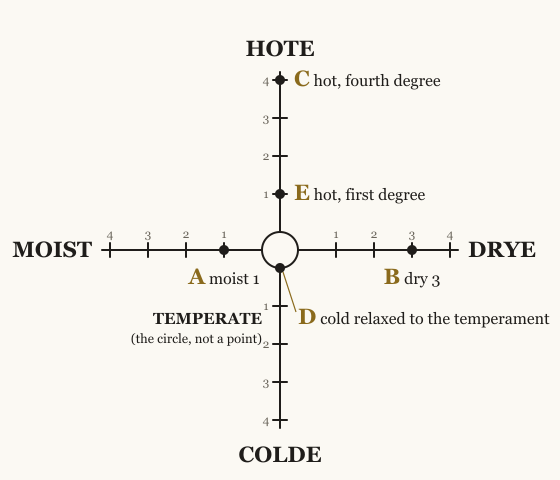
Counting then from B, 2. degrees, toward A: you finde it to be Dry in the first degree: So is the Forme resulting of the Mixture of A, and B, in our example. I will geue you an other example. Suppose, you haue two thinges, as C, and D: and of C, the Heate to be in the 4. degree: and of D, the Colde, to be remisse, euen vnto the Temperament. Now, for C, you take 4: and for D, you take a Ciphre: which, added vnto 4, yeldeth onely 4. The middle, or halfe, whereof, is 2. Wherefore the Forme resulting of C, and D, is Hote in the second degree: for, 2. degrees, accounted from C, toward D, ende iuste in the 2. degree of heate. Of the third maner, I will geue also an example: which let be this:
I haue a liquid Medicine whose Qualitie of heate is in the 4. degree exalted: as was C, in the example foregoing: and an other liquid Medicine I haue: whose Qualitie, is heate, in the first degree. Of eche of these, I mixt a like quantitie: Subtract here, the lesse frõ the more: and the residue diuide into two equall partes: whereof, the one part, either added to the lesse, or subtracted from the higher degree, doth produce the degree of the Forme resulting, by this mixture of C, and E. As, if from 4. ye abate 1. there resteth 3. the halfe of 3. is 1½: Adde to 1. this 1½: you haue 2½. Or subtract from 4. this 1½: you haue likewise 2½ remayning. Which declareth, the Forme resulting, to be Heate, in the middle of the third degree.
(The Second Rule.)
“But if the Quantities of two thinges Commixt, be diuerse, and the Intensions (of their Formes Miscible) be in diuerse degrees, and heigthes. (Whether those Formes be of one kinde, or of Contrary kindes, or of a Temperate and a Contrary, What proportion is of the lesse quantitie to the greater, the same shall be of the difference, which is betwene the degree of the Forme resulting, and the degree of the greater quantitie of the thing miscible, to the difference, which is betwene the same degree of the Forme resulting, and the degree of the lesse quantitie. As for example. Let two pound of Liquor be geuen, hote in the 4. degree: & one pound of Liquor be geuen, hote in the third degree.” I would gladly know the Forme resulting, in the Mixture of these two Liquors. Set downe your nũbers in order, thus.
£. 2. Hote. 4.
£. 1. Hote. 3.
Musean translation
Modern machine-assisted Musean edition by Mouseia, from Dee's 1570 Praeface. Latin quotations and titles are translated into English, using Dee's own English glosses where provided. Printer's type-size markup is normalized; marginal notes are kept as asides. Billingsley's separate address is omitted. Uncertain readings are marked.
And since Addition, Subtraction, Multiplication, Division, and Extraction of Roots are the chief and sufficient parts of arithmetic: which is the science that demonstrates the properties of numbers, and all operations to be performed in numbers:
"How often, therefore, these five sundry sorts of operations differ, for the most part in their execution, from the five operations of like general property and name practicable in our whole numbers, so often (for a more distinct doctrine) we commonly account and name it another kind of arithmetic." And by this reason:
(1.)
the consideration, doctrine, and working in whole numbers only, where of a Unit no lesser part is to be allowed, is named (as it were) an arithmetic by itself. And so of the arithmetic of fractions.
(2.)
In like manner the necessary, wonderful, and secret doctrine of Proportion and proportionality has won for itself a special manner of handling and working, and so may seem another form of arithmetic.
(3.)
Moreover, astronomers, for speed and more convenient calculation, have devised a special manner of ordering numbers about their circular motions by sixties and sixtieths — by Signs, Degrees, and Minutes, etc. — which commonly is called the arithmetic of astronomical or physical fractions. That have I briefly noted by the name of Circular Arithmetic, because it is also used in circles that are not astronomical, etc.
(4.)
Practice has led Numbers further, and has framed them to take on the show of magnitude's property, which is incommensurability and irrationality. (For in pure arithmetic a Unit is the common measure of all numbers.) And here numbers are become like lines, planes, and solids: sometimes rational, sometimes irrational. And they have proper and peculiar characters (as ²√, ³√, and so of others, which is to signify square root, cubic root, and so forth), and proper and peculiar fashions in the five principal parts; therefore the practitioner esteems this a diverse arithmetic from the other. Practice brings in here diverse compounding of numbers: as sometimes two, three, four (or more) radical numbers diversely knit by signs of More and Less, as thus ²√12 ³√15; or thus ⁴√19 ³√12 - ²√2, etc.; and sometimes with whole numbers, or fractions of whole numbers, among them: as 20 ²√24, ³√16, 33 - ²√10, ⁴√44, 12¼, ³√9. And so infinitely may the variety happen. After this, both the one and the other have fractions incident, and so is this arithmetic greatly enlarged by the diverse exhibiting and use of compositions and mixtures. Consider how I, being desirous to deliver the student from error and cavillation, give to this practice the name of the arithmetic of radical numbers — not of irrational or surd numbers, which are at times rational, though they have the sign of a root before them, which the arithmetic of whole numbers, most usual, would say they had no such root of, and so account them surd numbers; which generally spoken is untrue, as Euclid's tenth book may teach you. Therefore to call them generally radical numbers (by reason of the sign √ prefixed) is a sure way, and a sufficient general distinction from all other ordering and use of numbers. And yet besides all this, consider the infinite desire of knowledge and incredible power of man's search and capacity: how they jointly have waded further (by mixing speculation and practice), and have found out and attained the very chief perfection (almost) of the practical use of numbers. Which thing is well to be perceived in that great arithmetic art of equation, commonly called the Rule of Coss, or Algebra. The Latins termed it the Rule of the Thing and its Value; an apt name, comprehending the first and last points of the work. And the common names, both in Italian, French, and Spanish, depend (in naming it) upon the meaning of the Latin word for "a thing" — unless they use the name Algebra. And in this (commonly) is a double error: the one of them that think it to be of Geber's inventing; the other of such as call it Algebra. For first, though Geber, for his great skill in numbers, geometry, astronomy, and other marvelous arts, might have seemed able to have first devised the said rule, and also the name carries with it a very near likeness to Geber's name, yet it is true that a Greek philosopher and mathematician named Diophantus, before Geber's time, wrote 13 books of it (of which six are yet extant; and I had them for use,
(* A.D. 1550.)
of the famous mathematician, and my great friend, Petrus Montaureus:) And secondly, the very name is Algiebar, and not Algebra: as by the Arabian Avicen may be proved, who has these precise words, translated into Latin by Andreas Alpagus (most perfect in the Arabic tongue): The Science of working Algiebar and Almachabel, that is, the Science of finding an unknown number, by adding a number, and by division and equation. Here have you the name, and also the principal parts of the rule, touched. To name it The Rule or Art of Equation signifies the middle part and the state of the rule. This Rule has its peculiar characters:
(5.)
and the principal parts of arithmetic pertaining to it do differ from the other arithmetic operations. This arithmetic has numbers simple, compound, mixed, and fractions accordingly. This Rule and arithmetic of Algiebar is so profound, so general, and so (in a manner) contains the whole power of the practical application of numbers, that man's wit can deal with nothing more profitable about numbers, nor match with a thing more fit for the divine force of the Soul (in human studies, affairs, or exercises) to be tried in. Perhaps you looked for (long before now) to have had some particular proof or evident testimony of the use, profit, and commodity of vulgar arithmetic in the common life and trade of men. To that, then, I will now frame myself; but in this I have great care, for fear that the length of sundry proofs might make you think that either I doubted your zealous mind in the school of virtue, or mistrusted your able wits to guess much more by themselves. A proof, then, four, five, or six such will I bring as any reasonable man may by that be persuaded to love and honor, yes even to learn and exercise, the excellent Science of Arithmetic.
And first: who, nearer at hand, can be a better witness of the fruit received by arithmetic than all kinds of merchants? Though not all alike either need it or use it. How could they forgo the use and help of the rule called the Golden Rule — simple and compound, both forward and backward? How might they miss arithmetic help in the Rules of Fellowship, either without time or with time, and between the merchant and his factor? The Rules of Bartering, in wares only, or part in wares and part in money, would they gladly do without? Our merchant venturers and travelers overseas, how could they order their dealings justly and without loss, unless certain and general rules for exchange of money and re-exchange were devised for their use? The Rule of Alligation, in how sundry cases does it conclude for them such precise truths as neither by natural wit nor by other experience were they able otherwise to know? And (with the merchant then to make an end) how ample and wonderful is the Rule of False Positions, especially as it is now enlarged by two excellent mathematicians of my familiar acquaintance in their lifetime — I mean Gemma Frisius and Simon Jacob? Who can either in brief conclude the general and capital rules? Or who can imagine the myriads of sundry cases and particular examples, in act and earnest, continually wrought, tried, and concluded by the forenamed rules alone? How many other arithmetic practices are commonly in merchants' hands and knowledge, they themselves can at large testify.
The mintmaster and goldsmith, in their mixture of metals, either of diverse kinds or diverse values, how are they, or may they, exactly be directed and wonderfully pleased, if arithmetic be their guide? And the honorable physicians will gladly confess themselves much beholden to the Science of Arithmetic, and that in sundry ways; but chiefly in their Art of Graduation and compound medicines. And though Galen, Averroes, Arnoldus, and Lullus have published their positions, as well in the quantities of the Degrees above temperament as in the rules concluding the new Form resulting, yet a more precise, convenient, and easy Method is extant, invented by a countryman of ours
(Invented above 200 years ago.) And since I am uncertain who has the same, or when that little Latin treatise (as the author wrote it) shall come to be printed — both to declare the desire I have to pleasure my country as far as I may, and also for very good proof of the use of numbers in this most subtle and fruitful philosophical conclusion — I intend in the meanwhile, most briefly and with my further help, to communicate its pith to you.
First draw a circle whose diameter is an inch. Divide the circumference into four equal parts. From the center, by those 4 sections, extend 4 straight lines: each 4½ inches long, or as many as you please, above 4, outside the circumference of the circle; so that they shall be 4 inches long (at the least) outside the circle. Make clear and evident marks at the end of every inch. If you wish, you may subdivide the inches again into 10 or 12 smaller equal parts. At the ends of the lines write the names of the 4 principal elemental qualities: Hot and Cold, one opposite the other; and likewise Moist and Dry, one opposite the other. And in the circle write Temperate. Which temperature has a good latitude: as appears by the complexion of man. And therefore we have allowed to it the said circle, and not a mathematical or physical point.
(* Take some of Lullus's counsel in his book On the Fifth Essence.)
Now, when you have two miscible things whose degrees are * truly known: of necessity either they are of one quantity and weight, or of diverse. If they are of one quantity and weight: whether their forms are contrary qualities, or of one kind (but of diverse intentions and degrees), or a temperate and a contrary, the form resulting from their mixture is in the middle between the degrees of the forms mixed. As for example, let A be moist in the first degree, and B dry in the third degree. Add 1 and 3, that makes 4; the half or middle of 4 is 2. This 2 is the middle, equally distant from A and B
(* Note.)
(for the * temperate quality is counted as none, and for it you must put a zero, if at any time it is in a mixture).
Counting then from B, 2 degrees toward A, you find it to be dry in the first degree; so is the form resulting from the mixture of A and B in our example. I will give you another example. Suppose you have two things, as C and D, and of C the heat to be in the 4th degree, and of D the cold to be relaxed even down to the temperament. Now for C you take 4, and for D you take a zero, which, added to 4, yields only 4. The middle, or half, of which is 2. Therefore the form resulting from C and D is hot in the second degree; for 2 degrees counted from C toward D end exactly in the second degree of heat. Of the third manner I will give also an example; which let be this:
I have a liquid medicine whose quality of heat is exalted in the 4th degree, as was C in the example foregoing; and another liquid medicine I have whose quality is heat in the first degree. Of each of these I mixed a like quantity. Subtract here the less from the more, and divide the residue into two equal parts; of which the one part, either added to the less or subtracted from the higher degree, produces the degree of the form resulting from this mixture of C and E. As, if from 4 you subtract 1, there remains 3; the half of 3 is 1½: add to 1 this 1½, you have 2½; or subtract from 4 this 1½, you have likewise 2½ remaining. Which declares the form resulting to be heat in the middle of the third degree.
(The Second Rule.)
"But if the quantities of two commixed things are diverse, and the intensities (of their miscible forms) are in diverse degrees and heights (whether those forms be of one kind, or of contrary kinds, or of a temperate and a contrary), what proportion the lesser quantity has to the greater, the same shall be between the difference which is from the degree of the form resulting to the degree of the greater quantity of the miscible thing, and the difference which is from the same degree of the form resulting to the degree of the lesser quantity. As for example. Let two pounds of liquor be given, hot in the 4th degree; and one pound of liquor be given, hot in the third degree." I would gladly know the form resulting in the mixture of these two liquors. Set down your numbers in order, thus.
£. 2. Hot. 4.£. 1. Hot. 3.
Plain English translation
Modern machine-assisted Plain English edition by Mouseia, from Dee's 1570 Praeface. Latin quotations and titles are translated into English, using Dee's own English glosses where provided. Printer's type-size markup is normalized; marginal notes are kept as asides. Billingsley's separate address is omitted. Uncertain readings are marked.
And, since Addition, Subtraction, Multiplication, Division and Extraction of Roots are the chief and sufficient parts of arithmetic: which is the science that demonstrates the properties of numbers, and all the operations to be performed in numbers:
"How often, therefore, these five different sorts of operations differ, for the most part in their execution, from the five operations of the same general property and name that are practicable in our whole numbers, so often (for a clearer account) we commonly count and name it another kind of arithmetic." And by this reason:
1 The study, teaching, and working of whole numbers only, where no part smaller than a unit is allowed, is named (as it were) an arithmetic by itself. And so with the arithmetic of fractions.
2 In the same way, the necessary, wonderful, and secret doctrine of proportion and proportionality has gained for itself its own particular way of handling and working. So it may seem another form of arithmetic.
3 Also, astronomers, for speed and more convenient calculation, have devised a particular way of ordering numbers for their circular motions: by sixties and sixtieths, by signs, degrees, and minutes, etc. This is commonly called the arithmetic of astronomical or physical fractions. I have briefly noted this by the name Circular Arithmetic, because it is also used in circles that are not astronomical, etc.
4 Practice has led numbers further, and shaped them to take on the property of magnitudes, which is incommensurability and irrationality. (For in pure arithmetic, a unit is the common measure of all numbers.) Here numbers have become like lines, planes, and solids: sometimes rational, sometimes irrational. They have their own proper characters (as ²√, ³√, and so on for others, which is to signify square root, cube root, and so forth) and their own proper forms in the five principal parts. For that reason, the practitioner counts this a different arithmetic from the others. Practice brings in here various combinations of numbers: sometimes two, three, four (or more) radical numbers, joined in different ways by the signs of more and less, as thus ²√12 ³√15, or thus ⁴√19 ³√12 - ²√2, etc. And sometimes with whole numbers, or fractions of whole numbers, among them, as 20 ²√24. ³√16 33 - ²√10. ⁴√44 12¼ ³√9. And so the variety may be infinite. After this, both the one and the other have fractions attached, and so this arithmetic is greatly enlarged by the different showing and use of compositions and mixtures. Consider how I, being eager to free the student from error and quibbling, give this practice the name arithmetic of radical numbers, not of irrational or surd numbers. Those are at times rational, even though they have the sign of a root before them. The arithmetic of whole numbers, being the most usual, would say they have no such root, and so would count them as surd numbers. But that, spoken generally, is untrue, as Euclid's tenth book can teach you. So to call them, generally, radical numbers, because of the sign √ prefixed, is a sure way and a sufficient general distinction from every other ordering and use of numbers. And yet, beyond all this, consider the infinite desire for knowledge and the incredible power of human search and capacity: how together they have gone further (by mixing theory and practice) and have found and reached the very highest perfection, almost, of the practical use of numbers. This can be well seen in the great arithmetical art of equation, commonly called the Rule of Coss, or algebra. The Latins called it the rule of the thing and its value. A fitting name, covering the first and last points of the work. And the common names in Italian, French, and Spanish depend, in naming it, on the meaning of the Latin word Res, a thing, unless they use the name algebra. And in this there are commonly two errors. One is the error of those who think it was Geber's invention; the other is the error of those who call it algebra. First, though Geber, for his great skill in numbers, geometry, astronomy, and other marvelous arts, might have seemed able to have first devised the said rule, and though the name carries with it a very close likeness to Geber's name, yet it is true that a Greek philosopher and mathematician named Diophantus, before Geber's time, wrote 13 books about it (of which six are still in existence, and I had them for use,
In 1550.
from the famous mathematician and my great friend Petrus Montaureus.) And secondly, the very name is Algiebar, not algebra, as the Arab Auicen can prove, who has these exact words, translated into Latin by Andreas Alpagus, most skilled in the Arabic tongue: the science of working Algiebar and Almachabel, that is, the science of finding an unknown number by adding a number, and by division, and equation. Here you have the name, and also the principal parts of the rule, touched on. To call it the rule or art of equation signifies the middle part and the state of the rule. This rule has its own particular characters:
5 and the principal parts of arithmetic belonging to it differ from the other arithmetical operations. This arithmetic has simple, compound, and mixed numbers, and fractions accordingly. This rule and the arithmetic of Algiebar are so profound and so general, and so (in a manner) contain the whole power of the practical application of numbers, that the human mind can deal with nothing more profitable in numbers, nor find anything better suited to the soul's divine power (in human studies, business, or exercises) to be tested in. Perhaps you have been expecting, long before now, some particular proof or clear testimony of the use, profit, and benefit of ordinary arithmetic in the common life and trade of people. To that, then, I will now turn. But I take great care here, for fear that the length of several proofs make you think that I either doubted your zealous mind in the school of virtue, or distrusted your able wits to guess much more. A proof, then: four, five, or six such proofs I will bring, as any reasonable person may be persuaded by them to love and honor, yes, learn and practice the excellent science of arithmetic.
And first, who closer at hand could be a better witness of the fruit received from arithmetic than all kinds of merchants? Though not all of them equally need it or use it. How could they do without the use and help of the rule called the Golden Rule, simple and compound, both forward and backward? How could they do without arithmetic's help in the rules of partnership, either without time or with time, and between the merchant and his agent? Would they gladly do without the rules of bartering in goods alone, or part in goods and part in money? Our merchant venturers and travelers overseas, how could they order their dealings justly and without loss, unless certain and general rules for the exchange of money and re-exchange were devised for their use? In how many different cases does the rule of alligation conclude for them such precise truths as they could not otherwise know, either by natural wit or by other experience? And, to make an end with the merchant, how wide-ranging and wonderful is the rule of false positions, especially as it has now been enlarged by two excellent mathematicians (of my close acquaintance in their lifetimes)? I mean Gemma Frisius and Simon Iacob. Who can briefly sum up the general and capital rules? And who can imagine the myriads of different cases and particular examples, in real earnest, continually worked out, tried, and settled by the forenamed rules alone? How many other arithmetical practices are commonly in merchants' hands and knowledge, they themselves can testify at length.
The mintmaster and the goldsmith, in their mixing of metals, whether of different kinds or different values, how exactly are they, or may they be, directed and wonderfully served, if arithmetic is their guide? And the honorable physicians will gladly confess that they owe much to the science of arithmetic, and in several ways. But chiefly in their art of graduation and in compound medicines. And though Galenus, Auerrois, Arnoldus, Lullus, and others have published their positions, both in the quantities of the degrees above temperament and in the rules that conclude the newly resulting form, yet a more precise, convenient, and easy method exists, invented by a countryman of ours
(over 200 years ago) invented. And since I am uncertain who has it, or when that little Latin treatise (as the author wrote it) will come to be printed: (both to declare the desire I have to please my country, where I can, and also as very good proof of the use of numbers in this most subtle and fruitful philosophical conclusion,) I intend in the meantime, very briefly and with my further help, to communicate its essence to you.
First draw a circle whose diameter is one inch. Divide the circumference into four equal parts. From the center, through those 4 points, extend 4 straight lines, each 4½ inches long, or as long as you like, more than 4, outside the circumference of the circle: so that they are 4 inches long (at least) outside the circle. Make clear marks at the end of every inch. If you like, you may subdivide the inches again into 10 or 12 smaller equal parts. At the ends of the lines, write the names of the 4 principal elemental qualities: hot and cold, one opposite the other, and likewise moist and dry, one opposite the other. And in the circle write Temperate. This temperature has a good range, as appears in a person's complexion. And therefore we have allowed it the said circle, and not a mathematical or physical point.
Take some of Lullus's counsel in his book On the Fifth Essence.
Now, when you have two mixable things whose degrees are truly known, they must be either of one quantity and weight, or of different ones. If they are of one quantity and weight, whether their forms are contrary qualities, or of one kind (but of different intentions and degrees), or a temperate and a contrary, the form resulting from their mixture is in the middle between the degrees of the mixed forms. For example, let A be moist in the first degree, and B dry in the third degree. Add 1 and 3, which makes 4. The half or middle of 4 is 2. This 2 is the middle, equally distant from A and B.
Note.
For the temperament counts as none. For it you must put a zero, if at any time it is in the mixture.
Counting from B, 2 degrees toward A, you find it to be dry in the first degree. So is the form resulting from the mixture of A and B in our example. I will give you another example. Suppose you have two things, C and D: and the heat of C in the 4th degree, and the cold of D so weak that it reaches the temperament. For C you take 4, and for D you take a zero. Added to 4, that yields only 4. The middle, or half, of it is 2. Therefore the form resulting from C and D is hot in the second degree, because 2 degrees, counted from C toward D, end exactly in the 2nd degree of heat. I will also give an example of the third manner, which is this:
I have a liquid medicine whose quality of heat is raised to the 4th degree, as C was in the example above. And I have another liquid medicine whose quality is heat in the first degree. Of each of these I mixed an equal quantity. Subtract the lesser from the greater here, and divide the remainder into two equal parts. One of those two parts, either added to the lesser or subtracted from the higher degree, produces the degree of the form resulting from this mixture of C and E. Thus, if from 4 you take away 1, 3 remains. The half of 3 is 1½. Add this 1½ to 1, and you have 2½. Or subtract this 1½ from 4, and you likewise have 2½ remaining. This shows the resulting form to be heat in the middle of the third degree.
The second rule.
"But if the quantities of two things mixed together are different, and the intensities (of their mixable forms) are in different degrees and heights. (Whether those forms are of one kind, or of contrary kinds, or a temperate and a contrary, what proportion the lesser quantity has to the greater, the same proportion shall the difference between the degree of the resulting form and the degree of the greater quantity of the mixable thing have to the difference between that same degree of the resulting form and the degree of the lesser quantity.) As for example. Let two pounds of liquor be given, hot in the 4th degree, and one pound of liquor be given, hot in the third degree." I would gladly know the form resulting in the mixture of these two liquors. Set down your numbers in order, like this.
£. 2. Hot. 4.
£. 1. Hot. 3.
About this section
Arithmetic, 1 is part of The Mathematicall Praeface to the Elements of Geometrie by John Dee. This page sets the 16th-century English original beside 2 direct-source translations, so any line can be checked against the source. It is part 3 of 34 in the work, which is kept in the European tradition.
Open the work page for the full contents, every edition, and the download links, or go back to Explore to browse other complete works in the European tradition. The reader keeps your place when you are signed in and lets you compare the original with each translation, one edition at a time.